No human transcription currently available for this document.
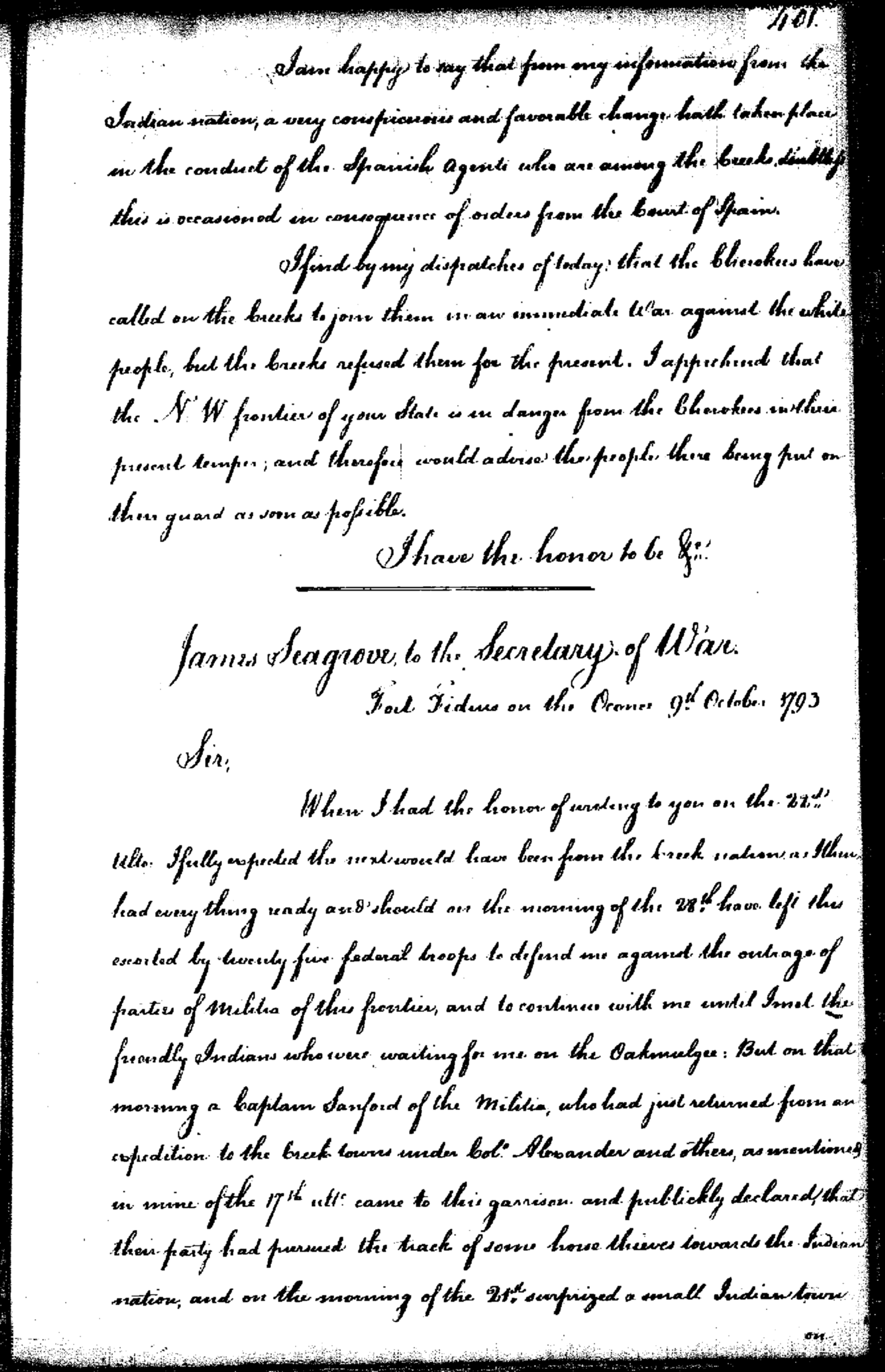
James Seagrove, to the Secretary of War.
Fort Fidius on the Oconee 9th October 1793
Sir,
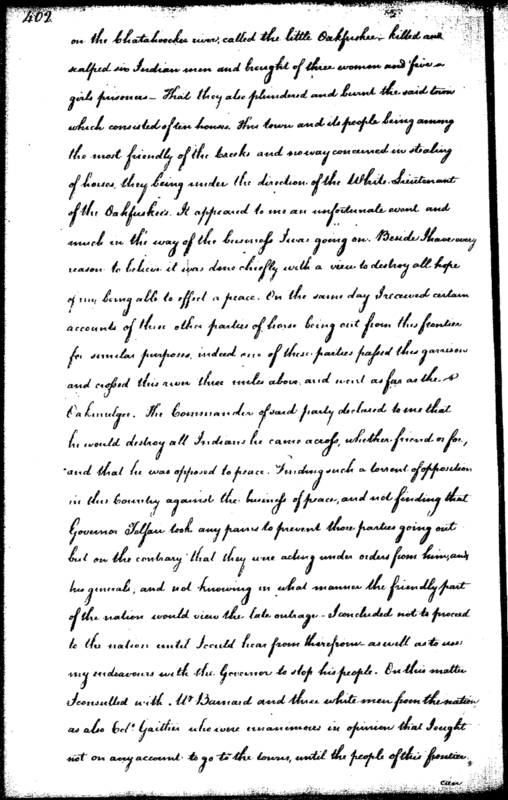
When I had the honor of writing to you on the 22d ult:. I fully expected the next would have been from the Creek nation as I then had every thing ready and should on the morning of the 28th have left this escorted by twenty five federal troops to defend me against the outrages of parties of Militia of this frontier, and to continue with me until I met the friendly Indians who were waiting for me on the Oakmulgee: But on that morning a Captain Sanford of the Militia, who had just returned from an expedition to the Creek towns under Col. Alexander and others, as mentioned in mine of the 17th ult: came to this garrison and publickly declared that their party had pursued the track of some horse thieves towards the Indian nation, and on the morning of the 28th surprized a small Indian town on the Chatahoochee river, called the little Oakfuskee- killed and scalped six Indian men and brought of three women and five girls prisoners— That they also plundered and burnt the said town which consisted of ten houses. This town and its people being among the most friendly of the Creeks and no way concerned in stealing of horses, they being under the direction of the White Lieutenant of the Oakfuskees. It appeared to me an unfortunate event and much in the way of the business I was going on. Beside I have very reason to believe it was done chiefly with a view to destroy all hope of my being able to effect a peace. On the same day I received certain accounts of three other parties of horse being out from this frontier for similar purposes, indeed one of these parties passed this garrison and crossed this river three miles above and went as far as the N. Oakmulgee. The Commander of said party declared to me that he would destroy all Indians he came across, whether friend or foe, and that he was opposed to peace. Finding such a torrent of opposition in this country against the business of peace, and not finding that Governor Telfair took any pains to prevent those parties going out but on the contrary that they were acting under orders from him, and his generals, and not knowing in what manner the friendly part of the nation would view the late outrage - I concluded not to proceed to the nation until I could hear from therefrom; as well as to use my endeavours with the Governor to stop his people. On this matter I consulted with Mr Barnard and three white men from the nation, as also Col. Gaither who were unanimous in opinion that I ought not on any account to go to the towns, until the people of this frontier can be restrained, and until I could have the prisoners lately taken put in my possession, to be reclaimed to their friends on proper terms. From these reasons I determined to rest my journey until I can see matters on a better footing.
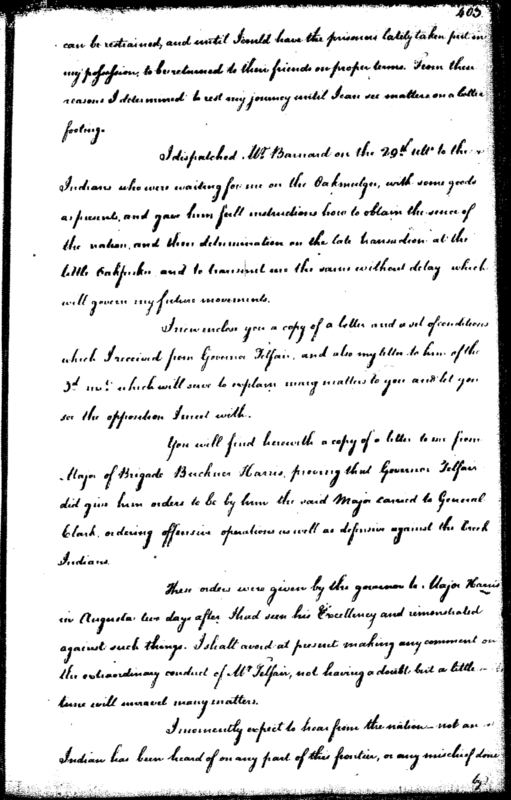
I dispatched Mr Barnard on the 29th ult: to the Indians who were waiting for me on the Oakmulgee, with some goods as presents, and gave him full instructions how to obtain the sense of the nation, and their determination on the late transaction at the little Oakfuskee and to transmit me the same without delay which will govern my future movements.
I now enclose you a copy of a letter and a set of conditions which I received from Governor Telfair, and also my letter to him of the 3d inst: which will serve to explain many matters to you and let you see the opposition I meet with.
You will find herewith a copy of a letter to me from Major of Brigade Burchner Harris, proving that Governor Telfair did give him orders to be by him the said Major carried to General Clark, ordering offensive operations as well as defensive against the Creek Indians.
These orders were given by the governor to Major Harris in Augusta ten days after I had seen his Excellency and remonstrated against such things. I shall avoid at present making any comment on the extraordinary conduct of Mr Telfair, not having a doubt but a little — time will unravel many matters.
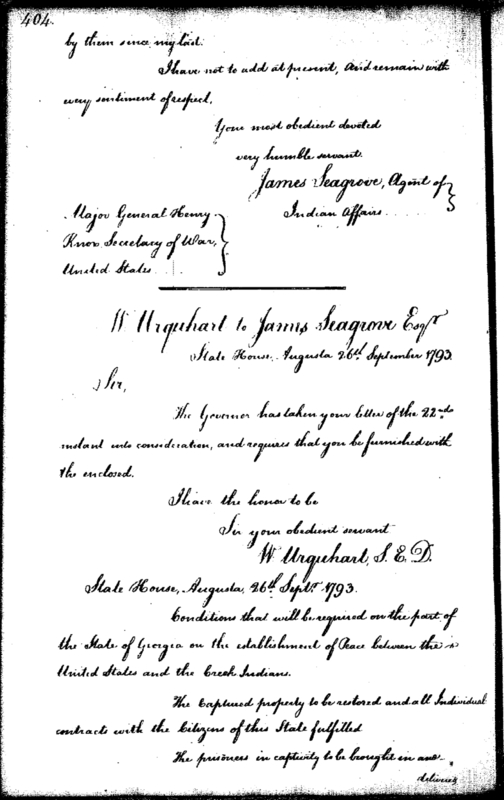
I momentarily expect to hear from the nation- not an Indian has been heard of on any part of this frontier, or any mischief done by them since my last.
I have not to add at present, And remain with every sentiment of respect,
Your most obedient devoted
very humble servant.
James Seagrove, Agent of
Indian Affairs
Major General Henry Knox
Secretary of War,
United States