

Detailed Account of Failed Peace with Indians
Document 1793Lincoln provided details on failed peace with Indian tribes from North of the Ohio River. Failed negotiations by commissioners, travel to Detroit.









No human transcription currently available for this document.
This transcription was generated by machine using Anthropic's Claude Code (model sonnet 4.6). It may contain errors or inaccuracies. Please verify against the document image. Learn more about our generative AI methodology.
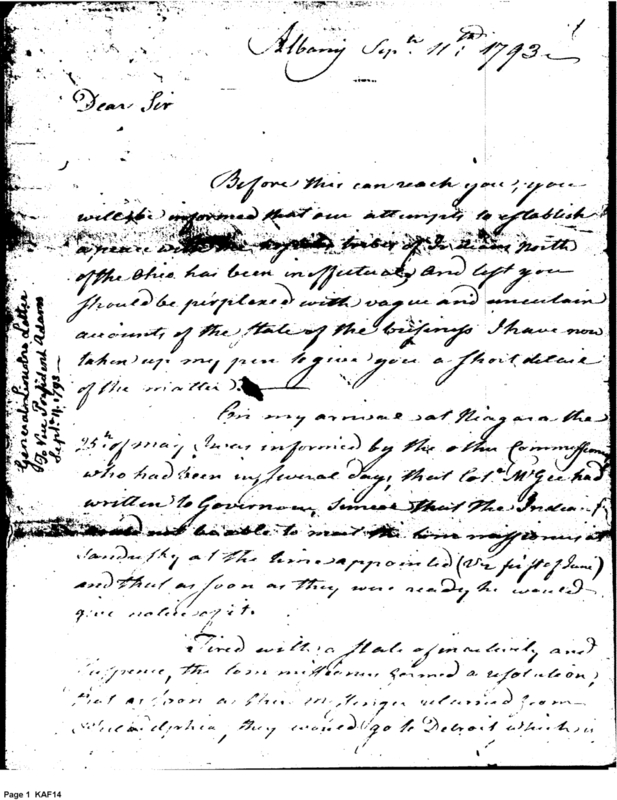
Albany Sep.r 11th 1793
[General Lincolns Letter To Vice President Adams Sep. 11th 1793]
Dear Sir
Before this can reach you, you will be informed that our attempts to establish a mean with the several tribes of Indians North of the Ohio has been ineffectual and left you to be perplexed with vague and uncertain accounts of the state of the business. I have now taken up my pen to give you a short detail of the matter.
On my arrival at Niagara the 25th of May, I was informed by the other Commissioners who had been in several days, that Col. McGee had written to Governor Simcoe that the Indians would not be able to meet the Commissioners at Sandusky at the time appointed (the first of June) and that as soon as they were ready he would give notice of it.
Fired with a state of impatience and suspence, the two Commissioners formed a resolution, that as soon as the Mr. [undecipherable] returned from Philadelphia, they would go to Detroit which is only one days travel to the foot of the rapids, where the Indians were assembled in private council. This measure they supposed might save fifteen or twenty days, as the distance from the rapids to Niagara is between three and four hundred miles. On our application to the Governour for a vessel to carry us to Detroit all were answered that it was a military post that [strikethrough: we] was not the foreign office in Canada; things no one could not permit our request; but that we might go to the mouth of the river, about Eighteen miles from the Garrison: this proposition we met, as it placed us as near the Indians, as we should have been at Detroit; and gave up the pleasure of seeing those bottom out the most important in Upper Canada.
On the 26th of June we left Niagara and reached Lake Erie, where the vessel was waiting our arrival. Here we were detained until the 5th of July, when a vessel arrived with a large deputation from the Council fire at the rapids aforesaid. Soon after they landed they gave the Commissioners notice that they wished to see them. They attended and informed us that they were sent by the nations of Indians assembled at the rapids of the Maumee, to meet us. After it was the wish of the chiefs, that their father the Governour of this Province should hear what they had to say, and our answer. They wished that we might not be uneasy, that as they did not mention us at the time first, prepared the reasons which caused the delay they would give at another time. — The business agreed to meet them in presence of the Governour at any time & place he and they should point out. Niagara was fixed on as the place of meeting.
July the 9th the Commissioners met the deputation in presence of the Governour a number of Civil & Military Officers. Captain Brandt then informed us that the reason why they had not Assembled at Sandusky at the time appointed arose from the war like appearances on our part. — He then informed us that the people we saw were sent to represent the Indians who own the lands North of the Ohio as their common property and who were all of one mind one heart. That they came to speak to us for two reasons because your warriors, being in our neighborhood have prevented our meeting at the time appointed place. — The other to know if [strikethrough: we were] properly authorized to run and establish a new boundary line between the lands of the United States and the lands of the Indian Nations. He assured us that it was [strikethrough: then] desire to meet at this place appointed. —
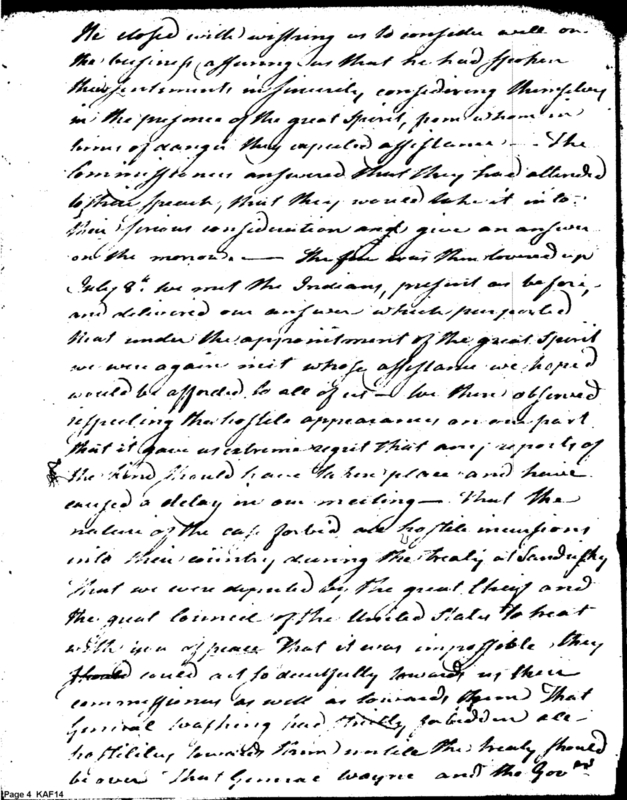
He closed with wishing us to concede well on the business assuring us that he had spoken their sentiments uniformly, considering themselves in the presence of the great Spirit, from whom being of danger they expected assistance. — The Commissioners answered that they had attended to their speech, that they would take it into their serious consideration and give an answer on the morrow. — The [undecipherable] was then formed up. July 9th we met the Indians, present as before, and delivered our answer which purported that under the appointment of the great Spirit we were again met whose assistance we hoped would be afforded to all of us. We then observed respecting the hostile appearances on our part that it gave us extreme regret that any reports of the kind should have taken place and have caused a delay in our meeting — That the nature of the case forbid all hostile incursions into their country during the treaty at Sandusky, that we were appointed by the great chiefs and the great Council of the United States to treat with in a spirit of peace. That it was impossible they [strikethrough: should] could act so disrespectfully towards us those Commissioners as well as towards them. That General Washington had strictly prohibited all hostilities towards them and that the treaty should be over. That General Wayne and the Gov[ernor]
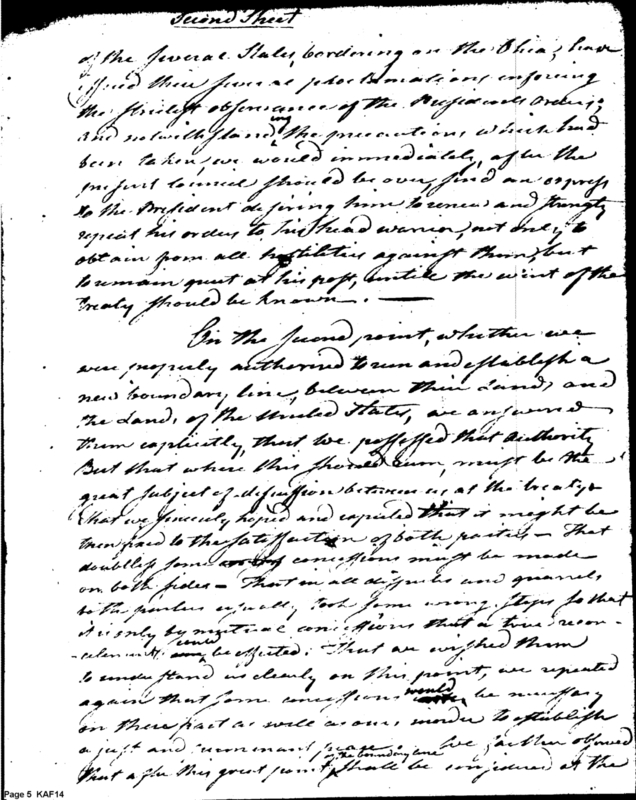
Second Sheet
of the Several States bordering on the Ohio, have issued their several proclamations enjoining the strictest observance of the President's Orders, and notwithstanding the precautions which had been taken, we would immediately, after the report reached Council, should be overjoyed to find an express to the President desiring him to send and forthwith request his orders to his Head warrior, not only to obtain from all hostilities against them but to remain quiet at his post, until the event of the treaty should be known. —
On the second point, whether we were properly authorized to run and establish a new boundary line, between their lands and the lands of the United States, we answered them explicitly, that we possessed that Authority. But that when this should come, must be the great subject of discussion between us at the treaty, that we sincerely hoped and expected [strikethrough: that] it might be transferred to the satisfaction of both parties — That doubting and [strikethrough: any] concessions might be made on both sides — That on all disputes and quarrels to the parties equally, took from among steps so that it is only by mutual concessions that a true reconciliation [strikethrough: new] may be effected. — That we wished them to understand us clearly on this point, we repeated again that some concession [strikethrough: would] be necessary on their part as well as one to establish a just and permanent [strikethrough: peace between]. We further showed that after this great point shall be considered at the treaty we should know what concessions and stipulations will be proper to make on our part and we trust that they would be just as the world would pronounce reasonable and just.
As they have told us that they represented the Nations of Indians North of the Ohio and whose chiefs were assembled at the rapids of Maumee we informed them that it would be a difficulty to us to be informed of the Names of those nations and of the number of chiefs so assembled. —
When we have finished our answer to them, yesterday one of the Shawnese chiefs [undecipherable] (the Lyon) arose and addressed us as follows: Brethren the Bostonians attend. We have heard your words; our fathers the English people have behind also heard them. We thank God that you have been prepared in peace and that we brought our papers together. The people of all the different nations here, salute you; they rejoiced to hear your words. It gives us great satisfaction that our fathers the English have also behind them are there for the present take up our papers and retire to our encampments where we are deliberately consider your speech and return you an answer tomorrow. —
July 9th — In council present as yesterday — Captains and other officers were [undecipherable] that they were glad that the great Spirit had now produced us in peace to meet again together. He then assured us that they most fully receive. He said our purpose that they would take it with them and send it to the chiefs at the great Council at Miami and that they thought that there was great power of us coming together, that the nations at the Maumee were all of one mind and if we agreed with them it would be binding and lasting. That you have not spoken to us unwisedly [undecipherable] till now, therefore what was done was not binding, now you have an opportunity to speak to us together. — and that we now take you by the hand to lead you to the place appointed for the meeting — He then delivered the following names agreed by us to our request as the Nations who were assembled
Five Nations Ottawas
Wyandots Chipeways
Shawanese Potawatamies
Delawares Mingoes — part of the Six Nations
Menogas Cherokees
Miami Nantikokes
and said that the principal men of all the above nations were there. —
The Commissioners then closed the business of the council by saying, that their ears had been open to their Speech — That they were ready to proceed with them to Sandusky — where under the direction of the great Spirit they hoped that [strikethrough: we shall] from [strikethrough: then] [undecipherable] establish arrangements on terms equally satisfying and agreeable to all parties. ——
July 10th we left Niagara and on the 11th went again on board the Dunmore, the vessel assigned us; in the morning of the 14th we sailed for the Mouth of Detroit River where we arrived on the 2[1st]
July 29th Captain Elliot one of the Indian agents arrived with a number of Indians, as deputies, along from the Nations assembled at the rapids of [Maumee].
July 30 we met the delegates, who, after a short speech, as introductory to their business, delivered us the following written Speech —
"To the Commissioners of the United States
"Brothers, the deputies we sent you did not fully explain our meaning — we leave them so just others to meet you once more, that you may fully and understand the great question we have to ask you, and to which we adjoin an explicit answer in writing —
"Brothers, you are here by the United States, made to make peace with us the confederate Indians.
"Brothers you know very well, that the boundary line which was drawn between the white people and us, at the treaty of Fort Stanwix, was the Ohio —
"Brothers, if you firmly [strikethrough: speaking] form a firm & lasting peace, you will immediately remove all your people from our side of that River. —
"Brothers are therefore ask you, are you fully authorized by the United States, to continue and firmly fix on the Ohio River, as the boundary line between your people and ours in."
Signed by the Bear Lennooys, Turkey
Delawares — Turtle Chippewa[ys], Crane
Shawness — Snake
Miamis Turtle
Mingoes Snipe
Pottawatimies — Fife
Ottawas — Otter
Seneoys
Third Sheet
July 31st The Commissioners gave the following answer —
Brothers, we are a little surprised at the suggestion, that in the conference at Niagara we did not come to a right understanding, and that your deputies did not fully explain their meaning — The deputies appeared to be men of good understanding, and when we saw them, they were perfectly plain — In that, we never saw men in public council more attentive, in behave with more propriety — We could not therefore suppose, that they would not give you our meaning along certainly, we were sufficiently explicit for in plain terms we declared, that in order to establish a just and permanent peace, some concessions would be necessary on your part, as well as ours.
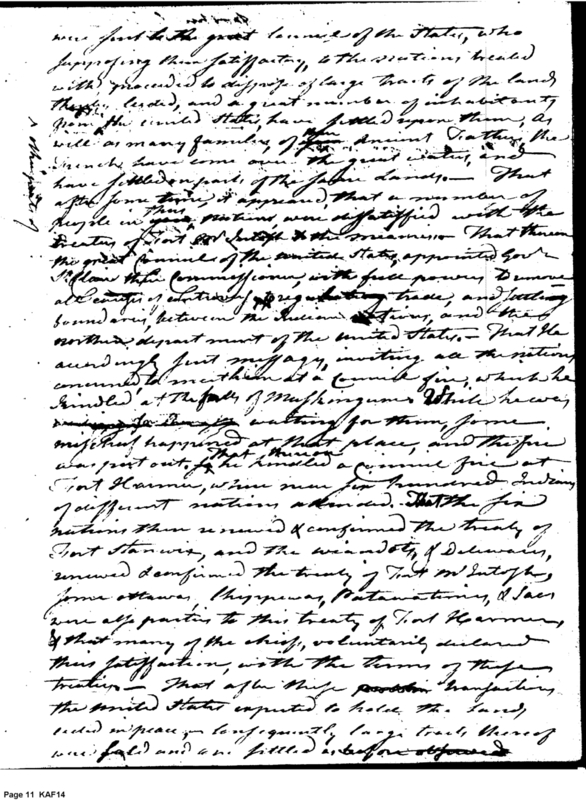
These words Brothers, are a part of our speech to your deputies, and that speech they appeared us, they fully understood. What those conditions should be on both sides, and where the boundary line should be fixed, were proper subjects of discussion at the treaty when we should meet face to face — This we are certain would be the best way to remove all difficulties: But your nations have adopted another mode, which, by speaking at a distance, prevents us knowing each other, and has taken away those jealousies, which are the great obstacles to peace. — We are desirous of meeting your nations without more delays; we have already waited in this province sixty days, beyond the time appointed for opening the treaty; we have then told them as their notice desired answers to certain questions, we wished to be explicit therein. But before we proceeded to this, we thought it proper to look back to former transactions, and we defined them particularly to bear upon. We acknowledged the treaty of Fort Stanwix, twenty five years ago, and that the Ohio was then agreed upon as the boundary, at between the Lands, and the Lands of the white peoples. We then showed that about some years after, a quarrel broke out between the King of Great Britain, and the peoples of these States, which are now the United States. That by the treaty of peace, made with the King, about two years [undecipherable] all within the great lakes and the waters within them, were by him ceded to be the boundaries of the United States. That after peace was made with the King, it remained to make peace with those nations, who had taken part in the war with him. For this purpose Commissioners were appointed to make them. First messengers to all the Indian nations inviting them to effect peace. The first treaty was held at Fort Stanwix, about nine years ago, with Mr. [undecipherable] Nation. That has been first and [undecipherable] to this day. That the next treaty was made about ninety days after, at [undecipherable] with the half king of the Wyandots, Capt. McGee, and other chiefs on behalf of the Wyandots, Delawares, Ottawas, and Chippewas, one nation — & that afterwards the treaty of Fort McIntosh [undecipherable]. Some Ottawas and Shawnees were also parties to the treaty of Fort Harmar. & That many of the chiefs, voluntarily declared their satisfaction with the terms of those treaties. That after those [strikethrough: present] Commissioners, the United States expected to hold the lands ceded in peace for a [undecipherable] large tracts thereof were sold and [undecipherable] entirely disposed were sent to the great Council of the States, who by purposing their said territory, to the nations treated with. They proceeded to dispose of large tracts of the lands, by settling a great number of inhabitants on them, as will as many families of [undecipherable] Indians. In doing this these friends have come over the great rivers, and have followed in parts of the Indian domains — That after this [strikethrough: for] time, it appeared that a number of the young nations were dissatisfied with the [undecipherable] of treaties, & the Commissioners, the great Council of the United States appointed Governor [undecipherable] the Commissioners with full powers to remove all causes of uncertainty, containing relating to trade & settling boundary between the Indian Nations and the Northern Departments of the United States. He accordingly sent messages inviting all the nations concerned to meet him at a council fire as [undecipherable] at the Falls of Muskingum. While he was waiting for them some mischief happened as that there was fire was, grew on. So he kindled a fire at Fort Harmar where near six hundred Indians of different nations, attended. The Six Nations then renewed & confirmed the treaty of Fort Stanwix; and the Wyandots & Delawares renewed & confirmed the treaty of Fort McIntosh. Some Ottawas, Chippewas, Pottawatamies & Saecs were also parties in the treaty of Fort Harmar. —
Now Brothers, there are your words, and it is necessary for
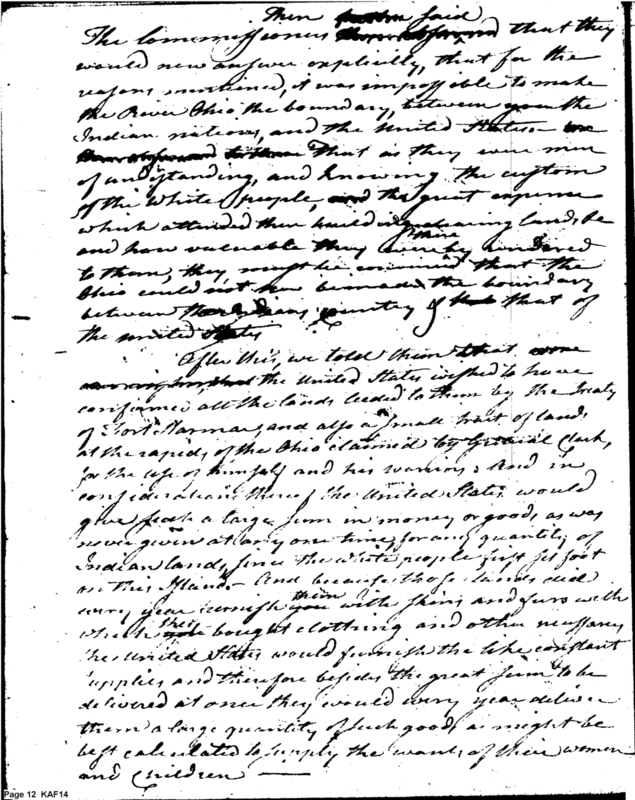
The Commissioners [strikethrough: then] expressed that they would answer explicitly, that for the reasons mentioned, it was impossible to make the River Ohio the boundary, between the Indian nations, and the United States — was [strikethrough: confirmed] to them. That as they were men of understanding, and knowing the custom of the White people, and the great expense which attended their hunts, and how valuable they thereby had considered to them, they must be convinced that the Ohio could not be removed the boundary between their [undecipherable: own] country of those that of the United States.
After this, we told them [strikethrough: that some] we had not rights the United States intended to have confirmed all the lands ceded to them by the Treaty of Fort Harmar, and also a small tract of land at the rapids of the Ohio (ceded to [undecipherable] by General Clark,) for the use of himself and his warriors. And also in considering thereof the United States would give at any one time for any quantity of Indian lands, once being given at any one time for any quantity of Indian lands, once [undecipherable] ever given at any one time for any quantity of Indian lands, once the white people first got their feet on this Island. And because those lands did every year furnish us with skins and furs with which you bought clothing, and therefore because those lands did every year furnish us with skins and furs with which we bought clothing and other necessaries the United States would therefore furnish the like contents supplies. And therefore, besides the great sum to be delivered at once, they will every year deliver us a large quantity of such goods as are best calculated to the wants of ourselves, your women & Children — —
Brothers. Money to us is of no value, & to most of us continues,
Fourth Sheet
But if all the lands before mentioned, could not be yielded up to the United States, the Commissioners wished to agree with them on a new boundary line; and therefore told them that for the quantity of lands they should relinquish within the new boundary lines, they would stipulate a generous compensation, not only for a large sum paid down, but for a yearly rent for the benefit of [strikethrough: their] nations.
These propositions we considered as concessions on the part of the United States, but we did not [strikethrough: there] we formerly gave up a claim to the whole country North of the great waters as the property of the United States in consequence of the Treaty of peace with Great Britain. By telling them the Indians, that we thought that we owed us consideration had been put on that part of our treaty with the King of Great Britain, as he had not purchased the Country of them; consequently he could not give it away. That he only relinquished to the United States his claim to it. — That claim was founded on a right acquired by treaty with other white nations to exclude them from purchasing, or settling on any part of their country. That this was the right which the King granted to the United States. — That before such a surrender, the King alone had a right to purchase of the Indian nations, any of their lands between the great Lakes, the Ohio, and the [undecipherable] comprising the part within the Charter bounds of Pennsylvania,
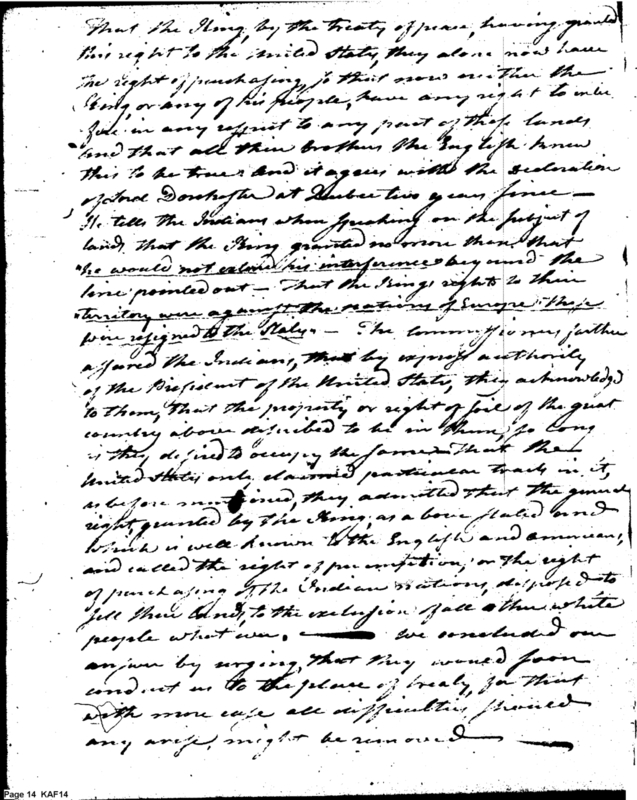
That the King, by the treaty of peace, having granted this right to the United States, they alone now have the right of purchasing, so that no more no other the King, or any of his peoples, have any right to interfere in any respect to any part of these lands, and that all their Brothers the English knew this to be true. And it agrees with the declaration of Lord Dorchester at Quebec two years since. —
If, tell the Indians when speaking on the subject of lands, that the King granted no more them that he would not extend his interference beyond the line pointed out — That the King's rights to their territory were against the nations of Europe. These were resigned [underline: to the States]. — The Commissioners further assured the Indians, that by express authority of the President of the United States, they acknowledged to them, that the property or right of Soil of the great country above described to be in them, so long as they desired to occupy, they assured them that the United States only claimed particular tracts in it, as before mentioned, they admitted that the general right granted by the King, as above stated, and well known to the English and Americans, and called the right of preemption, or the right of purchasing of the Indian nations, as it disposed to sell their land, to the exclusion of all other white people whatsoever. —— We concluded our answer by urging, that they would soon conduct us to the pleasure of treaty, for their with more ease all difficulties should any arise, might be removed —
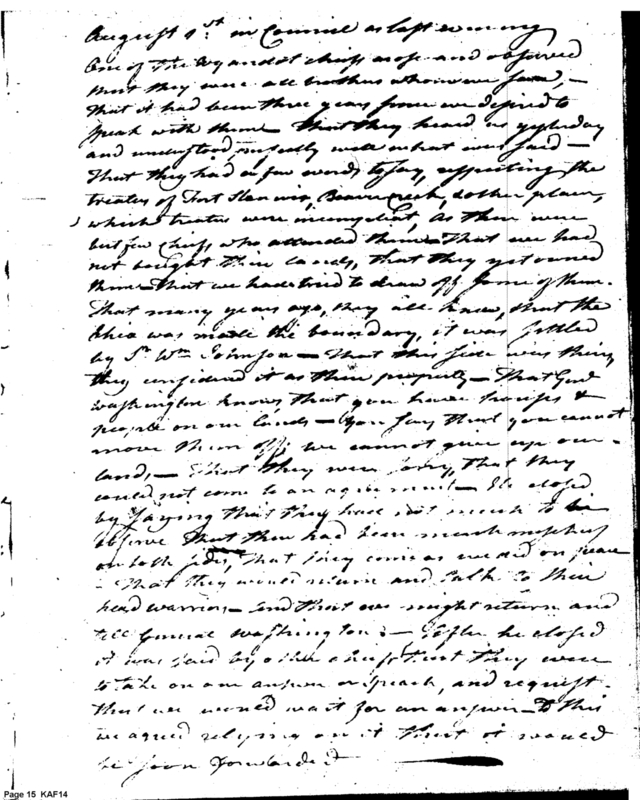
August 1st in Council as last evening every Chief of the day and other chiefs arose and observed that they were all brothers & shown present — That it had been three years since we desired to speak with them. That they heard us yesterday and understood perfectly well what we had — That they had a few words to say, expecting the treaties of Fort Stanwix, Beaucreck, & other places, which treaties were incomplete. As there were but few chiefs who attended these. That we had not taught them closely, that they yet owned those. That we had tried to draw off some of them. That many years ago, they all knew, that the Ohio was made the boundary, it was settled by Sir Wm Johnson — That their fine was there, they considered it as their property. — That God Washington knows, that you have troops & people on our lands — You say that you cannot move them off; we cannot give up our lands. — That they were in order, That they could get come to an agreement — He closed by saying that they have not met & be observe that then had been much mischief on both sides, that they come as mediators on peace — That they would receive and talk to their head warriors. And that we might return and tell General Washington — Little, he closed it was said by a little chief, that they were to take an answer on a speech, and request that we would wait for an answer. To this we agreed relying on a President it would be soon forwarded it —
Nothing particular took place from the time [strikethrough: left us] the Indians, until the 8th of August at when [strikethrough: then] two of Capt. Hendrick, and Willis [undecipherable] letter dispatching a supply of [undecipherable] money. — By the information attained from letter, and messages, our prospects respecting a peace appeared flattering; in this hope we were buoyed by different accounts for several days. But on the 7th: as no official information had arrived the Commissioners, judged that it would be expedient for them to proceed without any delay, to the Miami bay a river about Eighteen miles from the Council, that they might more easily and expeditiously send to and receive an answer from the Council — They accordingly wrote to Captain Tord requesting that his Vessel might be ready for sailing in the morning — This Vessel was assigned us by Governour Simcoe to attend us through the whole business — This created up a new matter, Capt. Ford informed us that he could not sail without the permission of Capt. Bainbury, a British Officer of the [undecipherable] who attended us — Bainbury said that he could not grant permission for us to proceed to [strikethrough: Det] Miami. but if we wished to go to Sandusky we might; this we did not wish as that would remove us farther from the Council than we were at the mouth of Detroit. Bound by rules we could not be as well accommodated [three] at the place [strikethrough: therefore] were encamped. Thus disappointed we concluded to send off two runners for information; they soon returned but not until afterwards we had received the following Speech which is copied verbatim —
Fifth Sheet
To the Commissioners of the United States
Brothers, we have received your speech dated the 31st of last month, and it has been interpreted to all the different nations — We have been long in giving you an answer because of the great importance of the subject; but we now answer it fully, having given it all the consideration in our power. — Brothers, you tell us that after you had made peace with the King you our father, about two years ago, it remained to make peace between the United States and the Indian nations, who had taken part with the King, for this purpose Commissioners were appointed who sent messages to all those nations inviting them to come and make peace.
"And after reciting the periods at which you say treaties were held at Fort Stanwix, Fort McIntosh & Maumee, all which treaties, according to your own acknowledgement, were for the sole intention of making peace, you then say, "Brothers, the Commissioners who concluded these treaties in behalf of the United States, sent the halters containing them to the General Council of the States, who authorise their satisfaction to the Nations treated with, proceeded to dispose of the lands thereby ceded. —
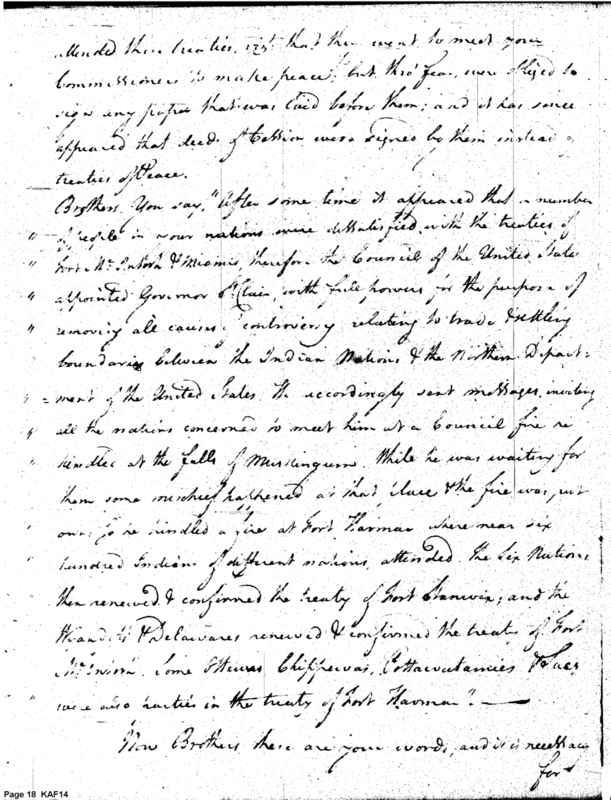
"Brothers. This is telling us plainly what we always understood to be the case and it agrees with the declarations of those few who attended those treaties, tho' had they went to meet your Commissioners to make peace, but those were obliged to sign any papers that was laid before them; and it has since appeared that deeds of cession were signed by them instead of treaties of Peace.
Brothers. You say, "After some time it appeared that a number of people in your nations were dissatisfied with the treaties of Fort McIntosh & Maumee, therefore the Council of the United States appointed Governor St Clair, with full powers, in the purpose of removing all causes of controversy, relating to trade & settling boundaries between the Indian Nations & the Northern Departments of the United States. He accordingly sent messages, meeting all the nations concerned to meet him at a council fire at [undecipherable] at the Falls of Mussingums. While he was waiting for them, some mischief happened as that there was fire grew on — So he kindled a fire at Fort Harmar where near six hundred Indians of different nations, attended. The Six Nations then renewed & confirmed the treaty of Fort Stanwix; and the Wyandots & Delawares renewed & confirmed the treaty of Fort McIntosh. Some Ottawas, Chippewas, Pottawatamies & Saecs were also parties in the treaty of Fort Harmar. —
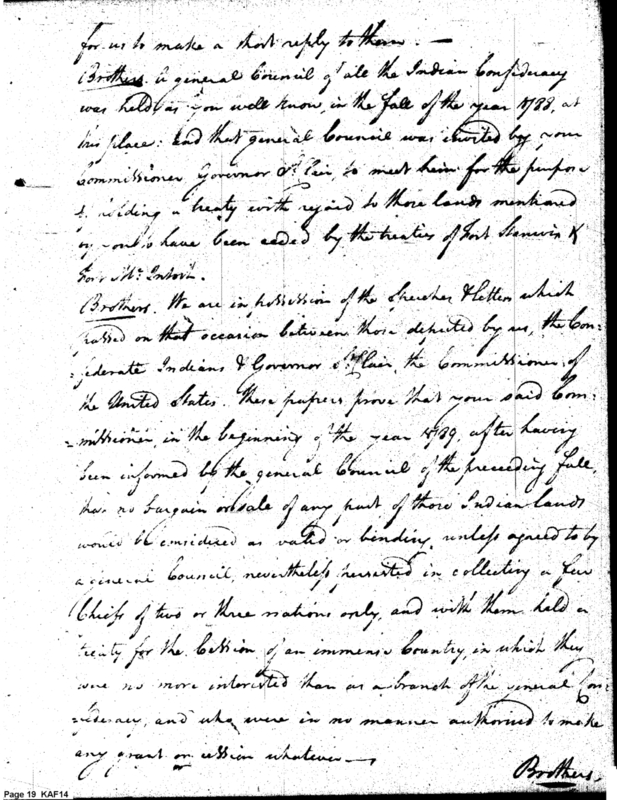
Now Brothers, there are your words, and it is necessary for us to make a short reply to them. —
Brothers. A general Council of all the Indian Confederacy was held, as you well know, in the Fall of the year 1788, at this place. And that general Council was invited by your Commissioners Governor St Clair, to meet him for the purpose of holding a treaty with regard to those lands mentioned in and which have been ceded by the Treaties of Fort Stanwix & Fort McIntosh.
Brothers. We are in possession of the Speeches & Letters which passed on that occasion between those deputied by us, the Confederate Indians & Governor St Clair, the Commissioner of the United States. These papers prove that your said Commissioner, in the beginning of the year 1789, after having been informed by the general Council of the preceding Fall, that no bargain or sale of any part of those Indian lands would be considered as valid or binding, unless agreed to by a general Council, nevertheless persisted in collecting a few Chiefs of two or three nations only, and with them held a treaty for the cession of an immense country, in which they were no more interested than as a branch of the general Confederacy, and who were in no manner authorized to make any grant or cession whatever. —
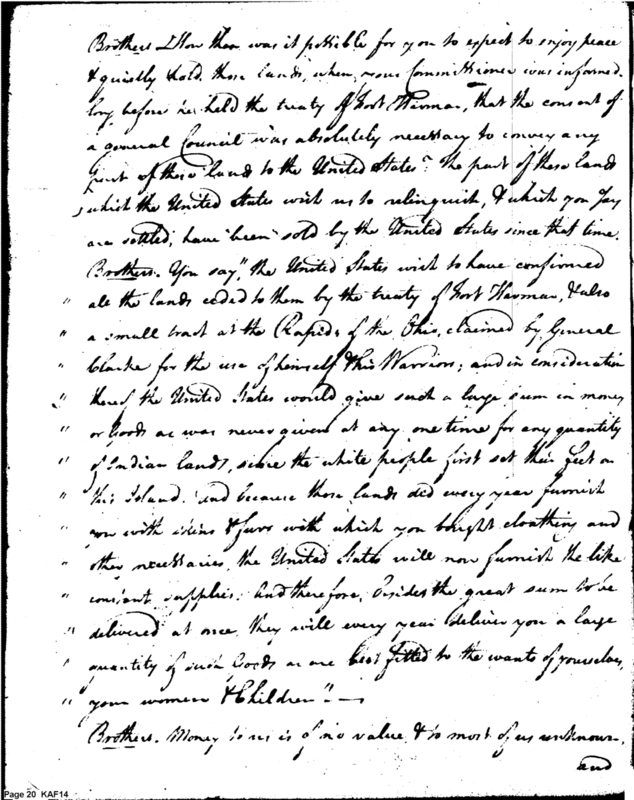
Brothers. How then was it possible for you to expect to enjoy peace & quietly hold those lands, when your Commissioners was informed, long before he held the treaty of Fort Harmar, that the consent of a general Council was absolutely necessary to convey any part of those lands to the United States? The part of those lands which the United States wish us to relinquish, & which you say are dotted, have been sold by the United States since that time.
Brothers. You say, "the United States wish to have confirmed all the lands ceded to them by the treaty of Fort Harmar, & also a small tract at the Rapids of the Ohio, claimed by General Blanke for the use of himself this Warrior; and in consideration thereof the United States would give such a large sum in money or goods as was never given at any one time for any quantity of Indian lands, since the white people first set their feet on this Island. And because those lands did every year furnish us with skins & furs with which you bought clothing and then necessaries the United States will now furnish the like constant supplies. And therefore, besides the great sum to be delivered at once, they will every year deliver you a large quantity of such goods as are best fitted to the wants of yourselves, your women & Children."—
Brothers. Money to us is of no value, & to most of us continues,
Tenth Sheet
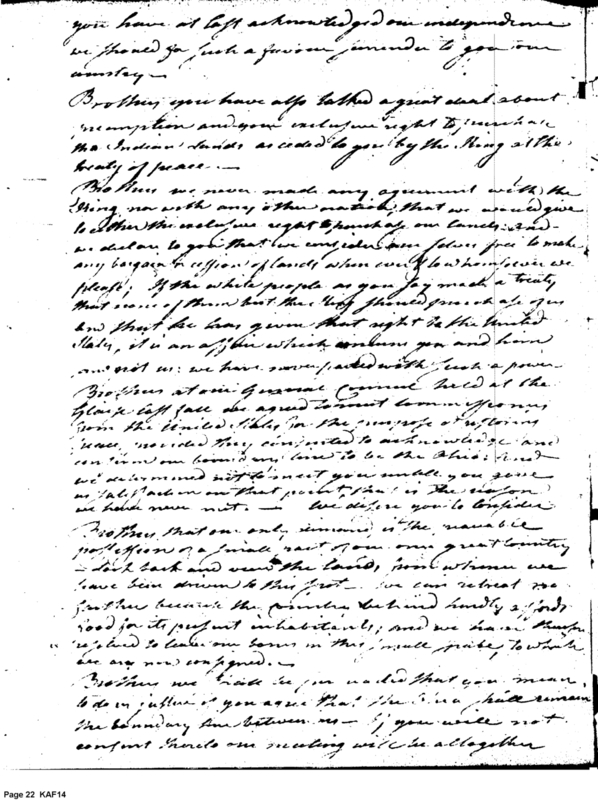
and as no consideration whatsoever can induce us to sell our lands on which we get support for our women and children we hope we may be allowed to point out a mode by which your settlers may leisurely removed and made thereby obliged. —
Brothers, we know that your settlers are poor, or they never would have ventured to live in a country which has been in continual trouble ever since they crossed the Ohio — Divide therefore this large sum of money which you have offered to us, among those people, give its cash also a proportion of what you pay, you would give us annually, over and above this very large. Your money and we are persuaded they would most readily accept of it in lieu of the lands you paid them. If you add also the great annual fund, you will certainly most improve the paying and growing among with a view to force us to yield you our country, you will certainly have more than sufficient for the purpose of paying those settlers for all their labours and improvements.
Brothers you have talked to us about concessions, it appears strange that you should expect any from us who have only been defending our just rights against your invasions — we want peace — listen. Brothers you make one confession to us, by offering us your money and an other by having agreed to do us justice, to the heavens long and unnecessarily withheld it — We neither see this act with acknowledgement you have now made that the King of England never did & we have a right to give you our country by the treaty of peace — and you want to make this act of common justice a great part of your concession, and seem to expect that thereby you have at last acknowledged our independence we should give you such a joyous surrender to you our country. —
Brothers, you have also talked a great deal about redemption and your exclusive right to purchase the Indian Lands as ceded to you by the King at the treaty of peace. —
Brothers, we never made any agreement with the King, nor with any other nation, that we would give to either the exclusive right to purchase our lands. And we declare to you that we consider our selves free to make any bargain or cession of lands when ever & with whom even we please. If the white people as you say made a treaty that some of them but the King should purchase all of us how that right be the United States, it is an affair which concerns you and have and not us: we have never parted with such a power.
Brothers at our General Council held at the Glaise last fall we agreed to meet your Commissioners from the United States on the terms of the confederates peace, provided they consented to acknowledge and confirm the Ohio as the boundary: And we determined not to meet you unless you gave us satisfaction in that point (as the reason). we had never met — We desire you to consider —
Brothers, that our only demand is the peaceable possession of a small part of our own great country — look back and view the lands from whence we have been driven to this place. — we can retreat no further because the country behind barely affords food for its present inhabitants; and we have therefore resolved to leave our towns in that, made prior to which we are now composed. —
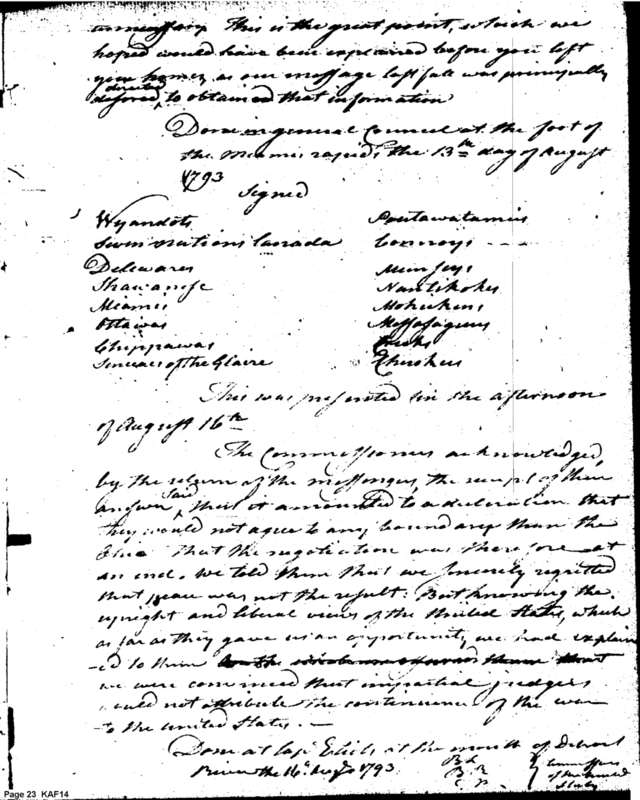
Brothers, we have been told that you meant to do in future if you agree that the Ohio line shall remain the boundary between us, if you will not consent, friends our meeting will be altogether unnecessary. This is the great point, which we hoped would have been explained before you left your homes, as our message last fall was principally deferred, to obtain that information.
Done in general Council at the foot of the Maumee rapids, the 13th day of August 1793. Signed
Wyandots Pottawatamies
Six Nations Canada Lonnoys ——
Delawares Miameys
Shawanese Nantikokes
Miamis Mohaukens
Ottawas Missisaugeys
Chippawas [undecipherable]
Senecas of the Glaive Cherokees
This was presented for the afternoon of August 16th
The Commissioners acknowledged by the return of the messengers the receipt of their answer, Said that it amounted to a declaration that they would not agree to any boundary than the Ohio. That the negotiation was therefore at an end. We told them that we sincerely regretted that peace was not the result. But knowing the upright and liberal views of the United States, which as far as they gave us an opportunity, we had explained to them [strikethrough: for the side of answers] those themes we were convinced that impartial judges could not attribute the continuance of the war to the United States. —
Done at Camp Elliot, at the mouth of Detroit River, the 16th August 1793 B. L. L[incoln]
C. m. T[undecipherable]
[undecipherable] States
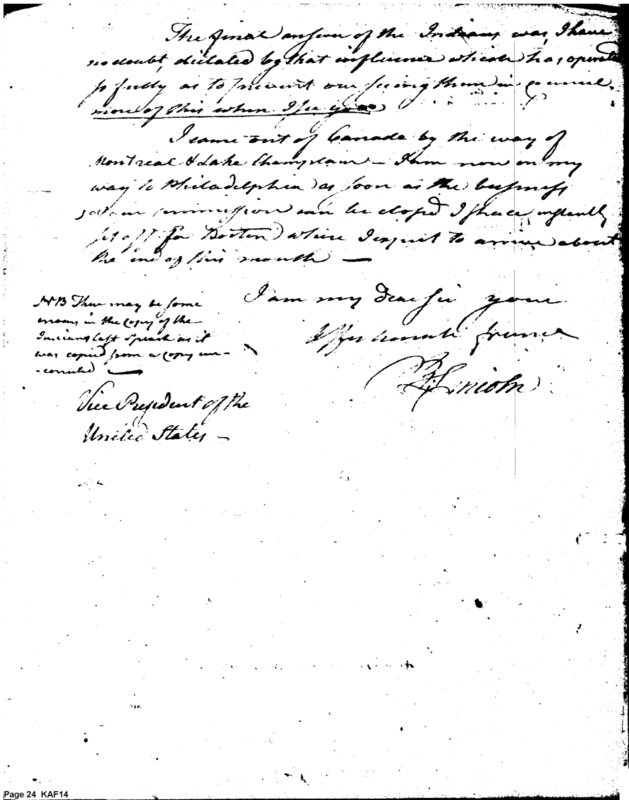
The final answer of the Indians was, I have no doubt dictated by that influence which is open to, operated to firmly as to [undecipherable] our seeing them in council, merely for this, as I see the —
I came out of Canada by the way of Montreal & Lake Champlain. I am now on my way to Philadelphia as soon as the business of our Commission can be closed I shall repeatedly set off, if to Boston where I request to arrive about the end of this month —
[NB There may be some errors in the Copy of the Indians last Speech as it was copied from a Copy unrecorded] [arrow]
Vice President of the United States —
I am my Dear Sir your
Most humble Servant
B. Lincoln
Type
Autograph Letter Signed
Description
Lincoln provided details on failed peace with Indian tribes from North of the Ohio River. Failed negotiations by commissioners, travel to Detroit.
Date
09/11/1793
Author
Recipient
Sent from
Albany
Repository
Collection
Document number
1793091190001
Page start
1
Notable persons
Jonathan Adams
B Lincoln
Indians
Indian Nation
tribes
savages
Notable locations
Albany
Detroit
North of the Ohio
Ohio River
Montreal
Sandusky
Notable items
treaty