

Failed Attempts to Reach a Peace Agreement
Document 1793The Commissioners describe their attempts to reach a peace agreement that ultimately ended in failure.





No human transcription currently available for this document.
This transcription was generated by machine using Anthropic's Claude Code (model sonnet 4.6). It may contain errors or inaccuracies. Please verify against the document image. Learn more about our generative AI methodology.
Now I have all eight pages. Let me compile the complete transcription.
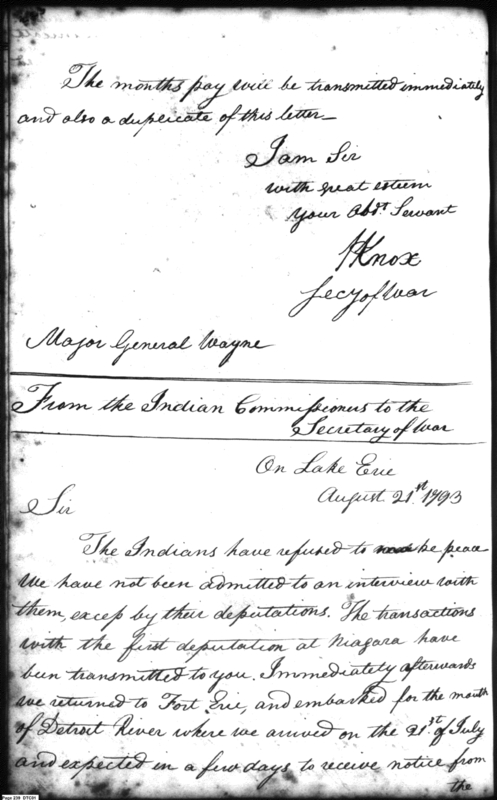
[From the Indian Commissioners to the Secretary of War]
On Lake Erie
August 21st 1793
Sir
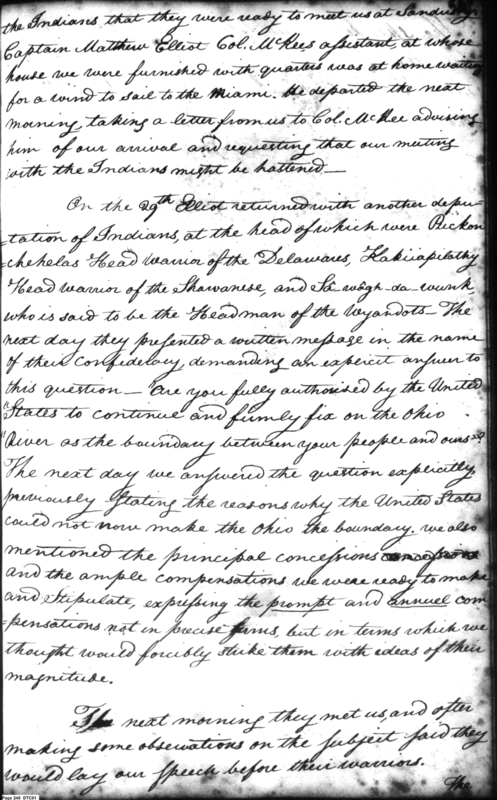
The Indians have refused to [strikethrough: make] be peace We have not been admitted to an interview with them, excep by their deputations. The transactions with the first deputation at Niagara have been transmitted to you. Immediately afterwards we returned to Fort Erie, and embarked for the mouth of Detroit River where we arrived on the 21.st of July and expected in a few days to receive notice from the Indians that they were ready to meet us at Sandusky. Captain Matthew Elliot Col. McKees assistant, at whose house we were furnished with quarters was at home waiting for a wind to sail to the Miami. He departed the next morning, taking a letter from us to Col. McKee advising him of our arrival and requesting that our meeting with the Indians might be hastened—
On the 29th Elliot returned with another deputation of Indians, at the head of which were Pickon chekelas Head Warrior of the Delawares, Hakiapilathy Head warrior of the Shawanese, and Sa waigh da wunk, who is said to be the Headman of the Wyandots— The next day they presented a written message in the name of their Confederacy, demanding an explicit answer to this question— Are you fully authorised by the United States to continue and firmly fix on the Ohio River as the boundary between your people and ours? The next day we answered the question explicitly, previously stating the reasons why the United States could not now make the Ohio the boundary. we also mentioned the principal concessions [strikethrough: concessions] and the ample compensations we were ready to make and stipulate, expressing the prompt and [underline: annual] compensations not in precise terms, but in terms which we thought would forcibly strike them with ideas of their magnitude.
The next morning they met us, and after making some observations on the subject said they would lay our speech before their warriors.
The speaker indeed told us we might go home, but this seemed to be a mistake and contrary to what our interpreters overheard other Chiefs say, as they sat in this council. As soon as the speaker had done Captain Elliott spoke to the Shawanee Chief mentioning the mistake, an explanation took place, and we were desired to remain where we were for an answer. This we requested to have forwarded without delay.
On the 8.th of August two of Captain Hendicks men arrived to obtain some necessaries. By their information there seemed to be a fair prospect of peace. Some Munseys and Chippawas who arrived the 9.th confirmed their account. on the 11.th Some Senekas arrived. They had come from the Council by the way of Detroit in order to go home most of them being sick. Their information corresponded with the former in respect to all the nations except the Wayandots Delawares Shawanese and Miamis who remained obstinate. yet they said that even of these nations near one half were for peace. They said also that the Six nations including Capt. Brant and his Mohocks [underline: held fast together], and strongly urged the hostile nations to make peace.
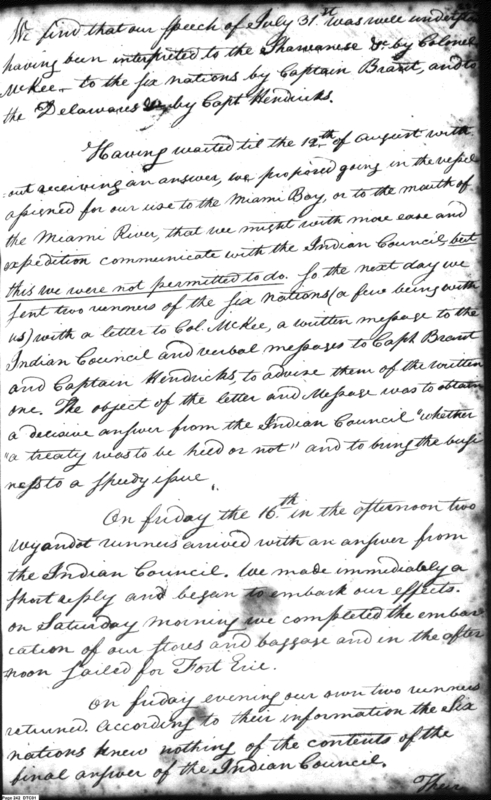
We find that our speech of July 31.st was well understood, having been interpreted to the Shawanese &c by Colonel McKee, to the Six nations by Captain Brant, and to the Delawares &c by Capt Hendricks.
Having waited til the 12.th of August without receiving an answer, we proposed going in the vessel opened for our use to the Miami Bay, or to the mouth of the Miami River, that we might with more ease and expedition communicate with the Indian Council, but [underline: this we were not permitted to do]. So the next day we sent two runners of the Six Nations (a few being with us) with a letter to Col. McKee, a written message to the Indian Council and verbal messages to Capt Brant and Captain Hendricks, to advise them of the written one. The object of the letter and Message was to obtain a decisive answer from the Indian Council "whether a treaty was to be held or not" and to bring the business to a speedy issue.
On Friday the 16.th in the afternoon two Wyandot runners arrived with an answer from the Indian Council. We made immediately a short reply and began to embark our effects. on Saturday morning we completed the embarcation of our stores and baggage and in the afternoon sailed for Fort Erie.
On friday evening our own two runners returned. According to their information the Six nations knew nothing of the contents of the final answer of the Indian Council.
Their name is not subscribed to it. They had heard [undecipherable] of an answer; but were told it was to invite the Commissioners to meet the Indian nations on the Miami (instead of Sandusky) about five miles below the rapids— to which place the Six Nations proposed to remove the day or the day after our runners left them.
From the same information it seemed probable that the Six Nations were not made acquainted with our written message of the 13.th nor the letter to Col. McKee. So we made out copies of them, of the final answer of the Indians and of our last reply and on Saturday morning sent them off by our runners, with directions to deliver them to Captain Brandt, and to inform the other Six Nation Chiefs thereof. A letter was also written to Hendricks referring him for information to those Copies. We verbally directed the runners to tell those Chiefs to be of good heart, and to assure them of the strong and unatterable friendship of the United States for the Six Nations.
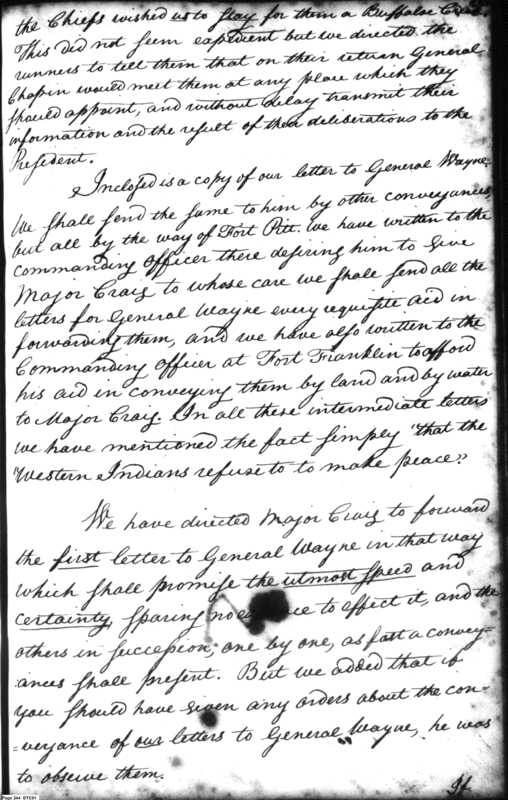
We had thought it a matter of no small moment that the Chiefs of the Six Nations should be seen and consulted on their return from the Miami, and our runners told us that the Chiefs wished us to stay for them a Buffaloe Creek. This did not seem expedient but we directed the runners to tell them that on their return General Chapin would meet them at any place which they should appoint, and without delay transmit their information and the result of their deliberations to the President.
Inclosed is a copy of our letter to General Wayne. We shall send the same to him by other conveyances, but all by the way of Fort Pitt. We have written to the Commanding Officer there desiring him to give Major Craig to whose care we shall send all the letters for General Wayne every requisite aid in forwarding them, and we have also written to the Commanding Officer at Fort Franklin to afford his aid in conveying them by land and by water to Major Craig. In all these intermediate letters we have mentioned the fact simply "that the Western Indians refuse to to make peace."
We have directed Major Craig to forward the first letter to General Wayne in that way which shall promise the [underline: utmost speed] and [underline: certainty], sparing no expense to effect it, and the others in succession, one by one, as fast a conveyances shall present. But we added that if you should have given any orders about the conveyance of our letters to General Wayne, he was to observe them.
If the wind had permitted, we should have set Sylvester Ash a shore at Presque Isle, and prepared letters accordingly to go by him. He will now proceed from Buffaloe Creek. We expect General Chapin will procure two Seneka runners to go with him as far as Fort Franklin. From thence he will proceed by land or by water as he and the Commanding officer shall think best.
But whichever route he pursues we have desired the Commanding Officer to send some trusty Indians by the other to afford the greater certainty of conveyance. We inclose him duplicate letters for Major Craig and General Wayne for that purpose—
Mr Wilson proposes to go as far as Genesee river, and thence proceed to the Susquehanna and thence to Pittsburg. by him we shall send the third set of letters for General Wayne—
Fort Erie,
August 23.} We arrived here between 12 & 1 oclock this morning, and our letters having been prepared on the voyage we shall be enabled to send them off as soon as General Chapin and Mr Jones can cross the River. They will go to Buffaloe Creek and procure two Indian runners to accompany Ash, and two more to carry this letter to Canandaiqua, whre General Chapin's son is instantly to procure an express to carry it to Philadelphia
We are with great respect
Sir
your most obt Servant
(Signed) B. Lincoln
Beverley Randolph } Commissioners of the United States
Timothy Pickering }
P.S. We could get no account of the numbers of the Indians at the rapids [strikethrough: and] except from the British Agents who told us there were about fifteen hundred men. We have noted them accordingly, but suppose they are rather likely to be less than more—
Type
Contemporary Copy of Letter made from Recipient's Files
Description
The Commissioners describe their attempts to reach a peace agreement that ultimately ended in failure.
Date
08/21/1793
Recipient
Repository
Collection
Document number
1793082140155
Page start
239
Note
Spans Images 239-246 of this collection.
Notable persons
Henry Knox
Indians
Captain Matthew Elliot, Colonel McKee's adjutant
Puckonchehelas, Head Warrior of the Delawares
Hadiiapilathy(?) Head Warrior of the Shawanese
La_avagh_da_wunk(?) who is said to be head man of the Wyandots
their Confederacy
their warriors
our interpreters
Captain Henrick's men
Munseys and Chippewas
Senecas
Miamis
Capt. Brant and his Mohawks
hostile Nations
Chiefs of the Six Nations
runners
Sylvester Ash
General Chapin and Mr. Jones
Indian Council
the President
General Wayne
Commanding Officr at Fort Franklin
Western Indians
two Seneca runners
Major Craig
Mr. Wilson
General Chapin's son
British agents
Notable locations
Niagara
Niagara
Fort Erie
mouth of the Detroit River
Sandusky
mouth of the Miami River
Ohio River
Miami Bay
Fort Erie
Buffalo Creek
Fort Pitt
Fort Franklin
Presque Isle
Genensee River
Susquehanna
Pittsburgh
Canandagua
Philadelphia
Notable items
meeting with the Indians
deputation of Indians
written message in the name of their Confederacy
boundary between your people and ours
principal concessions
ample compensations
fair prospect of peace
decisive answer from the Indian Council
final answer of the Indians
strong and unalterable friendship of the United States for the Six Nations
our letters to General Wayne
numbers of Indians at the rapids