

Speech of the Commissioners of the United States
Document 1793Speech of the Commissioners of the United States to the Deputies of the Confederate Nations assembled at the Rapids of the Miami River. Mention disputes over the boundary lines, along with past treaties. Commissioners of the United States include Benjamin Lincoln, Beverly Randolph, and Timothy Pickering.


No human transcription currently available for this document.
This transcription was generated by machine using Anthropic's Claude Code (model sonnet 4.6). It may contain errors or inaccuracies. Please verify against the document image. Learn more about our generative AI methodology.
[Copy]
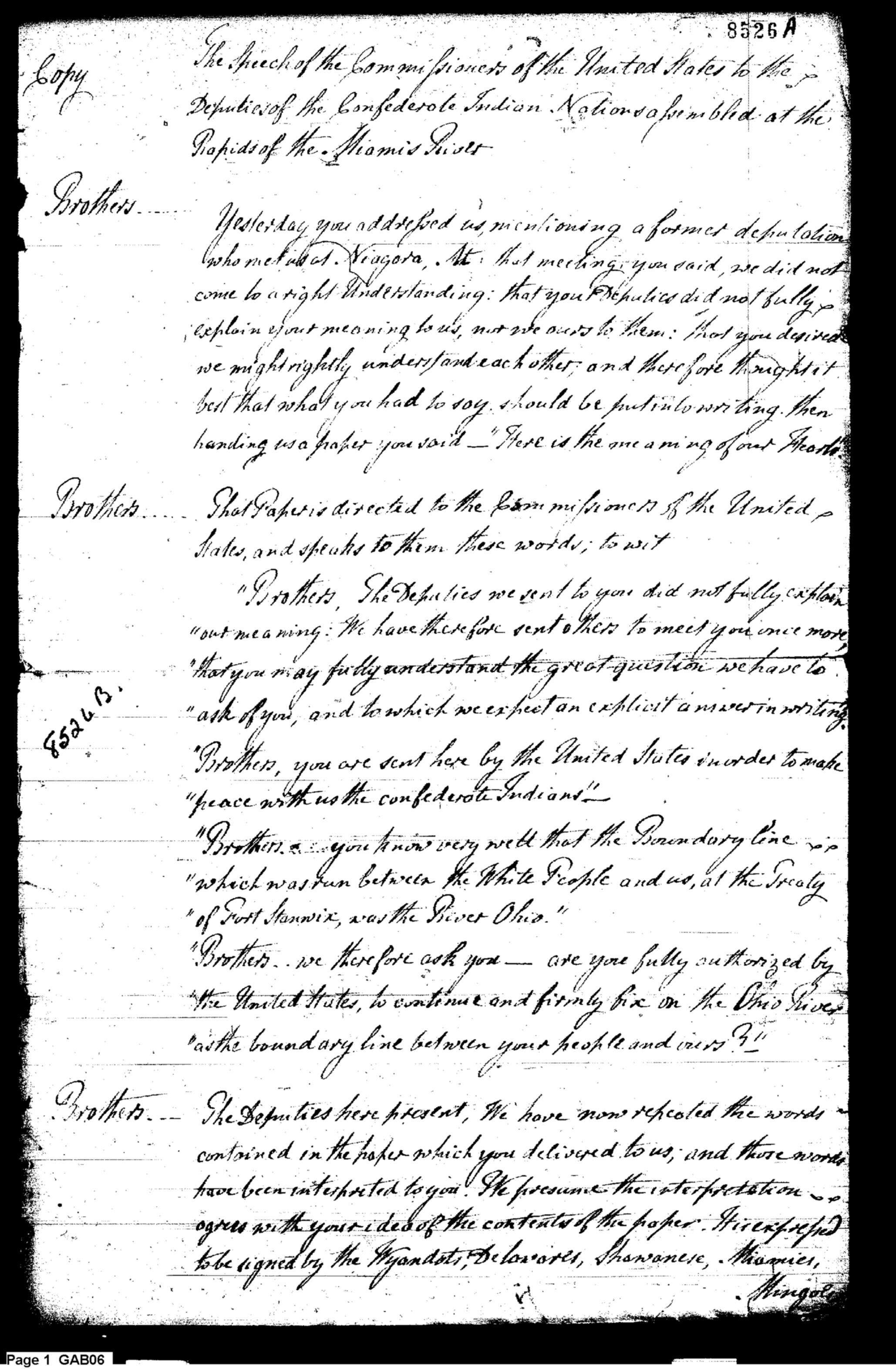
The Speech of the Commissioners of the United States to the Deputies of the Confederate Indian Nations assembled at the Rapids of the Miami River.
Brothers....
Yesterday you addressed us mentioning a former deputation to us met at Niagara. At that meeting you said, we did not come to a right Understanding; that your Deputies did not fully explain their meaning to us, nor we ours to them; that you desired we might rightly understand each other; and therefore thought it best that what you had to say, should be put in writing then handing us a paper you said — "Here is the meaning of our Thoughts"
Brothers....
That paper is directed to the Commissioners of the United States, and speaks to them these words, to wit
"Brothers. The Deputies we sent to you did not fully explain our meaning. We have therefore sent them to meet you once more that you may fully understand the great question we have to ask of you, and to which we expect an explicit answer in writing.
"Brothers, you are sent here by the United States in order to make peace with us the Confederate Indians.—
"Brothers, as you know very well that the Boundary Line agreed upon, was run between the White People and us, at the Treaty of Fort Stanwix, was the River Ohio."
"Brothers — we therefore ask you — are you fully authorized by the United States, to continue and firmly fix on the Ohio River as the boundary line between your people and ours?"
Brothers....
The Deputies here present, We have now repeated the words contained in the paper which you delivered to us, and these words have been interpreted to you. We presume the interpretation agrees with your idea of the contents of the paper. It is [undecipherable] to be signed by the Wyandots, Delawares, Shawnese, Miamis, Mingoes, Poutawatamies, Ottawas, Connoys, Chippewas and Munseys, on behalf of themselves and the whole Confederacy, and agreed to in a full Council.
Brothers:...
We are a little surprized at the suggestion that in the conference at Niagara, we did not come to a right understanding, and that your Deputies did not fully explain your meaning. Those Deputies appeared to be men of good truth; and when we saw them, they were perfectly sober. In short we never saw men in public Council more attentive, or behave with more propriety. We could not suppose therefore, they could not make your meaning [undecipherable]. Certainly we were sufficiently explicit; for in plain words we declared — that in order to establish a just and permanent peace, some concessions would be necessary on your part as well as ours. —
These words, Brothers, are a part of our Speech to your Deputies; and that Speech, they assured us, they fully understood. What those concessions should be, on both sides, and where the boundary line should be fixed, were proper subjects of discussion at the Treaty, when we should speak face to face — This we are certain would be the best way, to remove all difficulties; But you, it seems, have adopted another mode, which by keeping us at a distance, prevents our knowing each other, and keeps alive those jealousies which are the greatest obstacles to a Peace — We are therefore desirous of meeting your nations in full Council without more delay. We have already waited in this Province sixty days beyond the time appointed for opening the Treaty.
Brothers:...
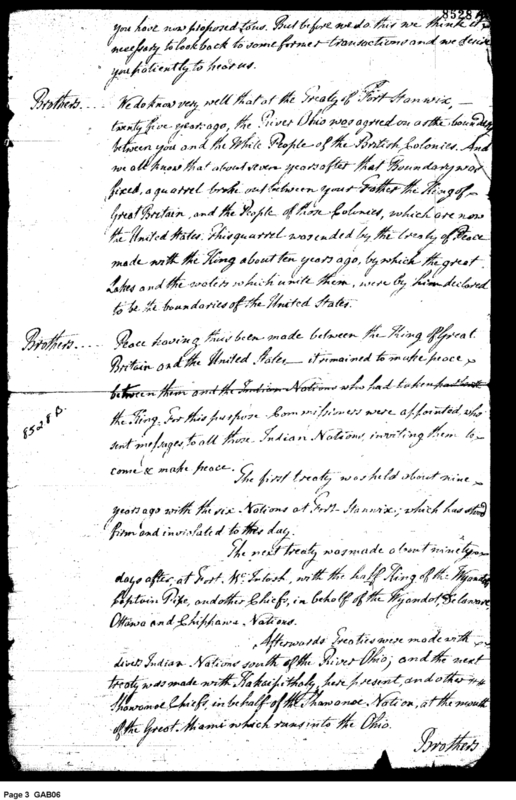
We have now expressed our opinion of the proper mode of settling the differences between you and the United States: But as your Nations have desired answers to certain questions before that meeting, and we are disposed to act with frankness and sincerity, we will give an explicit answer to the great question you have now proposed to us. But before we do this, we think it necessary to look back to some former transactions, and we desire you patiently to hear us.
Brothers....
We do know very well that at the Treaty of Fort Stanwix, twenty five years ago, the River Ohio was agreed on as the boundary between you and the White People of the British Colonies. And we all know that about seven years after that boundary was fixed, a quarrel broke out between your Father the King of Great Britain, and the People of those Colonies, which are now the United States. This quarrel was ended by the treaty of Peace made with the King, about ten years ago, by which the great Lakes and the waters which unite them, were by him declared to be the boundaries of the United States.
Brothers....
Peace having thus been made between the King of Great Britain and the United States — it remained to make peace between them and the Indian Nations who had taken part with the King. For this purpose Commissioners were appointed who sent messages to all those Indian Nations inviting them to come & make peace. The first treaty was held about nine years ago with the six Nations at Fort Stanwix, which has stood firm and inviolated to this day.
The next treaty was made about ninety days after, at Fort McIntosh, with the half King of the Wyandots, Captain Pipe, and other Chiefs, in behalf of the Wyandots, Delawares, Ottawa and Chippawa Nations.
Afterwards treaties were made with other Indian Nations south of the River Ohio; and the next treaty was made with [undecipherable], half [undecipherable], here present, and other Half Shawanoe Chiefs, in behalf of the Shawanoe Nation, at the mouth of the great Miami which runs into the Ohio.
Brothers.
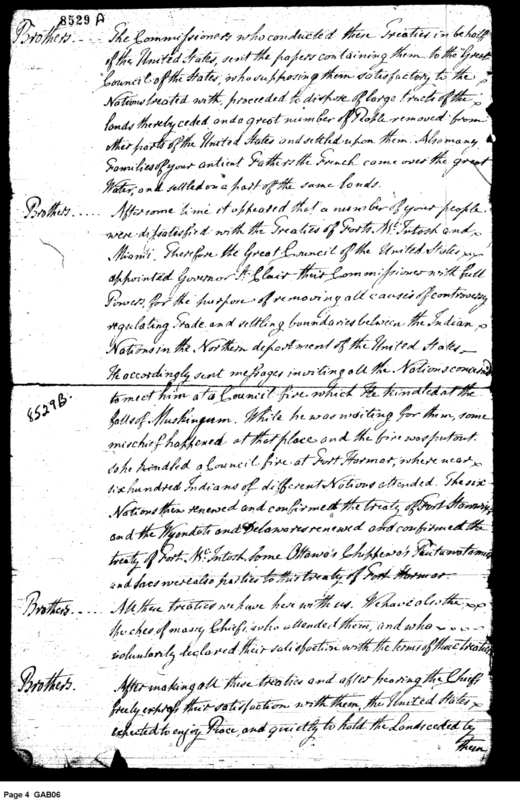
The Commissioners who conducted these Treaties in behalf of the United States, sent the papers containing them, to the Great Council of the States, who upon showing them satisfactory to the Nations treated with, proceeded to dispose of large tracts of the lands thereby ceded, and a great number of people removed from other parts of the United States and settled upon them. Also many families of your antient Father the French came over the great water, and settled on a part of the same lands.
Brothers....
After some time it appeared that a number of your people were dissatisfied with the Treaties of Forts McIntosh and Miami. Therefore the Great Council of the United States appointed Governor St. Clair their Commissioner with full Powers, for the purpose of removing all causes of controversy, regulating trade and settling boundaries between the Indian Nations in the Northern department of the United States.
He accordingly sent messages inviting all the Nations concerned to meet him at a Council fire which he kindled at the falls of Muskingum. While he was waiting for them, some mischief happened at that place and the fire was put out. He kindled a Council fire at Fort Harmar, where near six hundred Indians of different Nations attended. The six Nations then renewed and confirmed the Treaty of Fort Stanwix; and the Wyandots and Delawares renewed and confirmed the Treaty of Fort McIntosh. Some Ottawas, Chippewas, Poutawatamies and those were also parties to the Treaty of Fort Harmar.
Brothers....
All these treaties we have here with us. We have also the speeches of many Chiefs who attended them, and who — voluntarily declared their satisfaction with the terms of those Treaties.
Brothers....
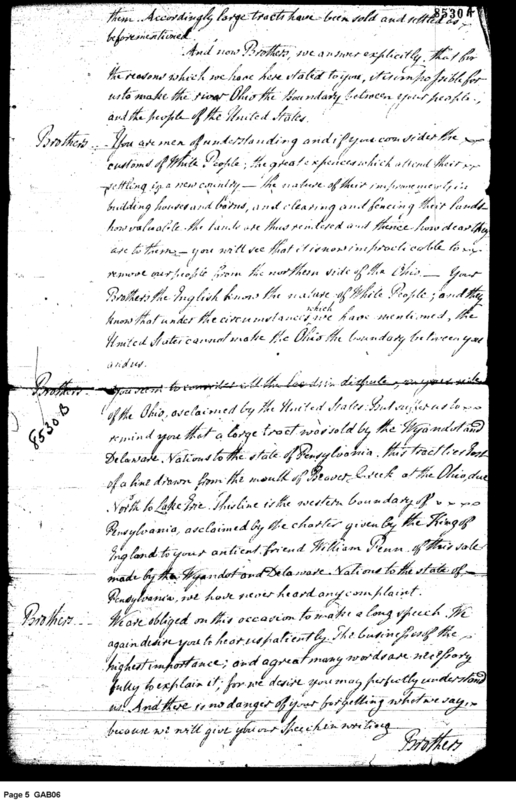
After making all those treaties and after hearing the Chiefs freely express their satisfaction with them, the United States expected to enjoy Peace, and quietly to hold the Lands ceded by them. Accordingly large tracts have been sold and settled as before mentioned.
And now Brothers, we answer explicitly that the reasons which we have here stated to you, it is impossible for us to make the River Ohio the boundary between your people and the people of the United States.
Brothers:
You are men of understanding and if you consider the customs of White People; the great impulse which attend their settling in a new country — the nature of their improvements in building houses and barns, and clearing and fencing their lands — how valuable the lands so thus rendered, and hence how dear they are to them — you will see that it is now impossible to us to remove our people from the northern side of the Ohio — Your Brothers the English know the nature of White People; and they know that under the circumstances we have mentioned, the United States cannot make the Ohio the boundary between you and us.
Brothers —
You seem to consider all the lands in dispute — you spoke of the lands on this side of the Ohio, as claimed by the United States. But [we] remind you that a large tract was sold by the Wyandot and Delaware Nations to the State of Pennsylvania. This tract lies east of a line drawn from the mouth of Beaver Creek at the Ohendue North to Lake Erie. This line is the western boundary of Pennsylvania, as claimed by the charter given by the King of England to your antient friend William Penn. Of this sale made by the Wyandot and Delaware Nations to the State of Pennsylvania, we have never heard any complaint.
Brothers:
We are obliged on this occasion to make a long speech. We again desire you to hear us patiently. The business is of the highest importance; and a great many words are necessary fully to explain it; for we desire you may perfectly understand us. And there is no danger of your forgetting what we say, because we will give you our Speech in writing.
Brothers —
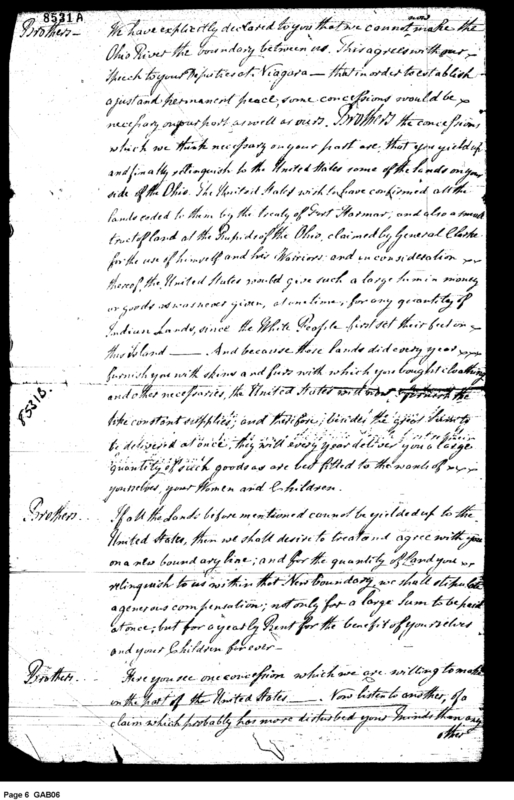
We have explicitly declared to you that we cannot and make the Ohio River the boundary between us. This agrees with your Speech beyond the mountains at Niagara — that in order to establish a just and permanent peace, some concessions would be necessary on your part as well as ours. Brothers — the concessions which we think necessary on your part are, that you yield up and finally relinquish to the United States some of the lands on your side of the Ohio. The United States wish to have confirmed all the lands ceded to them by the Treaty of Fort Harmar, and also a small tract of land at the Rapids of the Ohio, claimed by General Clarke for the use of himself and his Warriors; and in consideration thereof, the United States would give such a large sum in money, or goods as was never given, at one time, for any quantity of Indian Lands, since the White People first set their foot on this Island. And because those lands did every year furnish you with skins and furs with which you bought clothing and other necessaries, the United States would [and] [undecipherable] the [undecipherable: probable reading "give constant supplies"]; and therefore, besides the [undecipherable] to be delivered at once, this will every year deliver you a large quantity of such goods as are best fitted to the wants of yourselves, your Women and Children.
Brothers:
If all the lands before mentioned cannot be yielded up to the United States, then we shall desire to treat and agree with you on a new boundary line; and for the quantity of land you relinquish to us within that new boundary, we shall stipulate a generous compensation; not only for a large sum to be paid at once; but for a yearly Grant for the benefit of yourselves and your Children forever.
Brothers.
Here you see one concession which we are willing to make on the part of the United States. — Now listen to another, to a claim which probably has more disturbed your minds than any other whatever.
Brothers.
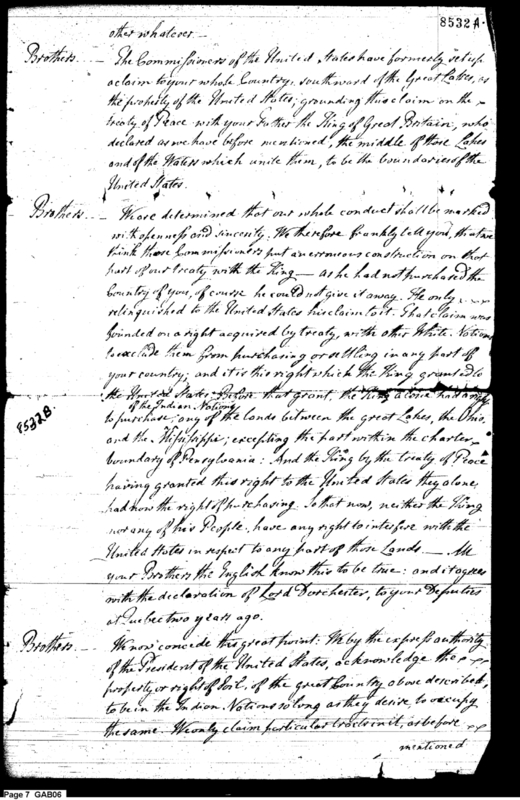
The Commissioners of the United States have formerly set up a claim to your whole Country, southward of the Great Lakes, as the property of the United States; grounding this claim on the Treaty of Peace with your Father the King of Great Britain, who declared as we have before mentioned, the middle of those Lakes and of the Waters which unite them, to be the boundaries of the United States.
Brothers. —
We have determined that our whole conduct shall be marked with openness and sincerity. We therefore frankly tell you, that we think those Commissioners put an erroneous construction on that part of your treaty with the King — as he had not purchased the Country of you, of course he could not give it away. The only right relinquished to the United States by that claim, was that claim was grounded on a right acquired by treaty, with the other White Nations to exclude them from purchasing or settling in any part of your Country; and it is this right which the King granted to the United States — that grant the King alone had to give, not of the Indian Nations. The United States had now the right of purchasing any of the lands between the great Lakes, the Ohio, and the Mississippi, excepting the part within the Charter boundary of Pennsylvania: And the King by the Treaty of Peace having granted this right to the United States, they alone had now the right of purchasing. So that now, neither the King nor any of his People, have any right to interfere with the United States in respect to any part of those Lands. — All your Brothers the English know this to be true; and it agrees with the declaration of Lord Dorchester, to your Deputies at Quebec two years ago.
Brothers.
We now concede this great point: We by the express authority of the President of the United States, acknowledge the property and right of the Indian Nations of the great Country above described, to be in the Indian Nations so long as they desire to occupy the same. We only claim particular tracts in it, as before mentioned, and the general right granted by the King, as above stated, and which is well known to the English and Americans, and called the right of pre-emption, or the right of purchasing of the Indian Nations disposed to sell their Lands, to the exclusion of all other White People whatever.
Brothers. —
We have now opened our hearts to you. We are happy in having an opportunity of doing it; though we should have been more happy to have done it in the full Council of your Nations. We expect [undecipherable] your next Deputation will take us by the hand, and lead us to the Treaty. When we meet and converse with each other freely, we may more easily remove any difficulties which may come in the way of peace.
At Captain Elliott's at the mouth of Detroit River, the Thirty first day of July 1793.
B Lincoln
Beverly Randolph } Commissioners of the United States
Timothy Pickering
[A true copy]
[signed J. McMil[undecipherable] D.A.G.A.]
Type
Copy of Signed Document
Description
Speech of the Commissioners of the United States to the Deputies of the Confederate Nations assembled at the Rapids of the Miami River. Mention disputes over the boundary lines, along with past treaties. Commissioners of the United States include Benjamin Lincoln, Beverly Randolph, and Timothy Pickering.
Date
07/31/1793
Document number
1793073190301
Page start
1
Notable persons
Benjamin Lincoln
Beverly Randolph
Timothy Pickering
Commissioners
Griffith McKee
deputies
Indians
Six Nations
Wyandots
Delaware
Shawanese
Miami
Mingoes
Powtawatamies
Ottawas
Connog
Chippowas
Munsegs
British
chiefs
French
Delawares
women
children
Notable locations
Niagara
Fort Stanwix
Ohio River
Britain
Fort McIntosh
France
Fort Harmar
Pennsylvania
Great Lakes
Mississippi River
Notable items
boundary
treaty
land