No human transcription currently available for this document.
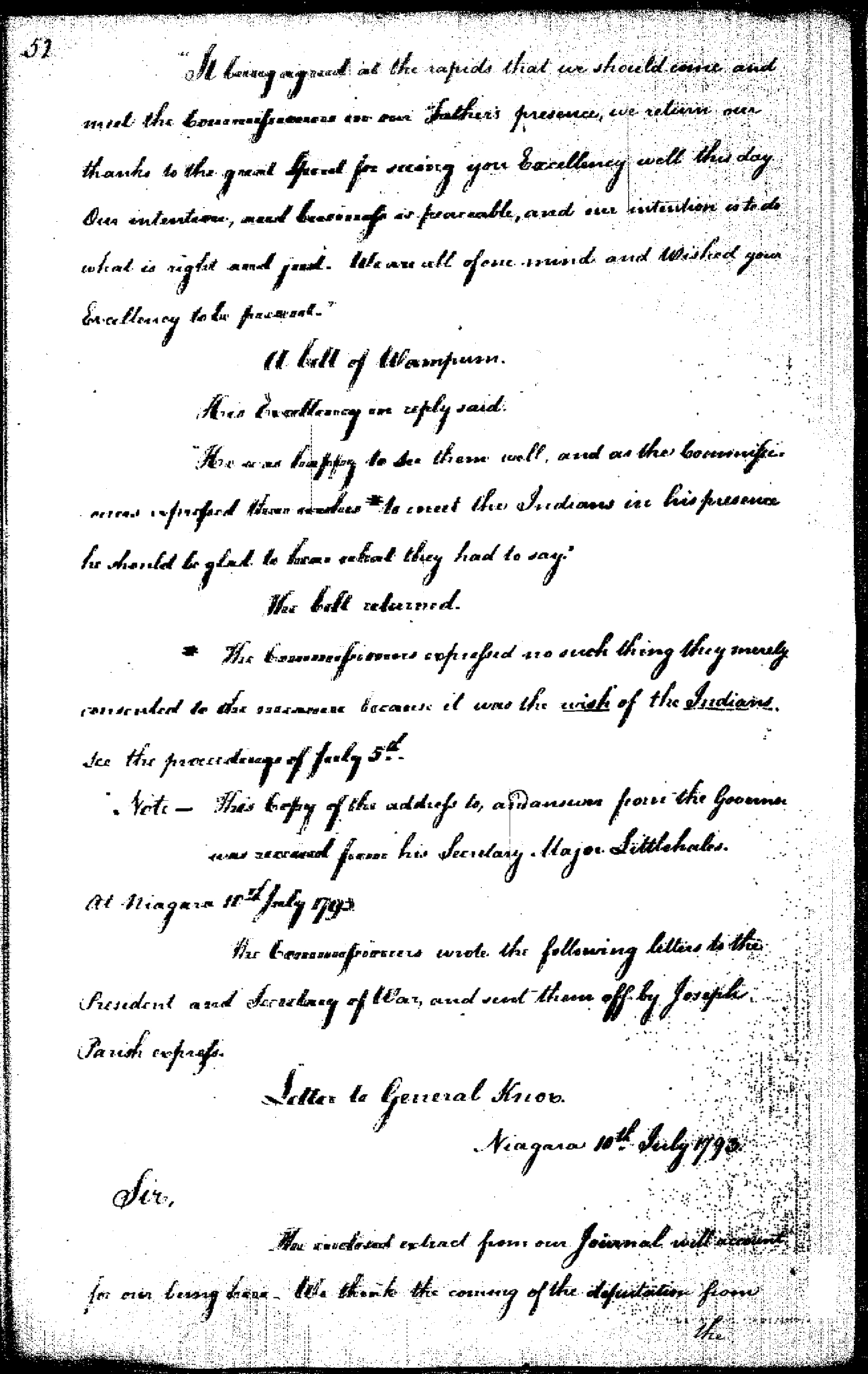
"It being agreed at the rapids that we should come and meet the Commissioners in our Father's presence, we return our thanks to the great Spirit for seeing your Excellency well this day. Our intentions, and business is peaceable, and our intention is to do what is right and just. We are all of one mind and Wished your Excellency to be present."
A Belt of Wampum.
His Excellency in reply said:
"He was happy to see them well, and as the Commissioners informed them and he* [undecipherable] to meet the Indians in his presence he should be glad to hear what they had to say."
The belt returned.
* The Commissioners expressed no such thing they merely consented to the measure because it was the wish of the Indians. See the proceedings of July 5th.
Note — This Copy of the address to, & Answers from the Governer was received from his Secretary Major Littlehales.
At Niagara 10th July 1793.
The Commissioners wrote the following letters to the President and Secretary of War, and sent them off by Joseph Parish express.
Letter to General Knox.
Niagara 10th July 1793.
Sir,
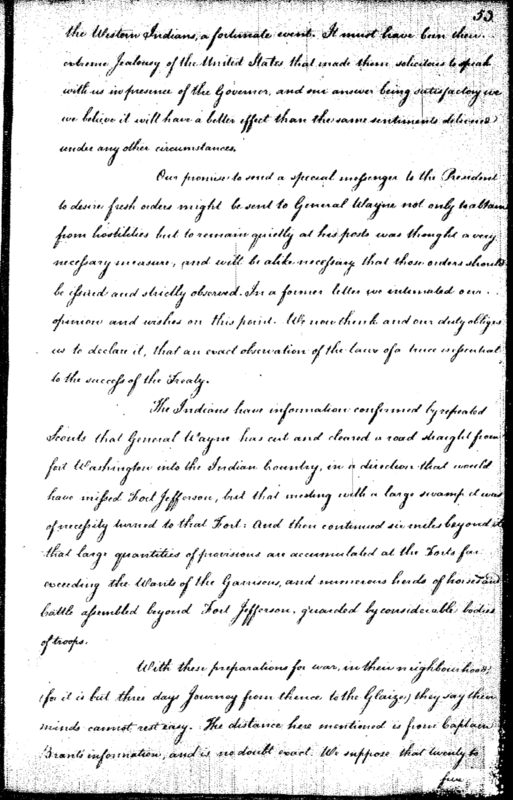
The enclosed extract from our Journal will [undecipherable] — for our being here. We think the coming of the deputation from the the Western Indians, a fortunate event. It must have been their extreme jealousy of the United States that made them solicitous to speak with us in presence of the Governer, and one answer being satisfactory we believe it will have a better effect than the same sentiments delivered under any other circumstances.
Our promise to send a special messenger to the President to desire fresh orders might be sent to General Wayne not only to abstain from hostilities but to remain quietly at his posts was thought a very necessary measure, and will be alike necessary that those orders should be obeyed and strictly observed. In a former letter we expressed our opinions and wishes on this point. We now think and our duty obliges us to declare it, that an exact observation of the laws of a truce is essential to the success of the Treaty.
The Indians have information confirmed by repeated Scouts that General Wayne has cut and cleared a road straight from fort Washington into the Indian country, in a direction that would have missed Fort Jefferson, but that meeting with a large swamp it was of necessity turned to that Fort: And then continued six miles beyond it; that large quantities of provisions are accumulated at the Forts far exceeding the Wants of the Garrison, and numerous herds of horned cattle assembled beyond Fort Jefferson, guarded by considerable bodies of troops.
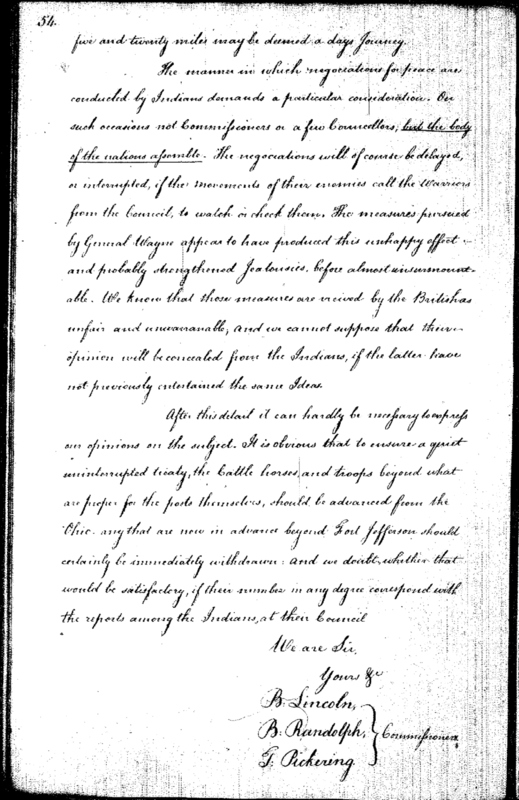
With these preparations for war, in their neighbourhood (so it is but three days Journey from thence to the Glaize) they say their minds cannot rest easy. The distance here mentioned is from Captain Brant's information, and is no doubt exact. We suppose that twenty to five and twenty miles may be deemed a days Journey.
The manner in which negotiations for peace are conducted by Indians demands a particular consideration. On such occasions not Commissioners or a few Councillors, [underline: but the body of the nations assemble]. The negotiations will of course be delayed, or interrupted, if the movements of their enemies call the Warriors from the Council, to watch or check them. The measures pursued by General Wayne appears to have produced this unhappy effect — and probably strengthened Jealousies, before almost unsurmountable. We know that these measures are viewed by the British as unfair and unwarrantable, and we cannot suppose that their opinion will be concealed from the Indians, if the latter have not previously entertained the same Ideas.
After this detail it can hardly be necessary to press our opinions on the subject. It is obvious that to ensure a quiet uninterrupted treaty, the cattle herses, and troops beyond what are proper for the posts themselves, should be withdrawn from the Ohio. any that are now in advance beyond Fort Jefferson should certainly be immediately withdrawn; and we doubt whether that would be satisfactory, if their number in any degree correspond with the reports among the Indians, at their Council.
We are Sir,
Yours &c
B. Lincoln,
B. Randolph, } Commissioners
T. Pickering