No human transcription currently available for this document.
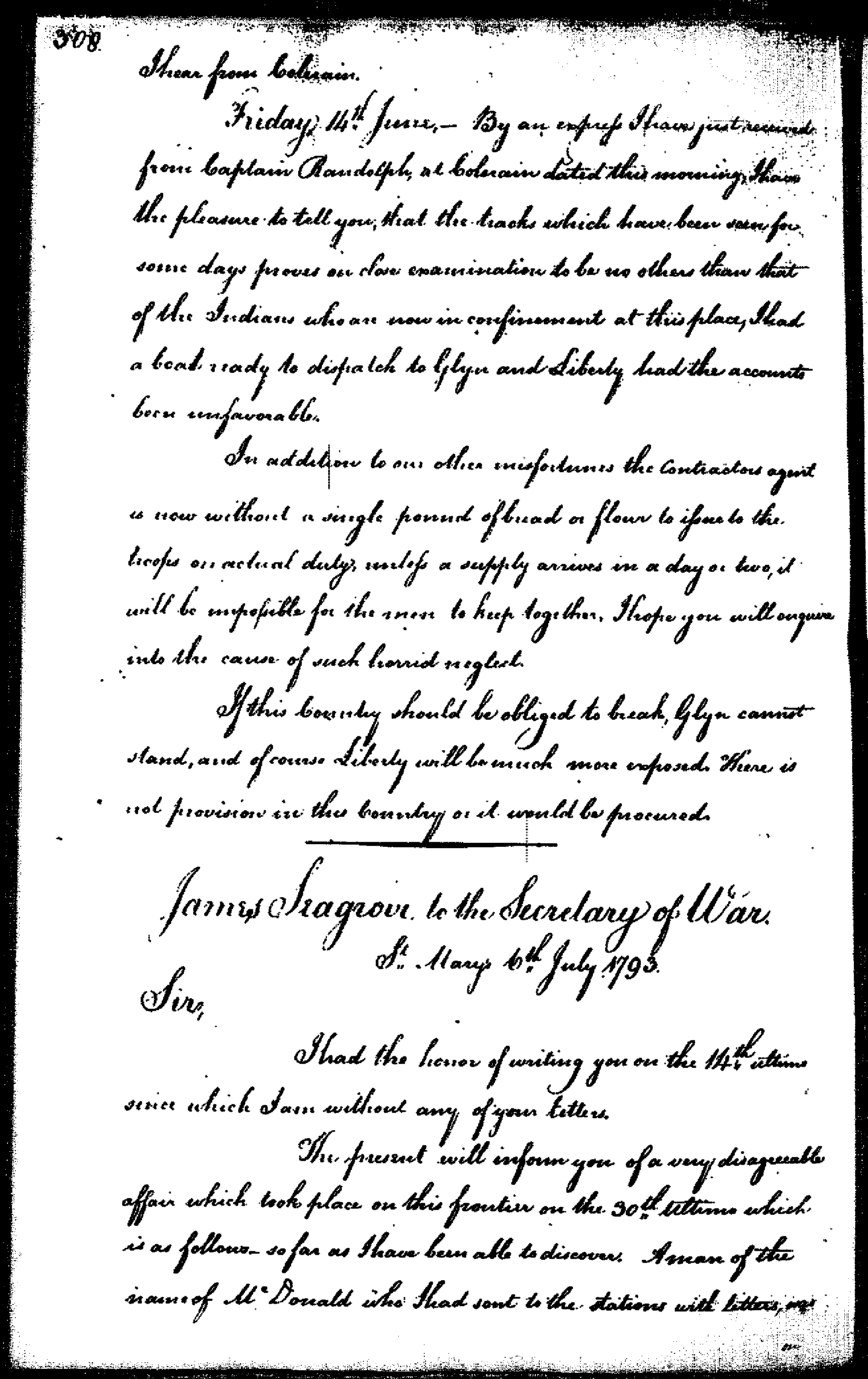
Shears from Boleain.
Friday, 11th June, — By an express I have just received from Captain Randolph, at Boleain dated this morning, I have the pleasure to tell you, that the tracks which have been seen for some days proves on close examination to be no others than that of the Indians who are now in confinement at this place, I had a boat ready to dispatch to Glynn and Liberty had the accounts been unfavourable.
In addition to our other misfortunes the contractors agent is now without a single pound of bread or flour to issue to the troops on actual duty; unless a supply arrives in a day or two, it will be impossible for the men to keep together. I hope you will enquire into the cause of such horrid neglect.
If this boundary should be obliged to break, Glynn cannot stand, and of course Liberty will be much more exposed. There is not provision in this boundary or it would be procured.
——————
James Seagrove to the Secretary of War.
St. Mary's 6th July 1793.
Sir,
I had the honor of writing you on the 14th ultimo since which I am without any of your letters.
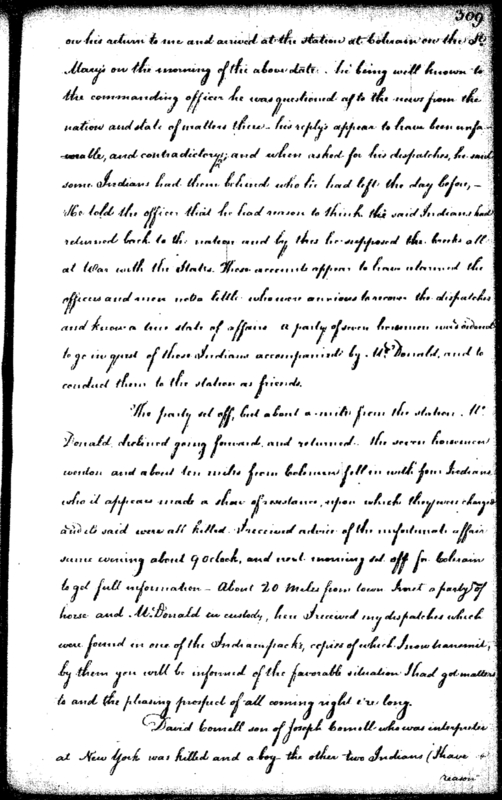
The present will inform you of a very disagreeable affair which took place on this frontier on the 30th ultimo which is as follows— so far as I have been able to discover. A man of the name of McDonald who I had sent to the stations with letters, on his return to me and arrived at the station at Boleain on the St. Marys on the morning of the above date. He being well known to the commanding officer he was questioned as to the news from the nation and state of matters there— his replys appear to have been unfavorable, and contradictory; and when asked for his dispatches, he said some Indians had them he had left the day before, — He told the officer that he had reason to think the said Indians had returned back to the nation and by this he supposed the [undecipherable] all at War with the States. These accounts appear to have alarmed the officers and even not a little who were anxious to receive the dispatches and know a true state of affairs. A party of seven horsemen was detach'd to go in quest of these Indians accompanied by McDonald, and to conduct them to the station as friends.
The party set off, but about a mile from the station, McDonald declined going forward, and returned. The seven horsemen went on and about ten miles from Boleain fell in with four Indians who it appears made a shew of resistance, upon which they were charged and it is said were all killed. I received advice of this unfortunate affair same evening about 9 o'clock, and next morning set off for Boleain to get full information— About 20 Miles from town I met a party of horse and McDonald in custody, here I received my dispatches which were found in one of the Indian packs, copies of which I now transmit; by them you will be informed of the favorable situation I had got matters to and the pleasing prospect of all coming right ere long.
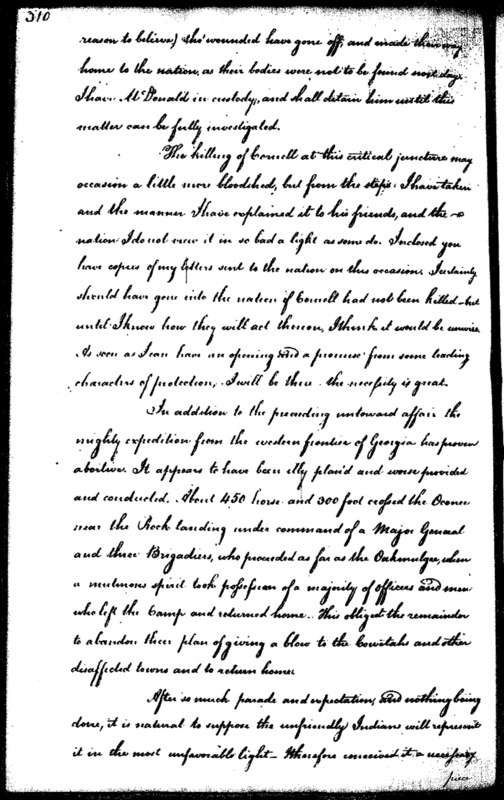
David Connell son of Joseph Connell who was interpreter at New York was killed and a boy, the other two Indians (I have reason to believe) the wounded have gone off, and made their way home to the nation, as their bodies were not to be found next day. I have McDonald in custody, and shall detain him until this matter can be fully investigated.
The killing of Connell at this critical juncture may occasion a little more bloodshed, but from the steps I have taken and the manner I have explained it to his friends, and the nation I do not view it in so bad a light as some do. Inclosed you have copies of my letters sent to the nation on this occasion. Certainly should have gone into the nation if Connell had not been killed— but until I know how they will act thereon, I think it would be unwise. As soon as I can have an opening and a promise from some leading characters of protection, I will be there— the necessity is great.
In addition to the preceding untoward affair the mighty expedition from the western frontier of Georgia has proven abortive. It appears to have been illy plann'd and worse provided and conducted. About 450 horse and 300 foot crossed the Oconee near the Rock landing under command of a Major General and three Brigadiers, who proceeded as far as the Oakmulgee, when a mutinous spirit took possession of a majority of officers and men, who left the camp and returned home. This obliged the remainder to abandon their plan of giving a blow to the Creeks and their disaffected towns and to return home.
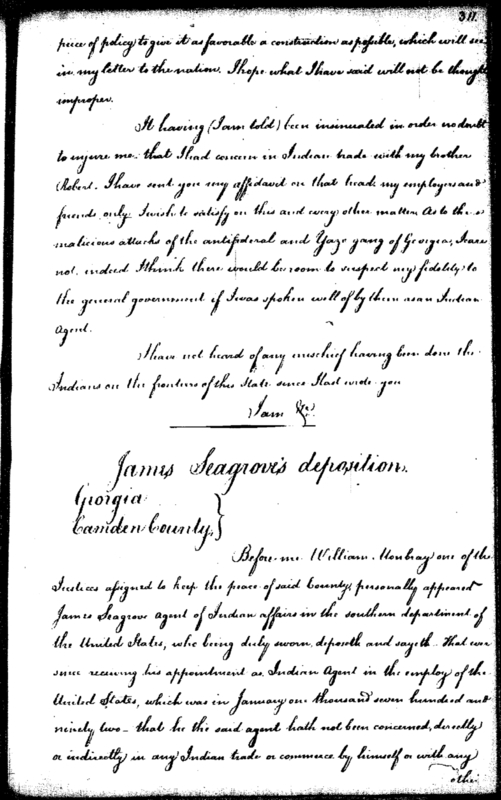
After so much parade and expectations and nothing being done, it is natural to suppose the unfriendly Indians will represent it in the most unfavorable light— Wherefore conceived it necessary, piece of policy to give it as favorable a construction as possible, which will see in my letter to the nation. I hope what I have said will not be thought improper.
It having (I am told) been insinuated in order no doubt to injure me, that I had concern in Indian trade with my brother Robert. I have sent you my affidavit on that head, my employers and friends only. I wish to satisfy on this and every other matter. As to the malicious attacks of the antifederal and Yazoo gang of Georgia; I have not, indeed I think there would be room to suspect my fidelity to the general government. I was spoken well of by them as an Indian agent.
I have not heard of any mischief having been done the Indians on the frontiers of this State since I last wrote you.
I am &c.
——————
James Seagrove's deposition.
Georgia
Camden County }
Before me William Maubray one of the Justices assigned to keep the peace of said County, personally appeared James Seagrove Agent of Indian affairs in the southern department of the United States, who being duly sworn, deposeth and sayeth. That ever since receiving his appointment as Indian Agent in the employ of the United States, which was in January one thousand seven hundred and ninety two— that he the said agent hath not been concerned, directly or indirectly, in any Indian trade or commerce by himself or with any other