No human transcription currently available for this document.
This transcription was generated by machine using Anthropic's Claude Code (a mix of sonnet and opus models). It may contain errors or inaccuracies. Please verify against the document image. Learn more about our generative AI methodology.
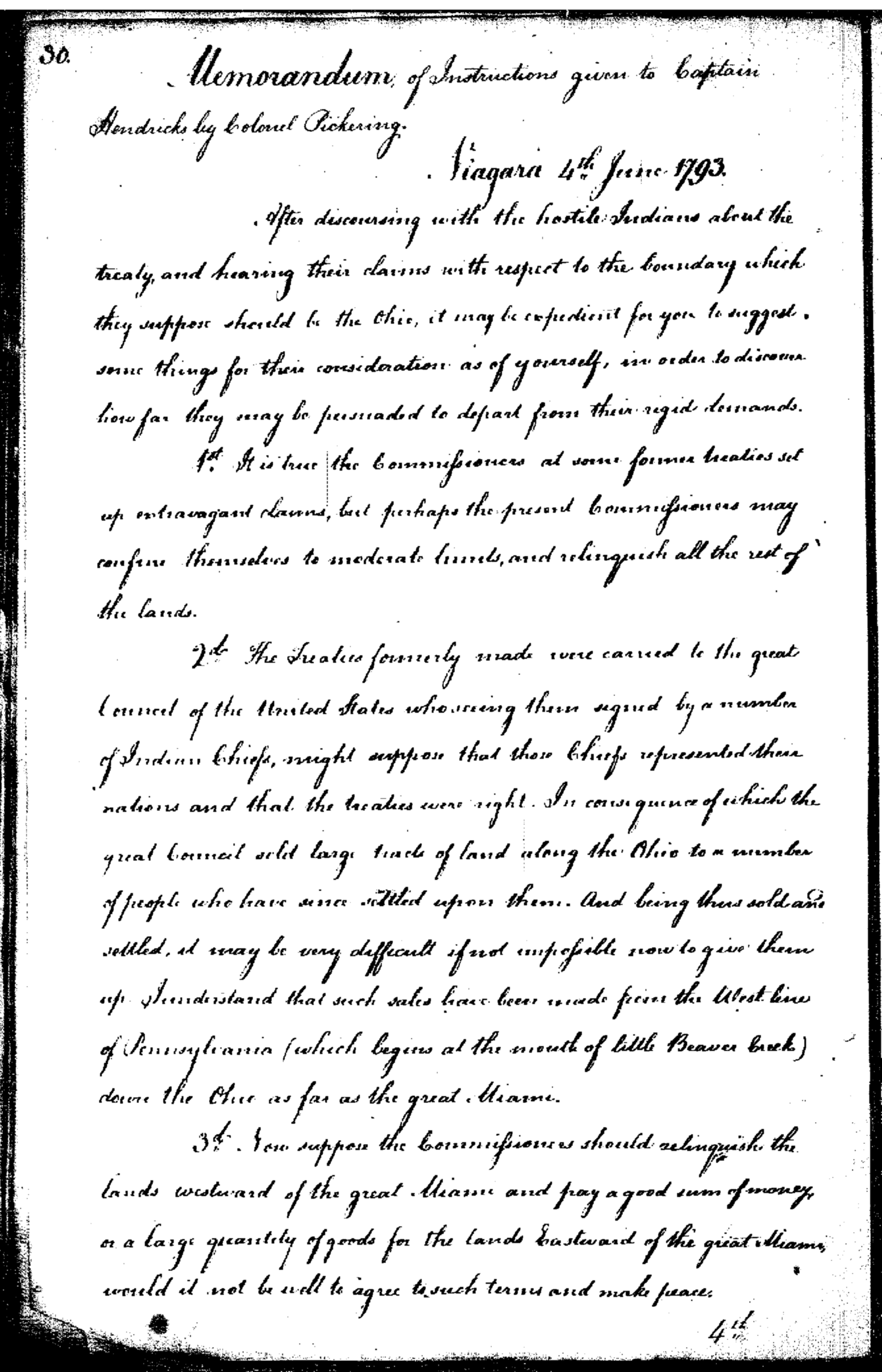
Memorandum of Instructions given to Captain Hendricks by Colonel Pickering.
Niagara 4th June 1793.
After discoursing with the hostile Indians about the treaty, and hearing their claims with respect to the boundary which they suppose should be the Ohio, it may be expedient for you to suggest some things for their consideration as of yourself, in order to discover how far they may be persuaded to depart from their rigid demands.
1st It is true the Commissioners at some former treaties set up extravagant claims, but perhaps the present Commissioners may confine themselves to moderate limits, and relinquish all the rest of the lands.
2d The Treaties formerly made were carried to the great Council of the United States who seeing them signed by a number of Indian Chiefs, might suppose that those Chiefs represented their nations and that the treaties were right. In consequence of which the great Council sold large tracts of land along the Ohio to a number of people who have since settled upon them. And being thus settled, it may be very difficult if not impossible now to give them up. I understand that such sales have been made from the West line of Pennsylvania (which begins at the mouth of little Beaver Creek) down the Ohio as far as the great Miame.
3d Now suppose the Commissioners should relinquish the lands westward of the great Miame and pay a good sum of money, or a large quantity of goods for the lands Eastward of the great Miame, would it not be well to agree to such terms and make peace.
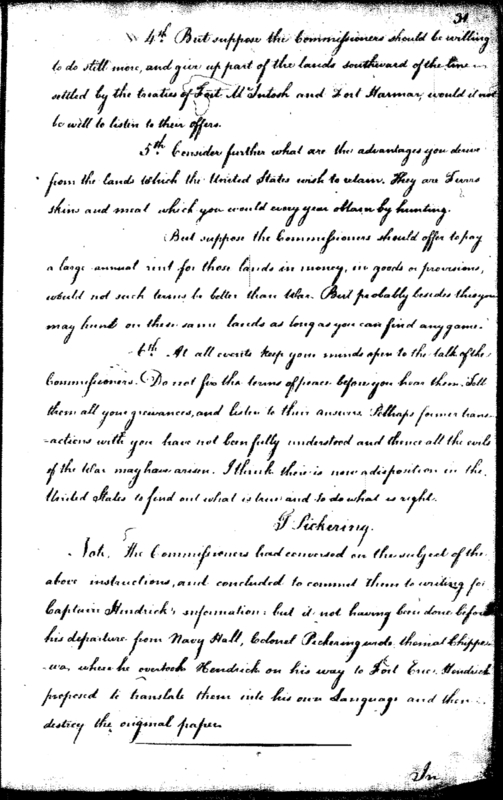
4th But suppose the Commissioners should be willing to do still more, and give up part of the lands southward of the line settled by the treaties of Fort McIntosh and Fort Harmar, would it not be well to listen to their offers.
5th Consider further what are the advantages you derive from the lands which the United States wish to retain. They are Furr skins and meat which you would every year obtain by hunting.
But suppose the Commissioners should offer to pay a large annual rent for those lands in money, in goods or provisions, would not such terms be better than war. But probably besides these you may hunt on those same lands as long as you can find any game.
6th At all events keep your minds open to the talk of the Commissioners. Do not fix the terms of peace before you hear them. Tell them all your grievances, and listen to their answers. Perhaps former transactions with you have not been fully understood and thence all the evils of the war may have arisen. I think there is now a disposition in the United States to find out what is true and to do what is right.
J Pickering.
Nob. The Commissioners had conversed on the subject of the above instructions, and concluded to commit them to writing for Captain Hendrick's information; but it not having been done before his departure from Navy Hall, Colonel Pickering rode thence [undecipherable: happened], where he overtook Hendrick on his way to Fort Erie. Hendrick proposed to translate them into his own language and then destroy the original paper.
In a few days after General Lincoln's Arrival with his stores and baggage (without which we could not provide for ourselves) we concluded to remove from Navy Hall to Queenstown, and there encamp, while we should be obliged to wait for the assembling of the Indian nations at Sandusky. But as soon as Governor Simcoe understood our intentions, he again insisted on our staying at his house, and in such terms that we could not without rudeness avoid a compliance with his request.
Navy Hall June 16th 1793.
At a meeting of the Commissioners this day, it being thought expedient to invite General Chapin superintendant of the six nations to attend them during the treaty with the hostile Indians at Sandusky. He being present was accordingly invited, and apprised of a reasonable compensation for his time and services. General Chapin accepted the invitation, and promised to attend.
Navy Hall 7th June 1793.
The Commissioners presented the following note to Governor Simcoe.
The Commissioners of the United States for making peace with the Western Indians, beg leave to suggest to Governor Simcoe,
That the very high importance of the negotiation committed to their management makes them desirous of using every proper means that may contribute to its success.
That they have observed with pleasure the disposition manifested by the Governor to afford every requisite assistance in the preparatory arrangements for holding the treaty with the hostile Indians. (But all the facilities thus afforded, and all the expenses incurred by the British Government on this occasion will perhaps be fruitlessly spent, unless some means are used to counteract the effects of deep rooted prejudices and unfounded reports among the Indian tribes; for the arts of a few bad men dwelling among them or having a familiar intercourse with them by cherishing their prejudices or raising and spreading those reports, may be sufficient to defeat every attempt to accomplish a peace.
As an instance of such unfounded reports the Commissioners have received the Declaration of a Mohawk from Grand river, That Governor Simcoe advised the Indians to make peace but not to give up any of their lands.
The Commissioners further observe that if any transactions at former treaties were exceptionable the principles of the present treaty are calculated to remove the causes of complaint, for the views of Government are perfectly fair.
And although it is now impossible to retrace all the steps then taken, the United States are disposed to redo as far as shall be indispensible and the existing state of things will admit and for the lands retained to make ample compensation.
The views of the United States being thus fair, and liberal the Commissioners wish to embrace every means of making them to appear to the Indians against any contrary suggestions. Among those means the Commissioners consider the presence of some Gentlemen of the Army to be of consequence; for although the Indians naturally look to their superintendants as their Patron yet the presence of some Officers of the Army will probably induce them to negotiate with greater confidence on the terms of peace. Independently of these considerations the Commissioners for their own sakes request the pleasure of their Company.
The Commissioners feeling the greatest solicitude to accomplish the object of their mission will be happy to receive from the Governor every information relating to it which his situation enables him to communicate. He must be aware that the sales and settlements of the lands over the Ohio, founded on the treaties of Forts McIntosh and Harmar, render it impossible now to make that river the boundary.
The expression of his opinion on this point in particular will give them great satisfaction.
Memorandum.
Besides the reasons expressly mentioned in the notes there were other inducements to present it.
With respect to the invitation to some British Officers to attend the treaty the Commissioners found they were desirous of attending and thought a direct invitation more eligible than a memorial sent to their wishes.
Colonel Butler and General Chapin also deemed the invitation to be of some moment.
It was the explicit opinion of the Chiefs of the Senecas that an open communication with the Governor on the subject of the treaty, might have a salutary effect. And Major Littlehales, the Governor's Secretary gave the Commissioners to understand that the Governor if requested would cheerfully give his opinion about it.
The conceived also that the presence of some Officers of the army would add to their security from insults and from danger.
The same day the following note was received from Governor Simcoe.
Colonel Simcoe commanding the Kings forces in upper Canada has the honor in answer to the paper delivered to him this morning by the Commissioners of the United States for making peace with the Western Indians, to state to these Gentlemen that he is duly impressed with the serious importance of the negotiation committed to his charge, and shall be happy to contribute by every proper means that may tend to its success. He is much obliged to them for the polite manner in which they have expressed their sense of his readiness to afford them such facilities as may have been in his power to assist in the preparatory arrangements for holding the treaty.
He is perfectly aware that unfounded reports and deep rooted prejudices have arisen among the Indian tribes, but whether from the acts of a few bad men living among them he cannot pretend to say, but he must observe upon the instance given by the Commissioners of one of their unfounded reports that a Mohawk from the Grand river, should say, that Governor Simcoe advised the Indians to make peace, but not to give up their lands. It is of that nature that cannot be true. The Indians as yet not having applied for his advice on the subject, and it being a point of all others on which they are the least likely to consult the British Officers commanding in upper Canada.
Colonel Simcoe considers himself perfectly justified in admitting on the requisition of the Commissioners some officers to attend the treaty, and therefore in addition to the Gentlemen appointed toβ
[continued]