No human transcription currently available for this document.
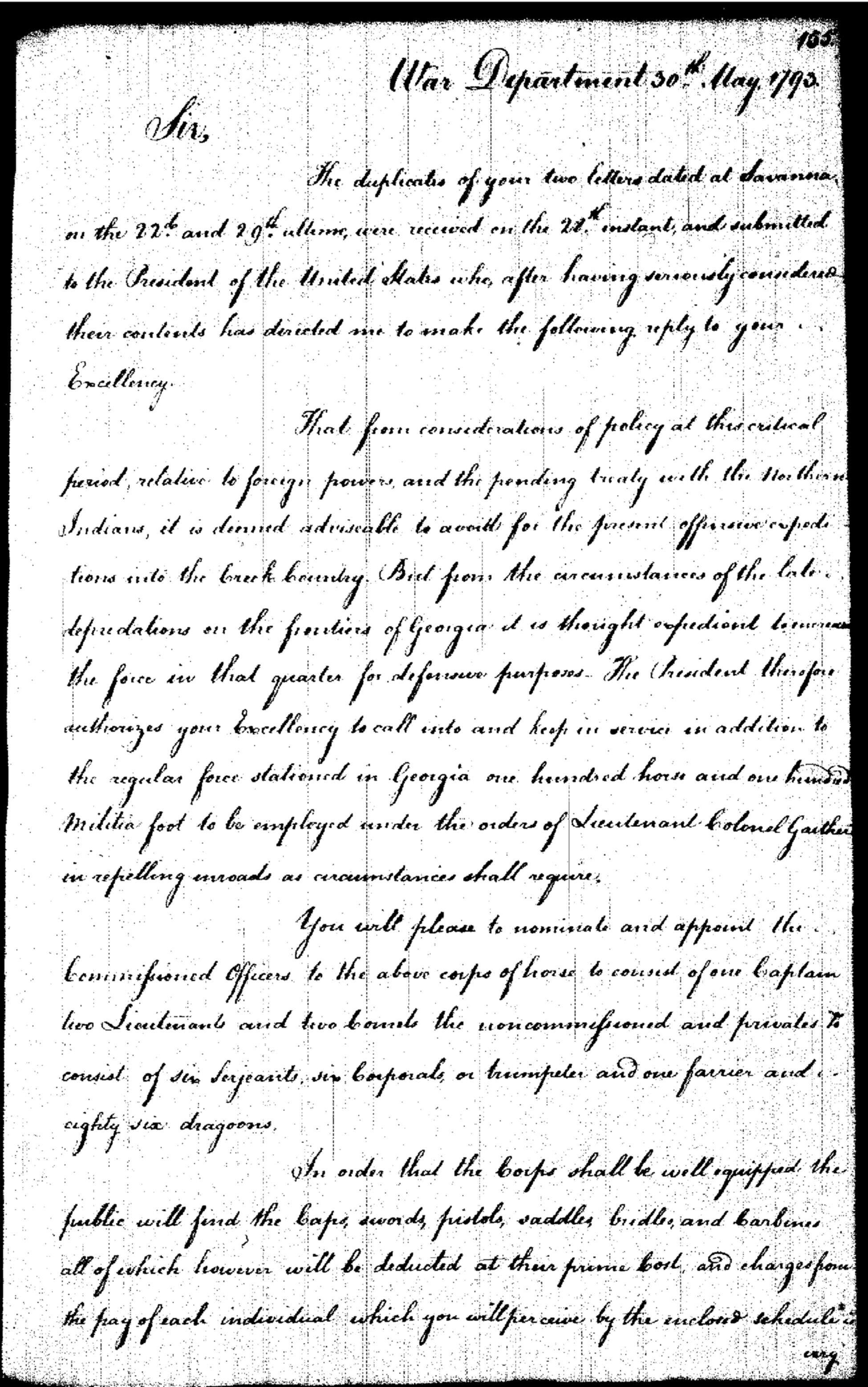
War Department 30th May 1793
Sir,
The duplicates of your two letters dated at Savanna on the 22d and 29th ultimo, were received on the 28th instant, and submitted to the President of the United States who, after having seriously considered their contents has directed me to make the following reply to your Excellency.
That from considerations of policy at this critical period, relative to foreign powers and the pending treaty with the Northern Indians, it is deemed adviseable to avoid for the present offensive expeditions into the Creek Country. But from the circumstances of the late depredations on the frontiers of Georgia it is thought expedient to increase the force in that quarter for defensive purposes. The President therefore authorizes your Excellency to call into and keep in service in addition to the regular force stationed in Georgia one hundred horse and one hundred Militia foot to be employed under the orders of Lieutenant Colonel Gaither in repelling inroads as circumstances shall require.
You will please to nominate and appoint the Commissioned Officers to the above corps of horse to consist of one Captain two Lieutenants and two Cornets the noncommissioned and privates to consist of six Serjeants, six Corporals, one trumpeter and one farrier and eighty six dragoons.
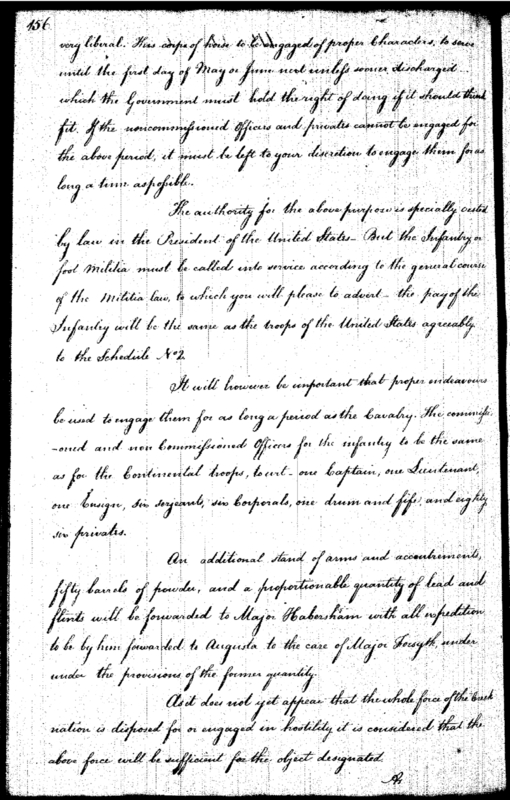
In order that the corps shall be well equipped the public will find the Caps, swords, pistols, saddles bridles, and carbines all of which however will be deducted at their prime cost, and charges from the pay of each individual which you will perceive by the enclosed schedule is very liberal. This corps of horse to be engaged of proper Characters, to serve until the first day of May or June next unless sooner discharged which the Government must hold the right of doing if it should think fit. If the noncommissioned Officers and privates cannot be engaged for the above period, it must be left to your discretion to engage them for as long a time as possible.
The authority for the above purposes is specially vested by law in the President of the United States. But the Infantry or foot Militia must be called into service according to the general course of the Militia law, to which you will please to advert. The pay of the Infantry will be the same as the troops of the United States agreeably to the Schedule N° 2.
It will however be important that proper endeavours be used to engage them for as long a period as the Cavalry. The commissioned and non Commissioned Officers for the infantry to be the same as for the Continental troops, to wit — one Captain, one Lieutenant, one Ensign, six Serjeants, six Corporals, one drum and fife, and eighty six privates.
An additional stand of arms and accoutrements, fifty barrels of powder, and a proportionable quantity of lead and flints will be forwarded to Major Habersham with all expedition to be by him forwarded to Augusta to the care of Major Forsyth, under under the provisions of the former quantity.
As it does not yet appear that the whole force of the Creek nation is disposed for or engaged in hostility it is considered that the above force will be sufficient for the object designated.
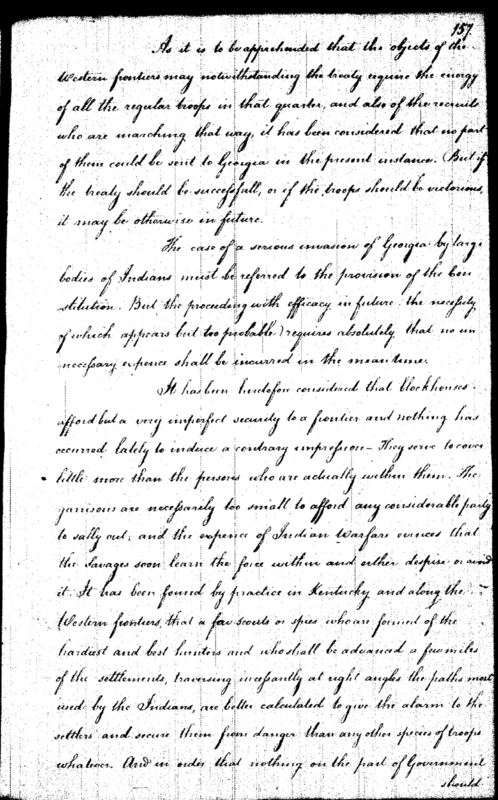
As it is to be apprehended that the objects of the Western frontiers may notwithstanding the treaty require the energy of all the regular troops in that quarter, and also of the recruits who are marching that way, it has been considered that no part of them could be sent to Georgia in the present instance. But if the treaty should be successfull, or if the troops should be victorious, it may be otherwise in future.
The case of a serious invasion of Georgia by large bodies of Indians must be referred to the provision of the Constitution. But the proceeding with efficacy in future, the necessity of which appears but too probable, requires absolutely that no unnecessary expence shall be incurred in the mean time.
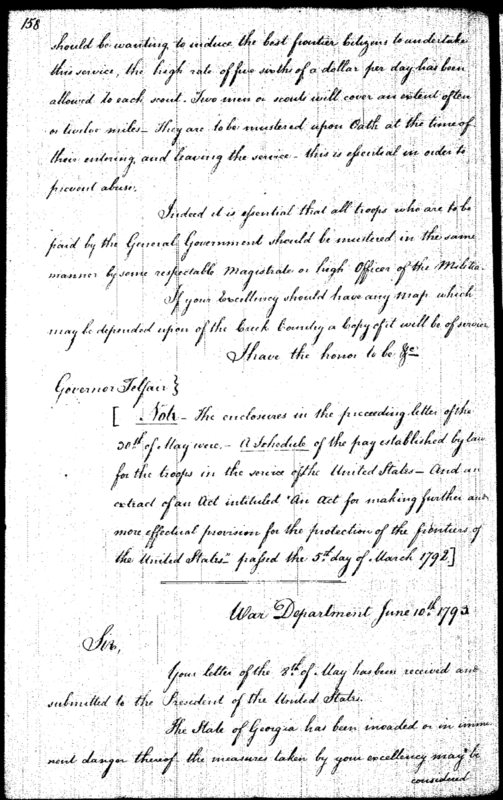
It has been heretofore considered that Block houses afford but a very imperfect security to a frontier and nothing has occurred lately to induce a contrary impression— They serve to cover little more than the persons who are actually within them. The garrisons are necessarily too small to afford any considerable party to sally out, and the experience of Indian Warfare evinces that the Savages soon learn the force within and either despise or avoid it. It has been found by practice in Kentucky and along the Western frontiers that a few scouts or spies who are formed of the hardiest and best hunters and who shall be advanced a few miles of the settlements, traversing incessantly at right angles the paths most used by the Indians, are better calculated to give the alarm to the settlers and secure them from danger than any other species of troops whatever. And in order that nothing on the part of Government should be wanting to induce the best frontier Citizens to undertake this service, the high rate of five sixths of a dollar per day has been allowed to each scout. Two men or scouts will cover an extent of ten or twelve miles. They are to be mustered upon Oath at the time of their entering and leaving the service — this is essential in order to prevent abuse.
Indeed it is essential that all troops who are to be paid by the General Government should be mustered in the same manner by some respectable Magistrate or high Officer of the Militia.
If your Excellency should have any Maps which may be depended upon of the Creek Country a Copy of it will be of service.
I have the honor to be &c.
Governor Telfair }
[ [underline: Note] — The enclosures in the preceding letter of the 30th of May were — A [underline: Schedule] of the pay established by law for the troops in the service of the United States — And an extract of an Act intituled "An Act for making further and more effectual provision for the protection of the frontiers of the United States." passed the 5th day of March 1792]