

Measures to prevent foreign aggression and protect neutrality
Document 1793Describes measures to prevent foreign arms and aggression; discusses fitting and manning vessels as privateers; discusses neutrality of United States; mentions militia.




No human transcription currently available for this document.
This transcription was generated by machine using Anthropic's Claude Code (model sonnet 4.6). It may contain errors or inaccuracies. Please verify against the document image. Learn more about our generative AI methodology.
[duplicate / Gov'r Jones]
[1793 May 24]
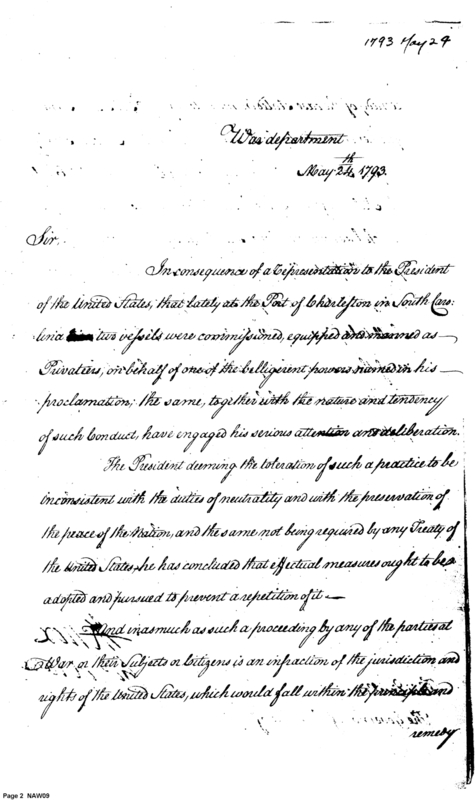
War department
May 24th, 1793.
Sir
In consequence of a Representation to the President of the United States, that lately at the Port of Charleston in South Carolina two vessels were commissioned, equipped and [strikethrough: armed] manned as Privateers, on behalf of one of the belligerent powers named in his proclamation; the same, together with the nature and tendency of such conduct, have engaged his serious attention and deliberation.
The President deeming the toleration of such a practice to be inconsistent with the duties of neutrality and with the preservation of the peace of the Nation, and the same not being required by any Treaty of the United States, he has concluded that effectual measures ought to be adopted and pursued to prevent a repetition of it.—
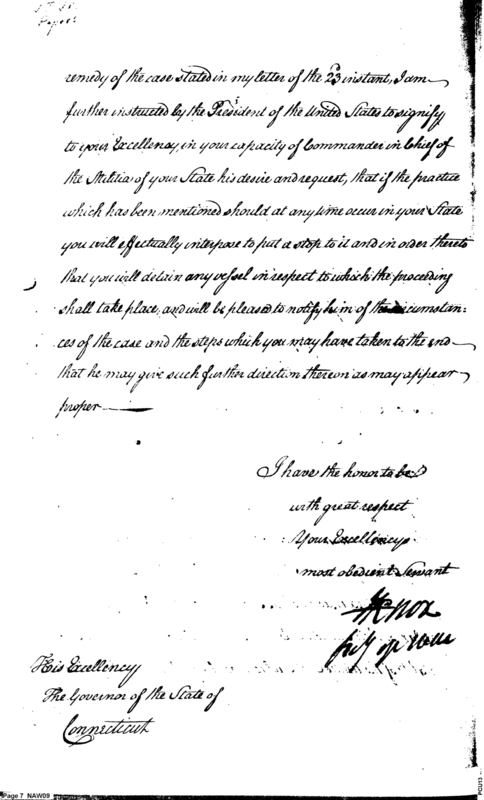
And inasmuch as such a proceeding by any of the parties at War, or their Subjects or Citizens is an infraction of the jurisdiction and rights of the United States, which would fall within the [undecipherable] remedy of the case Stated in my letter of the 23d instant, I am further instructed by the President of the United States to signify to your Excellency, in your capacity of Commander in Chief of the Militia of your State his desire and request, that if the practice which has been mentioned should at any time occur in your State you will effectually interpose to put a stop to it and in order thereto that you will detain any vessel in respect to which the proceeding shall take place, and will be pleased to notify him of the [undecipherable: probable reading 'circumstances'] of the case and the steps which you may have taken to the end that he may give such further direction thereon as may appear proper.—
I have the honor to be
with great respect
Your Excellency's
most obedient Servant
H Knox
[undecipherable]
His Excellency
The Governor of the State of
Connecticut
Type
Letter Signed
Description
Describes measures to prevent foreign arms and aggression; discusses fitting and manning vessels as privateers; discusses neutrality of United States; mentions militia.
Date
05/24/1793
Author
Recipient
Sent from
War Department
Repository
Collection
Document number
1793052405025
Page start
1
Note
Cited in Knox to Huntington, 08/07/1793. Circular letter from the Secretary of War to the State Governors. See Knox to Fenner, 05/24/1793, Knox to Lee 05/24/1793, Knox to Telfair, 05/24/1793, Knox to Huntington, 05/24/1793, and Knox to Clayton, 05/24/1793.
The second collection partially duplicates the first.
Notable persons
Samuel Huntington
Henry Knox
Governor of Connecticut
Notable locations
War Department
Charleston, South Carolina
United States
Connecticut
Notable items
proceeding by any of the parties at war or their subjects or citizens is an infraction of the jurisdiction and rights of the United States which
further instructed by the President of the United States to signify to your excellency in your capacity of commander in chief of the militia of your
detain any vessel in respect to which the proceeding shall take place
notify them of the circumstances of the case and the steps which you may have taken to the end that he may give such further direction thereon as may
deeming the toleration of such a practice to be inconsistent with the duties of neutrality and with the preservation of the peace of the nation
required by any treaty of the United States
concluded that effectual measures ought to be adopted and pursued to prevent a repetition of it
nature and tendency of such conduct
engaged his serious attention and deliberation
consequence of a representation to the president of the United states that lately at the port of Charleston in South Carolina two vessels were of one