No human transcription currently available for this document.
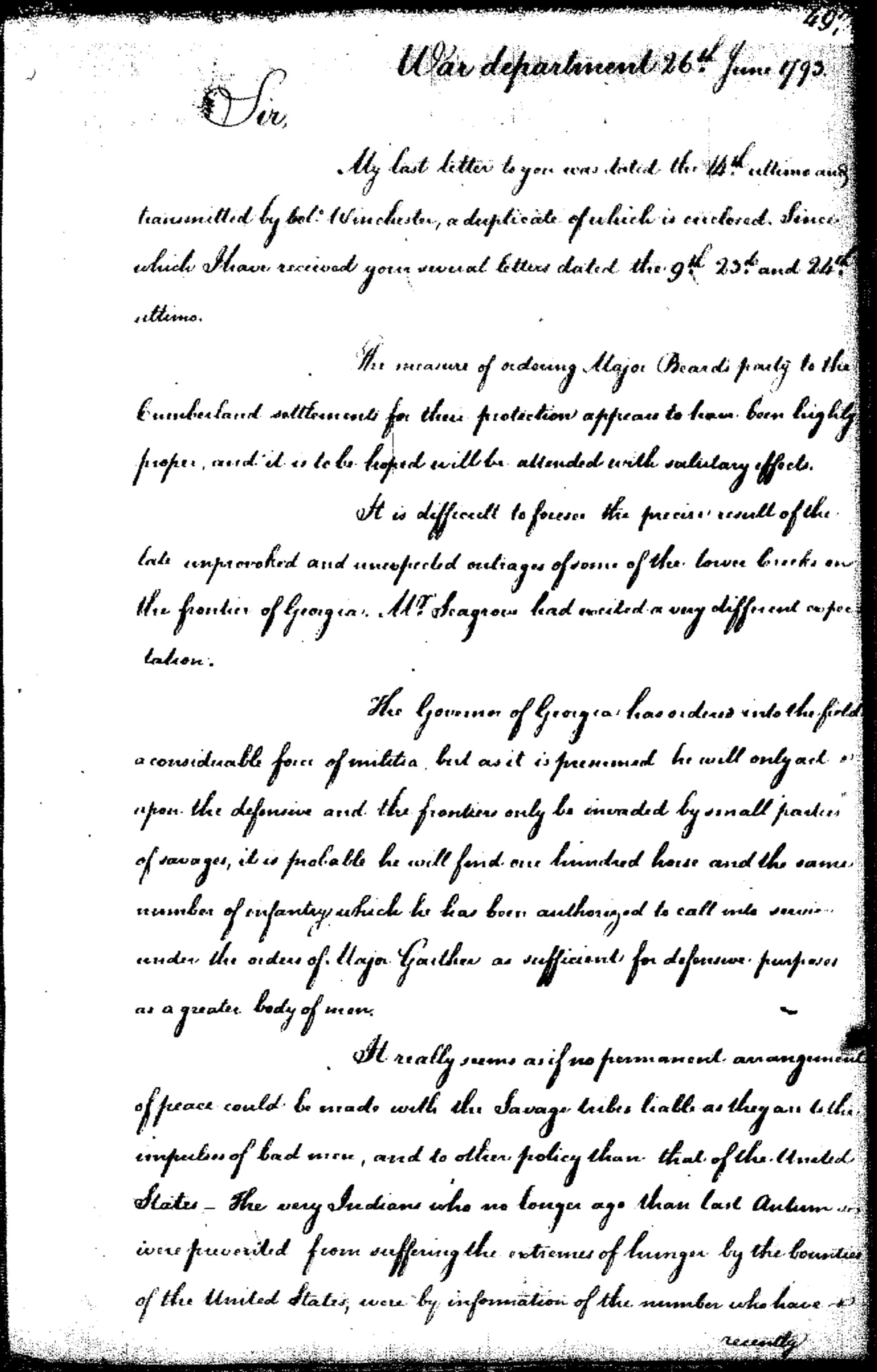
War department 26th June 1793
Sir,
My last letter to you was dated the 14th ultimo and transmitted by Col. Winchester, a duplicate of which is enclosed. Since which I have received your several letters dated the 9th 23d and 24th ultimo.
The measure of ordering Major Beard's party to the Cumberland settlements for their protection appears to have been highly proper, and it is to be hoped will be attended with salutary effects.
It is difficult to foresee the precise result of the late unprovoked and unexpected outrages of some of the lower Creeks on the frontier of Georgia. Mr Seagrove had excited a very different expectation.
The Governor of Georgia has ordered into the field a considerable force of militia but as it is presumed he will only act upon the defensive and the frontiers only be invaded by small parties of savages, it is probable he will find one hundred horse and the same number of infantry which he has been authorized to call into service under the orders of Major Gaither as sufficient for defensive purposes as a greater body of men.
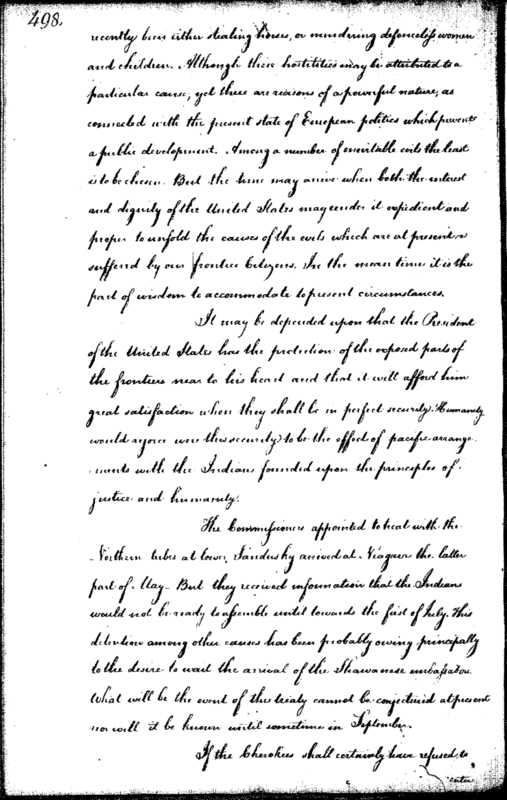
It really seems as if no permanent arrangement of peace could be made with the Savage tribes liable as they are to the impulses of bad men, and to other policy than that of the United States — The very Indians who no longer ago than last Autumn were prevented from suffering the extremes of hunger by the bounties of the United States, were by information of the number who have so recently been either stealing horses, or murdering defenceless women and children. Although these hostilities may be attributed to a particular cause, yet there are reasons of a powerful nature, as connected with the present state of European politics which prevents a public development. Among a number of inevitable evils the least is to be chosen. But the time may arrive when both the interest and dignity of the United States may render it expedient and proper to unfold the causes of the evils which are at present suffered by our frontier citizens. In the mean time it is the part of wisdom to accommodate to present circumstances.
It may be depended upon that the President of the United States has the protection of the exposed parts of the frontiers near to his heart and that it will afford him great satisfaction when they shall be in perfect security. Humanity would rejoice were this security to be the effect of pacific arrangements with the Indians founded upon the principles of justice and humanity.
The Commissioners appointed to treat with the Northern tribes at lower Sandusky arrived at Niagara the latter part of May. But they received information that the Indians would not be ready to assemble until towards the first of July. This detention among other causes has been probably owing principally to the desire to wait the arrival of the Shawanese ambassador. What will be the event of this treaty cannot be conjectured at present nor will it be known until sometime in September.
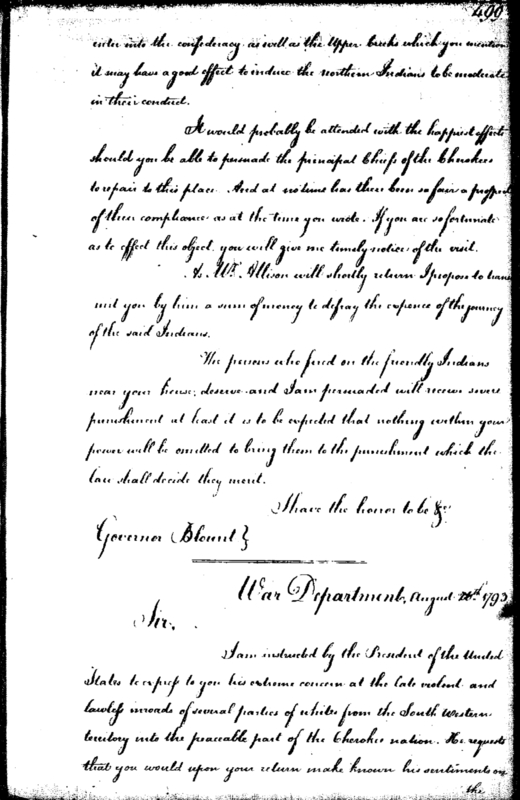
If the Cherokees shall certainly have refused to enter into the confederacy as well as the Upper Creeks which you mention it may have a good effect to induce the northern Indians to be moderate in their conduct.
It would probably be attended with the happiest effects should you be able to persuade the principal Chiefs of the Cherokees to repair to this place. And at no time has there been so fair a prospect of their compliance as at the time you wrote. If you are so fortunate as to effect this object, you will give me timely notice of the visit.
As Mr. Allison will shortly return I propose to transmit you by him a sum of money to defray the expense of the journey of the said Indians.
The persons who fired on the friendly Indians near your house, deserve and I am persuaded will receive severe punishment at least it is to be expected that nothing within your power will be omitted to bring them to the punishment which the law shall decide they merit.
I have the honor to be &c.
Governor Blount }