

Regarding the Brotherton settlers
Document 1793Letter, describes Brotherton settlers; alludes to Revolutionary War; discusses frontiers and pioneer life; asks for help establishing school; discusses remnants of Indian tribes; mentions White encroachment.



No human transcription currently available for this document.
This transcription was generated by machine using Anthropic's Claude Code (model sonnet 4.6). It may contain errors or inaccuracies. Please verify against the document image. Learn more about our generative AI methodology.
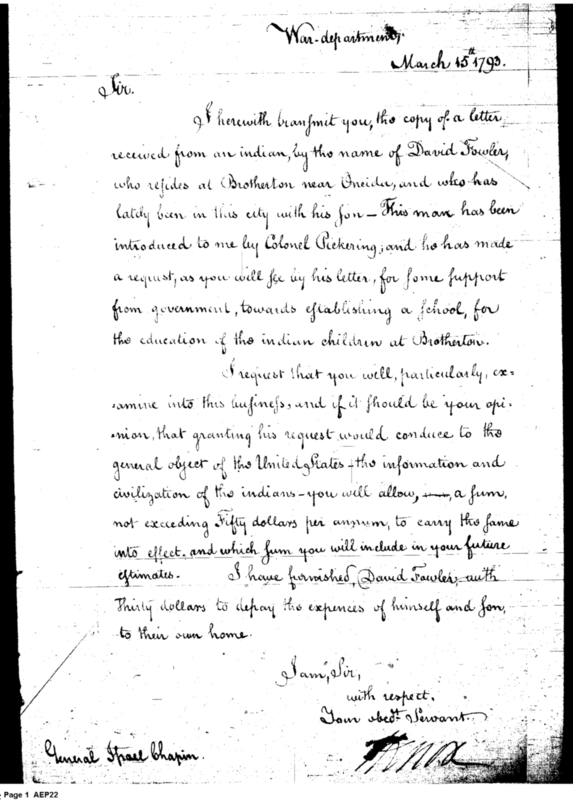
War department
March 16th 1793
Sir.
I herewith transmit you, the copy of a letter received from an indian, by the name of David Fowler, who resides at Brotherton near [undecipherable], and who has lately been in this city with his son — This man has been introduced to me by Colonel Pickering, and he has made a request, as you will see by his letter, for some support from government, towards establishing a school, for the education of the indian children at Brotherton.
I request that you will, particularly, examine into this business, and if it should be your opinion, that granting his request would conduce to the general object of the United States, the information and civilization of the Indians - you will allow, — a sum, not exceeding Fifty dollars per annum, to carry the same into effect, and which sum you will include in your future estimates. I have furnished David Fowler, with Thirty dollars to defray the expenses of himself and Son, to their own home
I am Sir,
with respect,
Your obet: Servant
[signature]
General Israel Chapin
[Copy]
Philadelphia
March 13 1793
Most Worthy Sir,
The inhabitants of Brotherton are one hundred and thirteen, who are already up there and those who are gone, and those that are going 37 perhaps there will be near seventy, and they are in general poor, some of those families who are up to Brotherton, who have no Children begin to live considerable comfortable but the rest are poor, we moving up so far has been very hard for many of us and some of us were driven off from our plantations and lost all — during late wars. This is another reason why we are so poor — This general poverty obliges us to ask the assistance of the United States in supporting a School for the education of our Children on like manner as the Stockbridge Indians our neighbours have been affected. We are more White Student from them —
The Subscriber and his Son have been travelling this [undecipherable] among the rem remnants of the tribes of Indians dwelling [undecipherable] at Brotherton. The land called Brotherton was given some years ago by the Oneidas in order to make an application to the Legislature of New York, to remove the White Intruders — This has put us to some expense and we shall be thankful for a small sum of money to enable us to travel home as soon as we shall be provided with an answer.
This is from
Your humble Serv
David Fowler
To the Honourable
the Secretary of War.
— Copy —
Type
Contemporary Copy of Letter
Description
Letter, describes Brotherton settlers; alludes to Revolutionary War; discusses frontiers and pioneer life; asks for help establishing school; discusses remnants of Indian tribes; mentions White encroachment.
Date
05/13/1793
Author
Recipient
Sent from
Philadelphia
Collection
Document number
1793051340101
Page start
3
Note
Enclosed in Knox to Chapin, 03/15/1793.
Image attached to this document is not correct
Notable persons
Henry Knox
David Fowler
Notable locations
Philadelphia
New York
New England
Stockbridge
Brotherton
Notable items
put us to some expence
thankful for a small sum of money to enable us to travel home
favored with an answer
subscriber and his son have been travelling thro New England among the remnants of the tribes of Indians dwelling
Oneidas
application to the legislature of New York to remove the white intruders
miles distant from them
general poverty obliges us to ask the assistance of the United States in supporting a school for the education of our children in like manner as the
some of those families who are up in Brotherton who have no children begin to live considerable comfortable
rest are poor
up so far makes it very hard for many of us
some of us were drove off from our plantations and lost all
late War
inhabitants of Brotherton are one hundred and thirteen who are already up there
they are in general poor