

Petitions of Hunt, Fox, and Bacon
Document 1793Knox reports on the petitions of Sergeant Isa Day and Private William Perkins who were in the Third Massachusetts Regiment. Arrears due them for pay were placed in hands of the Regimental Agent, who became bankrupt. Mentions the petitions of Thomas Hurrt, John Fox, and Henry Bacon as being the same.




No human transcription currently available for this document.
This transcription was generated by machine using Anthropic's Claude Code (model sonnet 4.6). It may contain errors or inaccuracies. Please verify against the document image. Learn more about our generative AI methodology.
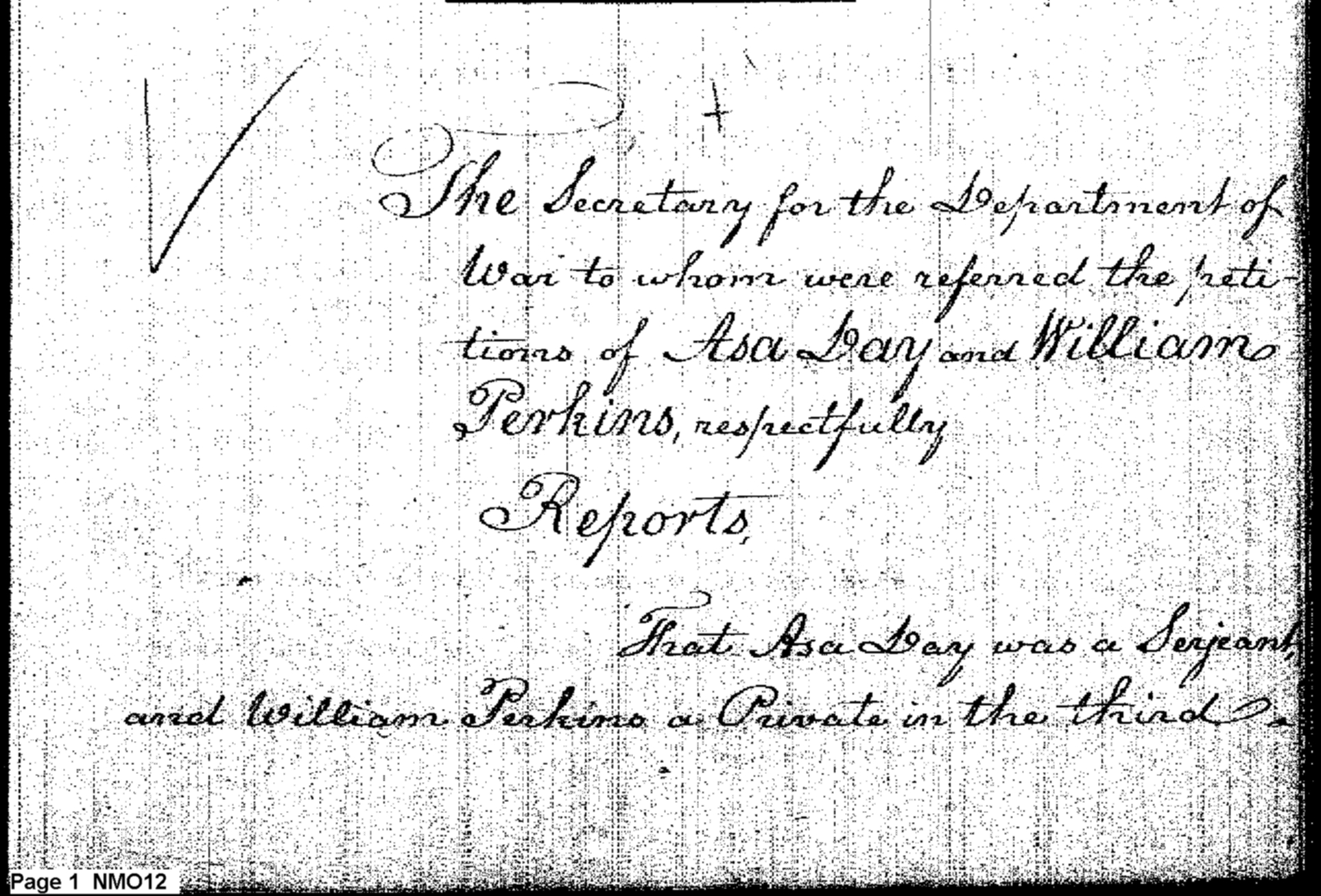
The Secretary for the Department of War to whom were referred the petitions of Asa Day and William Perkins, respectfully
Reports,
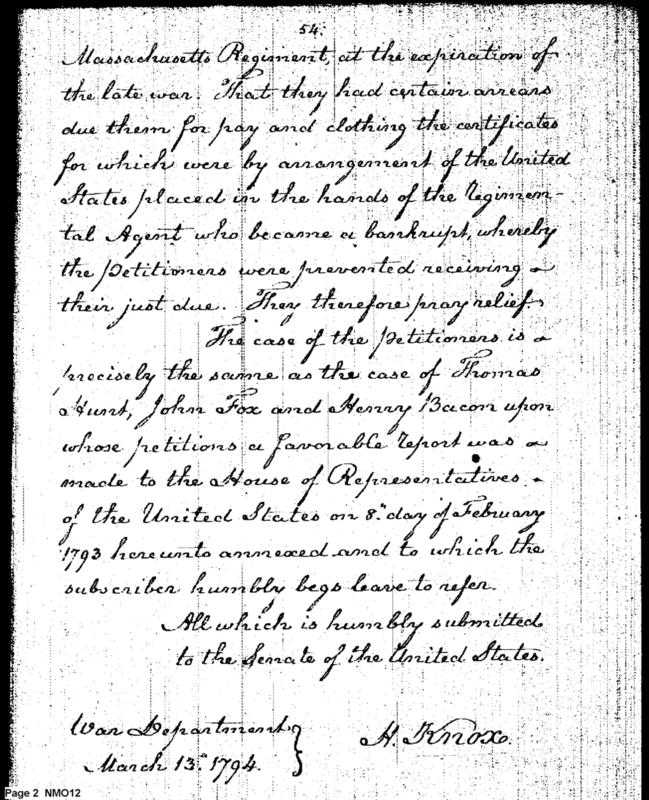
That Asa Day was a Serjeant and William Perkins a Private in the third Massachusetts Regiment, at the expiration of the late war. That they had certain arrears due them for pay and clothing the certificates for which were by arrangement of the United States placed in the hands of the Regimental Agent who became a bankrupt, whereby the Petitioners were prevented receiving their just due. They therefore pray relief.
The case of the Petitioners is precisely the same as the case of Thomas Hunt, John Fox and Henry Bacon upon whose petitions a favorable Report was made to the House of Representatives of the United States on 8.th day of February 1793 hereunto annexed and to which the subscriber humbly begs leave to refer.
All which is humbly submitted to the Senate of the United States.
War Department,
March 13.th 1794.
H. Knox.
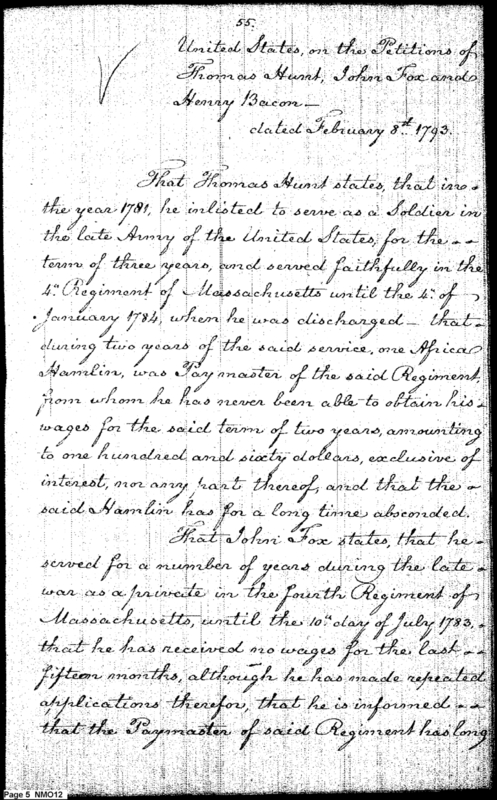
Extract from the Report of the Secretary of War, to the House of Representatives of the United States, on the Petitions of Thomas Hunt, John Fox and Henry Bacon —
dated February 8.th 1793.
That Thomas Hunt states, that in the year 1781, he inlisted to serve as a Soldier in the late Army of the United States, for the term of three years, and served faithfully in the 4.th Regiment of Massachusetts until the 4.th of January 1784, when he was discharged — that during two years of the said service, one Africa Hamlin, was Pay master of the said Regiment, from whom he has never been able to obtain his wages for the said term of two years, amounting to one hundred and sixty dollars, exclusive of interest, nor any part thereof, and that the said Hamlin has for a long time absconded.
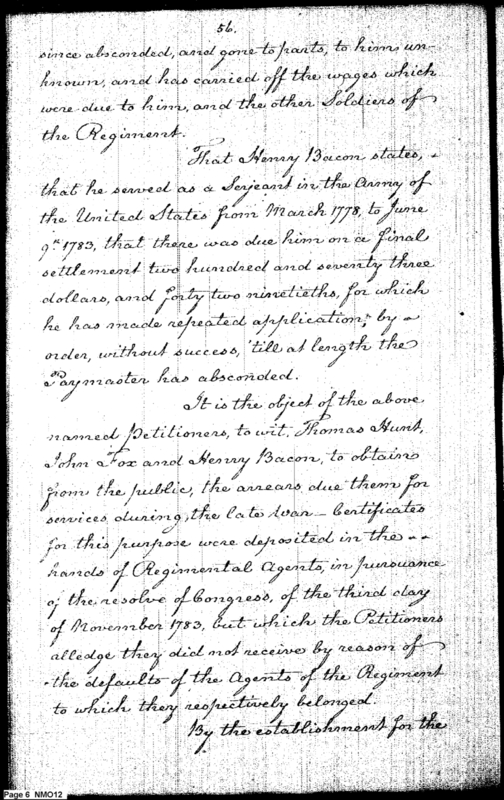
That John Fox states, that he served for a number of years during the late war as a private in the fourth Regiment of Massachusetts, until the 10.th day of July 1783, that he has received no wages for the last fifteen months, although he has made repeated applications therefor, that he is informed that the Paymaster of said Regiment has long since absconded, and gone to parts, to him unknown, and has carried off the wages which were due to him, and the other Soldiers of the Regiment.
That Henry Bacon states, that he served as a Serjeant in the Army of the United States from March 1778, to June 9.th 1783, that there was due him on a final settlement two hundred and seventy three dollars, and forty two ninetieths, for which he has made repeated application, by order, without success, 'till at length the Paymaster has absconded.
It is the object of the above named Petitioners, to wit, Thomas Hunt, John Fox and Henry Bacon, to obtain from the public, the arrears due them for services during the late war — Certificates for this purpose were deposited in the hands of Regimental Agents, in pursuance of the resolve of Congress, of the third day of November 1783, but which the Petitioners alledge they did not receive by reason of the defaults of the Agents of the Regiment to which they respectively belonged.
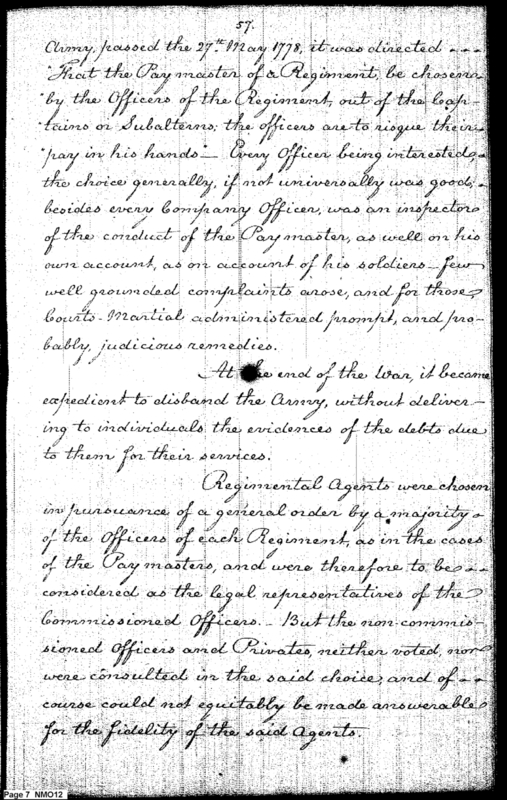
By the establishment for the Army, passed the 27.th May 1778, it was directed that the Pay master of a Regiment, be chosen by the Officers of the Regiment, out of the Captains or Subalterns; the officers are to risque their pay in his hands — Every Officer being interested, the choice generally, if not universally was good; besides every Company Officer, was an inspector of the conduct of the Pay master, as well on his own account, as on account of his soldiers — few well grounded complaints arose, and for those Courts-Martial administered prompt, and probably, judicious remedies.
At the end of the War, it became expedient to disband the Army, without delivering to individuals the evidences of the debts due to them for their services.
Regimental Agents were chosen in pursuance of a general order by a majority of the Officers of each Regiment, as in the cases of the Pay masters, and were therefore to be considered as the legal representatives of the Commissioned Officers. — But the non-commissioned Officers and Privates, neither voted, nor were consulted in the said choice, and of course could not equitably be made answerable for the fidelity of the said Agents.
It was directed by the before mentioned resolve of the 3.d day of November 1783. "That the Paymaster General deposit in the hands of Regimental Agents, the certificates for the arrears of pay due to the Officers and Soldiers of their respective lines, to be by them delivered to the individuals, to whom they belong, or deposited for their benefit as the supreme executive of the State, to which the respective Agents belong, shall direct." Some of the said Agents have proved unfaithful to their trust, and some of the non-commissioned and privates have thereby been prevented receiving their just dues.
Hence arises the question, whether the public are not obligated, by the principles of equity, to make good to such non commissioned officers and privates, as have suffered by the defaults of the said Regimental Agents, the arrears to which they are entitled.
It is difficult to perceive, by what just means the public can be exonerated from this obligation. — But in order to prevent abuse, it would require the greatest caution on the part of the officers of the Treasury. — It is therefore submitted with great deference, that the Comptroller of the Treasury, should be authorized to establish such rules in the premises, as may guard the public from further injury; and that the Register shall issue his certificates, for such sums, as shall be ascertained to be justly due to the Petitioners, or other persons, similarly circumstanced.
The foregoing is correctly copied from the records of the War Office
In.o Stagg Jun.r Chf Clk.
Type
Extract
Description
Knox reports on the petitions of Sergeant Isa Day and Private William Perkins who were in the Third Massachusetts Regiment. Arrears due them for pay were placed in hands of the Regimental Agent, who became bankrupt. Mentions the petitions of Thomas Hurrt, John Fox, and Henry Bacon as being the same.
Date
02/08/1793
Author
Document number
1793020800101
Page start
4
Note
Enclosed in Knox, 03/13/1794.
Notable persons
Henry Knox
Thomas Hunt
John Fox
Henry Bacon
soldier in the late Army of the United States
4th Regiment of Massachusetts
Africa Hamlin, Paymaster
regimental agents
Notable items
wages
interest
service during the late war
Sergeant
arrears due them