No human transcription currently available for this document.
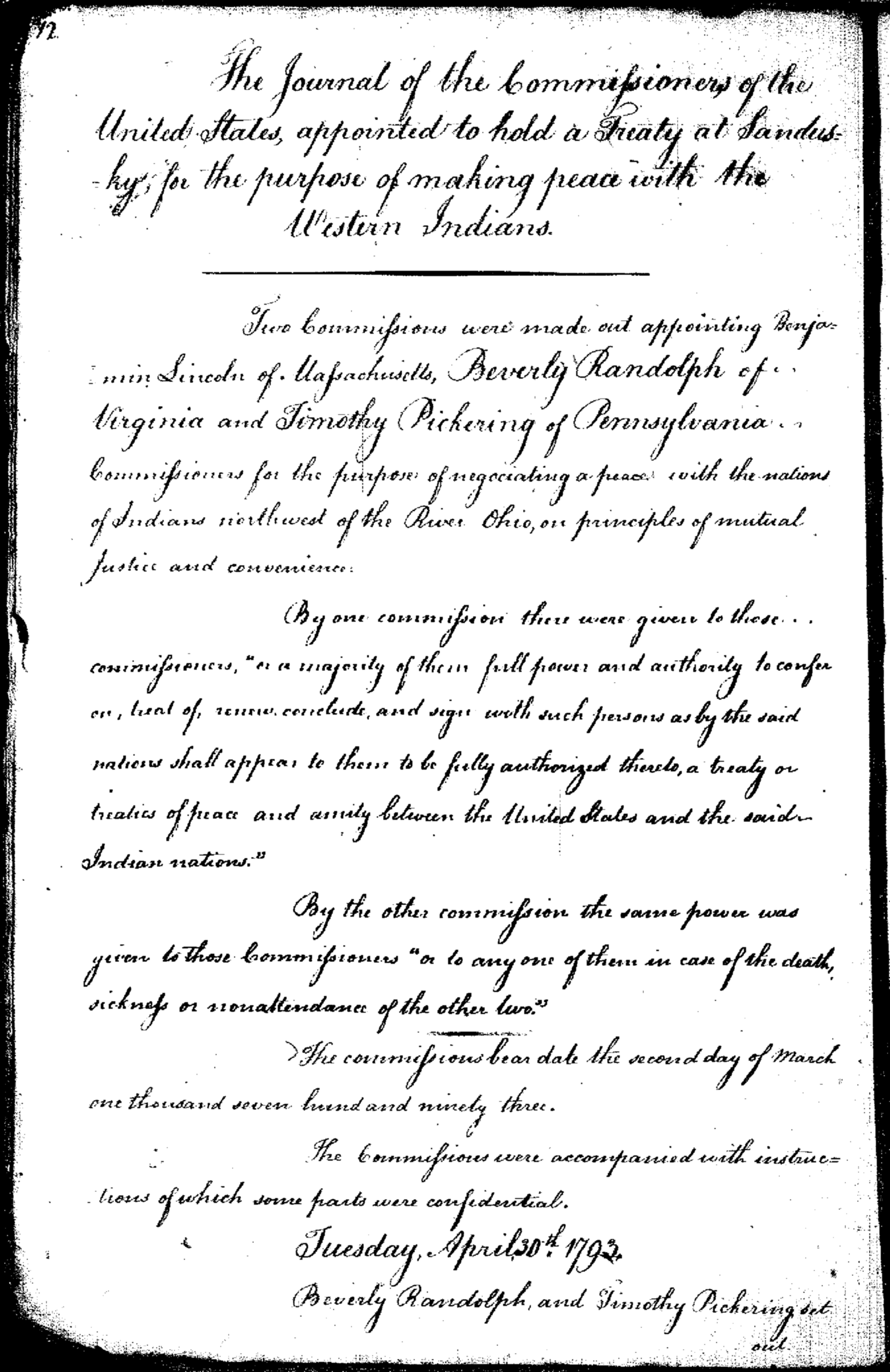
The Journal of the Commissioners of the United States, appointed to hold a Treaty at Sandusky, for the purpose of making peace with the Western Indians.
Two Commissions were made out appointing Benjamin Lincoln of Massachusetts, Beverly Randolph of Virginia and Timothy Pickering of Pennsylvania Commissioners for the purpose of negotiating a peace with the nations of Indians northwest of the River Ohio, on principles of mutual Justice and convenience.
By one commission there were given to these commissioners, "or a majority of them full power and authority to confer on, treat of, renew, conclude, and sign with such persons as by the said nations shall appear to them to be fully authorized thereto, a treaty or treaties of peace and amity between the United States and the said Indian nations."
By the other commission the same power was given to those Commissioners "or to any one of them in case of the death, sickness or nonattendance of the other two."
The commissions bear date the second day of March one thousand seven hundred and ninety three.
The Commissions were accompanied with instructions of which some parts were confidential.
Tuesday, April 30th 1793.
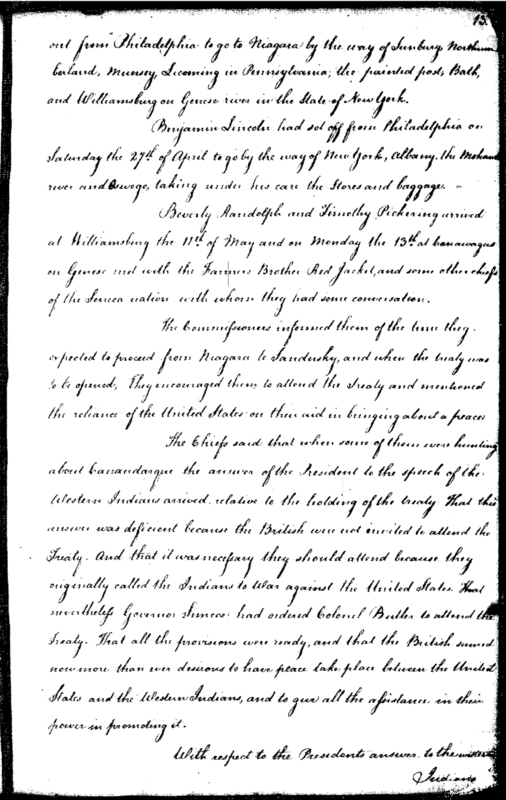
Beverly Randolph, and Timothy Pickering set out from Philadelphia to go to Niagara by the way of Sunbury, Northumberland, Munsey, Lecoming in Pennsylvania; the painted post, Bath, and Williamsburg on Genese river in the State of New York.
Benjamin Lincoln had set off from Philadelphia on Saturday the 27th of April to go by the way of New York, Albany, the Mohawk river and Oswego, taking under his care the Stores and baggage.
Beverly Randolph and Timothy Pickering arrived at Williamsburg the 11th of May and on Monday the 13th at Canawangus on Genese met with the Farmers Brother, Red Jacket, and some other chiefs of the Seneca nation with whom they had some conversation.
The Commissioners informed them of the time they expected to proceed from Niagara to Sandusky, and when the treaty was to be opened. They encouraged them to attend the treaty and mentioned the reliance of the United States on their aid in bringing about a peace.
The Chiefs said that when some of them were hunting about Canandaigua the answer of the President to the speech of the Western Indians arrived, relative to the holding of the treaty. That this answer was deficient because the British were not invited to attend the Treaty. And that it was necessary they should attend because they originally called the Indians to War against the United States. That nevertheless Governor Simcoe had ordered Colonel Butler to attend the treaty. That all the provisions were ready, and that the British seemed now more than ever desirous to have peace take place between the United States and the Western Indians, and to give all the assistance in their power in promoting it.
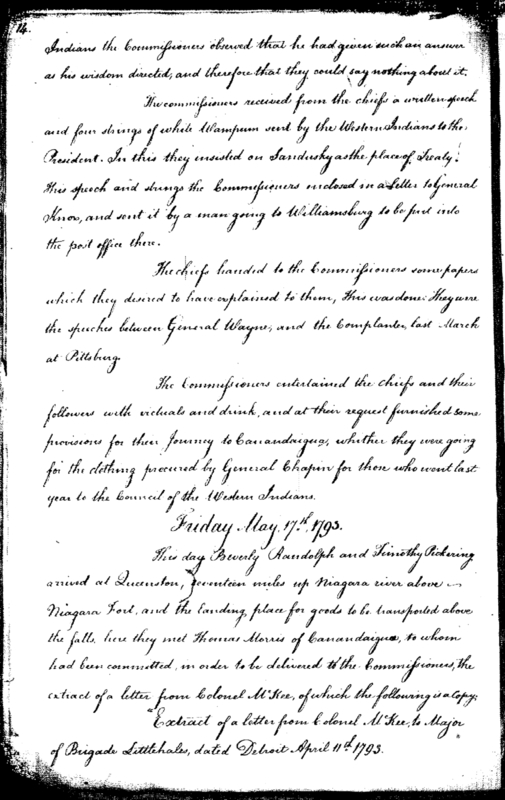
With respect to the Presidents answer to the western Indians the Commissioners observed that he had given such an answer as his wisdom directed, and therefore that they could say nothing about it.
The commissioners received from the chiefs a written speech and four strings of white Wampum sent by the Western Indians to the President. In this they insisted on Sandusky as the place of Treaty. This speech and strings the Commissioners enclosed in a Letter to General Knox, and sent it by a man going to Williamsburg to be put into the post office there.
The chiefs handed to the Commissioners some papers which they desired to have explained to them. This was done. They were the speeches between General Wayne, and the Complanter, last March at Pittsburg.
The Commissioners entertained the chiefs and their followers with victuals and drink, and at their request furnished some provisions for their journey to Canandaigua, whither they were going for the clothing procured by General Chapin for those who went last year to the Council of the Western Indians.
Friday May 17th 1793.
This day Beverly Randolph and Timothy Pickering arrived at Queenston, seventeen miles up Niagara river above Niagara Fort, and the landing place for goods to be transported above the falls. here they met Thomas Morris of Canandaigua, to whom had been committed, in order to be delivered to the Commissioners, the extract of a letter from Colonel McKee, of which the following is a copy;
"Extract of a letter from Colonel McKee, to Major of Brigade Littlehales, dated Detroit April 11th 1793.