

Consideration of Public Opinion and U.S. Reputation in Possible Indian War
Document 1793Knox expresses concern regarding the public's negative reaction to an Indian war and hopes that the current peace negotiations are successful. He fears that an Indian war will inevitably result in the destruction of the tribes and that will have an ill effect on the reputation of the US before the rest of the world.




No human transcription currently available for this document.
This transcription was generated by machine using Anthropic's Claude Code (model sonnet 4.6). It may contain errors or inaccuracies. Please verify against the document image. Learn more about our generative AI methodology.
Now I have all four pages. Let me compile the transcription carefully.
[No 34. From Major Genr Knox
See Glean.]
War department
January 5. 1793.
Sir, I have the honor to enclose a duplicate of my letter to you of the 28th ulti— and also to acknowledge the receipt of your letter [strikethrough: undecipherable] of the 28th December; inclosing the Cornplanter & New arrows speech of the 8th December and your second message of the 25th [undecipherable] to the Cornplanter and New arrow.
The messenger Mr Red Jacket left this place on the 13th ulti. It is much to be desired to receive further information on this interesting subject. The President is so anxious thereon that he has directed me to send in addition to your speech a special messenger for the Cornplanter; accordingly Col. Proctor will depart on the 6th instant for that purpose via Pittsburgh. I sincerely hope he will come as I believe much dependence may be placed upon the importance of the truth of his information. If he should come by the way of Pittsburgh Col. Proctor will wait upon you with— relying upon the truth of Mr Rosecrantz's evidence, the President has directed the message of the New arrow & Cornplanter to be laid before Congress this day.
Whatever the terms may be which shall be proposed at the Au Glaize the next spring the Government seems constrained to adopt the measure of the conference — We shall always possess the power of rejecting all unreasonable propositions — but the Sentiments of the great mass of the citizens of the United States are adverse on the extreme to an Indian War and altho these sentiments would not be considered as a sufficient cause for the Government to conclude an infamous peace, yet they are of such mature as to render it adviseable to embrace every expedient which may honorably terminate the conflict — the President of the United States is so conscious of their humaneness of motives to the Indians that his hopes of pacification are founded upon the opportunity of exhibiting those motives to the Indians and impressing them with the truth thereof. If the war continues the extirpation & destruction of the Indian tribes are inevitable — this is desired to be avoided, as the honor of future reputation of the country is more intimately blended therewith than is generally supposed —
The favorable opinion and piety of the world is easily excited in favor of the oppressed. The Indians are considered in a great degree of this description. If our mode of population & war destroy the tribes the adventuress part of mankind and posterity will be apt to class the effects of our conduct and that of the Spaniards in Mexico & Peru together —
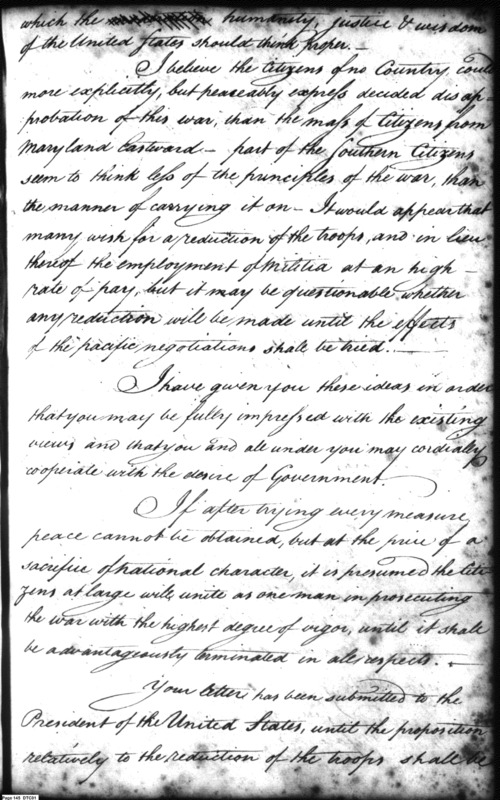
It is considered that were a foundation of intercourse once laid in peace & friendship that almost any fabric might be raised thereon which the [undecipherable] humanity, justice & wisdom of the United States should think proper.
I believe the citizens of no Country could more explicitly, but peaceably express decided disapprobation of this war, than the mass of citizens from Maryland Eastward — part of the Southern Citizens seem to think less of the principles of the war, than the manner of carrying it on — It would appear that many wish for a reduction of the troops, and in lieu thereof the employment of Militia at an high rate of pay, but it may be questionable whether any reduction will be made until the effects of the pacific negotiations shall be tried.
I have given you these ideas in order that you may be fully impressed with the existing views and that you and all under you may cordially cooperate with the views of Government.
If after trying every measure, peace cannot be obtained, but at the price of a sacrifice of national character, it is presumed the citizens at large will unite as one man in prosecuting the war with the highest degree of vigor, until it shall be advantageously terminated in all respects.
Your letter has been submitted to the President of the United States, until the proposition relatively to the reduction of the troops shall be
Type
Recipient's Letterbook Copy
Description
Knox expresses concern regarding the public's negative reaction to an Indian war and hopes that the current peace negotiations are successful. He fears that an Indian war will inevitably result in the destruction of the tribes and that will have an ill effect on the reputation of the US before the rest of the world.
Date
01/05/1793
Author
Recipient
Sent from
War Department
Repository
Collection
Document number
1793010513055
Page start
142
Note
Cited in Wayne to Knox, 01/15/1793.\
Spans Images 142-147 of this collection.
Notable persons
Anthony Wayne
Henry Knox
the Cornplanter
New Arrow
Red Jacket
the President
Col. Proctor
Mr. Rosecrantz
Congress
Citizens of the United States
Indian tribes
Spaniards
Southern citizens
recruiting officers
Major Asheton
Mr. Britt who is acting paymaster
old first regiment
Major Rudolph
Quartermaster General
Secretary of the Treasury
the Army
Comptroller
Capt Kersey
Capt. Slough
Notable locations
War Department
Pittsburgh
Auglaize
Mexico
Peru
Maryland
Lancaster
Legionville
Notable items
Cornplanter & New Arrow's speech
truth of Mr. Rosecrantz's evidence
sentiments of the great mass of the Citizens of the United States
Indian war
infamous peace
fair & humane motives to the Indians
hopes of pacification
favorable opinion and pity of the world
the oppressed
our mode and population
disapprobation of this war
reduction of the troops
employment of militia
high rate of pay
pacific negotiations
peace
price of a sacrifice of national character
pay belonging to the troops
the want of the paymaster at headquarters