

President's Opinion on Frontier Protection
Document 1792Discussed President's opinion for protecting frontier using Block Houses and how to staff them. Updates on General Wayne.
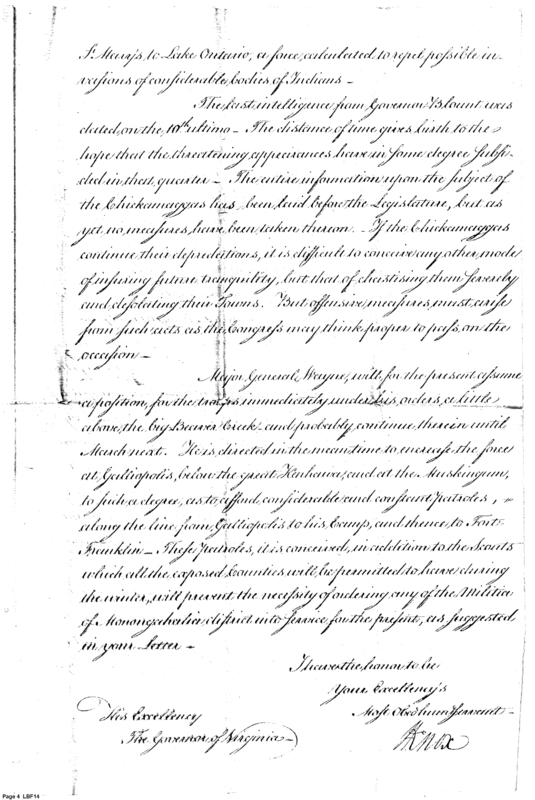
No human transcription currently available for this document.
This transcription was generated by machine using Anthropic's Claude Code (model sonnet 4.6). It may contain errors or inaccuracies. Please verify against the document image. Learn more about our generative AI methodology.
[Letter from the Secretary at War
November 24]
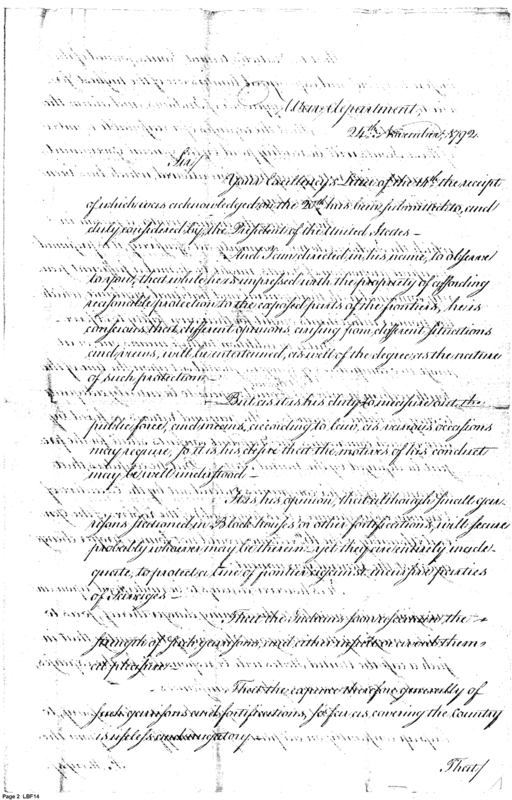
War Department
14th November 1792
Sir,
Your Excellency's letter of the [4th] the receipt of which was acknowledged on the [7th] has been submitted to, and duly considered by the President of the United States —
The President [laments] to say that while he is inspired with the propriety of affording respectable protection to the exposed parts of the frontiers, he is convinced that different opinions [are entertained] as to [the most proper means of affording] different situations and various, and sometimes [a variety] of the degree [and] nature of such protection —
[strikethrough: [undecipherable] [undecipherable] not [undecipherable] [undecipherable] [undecipherable] [undecipherable] [undecipherable] [undecipherable] [undecipherable] [undecipherable] [undecipherable]]
But as it is his duty to manifest to the public force and means according to law as various conjunctions may require, so it is his desire that the motives of his conduct may be well understood.
It is his opinion that although [small] garrisons stationed in block houses or other fortifications, will probably wherever may be therein, yet [they are not] quite [adequate] to protect [the] frontier [and their] frontier parties —
That the Indians from [undecipherable] [by means of] those garrisons and other [obstacles] return —
That the expence therefore generally of such garrisons and fortifications, so far as covering the country is [entirely] [undecipherable] —
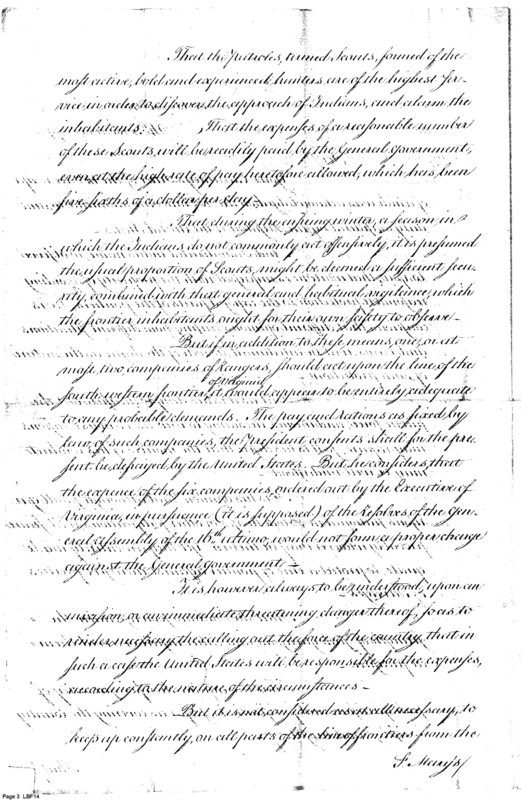
That the [practice] to [maintain] scouts found of the most active, bold and experienced hunters are of the highest service in order to discover the approach of Indians, and alarm the inhabitants —
That the expence of a reasonable number of these scouts will be readily paid by the general government, [except] the highest of pay [therefore] allowed, which has been [five sixths of a dollar per] day —
That during the [ensuing] winter, a season in which the Indians do not commonly act offensively, it is [proposed] the [usual] proportion of scouts, might be deemed a sufficient [security] combined with that general and habitual vigilance which the frontier inhabitants ought [to maintain] —
But if in addition to those means, one or at most two companies of Rangers, should act upon the line of the [south] western frontier [as shall] appear to be entirely adequate to any probable demands. The pay and rations as fixed by law of such companies, the President [confides] shall for the present be defrayed by the United States. But [he considers] that the expence of the six companies ordered out by the Executive of Virginia, [and perhaps] (as is supposed) of the [?] of the [?] citizens, would not form a proper charge against the General government —
It is however always to be understood, upon an occasion as an immediate threatening danger thereof, so as to render [insufficient] the [delay and] the laws of the country, that in such a case the United States will be responsible for the expences, [?] according to the nature of the circumstances —
But it is not considered necessary, to keep up constantly on all parts of the frontier parties from St. Mary's to Lake Ontario, a line calculated to repel [people] in regions of considerable bodies of Indians —
The last intelligence from Governor Blount was [dated] on the [10th] ultimo — The distance of time gives birth to the hope that the threatening appearances have in some degree [subsided] in that quarter — The entire information upon the subject of the Chickamaugas has been laid before the Legislature, but as yet no measures have been taken thereon — If the Chickamaugas continue their depredations, it is difficult to conceive any other mode of ensuring future tranquility, but that of chastising them severely and [depopulating] their towns — But offensive measures must arise from such acts as the Congress may think proper to pass on the occasion —
Major General Wayne, will for the present assume a position for the troops immediately under his order, a little above the Big Beaver Creek, and probably continue therein until March next. He is directed in the meantime to encamp the force at Gallipolis, below the great Kenhawa, and at the Muskingum, to such a degree as to afford comfortable and confident protection — along the line from Gallipolis to his troop, and thence to Fort Franklin — [Those] positions, it is conceived, in addition to the scouts which all the exposed counties will be permitted to have during the winter, will prevent the necessity of ordering any of the Militia of [Monongalia] into service for the present, as suggested in your letter —
I have the honor to be
Your Excellency's
Most Obedient Servant
H. Knox
His Excellency
The Governor of Virginia —
Type
Autograph Letter Signed
Description
Discussed President's opinion for protecting frontier using Block Houses and how to staff them. Updates on General Wayne.
Date
11/24/1792
Author
Recipient
Sent from
War Department
Document number
1792112413101
Notable persons
Henry Lee
Henry Knox
Anthony Wayne
Governor Blount
Indians
Indian Nation
Chiccamaga
hostiles
rangers
scouts
spies
spy
Secretary of War
President of United States
George Washington
savages
Virginia Executive
Chickamagua
Major General Wayne
miliitia
Notable locations
War Department
Virginia
towns
frontier
settlements
Muskingum
Kenhawa
Gallipolis
Fort Franklin
Monongahlia
Monongahela
Notable items
protection
offensive
defensive
block houses
fortifications
expenses
pay
rations
expenses
resolves of general assembly
intelligence
depredation