

Conditions of U.S. Treaty with Six Nations
Document 1792Formal invitation to Brandt to sit on General Council as Chief of Six Nations. Document explains the U.S. stance on hostile Indians, hopes Brandt will convey sentiments to Indians.
No human transcription currently available for this document.
This transcription was generated by machine using Anthropic's Claude Code (model sonnet 4.6). It may contain errors or inaccuracies. Please verify against the document image. Learn more about our generative AI methodology.
Now I have all the images. Let me compile the transcription from the primary source copy (pages 1–4, DCD03).
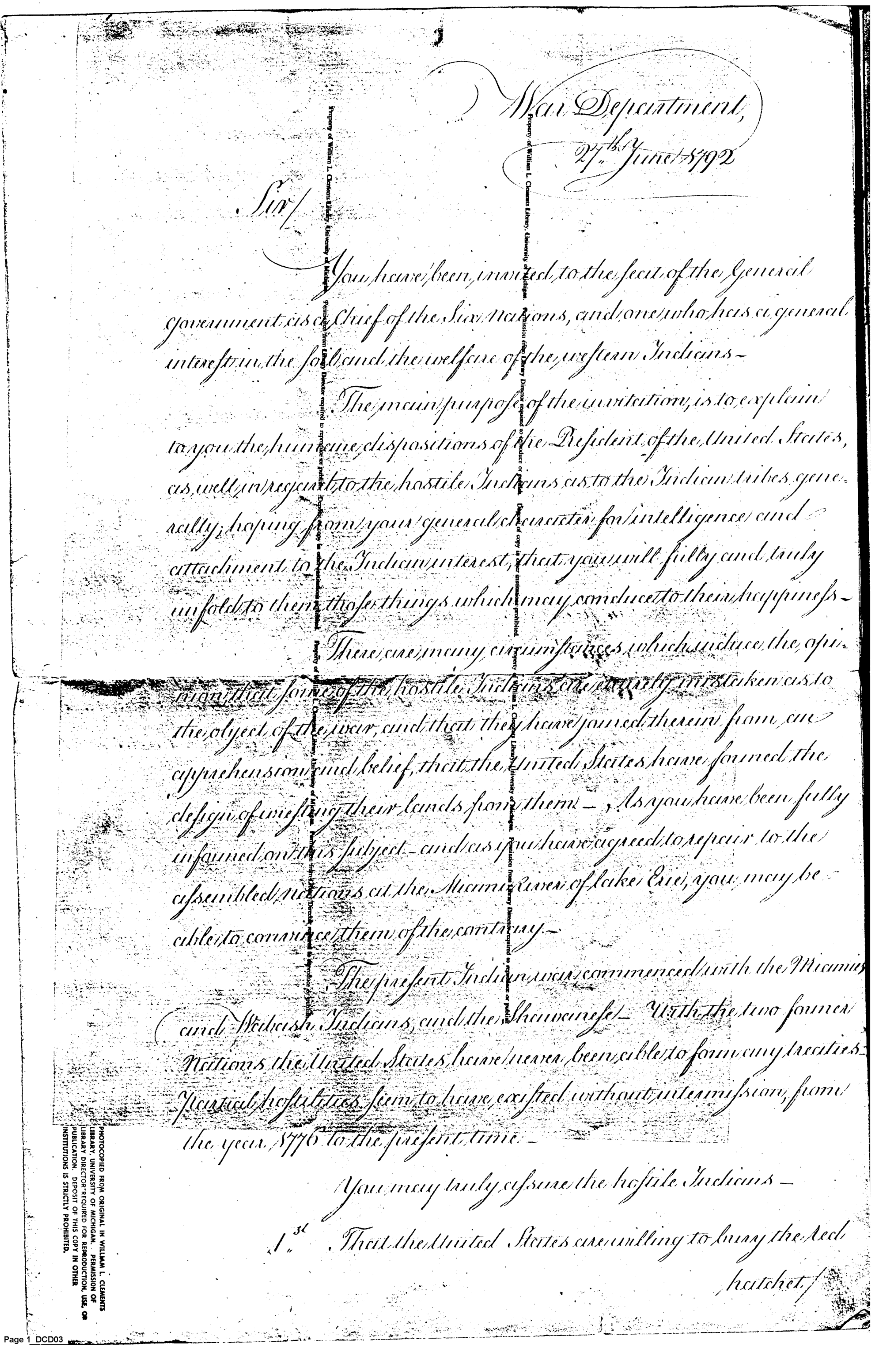
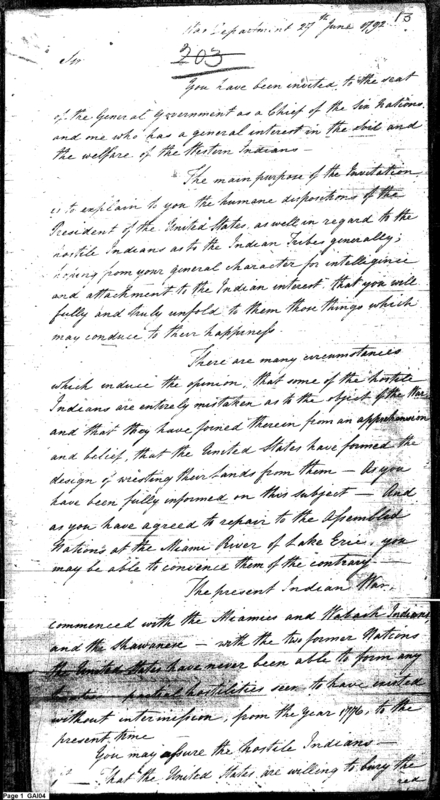
War Department,
27th June 1792
Sir/
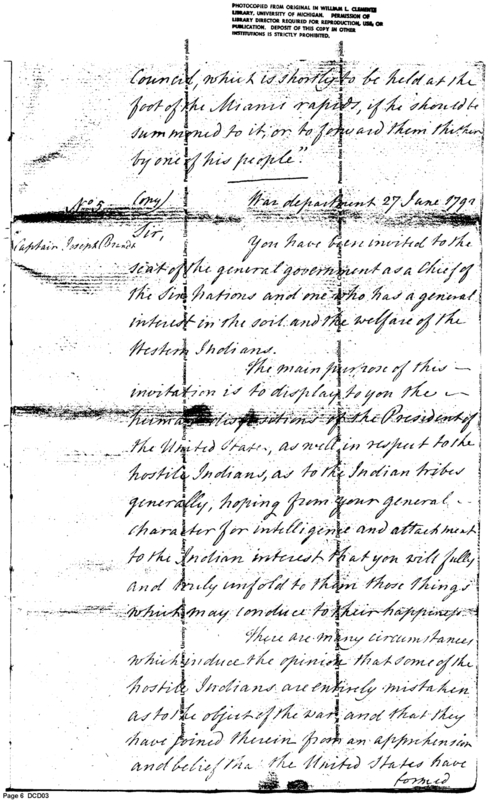
You have been invited to the seat of the General government as a Chief of the Six Nations, and one who has a general interest in the soil and the welfare of the western Indians —
The main purpose of the invitation, is to explain to you the humane dispositions of the President of the United States, as well in regard to the hostile Indians as to the Indian tribes generally; hoping from your general character for intelligence and attachment to the Indian interest, that you will fully and truly unfold to them those things which may conduce to their happiness —
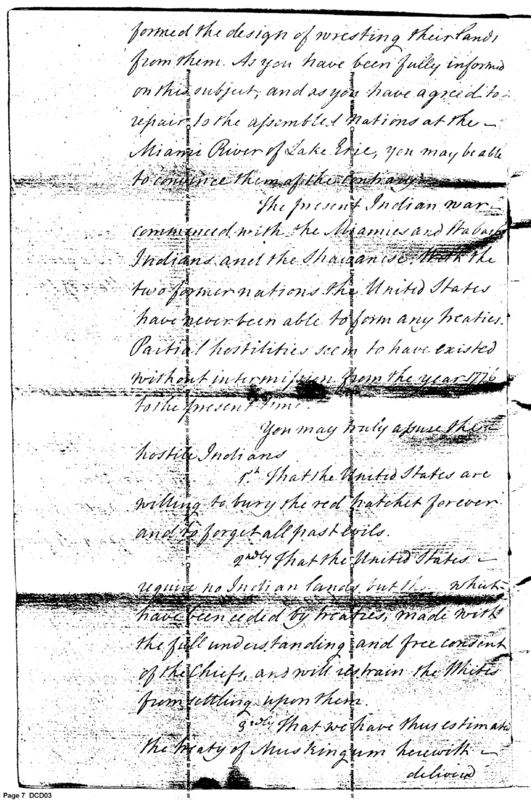
There are many circumstances which induce the opinion, that some of the hostile Indians are entirely mistaken as to the object of the war, and that they have joined therein from an apprehension and belief, that the United States have formed the design of wresting their lands from them — As you have been fully informed on this subject — and as you have agreed to repair to the assembled nations at the Miami River of Lake Erie, you may be able to convince them of the contrary —
The present Indian war commenced with the Miamis and Wabash Indians, and the Shawnees — With the two former Nations the United States have never been able to form any treaties — Partial hostilities seem to have existed without intermission, from the year 1776 to the present time —
You may truly assure the hostile Indians —
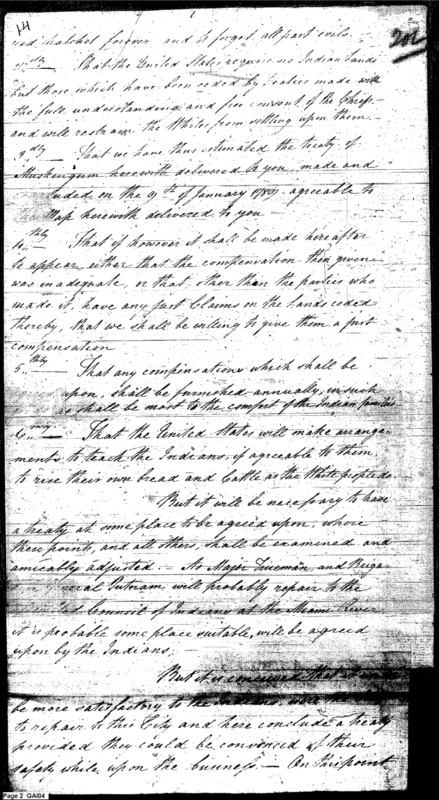
1.st That the United States are willing to bury the red hatchet forever; and to forget all past evils —
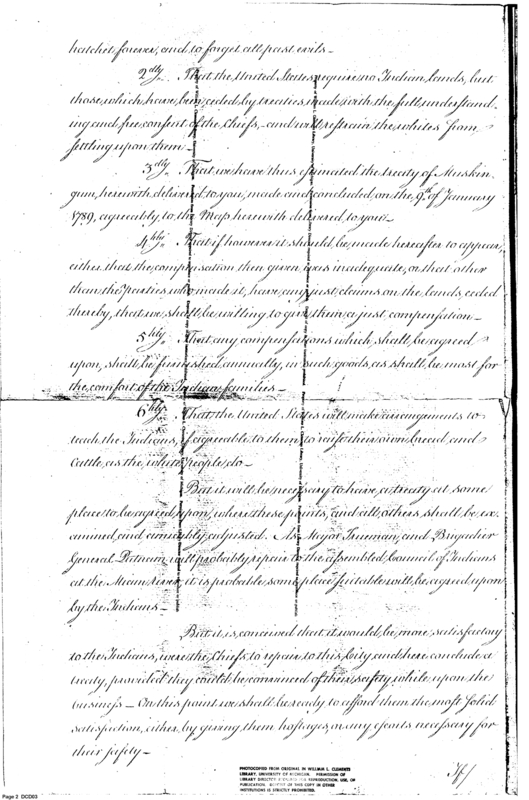
2dly That the United States require no Indian lands, but those which have been ceded by treaties made with the full understanding and free consent of the Chiefs, — and will restrain the whites from settling upon them —
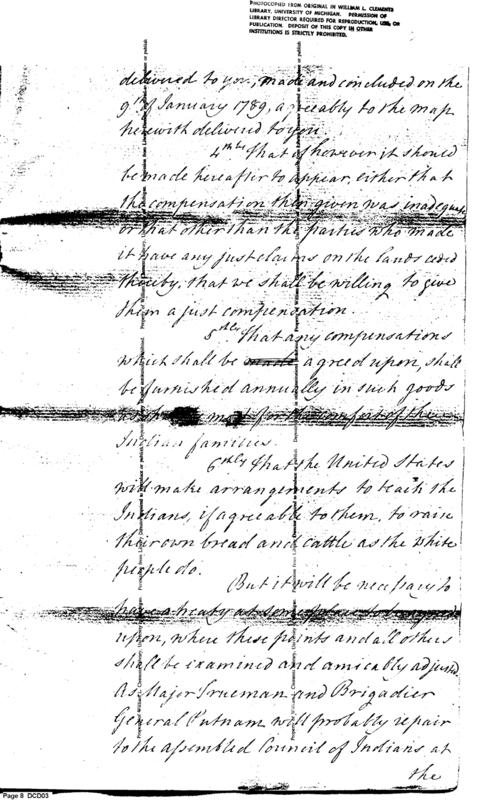
3dly That we have thus estimated the treaty of Muskingum, herewith delivered to you, made and concluded on the 9th of January 1789, agreeably to the Map herewith delivered to you —
4hly That if however it should be made hereafter to appear, either that the compensation then given was inadequate, or that other than the parties who made it, have any just claims on the lands ceded thereby, that we shall be willing to give them a just compensation —
5hly That any compensations which shall be agreed upon, shall be furnished annually, in such goods, as shall be most for the comfort of the Indian families —
6hly That the United States will make arrangements to teach the Indians, if agreeable to them, to raise their own bread and Cattle, as the white people do —
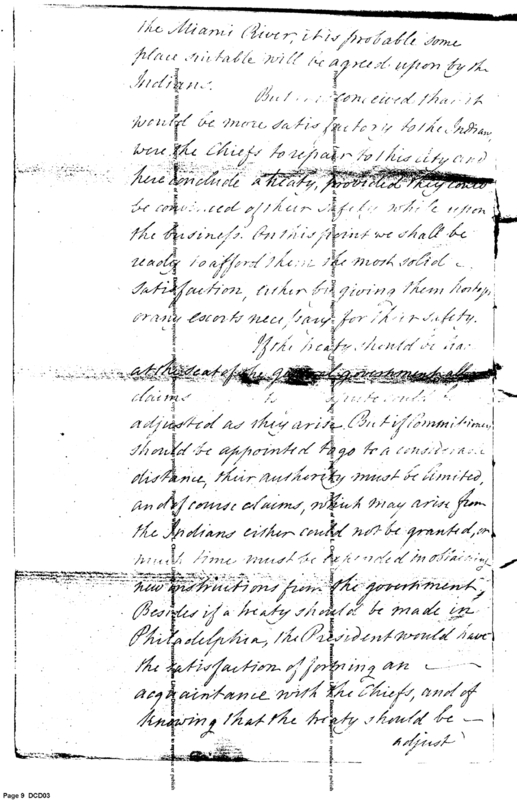
But it will be necessary to have a treaty at some place to be agreed upon, where these points, and all others, shall be examined, and amicably adjusted. As Major Trueman, and Brigadier General Putnam will probably repair to the assembled Council of Indians at the Miami River, it is probable some place suitable will be agreed upon by the Indians —
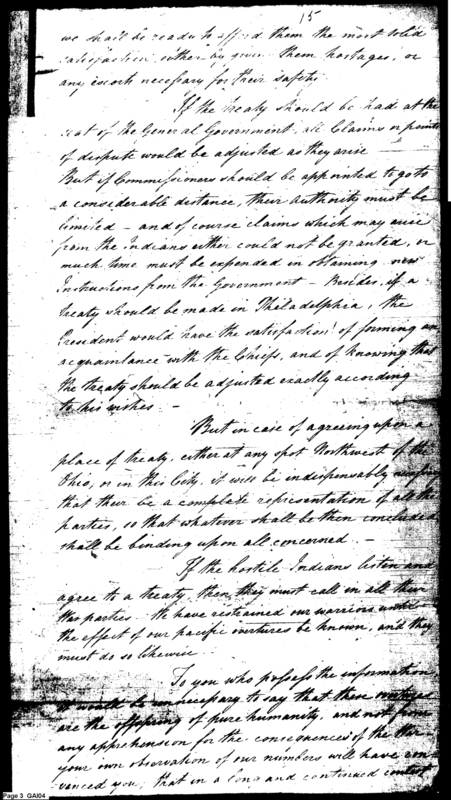
But it is conceived that it would be more satisfactory to the Indians, were the Chiefs to repair to this City and there conclude a treaty, provided they could be convinced of their safety while upon the business — On this point we shall be ready to afford them the most solid satisfaction, either by giving them hostages, or any escorts necessary for their safety —
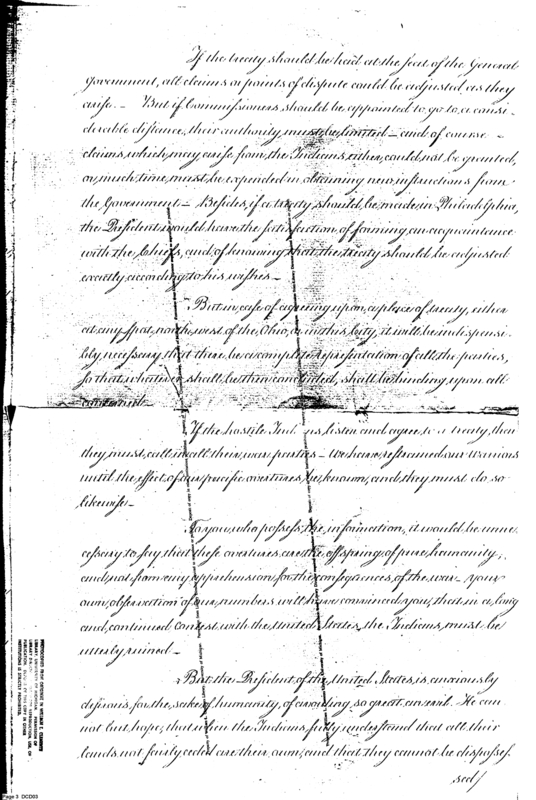
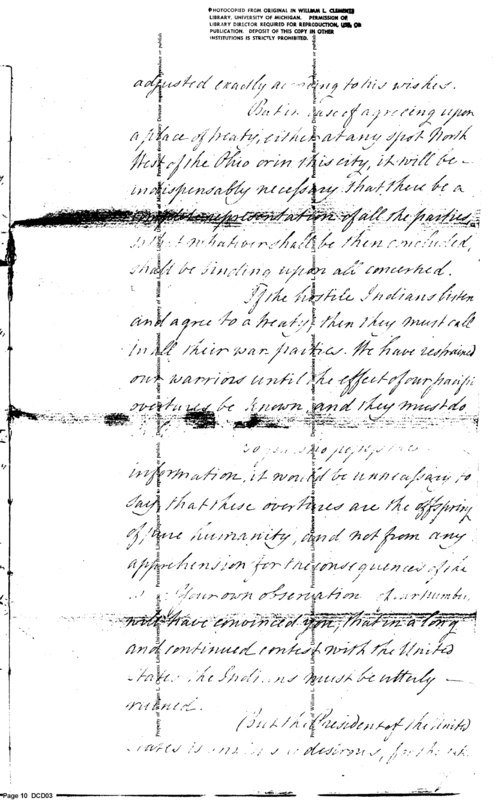
If the treaty should be had at the seat of the General Government, all claims or points of dispute could be adjusted as they arise — But if Commissioners should be appointed to go to a considerable distance, their authority must be limited — and of course claims which may arise from the Indians either could not be granted, or much time must be expended in obtaining new instructions from the Government — Besides, if a treaty should be made in Philadelphia, the President would have the satisfaction of forming an acquaintance with the Chiefs, and of knowing that the treaty should be adjusted exactly according to his wishes —
But in case of agreeing upon a place of treaty, either at any spot north west of the Ohio, or in this City, it will be indispensably necessary that there be a complete representation of all the parties, so that whatever shall be then concluded, shall be binding upon all concerned —
If the hostile Indians listen and agree to a treaty, then they must call in all their war parties — We have restrained our warriors until the effect of our pacific overtures be known, and they must do so likewise —
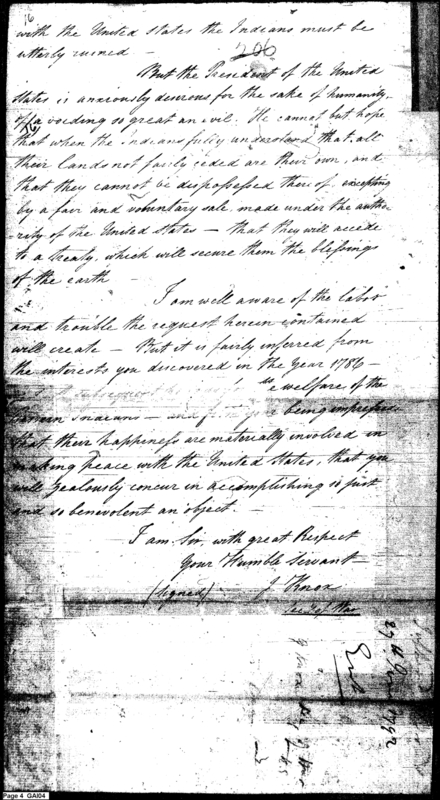
To you, who possess the information, it would be unnecessary to say, that these overtures are the offspring of pure humanity, and not from any apprehensions for the consequences of the war — Your own observation of our numbers will have convinced you, that in a long and continued contest with the United States, the Indians must be utterly ruined —
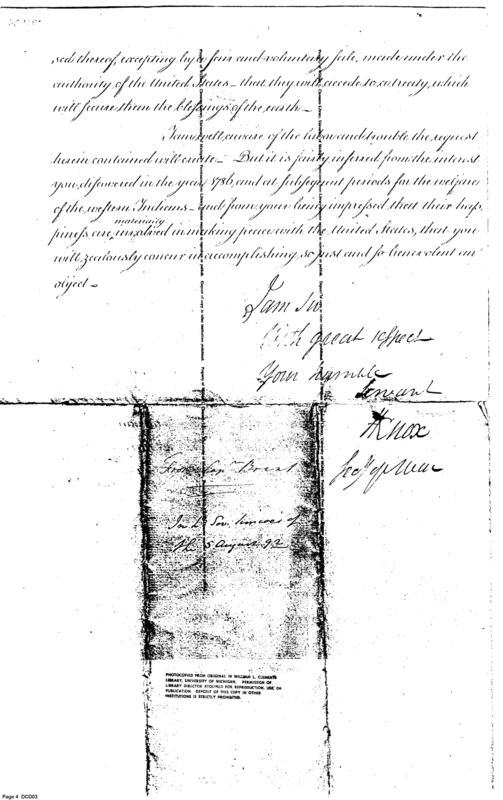
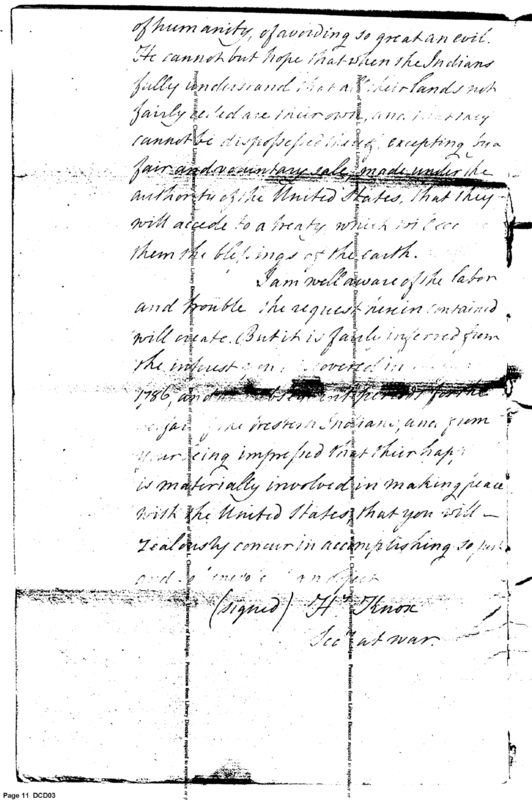
But the President of the United States is anxiously desirous for the sake of humanity, of avoiding so great an evil. He can not but hope, that when the Indians fully understand that all their lands not fairly ceded are their own; and that they cannot be dispossessed thereof, excepting by a fair and voluntary sale, made under the authority of the United States — that they will accede to a treaty, which will secure them the blessings of the earth —
I am well aware of the labor and trouble the request herein contained will create — But it is fairly inferred from the interest you discovered in the year 1786, and at subsequent periods for the welfare of the western Indians — and from your being impressed that their happiness are materially involved in making peace with the United States, that you will zealously concur in accomplishing so just and so benevolent an object —
I am Sr
With great respect
Your humble servant
Knox
Secy of War
[From Ind. Brant]
[In the Sov. [undecipherable]]
[Pha 5 Augt 92]
Type
Document Signed
Description
Formal invitation to Brandt to sit on General Council as Chief of Six Nations. Document explains the U.S. stance on hostile Indians, hopes Brandt will convey sentiments to Indians.
Date
06/27/1792
Author
Recipient
Sent from
War Department
Repository
Collection
Document number
1792062700001
Page start
1
Note
This document "other copy" was obtained by Hammond, Butch minister to the United States and copied into a dispatch [dictator unknown] to Lord Greenville.
Notable persons
Joseph Brandt
Henry Knox
Six Nations
Indian Nation
Indians
tribe
hostile Indians
Miamis
Wabash
Shawneses
whites
settlers
Notable locations
War Department
territory
frontier
lands
border
boundary
Miami River
Lake Erie
Muskingum
Notable items
treaty
red hatchet
Treaty of Muskingum