

Report on St. Clair's Expedition
Document 1792Report from the House of Representatives on Arthur St. Clair's expedition. Discusses training and discipline of recruits; desertions of militia; retreat of St. Clair's force; Indians and Indian warfare; recruiting service.





No human transcription currently available for this document.
This transcription was generated by machine using Anthropic's Claude Code (model sonnet 4.6). It may contain errors or inaccuracies. Please verify against the document image. Learn more about our generative AI methodology.
Now I have all six images. Let me produce the complete transcription.
[undecipherable: the] reasons for the discharge of the [undecipherable: levies] without their pay stipulation pay not contained in the only report, admitting [undecipherable] was to be correct, he now add that at the time of their discharge the Qr master Genl. had in his hands $16,292,70/100 subject to be applied as St. Clair might direct; and [he] might have applied the money to pay the levies, which would have given 2 mos to the officers & 4 mos to the men – Hodgdon [states] says he had money so to pay [of] St. Clair had ordered which he did not do. The Qr master [states] had over "no [undecipherable] on hand – $5[00] as he wrote to St. Clair for reg troops, if he shd deem that a proper application, wh – he did not do – The commander was subject to St. Clair's Contract – & the master was authorized to draw bills on [undecipherable] without restriction – all he drew were honored by [the]
[There was no requisition [undecipherable] performed [undecipherable] & he sent [undecipherable] in our [undecipherable] Yr]
As to this question it seems to [J. H.] to have been a matter between Hodgdon & St. Clair not [undecipherable] the [undecipherable].
The levies were engaged for 6 mos from [undecipherable: arrival] at Fort Washington and the payment was on the [undecipherable] of 6 mos – but that condition the Committee say was dispensed within [undecipherable] but they do not say by who – if condition was dispensed within there was no copying wrong designed nor any reason to charge the with any criminal neglect
[i.e. 6 mos from arrival at Fort Washington]
Except what changes the Committee have made in the report they enclose to the orig–
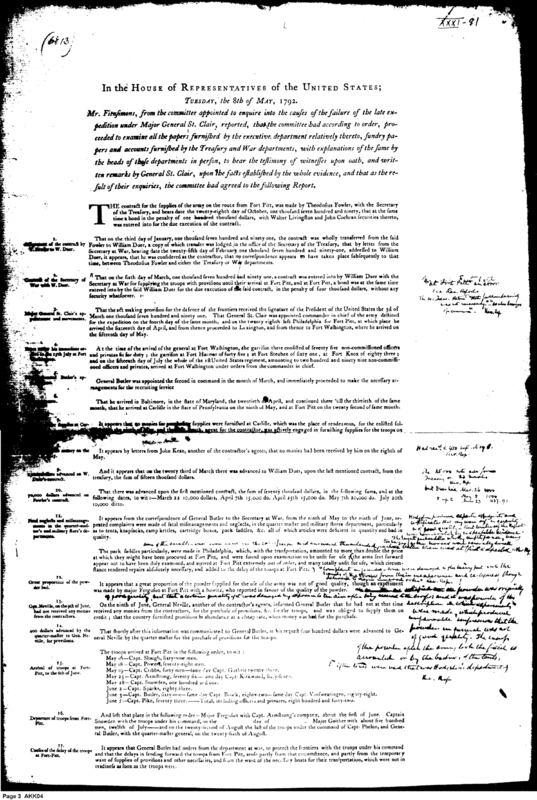
In the House of Representatives of the United States;
Tuesday, the 8th of May, 1792.
*Mr. Fitsimons, from the committee appointed to enquire into the causes of the failure of the late expedition under Major General St. Clair, reported, that the committee had according to order, proceeded to examine all the papers furnished by the executive department relatively thereto, sundry papers and accounts furnished by the Treasury and War departments, with explanations of the same by the heads of those departments in person, to bear the testimony of witnesses upon oath, and written remarks by General St. Clair, upon the facts established by the whole evidence, and that as the result of their enquiries, the committee had agreed to the following Report.*
THE contract for the supplies of the army on the route from Fort Pitt, was made by Theodosius Fowler, with the Secretary of the Treasury, and bears date the twenty-eighth day of October, one thousand seven hundred and ninety, that at the same time a bond in the penalty of one hundred thousand dollars, with Walter Livingston and John Cochran securities thereto, was entered into for the due execution of the contract.
[1. Assignment of the contract by Fowler to William Duer.]
On the third day of January, one thousand seven hundred and ninety one, the contract was wholly transferred from the said Fowler to William Duer, a copy of which transfer was lodged in the office of the Secretary of the Treasury, that by letters from the Secretary at War, bearing date the twenty-fifth day of February one thousand seven hundred and ninety-one, addressed to William Duer, it appears, that he was considered as the contractor, that no correspondence appears to have taken place subsequently to that time, between Theodosius Fowler and either the Treasury or War departments.
[Contract of the Secretary of War with W. Duer.]
That on the fifth day of March, one thousand seven hundred and ninety one, a contract was entered into by William Duer with the Secretary as War for supplying the troops with provisions until their arrival at Fort Pitt, and at Fort Pitt, a bond was at the same time entered into by the said William Duer for the due execution of the said contract, in the penalty of four thousand dollars, without any security whatsoever.
[Major General St. Clair's appointment and movements.]
That the act making provision for the defence of the frontiers received the signature of the President of the United States the 3d of March one thousand seven hundred and ninety one. That General St. Clair was appointed commander in chief of the army destined for the expedition on the fourth day of the same month, and on the twenty-eighth left Philadelphia for Fort Pitt, at which place he arrived the fifteenth day of April, and from thence proceeded to Lexington, and from thence to Fort Washington, where he arrived on the fifteenth day of May.
[Notes under his immediate orders to the 25th July at Fort Washington.]
At the time of the arrival of the general at Fort Washington, the garrison there consisted of seventy five non-commissioned officers and privates fit for duty ; the garrison at Fort Harmer of forty five ; at Fort Steuben of sixty one ; at Fort Knox of eighty three ; and on the fifteenth day of July the whole of the 1st United States regiment, amounting to two hundred and ninety nine non-commissioned officers and privates, arrived at Fort Washington under orders from the commander in chief.
[Butler's appointment.]
General Butler was appointed the second in command in the month of March, and immediately proceeded to make the necessary arrangements for the recruiting service.
That he arrived in Baltimore, in the state of Maryland, the twentieth 8th April, and continued there 'till the thirtieth of the same month, that he arrived at Carlisle in the state of Pennsylvania on the ninth of May, and at Fort Pitt on the twenty second of same month.
[Provisions at Car[lisle].]
It appears that 90 monies for purchasing supplies were furnished at Carlisle, which was the place of rendezvous, for the enlisted soldiers, and the agent for the contractor, was actively engaged in furnishing supplies for the troops on [the march].
[money on the [8th of May].]
It appears by letters from John Kean, another of the contractor's agents, that no monies had been received by him on the eighth of May.
[Substitution advanced on W. Duer's contract.]
And it appears that on the twenty third of March there was advanced to William Duer, upon the last mentioned contract, from the treasury, the sum of fifteen thousand dollars.
[10. [undecipherable] advanced on Fowler's contract.]
That there was advanced upon the first mentioned contract, the sum of seventy thousand dollars, in the following sums, and at the following dates, to wit :—March 22 10,000 dollars, April 7th 15,000 do. April 25th 15,000 do. May 7th 20,000 do. July 20th 10,000 ditto.
[11. Fatal neglects and mismanagements in the quarter-master's and military store's departments.]
It appears from the correspondence of General Butler to the Secretary at War, from the ninth of May to the ninth of June, repeated complaints were made of fatal mismanagements and neglects, in the quarter master and military stores department, particularly as to tents, knapsacks, camp kettles, cartridge boxes, pack saddles, &c. all of which articles were deficient in quantity and bad in quality.
The pack saddles particularly, were made in Philadelphia, which, with the transportation, amounted to more than double the price at which they might have been procured at Fort Pitt, and were found upon examination to be unfit for use (the arms sent forward appear not to have been duly examined, and arrived at Fort Pitt extremely out of order, and many totally unfit for use, which circumstances rendered repairs absolutely necessary, and added to the delay of the troops at Fort Pitt.)
[12. Great proportions of the powder bad.]
It appears that a great proportion of the powder supplied for the use of the army was not of good quality, though an experiment was made by major Ferguson at Fort Pitt with a howitzer, who reported in favour of the quality of the powder.
[13. Gen. Neville, on the 9th of June, had not received any monies from the contractors.]
On the ninth of June, General Neville, another of the contractor's agents, informed General Butler that he had not at that time received any monies from the contractors, for the purchase of provisions, &c. for the troops, and was obliged to supply them on credit ; that the country furnished provisions in abundance at a cheap rate, when money was had for the purchase.
[14. 400 dollars advanced by the quarter-master to Gen. Neville, for provisions.]
That shortly after this information was communicated to General Butler, at his request four hundred dollars were advanced to General Neville by the quarter master for the purchase of provisions for the troops.
[15. Arrival of troops at Fort Pitt, to the 5th of June.]
The troops arrived at Fort Pitt in the following order, to wit :
May 16.—Capt. Slough, forty-nine men.
May 18.—Capt. Powell, seventy-eight men.
May 19.—Capt. Cobbs, forty men—same day Capt. Gaither twenty-three.
May 25.—Capt. Armstrong, seventy-six— same day Capt. Kirkwood, sixty-five.
May 28.—Capt. Snowden, one hundred and one.
June 2.—Capt. Sparks, eighty-three.
June 3.—Capt. Butler, sixty-one—same day Capt. Brock, eighty-two—same day Capt. Vanflearingen, eighty-eight.
June 5.—Capt. Pike, seventy three.——Total, including officers and privates, eight hundred and forty-two.
[16. Departure of troops from Fort Pitt.]
And left that place in the following order—Major Ferguson with Capt. Armstrong's company, about the first of June. Captain Snowden with the troops under his command, on the [blank] day of [blank]. Major Gaither with about five hundred men, twelfth of July——and on the twenty-second of August the last of the troops under the command of Capt. Phelon, and General Butler, with the quarter-master general, on the twenty-sixth of August.
[17. Causes of the delay of the troops at Fort Pitt.]
It appears that General Butler had orders from the department at war, to protect the frontiers with the troops under his command and that the delays in sending forward the troops from Fort Pitt, arose partly from that circumstance, and partly from the temporary want of supplies of provisions and other necessaries, and from the want of the necessary boats for their transportation, which were not in readiness as soon as the troops were.
( 2 )
[18. Good conduct of Gen. Butler.]
It appears that General Butler acted with ability, activity and zeal, in his command at Fort Pitt, and that the delays of the troops there cannot be imputed to his want of judgment or his want of exertion.
[19. Arrival of the troops at Fort Washington.]
The troops met with considerable difficulties and delays in going down the river from the low state of the water, and arrived at Fort Washington in the following order—Capt. Mumford from North Carolina, with about fifty men on the [blank] day of [blank]. Major Ferguson with Capt. Armstrong's company, on the [blank] day of [blank]. Major Gaither with the troops under his command, on the [blank] day of [blank]. Colonel Darke with the troops under his command, on the [blank] day of [blank] and the Kentucky militia on the [blank] day of [blank].
[20. Numbers of the army.]
The army, consisting of about two thousand non-commissioned officers and privates, moved from Fort Washington by orders from the commander in chief, to a place about five or six miles from thence, called Ludlow's Station, where they continued till the 17th day of September, at which time the whole army amounted to about two thousand three hundred non-commissioned officers and privates fit for duty.
[21. Price of rations at Ludlow's Station & Fort Washington.]
That the price of rations at Fort Washington, agreeably to contract, was 6 ¾ 9ths of a dollar per ration, the price of rations at Ludlow's flation was 15 ½ 9oths of a dollar per ration.
[22. Reasons for removal.]
That the inducements of the commander in chief to this movement, appear to have been to furnish Green forage for the horses and beef cattle, to instruct the soldiery in field exercise and other necessary discipline, and to deprive them of the means of intoxication which were very plentifully supplied at Fort Washington, and used to an excessive degree by the soldiery, to correct the excessive use of which the most rigid attention to discipline was found incompetent.
[23. Appointment and delays of the quarter-master.]
Mr. Hodgdon was appointed quarter master general in the month of March, and continued at Philadelphia until the 4th of June ; he then proceeded to Fort Pitt, where he arrived the tenth of the same month—no sufficient cause has appeared to the committee to justify this delay, and his presence with the army appears to have been essentially necessary to prevent to that time, the duties of the commander in chief were much increased in consequence of the absence of the quarter master general, and after a continued expectation of his arrival at Fort Washington, for more than six weeks, the commander in chief gave him express orders by letter, to repair to camp without delay. The receipt of the letter is acknowledged, but the orders contained therein were neither answered nor obeyed, and his arrival at camp was not until the tenth of September.
[24. Delinquencies of the quarter-master.]
The commander in chief, until that time, in addition to the duties of his office, discharged those of the quarter master general, and the military stores furnished by that department were so deficient from mismanagement and neglect, that many things essential to the movements of the army were either wholly made or repaired at Fort Washington, and even the tools for the artificers to work with ; the quarter master particularly informed the commander in chief that two complete travelling forges were sent forward, and upon examination numbers of them were found to be without an anvil, many other things equally necessary were either wholly omitted, or unfit for their intended use.—There were six hundred and seventy-five stand of arms at Fort Washington the first of June, and most of those requiring repairs which had been called for and were not repaired on as many [undecipherable] of the deputy [undecipherable] arms for the expedition and a number [undecipherable] had been reported by order [undecipherable].
The regular troops and levies were completely supplied with arms without [undecipherable] on [undecipherable].
[25. Good conduct of the Commander in Chief.]
The commander in chief appears to have been correct and attentive in all his communications with the secretary at war, and to have discharged the various duties which devolved upon him with ability, activity and zeal.
[26. Arrival of the army.]
The army moved from Ludlow's flation on the seventeenth day of September, and arrived at the place where Fort Hamilton is now erected, on the [blank] day of [blank] ; they employed about fifteen days building that Fort, and then proceeded in their march to the place where Fort Jefferson is now erected, forty-four miles distant from Fort Hamilton, where they arrived on the twelfth day of October, and commenced their march from that place on the 24th of the same month.
[27. [undecipherable] from Fort [undecipherable].]
That the army at this time consisted of about 1700 non-commissioned officers and privates fit for duty.
[undecipherable]
And the army was delayed five or six days on the march from Fort Jefferson, for the want of provisions.
And the season was so far advanced that sufficient green forage for the horses could not be procured, from which circumstances many of the horses were totally lost, and others rendered unfit for service.
[30. Orders to the commander in chief [undecipherable] approbation.]
The orders to the commander in chief to proceed with the expedition, were express and unequivocal, so much so, as in the opinion of the committee to preclude the commander in chief from exercising any discretion relatively to that object.
On the 31st of October about sixty of the Kentucky militia defected in a body, and the first regiment consisting of about three hundred effective men was detached with a view to cover a convoy of provisions which was expected and which it was supposed was in danger from the defected militia, and to prevent further defection.
[31. Action of the 4th of November.]
On the 3d of November, after detaching the first regiment, the army consisted of about fourteen hundred effective men, and on the morning of the 4th, about a half an hour before sunrise, a general attack was commenced, and in a few minutes thereafter, nearly the whole army was surrounded by the enemy, the action continued about four hours, during which several charges were made by part of the troops, which caused the enemy to give way, but produced no good effect : the attack was unexpected, the troops having been just dismissed from the morning parade ; it commenced upon the militia who were in advance of the main army, and who fled through the main army without firing a gun, this circumstance threw the troops into some disorder which it appears they never completely recovered during the action ; the fire of the army was constant but not well directed, and it appears that a part of the troops behaved as well as could be expected from their state of discipline, and the manner and suddenness of the attack ; the commander in chief appears to have been cool and deliberate in the whole of the action, and the officers in general active and intrepid—the whole order of march as far as the committee are capable of expressing an opinion, appears to have been judicious, and the ground for action well chosen ; the retreat was disorderly in the extreme ; after it commenced no orders were obeyed, if any were given, the men having lost all regard to discipline or controul. All the precautions appear to have been taken for the safety and comfort of the wounded which the circumstances of the case would admit of.
[32. Number of the enemy.]
The committee have had no competent evidence before them to ascertain the number of the enemy in action—there were various conjectures as to the number, from different persons from five hundred the lowest, to one thousand or twelve hundred the highest. Mr. Barton, a witness examined by the committee, conversed with a chief at Niagara who was in the action, and was by him informed that the number of the enemy in action was one thousand and fifty, and that six hundred more had convened, but were engaged in hunting, at the time of the action. He was also informed that the enemy had not collected in any considerable numbers until a few days before the action. This information appears to be corroborated by some other circumstances sufficient to induce a belief of the fact in the committee.
[33. Failure of the transportation of provisions.]
The Contractors for supplies agreeably to the terms of the contract were to furnish horses, &c. for the transportation of the supplies ; in this condition of the contract there was a total failure, which compelled the commander in chief to direct between fix and seven hundred horses to be purchased by Israel Ludlow, one of the contractor's agents, to draw bills on Wm. Duer, the acting agent for payment, which bills were endorsed by the commander in chief, to the amount of about seventeen thousand dollars, were protested by the contractor and paid at the treasury; the persons employed by the agents of the contractor to drive the horses, appear to have been totally unacquainted with that business, and from the want of horses, bags, packing, and other necessaries of that kind, and other gross mismanagement, many of the horses were lost, and others rendered unfit for service; from which causes there were not pack-horses sufficient to transport the necessary quantity of flour from Fort Washington for the use of the army on their march : this circumstance retarded the execution of the expedition.
[34. Due bills.]
The officers agreeably to the terms of contract had an election, of drawing the whole of the rations to which their rank entitled them, or of receiving the contract price of them in cash, the contractor's agents not being furnished with money for this purpose gave rise to a general order, by which the officer was directed to receive a certificate from the contractor's agent called a due bill, of one of which bills the following is a copy :—" Due Major H. Gaither, one hundred and twenty-three complete rations, on the route to Mi-
( 3 )
ami village, as appears by Mr. Wilson's certificate. Signed, Matthew Earnes, for William Duer. Fort Washington, November 27, 1791." This due bill issued upon the officer's signing some acknowledgement of satisfaction for his whole retained rations, which acknowledgement of satisfaction forms a voucher for settlement to the contractor, was the treasury department ; and the officer is refused payment for their due bills at the pay office, all casualties by which these evidence of debt become lost or destroyed, are the gain of the contractor and the loss of the officer. It is suggested by the Secretary of the Treasury, though not with positive certainty, that a sufficient sum will be found due from the treasury to the contractors upon a final settlement, to cover all these debts to the officers ; the general order which had the operation before stated, continued in force about five or six weeks, and was abolished about the 19th of October.
The privates of the levies received but three dollars pay each, from the time of their respective inlistments to the time of their respective discharges, and were actually discharged without further pay or settlement; notes of discharge were given them, specifying the [undecipherable: terms] of their service, and bearing indorsations, that some advancements had been made to them in account, without stating the amount, of which is suggested to have been to prevent transfers, the intended effect was not produced by the measure ; the notes were sold for trifling considerations, the real sums due on the notes were various, from ten to twenty-five dollars, and they were frequently sold for one dollar, or one gallon of whiskey ; the monies for the pay of the levies did not leave Philadelphia till the 4th of December, nor arrive at Fort Washington till the 3d of January, 1792, some time after the last inlisted levies were known to be entitled to their discharges : two reasons have been assigned by the Secretary of War for this delay of payment, the one, because there was no regular Paymaster to the army, and the difficulties of transmitting monies to the army at so great a distance, in consequence of the want of such an officer ; the other, because it was supposed the army would be at that time at the Miami village, so far advanced in the wilderness, as not to admit of the practicability of discharging the levies, the total defeat of the army not having been previously counted upon.
[36. Bad cloathing of the Levies.]
The cloathing for the levies appears to have been of a very inferior quality, particularly, coats, hats and shoes, the last of which in many cafes lasted not more than four days, and better cloathing was furnished them upon their enlisting into the regular service, which was for a time countenanced by the Commander in Chief.
[37. Various modes of enlisting Levies.]
Various modes appear to have been pursued by the officers in enlisting the levies, which occasioned great uneasiness and some confusion ; a considerable part of the Virginia battalion was so enlisted, that the terms of their inlistments appear to have expired the 1st of November.
[38. Orders not explicit.]
The orders to the recruiting officers appear not to have been sufficiently explicit upon this point—whether the terms of inlistment were to commence at the time of inlistment, or at the arrival at a place of rendezvous.
[39. Militia undisciplined.]
The militia appear to have been composed principally of substitutes, and totally ungovernable, and regardless of military duty or subordination.
[40. Commencement of the expedition delayed by defaults of quarter-master and contractor.]
It appears that the Commander in Chief had it in contemplation to commence the expedition at least one month earlier than it was commenced, with the force he then had, which was not very different from the real force in action ; but was prevented for the want of the quarter-master and contractor; and in consequence of the extreme deficiencies and derangements of the business of those departments, the period was extended by the quarter-master being totally incompetent for the business, and the contractor's agents not being sufficiently supplied with money to enable them to execute their duties.
[[undecipherable] of the rations.]
It appears to the committee, that in the wilderness where vegetables are not to be had, and the duties of the soldier uncommonly hard, the rations allowed by law, if completely supplied, are insufficient. This circumstance, with others, produced discontent and desertion among the soldiers.
It appears to the committee that they were appropriated for the use of the war department, for the year one thousand seven hundred and ninety one, the sum of six hundred and fifty-two thousand seven hundred and sixty-one dollars, and sixty-one cents, and that there have been advanced by the treasury to the war department, upon that appropriation, five hundred and seventy-five thousand [undecipherable] dollars and [undecipherable] cents ;
April do. 100,106 dolls. 20 cts. May do. 80,109 dolls. 80 cts. June do. 55,317 dolls. 44 cts. July do. 14,105 dolls. 39 cts. August do. 14,554. 59 cts. September do. 14,796 dolls. 55 cts. October do. 184 dolls. 81 cts. November do. 107 dolls. 28 cts. January 1792 do. 33,753 dolls. February do. 43,562 dolls. 61 cts. March do. 1,741 dolls. 16 cts. Amounting to 419,311 dolls. 1 cent : to which add monies borrowed from the bank of North America on loan, without interest, 156,595 dolls. 56 cts.—575,906 dolls. 57 cts. And that the treasury has always been in readiness to make the requisite advances upon the request of the secretary at war. It does not appear to the committee in what manner, and to what amount these advancements have been disbursed, the accounts not having been yet settled at the treasury—nor was it possible, from the nature of the case, that they could at this time, have received any conclusive or satisfactory information on that point.
From the foregoing state of facts, the committee suggest the following as the principal causes, in their opinion, of the failure of the late expedition, under Major General St. Clair.
The delay in furnishing the materials and estimates for, and in passing the act for the protection of the frontiers, the time after the passing of which was hardly sufficient to complete and discipline an army for such an expedition, during the summer-months of the same year.
The delays consequent upon the gross and various mismanagements and neglects in the quarter-master's and contractor's departments; the lateness of the season at which the expedition was undertaken, the green forage having been previously destroyed by the frost, so that a sufficiency of subsistence for the horses necessary for the army could not be procured.
The want of discipline and experience in the troops.
The committee conceive it but justice to the Commander in Chief to say, that in their opinion, the failure of the late expedition can in no respect be imputed to his conduct, either at any time before or during the action ; but that as his conduct in all the preparatory arrangements was marked with peculiar ability and zeal, so his conduct during the action furnished strong testimonies of his coolness and intrepidity.
The committee suggest as reasons for leaving the numbers of troops at particular periods, and the dates of some facts blank, the want of sufficient time to complete the report with minuteness, and in some instances, the want of the necessary evidence.
——————
The said report being read,
Resolved, That this house will early in the next session proceed to take the same into consideration.
Extract from the Journal,
J O H N B E C K L E Y, Clerk.
[House Report
(68)
St. Clair's
Expedition
may 8 1792]
Type
Draft Document
Description
Report from the House of Representatives on Arthur St. Clair's expedition. Discusses training and discipline of recruits; desertions of militia; retreat of St. Clair's force; Indians and Indian warfare; recruiting service.
Date
05/08/1792
Author
Recipient
Repository
Collection
Document number
1792050890101
Page start
1
Notable persons
Wilson
Matthew Earnest
Israel Ludlow
Barton
Hodgdon
Capt. Mumford
Colonel Darke
Capt. Slough
Capt. Powers
Capt. Cribbs
Capt. Guthrie
Capt. Armstrong
Capt. Kirkwood
Captain Snowden
Major Gaither
Capt. Phelon
Capt. Sparks
Capt. Butler
Capt. Brock
Capt. Vanswearingen
Capt. Pike
General Neville
Major Ferguson
John Kean
General Butler
William Duer
Walter Livingston
John Cochran
Theodosius Fowler
Major General St. Clair
Fitzsimmons
Notable locations
Virginia
Miami Village
Fort Jefferson
Fort Hamilton
Ludlow's Station
Kentucky
North Carolina
Baltimore, Maryland
Carlisle, Pennsylvania
Fort Harmar
Fort Steuben
Fort Knox
Philadelphia
Lexington
Fort Washington
Fort Pitt
United States
Notable items
militia appear to have been composed principally of substitutes and totally ungovernable and regardless of military duty or subordination
consequence of the extreme deficiencies and derangements of the business of those departments
person sent forward by the quarter master being totally incompetent for the business
wilderness where vegetables are not to be had
duties of the soldier uncommonly hard
rations allowed by law, if completely supplied, are not sufficient
discontent and desertion among the soldiers
appropriated for the use of the war department
treasury has always been in readiness to make the requisite advances upon the request of the secretary ar war
accounts not having been yet settled
foregoinig statement of facts
failure of the late expedition
delay in furnishing the materials
passing the act for the protection of the frontiers
complete and discipline an army for such an expedition
summer-months
delays consequent upon the gross and various mismanagements and neglects in the quarter-master's and contractor's departments
lateness of the season
green forage having been previously destryed by the frost
sufficiency of subsistence for the horses necessary for the army could not be procured
want of discipline and experience in the troops
failure of the late expedition can in no respect be imputed to his conduct
strong testimonies of his coolness and intrepidity
want of sufficient time to complete the report in minuteness
want of necessary evidence
modes of enlisting levies
orders to the recruiting officers appear not to have been sufficiently explicit
terms of inlistment were to commence at the time of inlistment or at the arrival at a place of rendezvous
signing some acknowledgement of satisfaction forms a voucher for settlement to the contractor
officer is refused payment for these due bills at the pay office, all casualties by which these evidence of debt become lost or destroyed are the
debts to the officers
privates of the levies received but three dollars pay each
time of their respective enlistments to the time of their respective discharges
discharged without further pay or settlement
notes of discharge
notes were sold for rifling considerations
real sums due on the notes were various
one gallon of whiskey
monies for the pay of the levies
regular paymaster to the army
difficulties of transmitting monies to the army at so great a distance
far advanced on the wilderness as not to admit of the practicability of discharging the levies
total defeat of the army not having been previously counted upon
cloathing for the levies appears to have been of a very inferior quality
[clothing]
coats
hats
shoes
better cloathing was furnished them upon their enlisting in the regular service
Virginia battalion
terms of the contract had an election of drawing the whole of the rations to which their rank entitled them or of receiving the contract price of
officer was directed to receive a certificate from the contractor's agent called a due bill
complete rations
protested by the contractor and paid at the treasury
persons employed by the agents of the contractor to drive the horses appear to have been totally unacquainted with that business and from the want of
pack-horses sufficient to transport the necessary quantity of flour from for washington for the use of the army on their march
retarded the execution of the expedition
transportation for the supplies
in this condition of the contract there was a total failure which compelled the commander in chief to direct between six and seven hundred horses to
witness examined by the committee
conversed with a chief at Niagara who was in the action
engaged in hunting at the time of the action
men having lost all regard ato discilpline or controul
precautions appear to have been taken for the safety and comfort of the wounded
competent evidence before them to ascertain the numer of the enemy in action
various conjectures to the number
convoy of provisions which was expected and which was supposed in danger from the deserted militia
half an hour before sunrise a general attack commenced
nearly the shole army was surronded by the enemy
several charges were made by part of the army which caused the enemy to give way
attack was unexpected the troops having been just dismissed from the morning parade
commenced upon the militia who were in advance of the army and who fled throught the main army without firing a gun
circumstance through the troops into some disorder which it appears they never completely recovered during the action
fire of the army was constant but not well directed
state of discipline
manner of the suddenness of the attack
commander in chief appears to have been cool and deliberate in the whole action and the officers in general active and intrepid
order of march appears to be judicious and the ground for action well chosen
retreat was disorderly in the extreme
season was so far advanced that sufficient green forage for the horses could not be procured
horses were totally lost and others rendered unfit for service
appointment and delays of the quarter master
delinquincies of the quarter master
desertions of militia
no sufficient causes have appeared to the committee to justify this delay and his presence with the army appears to have been essentially necessary
duties of the commander in chief were much increasedin consequence of the absence of the quarter master general
continued expectation of his arrival
express orders by letter to repair to camp without delay
receipt of this letter is acknowledged but the orders contained therein were neither answered nor obeyed
military stores furnished by that department were so deficient from mismanagement or neglect that many things essential to the movement of the army
tools for the artificers
quarter master particularly informed the commander in chief that two complete travelling forges were sent forward and upon examination of them both
stand of arms
discharged the various duties which devolved to him with ability activity and zeal
most rigid attention to discipline was found incompetent
fit for duty
price of rations
inducements of the commander in chief to this movement appear to have been to furnish green forage for the horses and beef cattle of the army, to
used to an excessive degree by the soldiery
Kentucky militia
army consisting of about two thousand non-commissioned officers and privates
quarter-master general
order from the department at war to protect the frontiers with the troops under his command
temporary want of supplies of provisions and other necessaries
want of the necessary boats for their transportation which were not in readiness as soon as the troops
acted with ability, activity and zeal in his command
delays of the troops there cannot be imputed to his want of judgement or his want of exertion
considerable difficulties and delays in going down the river from the low state of the water
officers and privates
obliged to supply them on credit
county furnished provisions in abundance at a cheap rate when money was had for the purchase
howitz
reported in favour of the quality of the powder
dollars advanced
repeated complaints were made of fatal mismanagement and neglects in the quarter master and stores department particularly as to tents, knapsacks,
articles were deficient in quantity and bad in quality
amounted to more than double the price
found upon examination to be unfit for use
arms sent forward appear not to have been examined
rendered repairs absolute necessary
added to the delay of the troops
great proportion of the powder supplied for the use of the army was not of good quality
experiment
no monies for purchasing supplies were furnished
place of rendezvous for enlisted soldiers
agent for the contractor was actively engaged in furnishing supplies for the troops
appointed second in command
immediately proceeded to make the necessary arrangements for the recruiting service
1st United States Regiment
time of the arrival of the general
garrison there consisted of seventy five non-commissioned officers and privates fit for duty
copy of which transfer was lodged in the office of the Secretary of the Treasury
letter from the Secretary at War
correspondence
Secretary at War
[Secretary of War]
supplying the troops with provisions
act making provision for the defence of the frontiers received the signature of the president of the United States
appointed commander in chief of the army destined for the expedition
due execution of the contract
contract was wholly transferred
Secretary of the Treasury
bond in the penalty of one hundred thousand dollars
proceeded to examine all the papers furnished by the Treasury and War department
sundry papers and accounts furnished by the Treasury and War Departments
explanations of the same by the heads of those departments in person
testimony of witnesses upon oath
written remarks
facts established by the whole evidence
result of their enquiries, the committee had agreed to the following report
contract for the supplies of the army on the route from Fort Pitt
House of Representatives of the United States
committee appointed to enquire into the causes of the failure of the late expedition