

Petition of Samuel B. Turner
Document 1792In considering the petition of Samuel B. Turner, Knox wrestles with the question as to whether a prisoner of the Indians should receive full pay and emoluments while in captivity and also be rembursed the amount of his ransom. While refusing to establish a general precedent for such cases, he concludes that the $42 requested by Turner is not unreasonable.


No human transcription currently available for this document.
This transcription was generated by machine using Anthropic's Claude Code (model sonnet 4.6). It may contain errors or inaccuracies. Please verify against the document image. Learn more about our generative AI methodology.
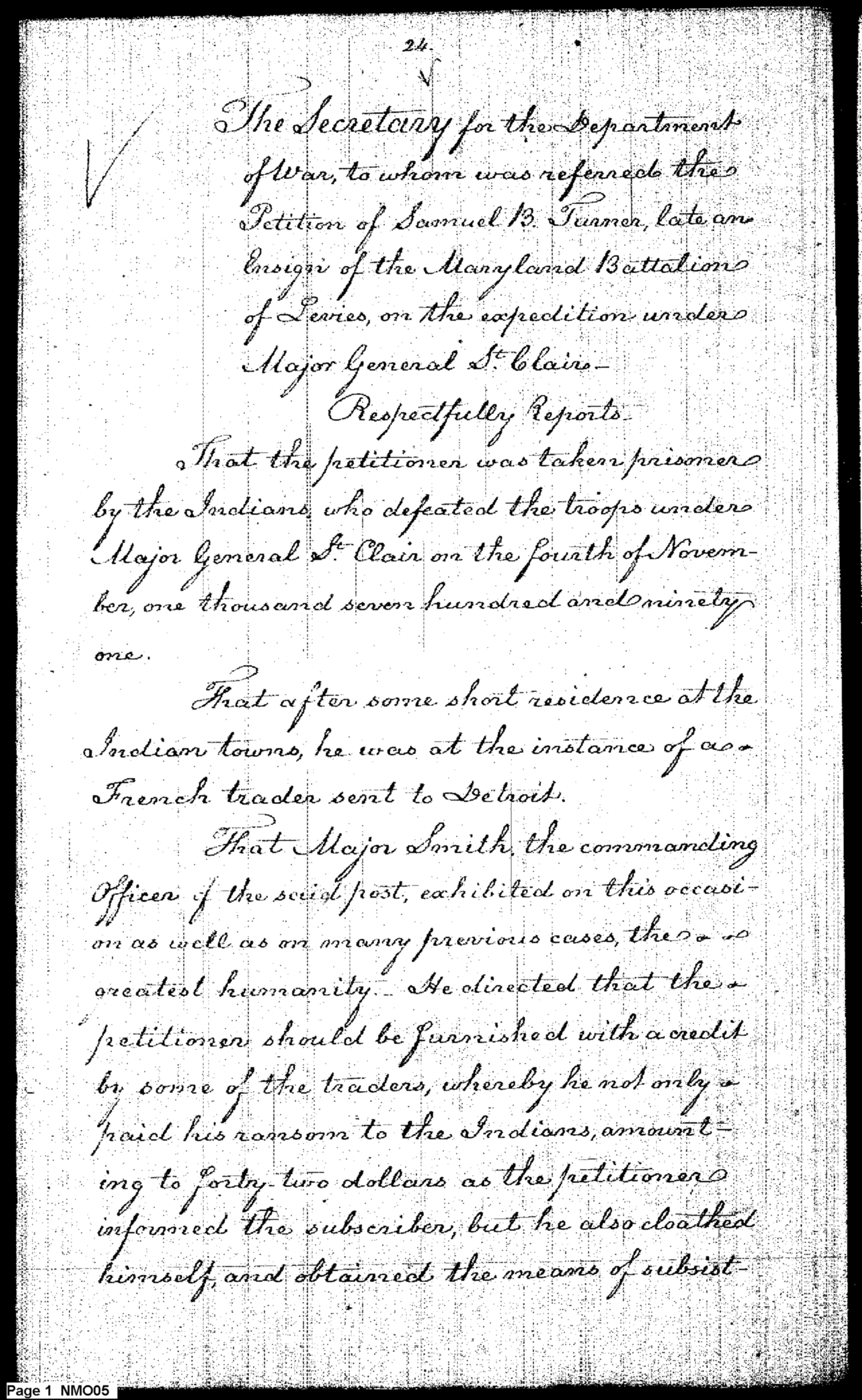
The Secretary for the Department of War, to whom was referred the Petition of Samuel B. Turner, late an Ensign of the Maryland Battalion of Levies, on the expedition under Major General St. Clair—
Respectfully Reports.
That the petitioner was taken prisoner by the Indians, who defeated the troops under Major General St. Clair on the fourth of November, one thousand seven hundred and ninety one.
That after some short residence at the Indian towns, he was at the instance of a French trader sent to Detroit.
That Major Smith, the commanding Officer of the said post, exhibited on this occasion as well as on many previous cases, the greatest humanity. He directed that the petitioner should be furnished with a credit by some of the traders, whereby he not only paid his ransom to the Indians, amounting to forty two dollars as the petitioner informed the subscriber, but he also cloathed himself, and obtained the means of subsistence to Niagara.
That at Niagara the petitioner was furnished with a sum of money by Colonel Gordon, commanding officer, to the amount of thirty seven dollars and fifty cents.
That the object of the petitioner is to obtain from the public, in whose service he was captured, the expences attending his captivity, amounting to two hundred and sixty four dollars, forty five cents.
That the petitioner is equitably entitled to his pay and subsistence from the fourth of November, the time of his captivity, until the time of his arrival at his own home, amounting probably to about one hundred and thirty dollars, which he has received in part, some vouchers being wanting in order to ascertain the precise amount.
That it was a custom during the late war, that officers who were taken prisoners, continued to receive their pay and subsistence during the time they remained prisoners; but it does not appear to have been the practice that any extra expences were paid, excepting for medical assistance, and the additional price of one third of the price of the rations allowed to Officers not in captivity.
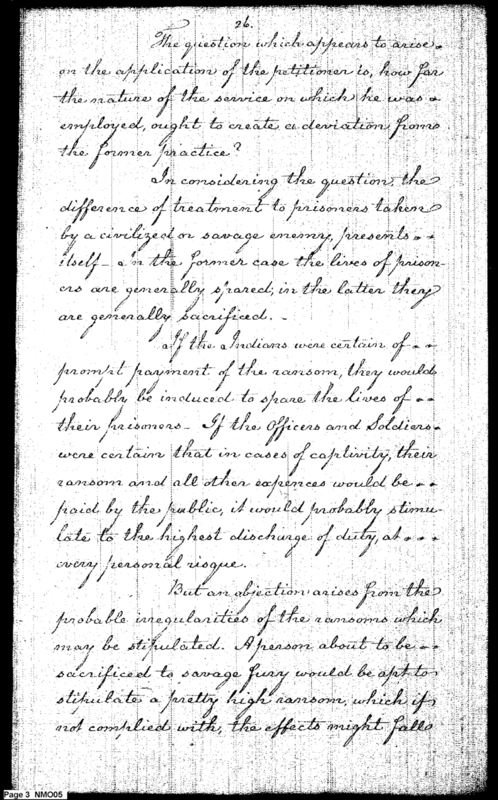
The question which appears to arise on the application of the petitioner is, how far the nature of the service on which he was employed, ought to create a deviation from the former practice?
In considering the question, the difference of treatment to prisoners taken by a civilized or savage enemy, presents itself— in the former case the lives of prisoners are generally spared; in the latter they are generally sacrificed.
If the Indians were certain of prompt payment of the ransom, they would probably be induced to spare the lives of their prisoners. If the Officers and Soldiers were certain that in cases of captivity, their ransom and all other expences would be paid by the public, it would probably stimulate to the highest discharge of duty, at very personal risque.
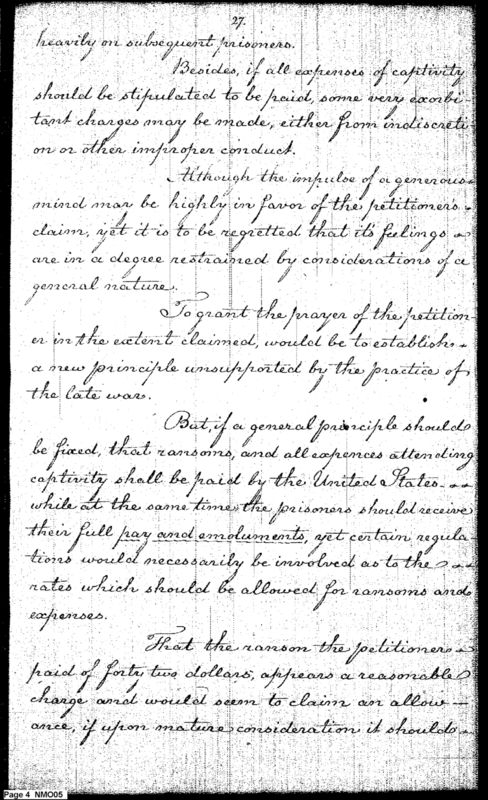
But an objection arises from the probable irregularities of the ransoms which may be stipulated. A person about to be sacrificed to savage fury would be apt to stipulate a pretty high ransom, which if not complied with, the effects might fall heavily on subsequent prisoners.
Besides, if all expences of captivity should be stipulated to be paid, some very exorbitant charges may be made, either from indiscretion or other improper conduct.
Although the impulse of a generous mind may be highly in favor of the petitioner's claim, yet it is to be regretted that its feelings are in a degree restrained by considerations of a general nature.
To grant the prayer of the petitioner in the extent claimed, would be to establish a new principle unsupported by the practice of the late war.
But if a general principle should be fixed, that ransoms and all expences attending captivity shall be paid by the United States, while at the same time the prisoners should receive their full [underline: pay and emoluments], yet certain regulations would necessarily be involved as to the rates which should be allowed for ransoms and expences.
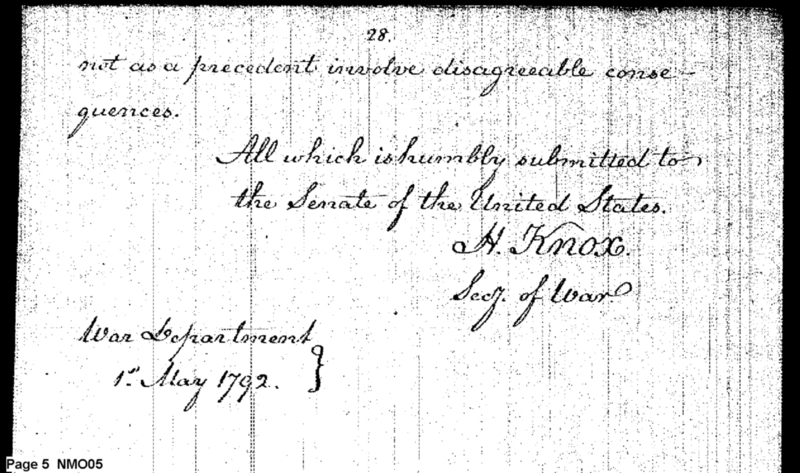
That the ransom the petitioner paid of forty two dollars, appears a reasonable charge and would seem to claim an allowance, if upon mature consideration it should not as a precedent involve disagreeable consequences.
All which is humbly submitted to the Senate of the United States.
H. Knox.
Secy. of War.
War Department,
1st May 1792.
Type
Copy of Signed Document
Description
In considering the petition of Samuel B. Turner, Knox wrestles with the question as to whether a prisoner of the Indians should receive full pay and emoluments while in captivity and also be rembursed the amount of his ransom. While refusing to establish a general precedent for such cases, he concludes that the $42 requested by Turner is not unreasonable.
Date
05/01/1792
Author
Recipient
Sent from
War Department
Document number
1792050100001
Page start
1
Notable persons
Henry Knox
Samuel B. Turner, Ensign of the Maryland Battalion of Levies
Major General St. Clair
prisoner of the Indians
French trader
Major Smith
Colonel Gordon
civilized enemy
savage enemy
Notable locations
War Department
Indian towns
Detroit
Niagara
Notable items
greatest humanity
credit
prompt payment of the ransom
expenses attending his captivity
vouchers
the late war
pay and subsistence
extra expenses
medical assistance
rations
personal risk
sacrifice to savage fury
exorbitant charges
impulse of a generous mind
new principle unsupported by the practice of the late war
full pay and emoluments
disagreeable consequences