No human transcription currently available for this document.
[Copied]
[1792]
[Chapin]
Special Instructions to Israel Chapin Esquire
Deputy temporary Agent to the Five Nations of
Indians, the Stockbridge Indians included
1st By the stipulation recited in your General
Instructions, and the annexed Speech delivered
to the said nations of Indians, at Philadel-
=phia the 25th day of April 1792, will be seen
the appropriation of Fifteen hundred dollars
annually, and the general mode of applying
that bounty of the United States to the use of
those nations in connection with which the
following instructions are to be attended to.
If however, in carrying the plan into execution
any material alterations should be thought ex-
-pedient, you are to represent the same. —
2d The choice of Schoolmasters, blacksmiths
and Carpenters, is left with you, but as the suc-
cess of the plan will depend on the selection of
proper characters for those employments, you
are to use all possible care to choose such only
as sustain fair reputations; men of perfect
temperance, of unblemished integrity, and unaf-
-fected reverence for Religion,— Profane and
vicious persons would do more hurt by their
examples, than all their Instructions would do
good.
3d If you can find men practically acquainted
with husbandry, who have competent abilities
and learning to be Schoolmasters, such are to be
preferred. But however this may happen, the
Schoolmaster's attention will be so much occupied
with their schools, that occasional help, and per-
haps the constant assistance of a sober young
man may be necessary in the management of
their farms.—
4th If blacksmiths can be found, who
are competent to the repairs of the Indians Guns,
such one to be preferred: otherwise they must
each procure a sober Gunsmith for the purpose.
5. The Carpenters ought to be Wheelwrights,
or at least capable of repairing Wheels.
6. The Schoolmasters, blacksmiths and Carpen-
-ters should in preference be married men; and
must each be provided with a yoak of Oxen
and a cow or two, and the implements of Hus-
-bandry: one Bull at each establishment, will
answer for all of them. The blacksmith and
Carpenter must have the requisite tools of their
trades. The persons you may find most ready
to engage in this undertaking, will perhaps —
need assistance in providing all those things, which
assistance you will furnish, with the money
which shall be sent you for that purpose.—
An estimate of the expence of these articles and
other parts of the Institution is annexed. It is
supposed to be liberal: if you can provide them
at less expence, you will do it. In all cases
you are to study the strictest œconomy.—
7. The wives of the persons you engage
are to teach the Indian girls to spin, Sew, knit
and do all sorts of business proper for farmers
wives to be acquainted with. If either of them
is a weaver, She is also to teach some of the In-
-dian girls to weave. But they should be imme-
-diately taught to spin: for which purpose wheels
and Flax should be provided as soon as the
establishments are formed.
8. The farms of the Schoolmaster, blacksmith
and Carpenter should lie together and the School-
house erected near them. The farms will then
be easily fenced: the three Families will form
a little society, and their Children will be near
the School. The Indian children also, who go to
school, will be at hand to work on the Farms, more
or less daily, and some of them with the blacksmith
and Carpenter. —
9. To learn to milk Cows and do household
work, the girls may be divided into classes, and
attend in the white families weekly in succession,
at the same time going to School certain Hours
every day.
10. Not only children, but young men and
young women desirous to learn any of the arts
proposed, should be admitted freely to all the advant-
-ages the institution can afford. And it may not
be adviseable at first to attempt the instruction
of any children under ten years old. —
11. On Sundays the Schoolmaster should give
his Scholars information of [underline: the works of creation,]
in order to lead them up to [underline: the Creator;] and thence
deduce their obligations to him. He should instruct
them in the duties they owe to each other as mem-
-bers of Society, and to all people, of whatever colour
as children of the great Spirit, whose parental
kindness extends to all. But he should, for some
time make no attempt to teach them the peculiar
doctrines of Revealed Religion; excepting those
Indians to whom any of its mysteries have
been already unfolded.
12. The government to which the Indians have
been accustomed is so gentle, every thing bearing
the semblance of [underline: severity] must be avoided: not a
blow must be struck, nor any reproof given but
with mildness and in the form of [underline: advice:] neither
must it be attempted to employ them in any
Services in which the white people and their chil-
-dren do not Participate. This shows how necessa-
-ry it will be for the persons you engage to possess
good dispositions with the other qualifications
which have been mentioned. —
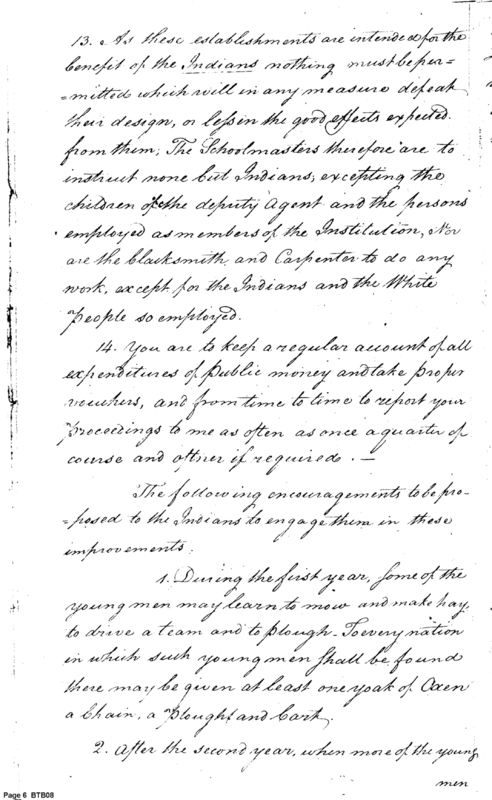
13. As these establishments are intended for the
benefit of the Indians nothing must be per-
-mitted which will in any measure defeat
their design, or lessen the good effects expected
from them; The Schoolmasters therefore are to
instruct none but Indians; excepting the
children of the deputy Agent and the persons
employed as members of the Institution. Nor
are the blacksmith, and Carpenter to do any
work, except for the Indians and the White
People so employed.
14. You are to keep a regular account of all
expenditures of public money and take proper
vouchers, and from time to time to report your
Proceedings to me as often as once a quarter of
course and oftner if required. —
The following encouragements to be pro-
-posed to the Indians to engage them in these
improvements.
1. During the first year, some of the
young men may learn to mow and make hay,
to drive a team and to plough. To every nation
in which such young men shall be found
there may be given at least one yoak of Oxen
a Chain, a Plough and Cart.
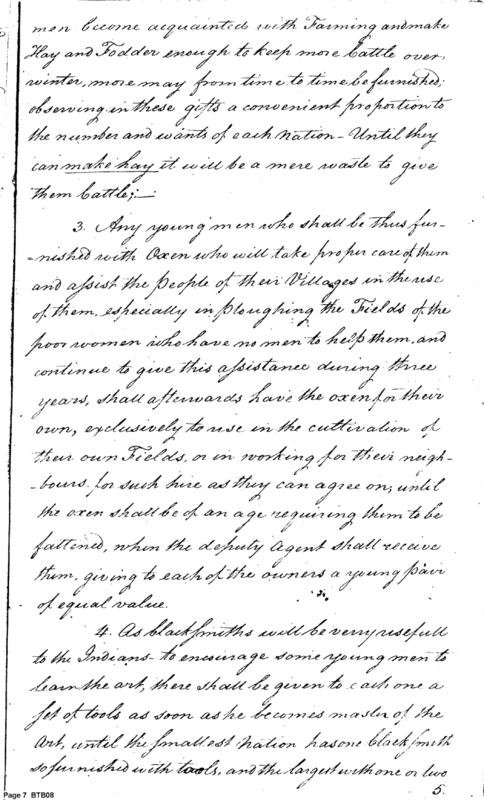
2. After the second year, when more of the young
men become acquainted with Farming and make
Hay and Fodder enough to keep more Cattle over
winter, more may from time to time be furnished:
observing in these gifts a convenient proportion to
the number and wants of each Nation. Until they
can make hay it will be a mere waste to give
them Cattle;—
3. Any young men who shall be thus fur-
-nished with Oxen who will take proper care of them
and assist the people of their Villages in the use
of them, especially in ploughing the Fields of the
poor women who have no men to help them, and
continue to give this assistance during three
years, shall afterwards have the oxen for their
own, exclusively to use in the cultivation of
their own Fields, or in working for their neigh-
-bours, for such hire as they can agree on; until
the oxen shall be of an age requiring them to be
fattened, when the deputy Agent shall receive
them, giving to each of the owners a young pair
of equal value.
4. As blacksmiths will be very useful
to the Indians — to encourage some young men to
learn the art, there shall be given to each one a
set of tools as soon as he becomes master of the
Art, until the smallest Nation has one blacksmith
so furnished with [strikethrough: tools,] and the largest with one or two
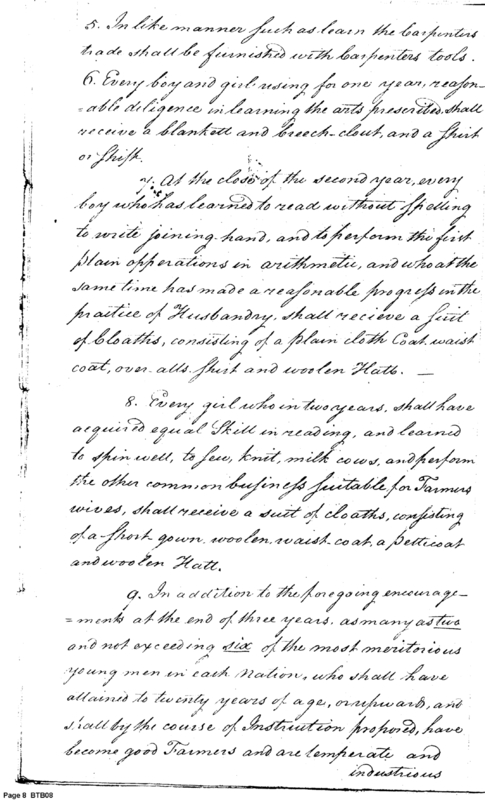
5. In like manner such as learn the Carpenters
trade shall be furnished with Carpenters tools.
6. Every boy and girl using for one year, reason-
-able diligence in learning the arts prescribed, shall
receive a blanket and breech-clout, and a shirt
or shift.
7. At the close of the second year, every
boy who has learned to read without Spelling
to write Joining hand, and to perform the first
plain operations in arithmetic, and who at the
same time has made a reasonable progress in the
practice of Husbandry, shall receive a suit
of Cloaths, consisting of a plain cloth Coat, waist
coat, over alls, shirt and woolen Hatt. —
8. Every girl who in two years, shall have
acquired equal Skill in reading, and learned
to spin well, to sew, knit, milk cows, and perform
the other common business suitable for Farmers
wives, shall receive a suit of cloaths, consisting
of a short gown, woolen waist coat, a petticoat
and woolen Hatt.
9. In addition to the foregoing encourage-
-ments, at the end of three years, as many as [underline: two]
and not exceeding [underline: six] of the most meritorious
young men in each Nation, who shall have
attained to twenty years of age, or upwards, and
shall by the course of Instruction proposed, have
become good Farmers and are temperate and
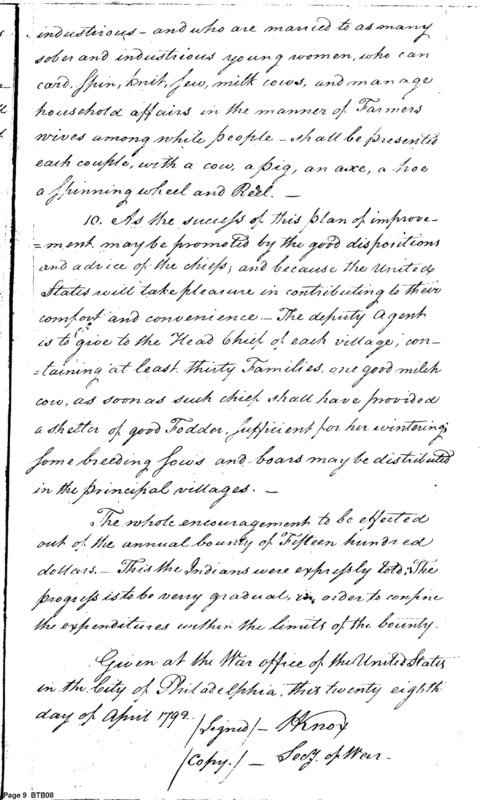
Industrious — and who are married to as many
sober and industrious young women, who can
card, spin, knit, sew, milk cows, and manage
houshold affairs in the manner of Farmers
wives among white people — shall be presented
each couple, with a cow, a pig, an axe, a hoe,
a Spinning wheel and Reel. —
10. As the success of this plan of improve-
-ment may be promoted by the good dispositions
and advice of the chiefs; and because the United
States will take pleasure in contributing to their
comfort and convenience — The deputy Agent
is to give to the Head Chief of each village, con-
-taining at least thirty Families, one good milk
cow, as soon as such chief shall have provided
a shelter of good Fodder, sufficient for her wintering;
Some breeding Sows and boars may be distributed
in the principal villages. —
The whole encouragement to be effected
out of the annual bounty of Fifteen hundred
dollars.— This the Indians were expressly told; the
progress is to be very gradual, in order to confine
the expenditures within the limits of the bounty.
Given at the War office of the United States
in the City of Philadelphia, this twenty eighth
day of April 1792. /Signed/ — H Knox
/Copy/ — Secy. of War—