

Speech to the Five Nations of Indians at Philadelphia
Document 1792Pickering reiterates the offers of peace and friendship with the Indians, and urges them to understand why the United States is warring with the Western Indians, who have killed upwards of 1500 whites. Pickering hopes that they will convince the Western Indians that peace is the best option, and that if they have any complaints regarding the treaties, they will be examined in due course.
No human transcription currently available for this document.
This transcription was generated by machine using Anthropic's Claude Code (model sonnet 4.6). It may contain errors or inaccuracies. Please verify against the document image. Learn more about our generative AI methodology.
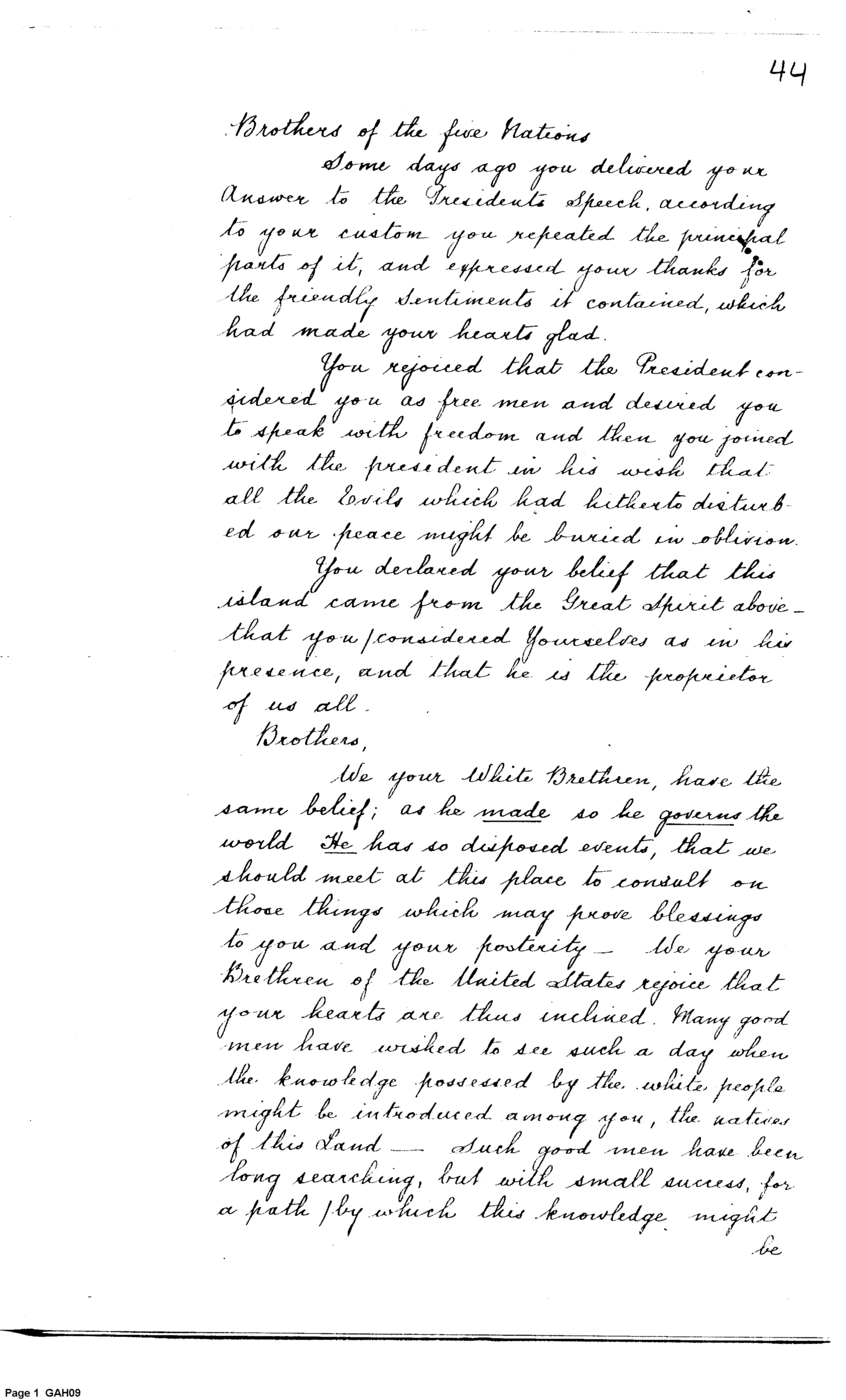
Brothers of the five Nations
Some days ago you delivered your Answer to the Presidents Speech, according to your custom you repeated the principal parts of it, and expressed your thanks for the friendly Sentiments it contained, which had made your hearts glad.
You rejoiced that the President considered you as free men and desired you to speak with freedom and then you joined with the president in his wish that all the Evils which had hitherto disturbed our peace might be buried in oblivion.
You declared your belief that this island came from the Great Spirit above — that you considered Yourselves as in his presence, and that he is the proprietor of us all.
Brothers,
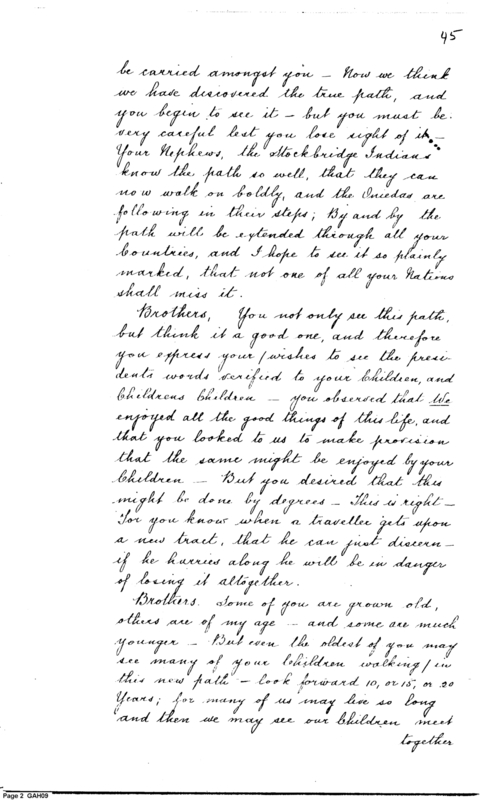
We your White Brethren, have the same belief; as he [underline: made] so he [underline: governs] the world [underline: He] has so disposed events, that we should meet at this place to consult on those things which may prove blessings to you and your posterity — We your Brethren of the United States rejoice that your hearts are thus inclined. Many good men have wished to see such a day when the knowledge possessed by the white people might be introduced among you, the natives of this land — Such good men have been long searching, but with small success, for a path by which this knowledge might be carried amongst you — Now we think we have discovered the true path, and you begin to see it — but you must be very careful lest you lose sight of it — Your Nephews, the Stockbridge Indians know the path so well, that they can now walk on boldly, and the Oneidas are following in their steps; By and by the path will be extended through all your countries, and I hope to see it so plainly marked, that not one of all your Nations shall miss it.
Brothers, You not only see this path, but think it a good one, and therefore you express your wishes to see the presidents words verified to your children, and Childrens children — you observed that We enjoyed all the good things of this life, and that you looked to us to make provision that the same might be enjoyed by your children — But you desired that this might be done by degrees — This is right — For you know when a traveller gets upon a new tract, that he can just discern — if he hurries along he will be in danger of losing it altogether.
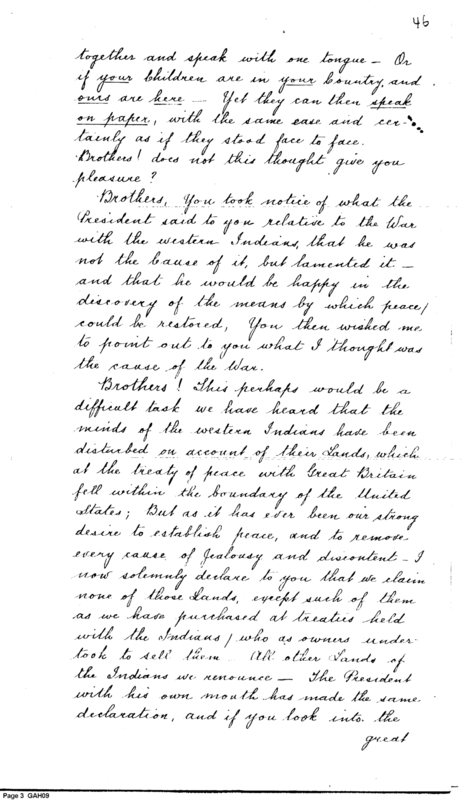
Brothers Some of you are grown old, others are of my age — and some are much younger — But even the oldest of you may see many of your children walking in this new path — look forward 10, or 15, or 20 Years; for many of us may live so long — and then we may see our Children meet together and speak with one tongue — Or if [underline: your] children are in [underline: your] country, and [underline: ours] are [underline: here] — Yet they can then [underline: speak on paper], with the same ease and certainly as if they stood face to face. Brothers! does not this thought give you pleasure?
Brothers, You took notice of what the President said to you relative to the War with the western Indians, that he was not the cause of it, but lamented it — and that he would be happy in the discovery of the means by which peace could be restored, You then wished me to point out to you what I thought was the cause of the War.
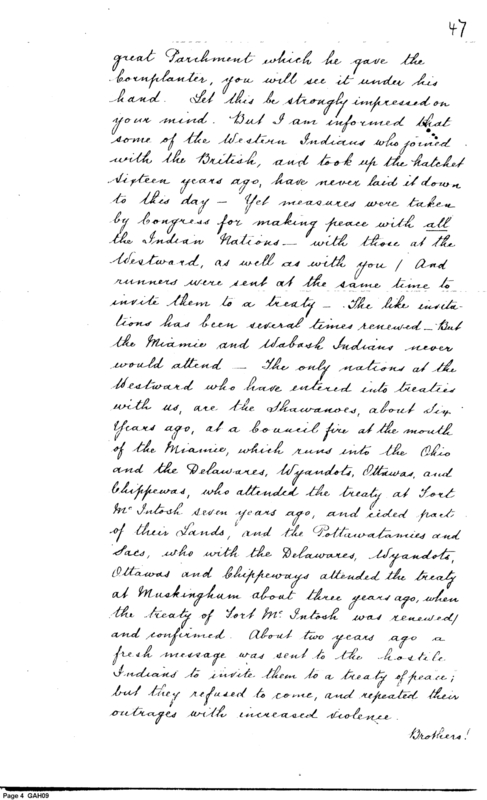
Brothers! This perhaps would be a difficult task we have heard that the minds of the western Indians have been disturbed on account of their lands, which at the treaty of peace with Great Britain fell within the boundary of the United States; But as it has ever been our strong desire to establish peace, and to remove every cause of jealousy and discontent — I now solemnly declare to you that we claim none of those lands, except such of them as we have purchased at treaties held with the Indians who as owners undertook to sell them. All other lands of the Indians we renounce — The President with his own mouth has made the same declaration, and if you look into the great Parchment which he gave the Cornplanter, you will see it under his hand. Let this be strongly impressed on your mind. But I am informed that some of the Western Indians who joined with the British, and took up the hatchet sixteen years ago, have never laid it down to this day — Yet measures were taken by Congress for making peace with all the Indian Nations — with those at the Westward, as well as with you / And runners were sent at the same time to invite them to a treaty — The like invitations has been several times renewed — But the Miamie and Wabash Indians never would attend — The only nations at the Westward who have entered into treaties with us, are the Shawanoes, about Six Years ago, at a Council fire at the mouth of the Miamie, which runs into the Ohio and the Delawares, Wyandots, Ottawas, and Chippewas, who attended the treaty at Fort Mc Intosh seven years ago, and cided part of their lands, and the Pottawatamies and Saes, who with the Delawares, Wyandots, Ottawas and Chippeways attended the treaty at Muskingham about three years ago, when the treaty of Fort Mc Intosh was renewed and confirmed. About two years ago a fresh message was sent to the Hostile Indians to invite them to a treaty of peace; but they refused to come, and repeated their outrages with increased violence.
Brothers!
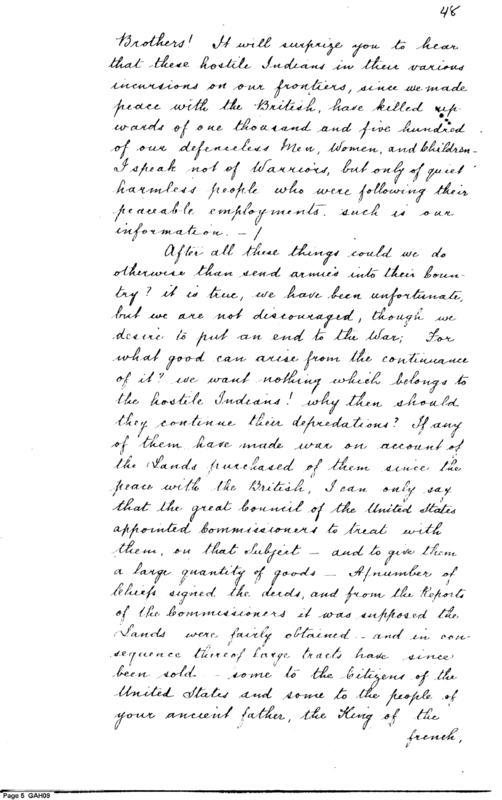
Brothers! It will surprize you to hear that these hostile Indians in their various incursions on our frontiers, since we made peace with the British, have killed upwards of one thousand and five hundred of our defenseless Men, Women, and children — I speak not of Warriors, but only of quiet harmless people who were following their peaceable employments. such is our information. —
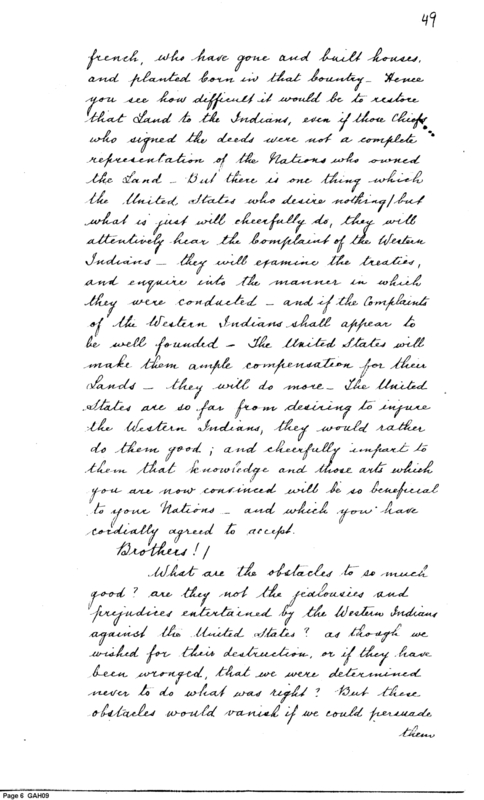
After all these things could we do otherwise than send armies into their country? it is true, we have been unfortunate, but we are not discouraged, though we desire to put an end to the War; For what good can arise from the continuance of it? we want nothing which belongs to the hostile Indians! why then should they continue their depredations? If any of them have made war on account of the Lands purchased of them since the peace with the British, I can only say that the great Council of the United States appointed Commissioners to treat with them, on that Subject — and to give them a large quantity of goods — A number of Chiefs signed the deeds, and from the Reports of the Commissioners it was supposed the Lands were fairly obtained — and in consequence thereof large tracts have since been sold — some to the Citizens of the United States and some to the people of your ancient father, the King of the french, who have gone and built houses, and planted corn in that country — Hence you see how difficult it would be to restore that land to the Indians, even if those Chiefs who signed the deeds were not a complete representation of the Nations who owned the land — But there is one thing which the United States who desire nothing but what is just will cheerfully do, they will attentively hear the complaint of the Western Indians — they will examine the treaties, and enquire into the manner in which they were conducted — and if the Complaints of the Western Indians shall appear to be well founded — The United States will make them ample compensation for their lands — they will do more — The United States are so far from desiring to injure the Western Indians, they would rather do them good; and cheerfully impart to them that knowledge and those arts which you are now convinced will be so beneficial to your Nations — and which you have cordially agreed to accept.
Brothers! /
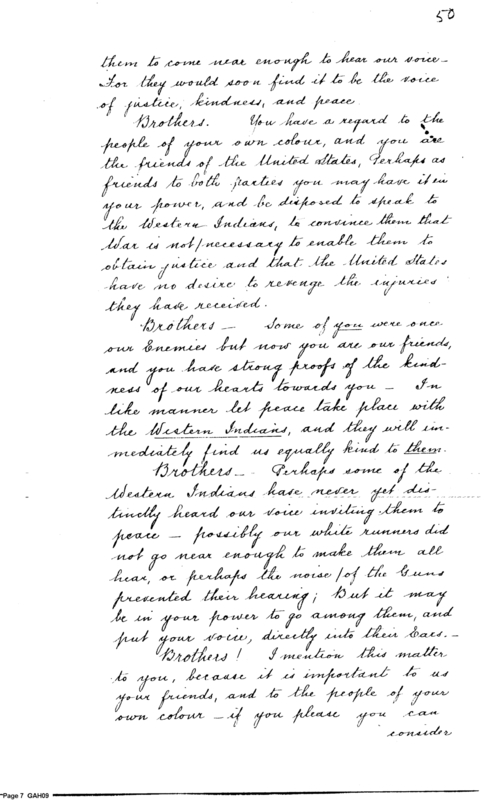
What are the obstacles to so much good? are they not the jealousies and prejudices entertained by the Western Indians against the United States? as though we wished for their destruction, or if they have been wronged, that we were determined never to do what was right? But these obstacles would vanish if we could persuade them to come near enough to hear our voice — For they would soon find it to be the voice of justice, kindness, and peace.
Brothers. You have a regard to the people of your own colour, and you are the friends of the United States. Perhaps as friends to both parties you may have it in your power, and be disposed to speak to the Western Indians, to convince them that War is not necessary to enable them to obtain justice and that the United States have no desire to revenge the injuries they have received.
Brothers — Some of [underline: you] were once our Enemies but now you are our friends, and you have strong proofs of the kindness of our hearts towards you — In like manner let peace take place with the [underline: Western Indians], and they will immediately find us equally kind to [underline: them].
Brothers — Perhaps some of the Western Indians have never yet distinctly heard our voice inviting them to peace — possibly our white runners did not go near enough to make them all hear, or perhaps the noise of the Guns prevented their hearing; But it may be in your power to go among them, and put your voice, directly into their Ears. —
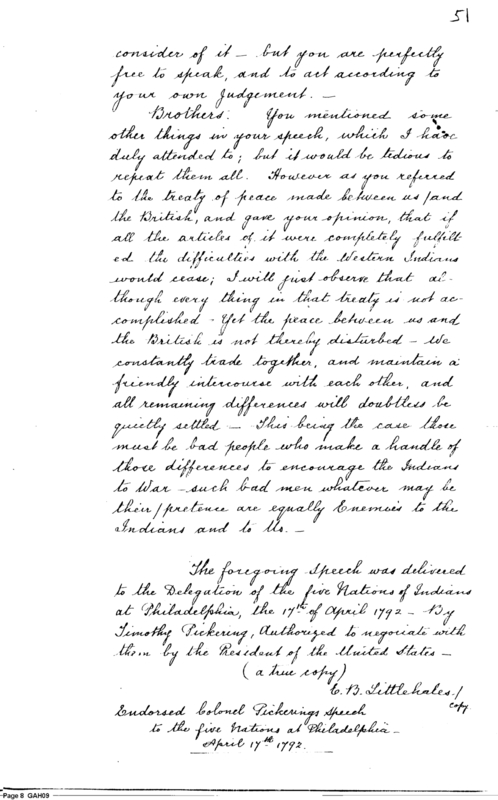
Brothers! I mention this matter to you, because it is important to us your friends, and to the people of your own colour — if you please you can consider of it — but you are perfectly free to speak, and to act according to your own Judgement. —
Brothers. You mentioned some other things in your speech, which I have duly attended to; but it would be tedious to repeat them all. However as you referred to the treaty of peace made between us and the British, and gave your opinion, that if all the articles of it were completely fulfilled the difficulties with the Western Indians would cease; I will just observe that although every thing in that treaty is not accomplished — Yet the peace between us and the British is not thereby disturbed — We constantly trade together, and maintain a friendly intercourse with each other, and all remaining differences will doubtless be quietly settled — This being the case those must be bad people who make a handle of those differences to encourage the Indians to War — such bad men whatever may be their pretence are equally Enemies to the Indians and to Us. —
The foregoing Speech was delivered to the Delegation of the five Nations of Indians at Philadelphia, the 17th of April 1792 — By Timothy Pickering, Authorized to negotiate with them by the President of the United States —
( a true copy)
C.B. Littlehales /
[Endorsed Colonel Pickerings speech copy
to the five Nations at Philadelphia —
April 17th 1792.]
Type
Contemporary Copy of Letter
Description
Pickering reiterates the offers of peace and friendship with the Indians, and urges them to understand why the United States is warring with the Western Indians, who have killed upwards of 1500 whites. Pickering hopes that they will convince the Western Indians that peace is the best option, and that if they have any complaints regarding the treaties, they will be examined in due course.
Date
04/17/1792
Author
Recipient
Sent from
Philadelphia
Collection
Document number
1792041700001
Page start
1
Notable persons
Timothy Pickering: George Washington
Five Nations
Stockbridge Indians
Oneida
Western Indians
Cornplanter
Miami
Wabash
Shawnee
Delware
Wyandot
Ottawa
Chippewa
Pottawatami
Sac
King of the French
E. B> Littlehales
Notable locations
Philadelphia: Ohio River
Fort McIntosh
Muskinghum
Notable items
Treaty of Paris
great Parchment