

Recruiting Instructions
Document 1792Instructions, recruiting.


No human transcription currently available for this document.
This transcription was generated by machine using Anthropic's Claude Code (model sonnet 4.6). It may contain errors or inaccuracies. Please verify against the document image. Learn more about our generative AI methodology.
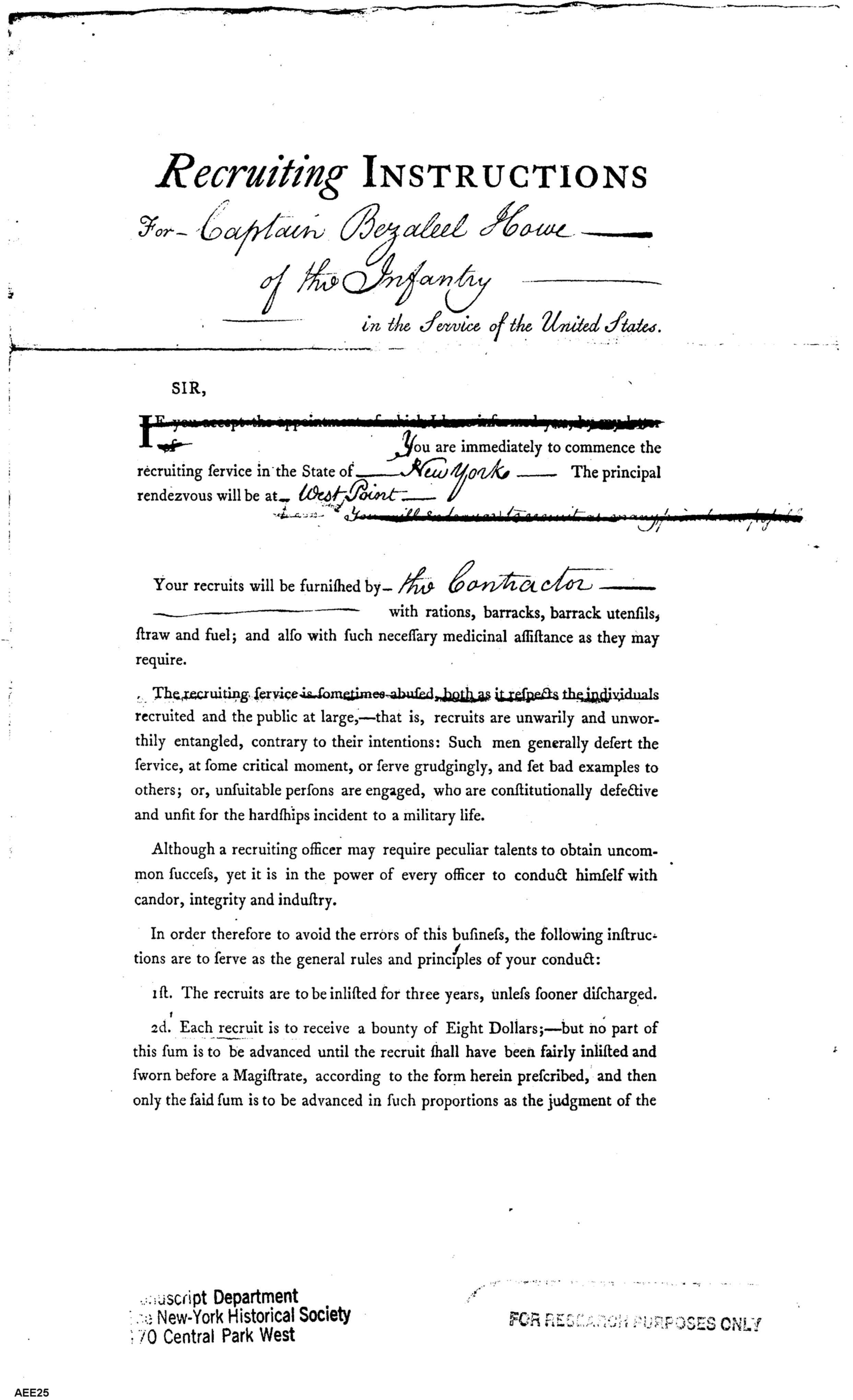
Recruiting INSTRUCTIONS
For Captain Bezaleel Howe
of the Infantry
in the Service of the United States.
SIR,
You are immediately to commence the recruiting service in the State of New York. The principal rendezvous will be at West Point
Your recruits will be furnished by his Contractor with rations, barracks, barrack utensils, straw and fuel; and also with such necessary medicinal assistance as they may require.
The recruiting service in [strikethrough: undecipherable], both as it respects the individuals recruited and the public at large—that is, recruits are unwarily and unworthily entangled, contrary to their intentions: Such men generally desert the service, at some critical moment, or serve grudgingly, and set bad examples to others; or, undesirable persons are engaged, who are constitutionally defective and unfit for the hardships incident to a military life.
Although a recruiting officer may require peculiar talents to obtain uncommon success, yet it is in the power of every officer to conduct himself with candor, integrity and industry.
In order therefore to avoid the errors of this business, the following instructions are to serve as the general rules and principles of your conduct:
1st. The recruits are to be inlisted for three years, unless sooner discharged.
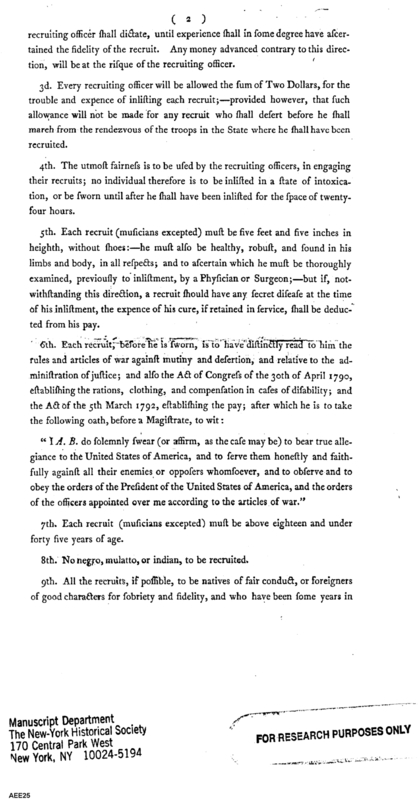
2d. Each recruit is to receive a bounty of Eight Dollars;—but no part of this sum is to be advanced until the recruit shall have been fairly inlisted and sworn before a Magistrate, according to the form herein prescribed, and then only the said sum is to be advanced in such proportions as the judgment of the recruiting officer shall dictate, until experience shall in some degree have ascertained the fidelity of the recruits. Any money advanced contrary to this direction, will be at the risque of the recruiting officer.
3d. Every recruiting officer will be allowed the sum of Two Dollars, for the trouble and expence of inlisting each recruit;—provided however, that such allowance will not be made for any recruit who shall desert before he shall march from the rendezvous of the troops in the State where he shall have been recruited.
4th. The utmost fairness is to be used by the recruiting officers, in engaging their recruits; no individual therefore is to be inlisted in a state of intoxication, or be sworn until after he shall have been inlisted for the space of twenty-four hours.
5th. Each recruit (musicians excepted) must be five feet and five inches in heighth, without shoes;—he must also be healthy, robust, and sound in his limbs and body, in all respects; and to ascertain which he must be thoroughly examined, previously to inlistment, by a Physician or Surgeon;—but if, notwithstanding this direction, a recruit should have any secret disease at the time of his inlistment, the expence of his cure, if retained in service, shall be deducted from his pay.
6th. Each recruit, before he is sworn, is to have distinctly read to him the rules and articles of war against mutiny and desertion, and relative to the administration of justice; and also the Act of Congress of the 30th of April 1790, establishing the rations, clothing, and compensation in cases of disability; and the Act of the 5th March 1792, establishing the pay: after which he is to take the following oath, before a Magistrate, to wit:
"I A. B. do solemnly swear (or affirm, as the case may be) to bear true allegiance to the United States of America, and to serve them honestly and faithfully against all their enemies or opposers whomsoever, and to observe and to obey the orders of the President of the United States of America, and the orders of the officers appointed over me according to the articles of war."
7th. Each recruit (musicians excepted) must be above eighteen and under forty-five years of age.
8th. No negro, mulatto, or Indian, to be recruited.
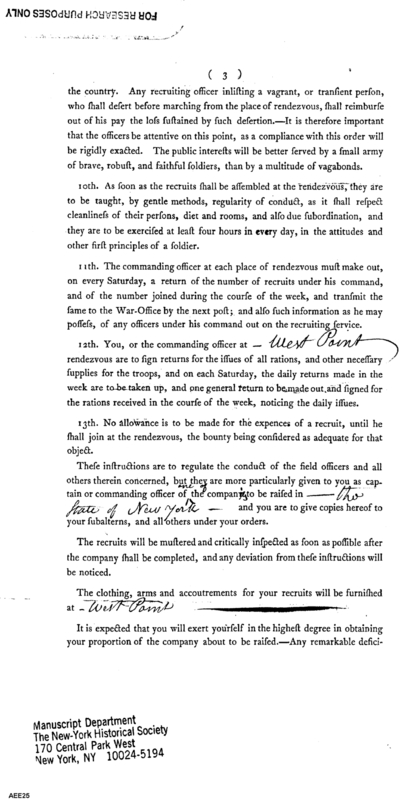
9th. All the recruits, if possible, to be natives of fair conduct; or foreigners of good characters for sobriety and fidelity, and who have been some years in the country. Any recruiting officer inlisting a vagrant, or transient person, who shall desert before marching from the place of rendezvous, shall reimburse out of his pay the loss sustained by such desertion.—It is therefore Important that the officers be attentive on this point, as a compliance with this order will be rigidly exacted. The public interests will be better served by a small army of brave, robust, and faithful soldiers, than by a multitude of vagabonds.
10th. As soon as the recruits shall be assembled at the rendezvous, they are to be taught, by gentle methods, regularity of conduct, as it shall respect cleanliness of their persons, diet and rooms, and also due subordination, and they are to be exercised at least four hours in every day, in the attitudes and other first principles of a soldier.
11th. The commanding officer at each place of rendezvous must make out, on every Saturday, a return of the number of recruits under his command, and of the number joined during the course of the week; and transmit the same to the War-Office by the next post; and also such information as he may possess, of any officers under his command out on the recruiting service.
12th. You, or the commanding officer at — West Point rendezvous are to sign returns for the issues of all rations, and other necessary supplies for the troops, made on each Saturday; the daily returns made in the week are to be taken up, and one general return to be made, and signed for the rations received in the course of the week, noticing the daily issues.
13th. No allowance is to be made for the expences of a recruit, until he shall join at the rendezvous, the bounty being considered as adequate for that object.
These instructions are to regulate the conduct of the field officers and all others therein concerned, but they are more particularly given to you as captain or commanding officer of the company to be raised in — State of New York — and you are to give copies hereof to your subalterns, and all others under your orders.
The recruits will be mustered and critically inspected as soon as possible after the company shall be completed, and any deviation from these instructions will be noticed.
The clothing, arms and accoutrements for your recruits will be furnished at — West Point
It is expected that you will exert yourself in the highest degree in obtaining your proportion of the company about to be raised.—Any remarkable deficiency arising from want of due industry, on your part, will be reported to the President of the United States, and such conduct may be considered by him as a just cause for withholding your commission, in pursuance of the power vested in him by law.
The establishment of the troops, the articles of war, and blank inlistments are herewith transmitted.
[decorative rule]
You will observe by the bill, the liberal pay established for the non commissioned officers, this will be a good reason that you should not place any man in the [undecipherable] of [undecipherable] a [undecipherable] but for most excellent character.
Given at the War Office of the United States in the City of Philadelphia this 12th day of April 1792
In the absence of the Secretary of War
[undecipherable signature]
[marginalia, left margin, partially illegible: undecipherable]
Type
Document Signed
Description
Instructions, recruiting.
Date
04/12/1792
Author
Sent from
War Department
Collection
Document number
1792041215004
Page start
1
Notable persons
John Stagg
Captain Bezaleel Howe
Notable locations
War Department
New York [state]
West Point
War Office
United States
Notable items
President
recruiting service
contractor
rations
barracks
barrack utensils
straw
fuel
medical assistance
public at large
[abuses]
desert
suitable persons
hardships
military life
business
rules
principles
conduct
bounty
magistrate
dollars
intoxication
heighth
shoes
healthy
robust
limbs
body
physician
surgeon
disease
cure
pay
rules and articles of war
mutiny
desertion
justice
act of Congress
rations
clothing
compensation in cases of disability
oath
orders
officers
musicians
negro
mulatto
indian
natives
foreigners
sobriety
fidelity
country
vagrant
transient person
rendezvous
taught
conduct
cleanliness
dite
rooms
subordination
return
rations
supplies
troops
Saturday
daily returns
issues
bounty
conduct
field officers
captain
commanding officer
subalterns
clothing
arms
accoutrements
establishment of the troops
blank inlistments
sergeant
corporal