

Knox makes public the causes of hostilities with Indians
Document 1792Document, Causes of hostilities with Indians; describes Indians and Indian warfare; describes Indian aggression; mentions Territorial Governments; describes White encroachment; discusses Indian torture tactics; discusses Harmar's Expedition; mentions Indian delegations; discusses pioneers and frontier life.


No human transcription currently available for this document.
This transcription was generated by machine using Anthropic's Claude Code (model sonnet 4.6). It may contain errors or inaccuracies. Please verify against the document image. Learn more about our generative AI methodology.
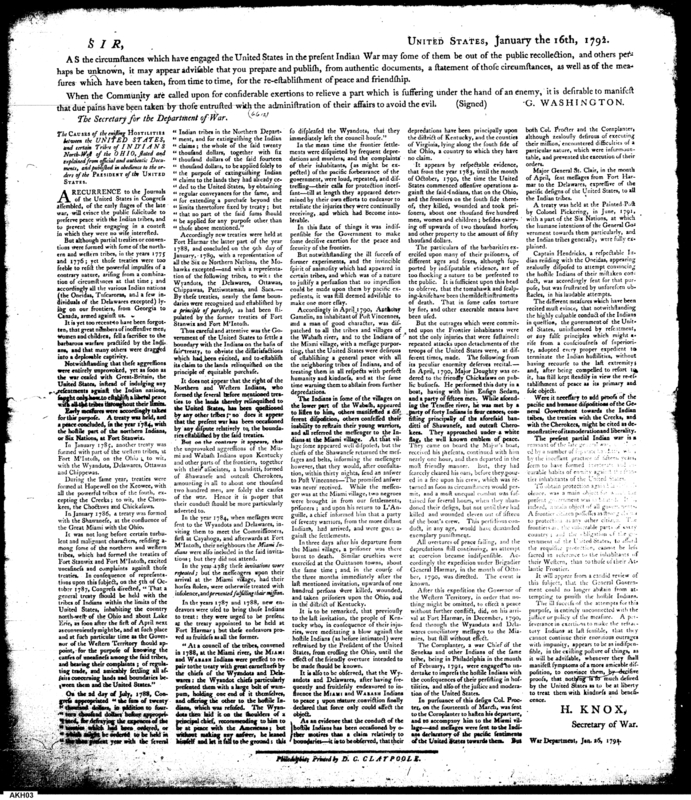
§ I R, UNITED STATES, January the 16th, 1792.
AS the circumstances which have engaged the United States in the present Indian War may some of them be out of the public recollection, and others perhaps be unknown, it may appear advisable that you prepare and publish, from authentic documents, a statement of those circumstances, as well as of the measures which have been taken, from time to time, for the re-establishment of peace and friendship.
When the Community are called upon for considerable exertions to relieve a part which is suffering under the hand of an enemy, it is desirable to manifest that due pains have been taken by those entrusted with the administration of their affairs to avoid the evil. (Signed) G. WASHINGTON.
The Secretary for the Department of War. [6512]
THE CAUSES of the existing HOSTILITIES between the UNITED STATES, and certain Tribes of INDIANS North-West of the OHIO, Stated and explained from official and authentic Documents, and published in obedience to the orders of the PRESIDENT of the UNITED STATES.
A RECURRENCE to the Journals of the United States in Congress assembled, of the early stages of the late war, will evince the public solicitude to preserve peace with the Indian tribes, and to prevent their engaging in a contest in which they were no wise interested.
But although partial treaties or conventions were formed with some of the northern and western tribes, in the years 1775 and 1776; yet those treaties were too feeble to resist the powerful impulses of a contrary nature from a fair representation of circumstances at that time; and accordingly all the various Indian nations (the Oneidas, Tuscaroras, and a few individuals of the Delawares excepted) lying on our frontiers, from Georgia to Canada, armed against us.
It is yet too recent to have been forgotten, that great numbers of inoffensive men, women and children, fell a sacrifice to the barbarous warfare practised by the Indians, and that many others were dragged into a deplorable captivity.
Notwithstanding that these aggressions were entirely unprovoked, yet as soon as the war ceased with Great-Britain, the United States, instead of indulging any resentments against the Indian nations, eagerly endeavored to establish a liberal peace with all the tribes throughout their limits.
Early measures were accordingly taken for that purpose. A treaty was formed, as a peace concluded, in the year 1784, with the hostile part of the northern Indians, or Six Nations, at Fort Stanwix.
In January 1785, another treaty was formed with part of the western tribes, at Fort M'Intosh, on the Ohio; to wit, with the Wyandotes, Delawares, Ottawas and Chippewas.
During the same year, treaties were formed at Hopewell on the Keowee, with all the powerful tribes of the south excepting the Creeks; to wit, the Cherokees, the Choctaws and Chickasaws.
In January 1786, a treaty was formed with the Shawnese, at the confluence of the Great Miami with the Ohio.
It was not long before certain turbulent and malignant characters, residing among some of the northern and western tribes, who had formed the treaties of Fort Stanwix and Fort M'Intosh, excited uneasiness and complaints against those treaties. In consequence of representations upon this subject, on the 5th of October 1787, Congress directed, "That a general treaty should be held with the tribes of Indians within the limits of the United States, inhabiting the country north-west of the Ohio and about Lake Erie, as soon after the first of April next as conveniently might be, and at such place and at such particular time as the Governor of the Western Territory should appoint; for the purpose of knowing the causes of uneasiness among the tribes, and hearing their complaints; of regulating trade, and amicably settling all affairs concerning lands and boundaries between them and the United States."
On the 2d day of July, 1788, Congress appropriated " the sum of twenty thousand dollars, in addition to fourteen thousand dollars before appropriated, for defraying the expenses of the treaties which had been ordered, or which might be ordered to be held in the present year with the several
"Indian tribes in the Northern Department, and for extinguishing the Indian " claims; the whole of the said twenty " thousand dollars, together with six " thousand dollars of the said fourteen " thousand dollars, to be applied solely to " the purpose of extinguishing Indian " claims to the lands they had already ce" ded to the United States, by obtaining " regular conveyances for the same, and " for extending a purchase beyond the " limits theretofore fixed by treaty; and " that no part of the said sums should " be applied for any purpose other than " those above mentioned."
Accordingly new treaties were held at Fort Harmar the latter part of the year 1788, and concluded on the 9th day of January, 1789, with a representation of all the Six or Northern Nations, the Mohawks excepted—and with a representation of the following tribes; to wit, the Wyandots, the Delawares, Ottawas, Chippawas, Pattawatamas, and Sacs— By these treaties, nearly the same boundaries were recognized and established, by a principle of purchase, as had been stipulated by the former treaties of Fort Stanwix and Fort M'Intosh.
Thus careful and attentive was the Government of the United States to settle a boundary with the Indians on the basis of fair-dealing, to obviate the dissatisfactions which had been excited, and to establish its claim to the lands relinquished on the principle of equitable purchase.
It does not appear that the right of the Northern and Western Indians, who formed the several before mentioned treaties to the lands thereby relinquished to the United States, has been contested by any other tribes; no does it appear that the present war has been occasioned by any dispute relatively to the boundaries established by the last treaties.
But on the contrary it appears, that the unprovoked aggressions of the Miami and Wabash Indians, and Shawanese, and other parts of the frontiers, together with their associates, a banditti, formed of Shawanese and outcalt Cherokees, amounting in all to about one thousand two hundred men, are solely the causes of the war. Hence it is proper that their conduct should be more particularly adverted to.
In the year 1784, when messages were sent to the Wyandots and Delawares, inviting them to meet the Commissioners, first at Cayahoga, and afterwards at Fort M'Intosh, their neighbours the Miami Indians were also included in the said invitations; but they did not attend.
In the year 1785 their invitations were repeated; but the messengers upon their arrival at the Miami village, had their horses stolen, were otherwise treated with insolence, and prevented fulfilling their mission.
In the years 1787 and 1788, new endeavors were used to bring the Miamis to terms; they were urged to be present at the treaty appointed to be held at Fort Harmar; but these endeavors proved as fruitless as all the former.
"As at council of the tribes, convened in 1788, at the Miami river, the MIAMI and WABASH Indians were pressed to repair to the treaty with great earnestness by the chiefs of the Wyandots and Delawares: the Wyandot chiefs particularly presented them with a large belt of wampum, renewing the chain of friendship, and offering the other to the hostile Indians, which was refused. The Wyandot chief laid it on the floor before the principal chief, recommending to him to be at peace with the Americans; but without making any answer, he leaned himself and let it fall to the ground: this
so displeased the Wyandots, that they immediately left the council house."
In the mean time the frontier settlements were disquieted by frequent depredations and murders; and the complaints of their inhabitants, (as might be expected) of the pacific forbearance of the government, were loud, repeated, and distressing—their calls for protection incessant—till at length they appeared determined by their own force to endeavor to retaliate the injuries they were continually receiving, and which had Become intolerable.
In this state of things it was indispensible for the Government to make some decisive exertion for the peace and Security of the frontier.
But notwithstanding the ill success of former experiments, and the invincible Spirit of animosity which had appeared in those tribes, and which was of a nature to justify a persuasion that no impression could be made upon them by pacific expedients, it was still deemed advisable to make one more effort.
Accordingly in April 1790, Anthony Gamelin, an inhabitant of Post Vincennes, was sent as a good will messenger, attached to all the tribes and villages of the Wabash river, and to the Indians of the Miami village, with a message purporting, that the United States were desirous of establishing a general peace with all the neighboring tribes of Indians, and of treating them in all respects as the effect of good will and friendship, and at the same time warning them to abstain from further depredations.
The Indians in some of the villages on the lower part of the Wabash, appeared to listen to him, others manifested a different disposition; but promised, at least to refrain their young warriors, and all referred the messenger to the Indians at the Miami village. At that village he was not well received, but some chiefs of the Shawanese returned the messages and belts, informing the messenger in return, that they would give a resolution, within thirty nights, send an answer to Post Vincennes—The promised answer was never received. While the messenger was at the Miami village, two negroes were brought in from our settlements, prisoners; and upon his return to L'Anguille, a chief informed him that a party from Sandusky, and five hundred Wabash Indians, had arrived, and were going against the settlements.
A few days after his departure from the Miami village, a prisoner was there burnt to death. Similar cruelties were exercised at the Ouiatanon towns, about the same time; and in the course of the three months immediately after the last mentioned invitation, upwards of one hundred persons were killed or made prisoners upon the Ohio, and in the district of Kentucky.
It is to be remarked, that previously to this, all inhabitants of the State of Kentucky who, in consequence of their injuries, were meditating a blow against the hostile Indians (as before intimated) were restrained by the President of the United States, from crossing the Ohio, until the effect of the friendly overture intended to be made should be known.
It is also to be observed, that the Wyandots and Delawares, after having frequently and fruitlessly endeavored to induce the Miami and Wabash Indians to peace; upon mature conviction finally declared that force only could affect the object.
As an evidence that the conduct of the hostile Indians has been occasioned by other motives than a claim relatively to boundaries—it is to be observed, that their
depredations have been principally upon the district of Kentucky, and the counties of Virginia, lying along the south side of the Ohio, a country to which they have no claim.
It appears by respectable evidence, that from the year 1783, until the month of October, 1790, the time when the United States commenced offensive operations against the said Indians, that on the Ohio, and the frontiers on the south side thereof, they killed, wounded and took prisoners, about one thousand five hundred men, women and children; besides carrying off upwards of two thousand horses, and other property to the amount of fifty thousand dollars.
The particulars of the barbarities exercised upon many of their prisoners, of different ages and fexes, although supported by indisputable evidence, are of too shocking a nature to be exhibited to the public. It is sufficient upon this head to observe, that the tomahawk and scalping-knife have been the mildest instruments of death. That in some cases torture by fire, and other execrable means have been used.
The different measures which have been recited must evince, that notwithstanding the highly culpable conduct of the Indians upon all the occasions stated, the United States, uninfluenced by resentment, or any false principles which might arise from a consciousness of superior power, adopted every proper expedient to terminate the Indian hostilities, without having recourse to the last extremity; and having been compelled to exercise it, has still kept steadily in view the re-establishment of peace as its primary and sole object.
It were it necessary to add proofs of the pacific and humane dispositions of the General Government towards the Indian Nations, the conduct of the United States, with the Cherokees, might be cited as demonstrative of its moderation and liberality.
The present partial Indian war is a great calamity [undecipherable] [undecipherable] [undecipherable] [undecipherable] [undecipherable] [undecipherable] [undecipherable] [undecipherable] by a number of [undecipherable] [undecipherable] [undecipherable] [undecipherable] [undecipherable] by the incessant practice of [undecipherable] years, in the [undecipherable] [undecipherable] incurable habits of enmity against [undecipherable] tier inhabitants of the United States.
To obtain protecting [undecipherable] [undecipherable] was a main object, and the present government was [undecipherable] [undecipherable] [undecipherable] indeed, a main object of all government [undecipherable] A frontier post [undecipherable] [undecipherable] to protect [undecipherable] as any other citizen. The [undecipherable] frontiers as the vulnerable parts of every country [undecipherable] the obligation of [undecipherable] government to protect them [undecipherable] the requisite protection, cannot be [undecipherable] fered in reference to the inhabitants of the frontiers, than to those of their Atlantic Frontier.
It will appear from a candid review of this subject, that the General Government has acted in good faith, in a line attempting to punish the hostile Indians.
The ill success of the attempts for this purpose, is entirely unconnected with the want of sincere and just intentions. A perseverance in exertions to make the refractory Indians at last sensible, that they cannot commit their enormous outrages with impunity, appears, to be as indispensible, in the existing picture of things, as it will be advisable, whenever they shall manifest symptoms of a more amicable disposition, to convince them, by decisive proofs, that nothing is so much desired by the United States, as to be at liberty to treat them with kindness and benevolence.
H. KNOX,
Secretary of War.
War Department, Jan. 26, 1794.
[Philadelphia: Printed by D. C. CLAYPOOLE.]
Type
Printed or published document
Description
Document, Causes of hostilities with Indians; describes Indians and Indian warfare; describes Indian aggression; mentions Territorial Governments; describes White encroachment; discusses Indian torture tactics; discusses Harmar's Expedition; mentions Indian delegations; discusses pioneers and frontier life.
Date
01/26/1792
Author
Sent from
War Department
Repository
Collection
Document number
1792012600001
Page start
1
Note
Enclosed in Knox [Instructions to Brigadier General Rufus Putnam], 05/22/1799.
Notable persons
Henry Knox
Captain Hendricks
Colonel Pickering
Major General St. Clair
Col. Procter
Cornplanter
Brigadier General Harmar
Ensign Sedam
Major Doughty
Anthony Gamelin
Notable locations
War Department
Painted-Post
Philadelphia
Tenessee River
Virginia
L'Anguille
Wabash River
Post Vincennes
Cayahoga
Kentucky
Fort Harmar
Lake Erie
Western Territory
Great Miami [river]
Hopewell on the Keowee
Fort M'Intosh on the Ohio
Fort Stanwix
western tribes
Great Britain
Georgia
Canada
Ohio [river]
United States
Notable items
candid review of this subject
justice or policy of the measure
perseverance in exertions to make the refractory indians at last sensible
enormous outrages with impunity
manifest symptoms of a more amicable disposition to convince them by decisive proofs
liberty to treat them with kindness and beneficence
present partial indian war is a remnant of the late general war
formed inveterate and incurable habits of enmity
protection against lawless violence
frontier citizen possesses as strong claims to protection as any other citizen
Atlantic frontier
zealously disposed to attempt convincing the hostile indians of their mistaken conduct
frustrated by unforeseen obstacles in his laudable attempts
culpable conduct of the indians
influenced by resentment or any false principles which might arise from a consciousness of superiority adopted every proper expedient to terinate the
re-establishment of peace as its primary sole and object
encountered difficulties of a particular nature which were insurmountable and prevented the execution of their orders
war chief of the Senekas
engaged to undertake to impress the hostile indians with the consequences of their persisting in hostilities
justice and moderation of the United States
Governor of the Western territory
party of forty indians in four canoes
approached under a white flag, the well known emblem of peace
scarcely cleared his oars before they poured in fire upon his crew
unequal combat was sustained for several hours when they abandoned their design
killed and wounded
conduct would have demanded exemplary punishment
overtures of peace failing
performed this duty in a boat
party of fifteen men
outrages which were committed upon the frontier inhabitants were not the only injuries that were sustained
repeated attaclks upon detachments of the troops
country to which they have no claim
commenced offensive operations
carrying off upwards of two thousand horses and other property to the amount of fifty thousand dollars
particulars of the barbarities exercised upon many of their prisoners of different ages and sexes, although supported by indisputable evidence
are of too shocking a nature to be presented to the public
tomahawk and scalping knife have been the mildest instruments of death
torture by fire and other execrable means have been used
chielf informed him that a party of seventy warriors from the more distant indians had arrived and were gone against the settlements
prisoner was there burnt to death
cruelties were exercised at the Ouittanon towns about the same time
upwards of one hundred persons were killed wounded and taken prisoners upon th Ohio and in the district of Kentucky
meditating a blow against the hostile indians were restrained by the President
effect of friendly overture intended to be made should be known
evidence that the conduct of the hostile indians has been occasioned by other motives that a claim relatively to the boundaries
establishiing a general peace with all the neighboring tribes of indians
treating them in all respects with perfect humanity and kindness
warning them to abstain from further depredations
appeared to listen to him
manifested a different disposition
confessed their inability to restrain their young warriors
chiefs of the Shawanese returned the messages and belts
promised answer was never received
negroes were brought in from our settlements, prisoners
inhabitant
man of good character
dispatched to all the tribes and villages of the Wabash river
calls for protection incessant
appeared determined by their own efforts to endeavor to retaliate the injuries they were continually receiving and which had become intolerable
indispensable of the government to make some decisive exertion for the peace and security of the frontier
ill success of former experiments
invincible spirit of animosity which had appeared in certain tribes
invitations were repeated but the messengers upon their arrival at the Miami village had their horses stolen were otherwise treated with insolence
council of the tribes
pressed to repair to the treaty with great earnestness by the chiefs
presented them with a large belt of wampum, holding one end of it themselves and offering the other to the hostile indians
shoulders of a principal chief
recommending him to be at peace with the Americans
leaned himself and let it fall to the ground
left the council house
frontier settlements were disquieted by frequent depredations and murders and the complaints of their inhabitants of the pacific forbearance of the
inviting them to meet the commissioners
Six or Northern Nations
Mohawks
representation of the following tribes
Chippawas
Pattiwatamas
Sacs
same boundaries were recognized and established by a principle of purchase
stipulated by the former treaties
careful and attentive was the government of the United States to settle a boundary with the indians on the basis of fair treaty to obviate the
establish its claims to the lands relinquished on the principle of equitable purchase
present war has been occasioned by any dispute relatively to the boundaries established
unprovoked aggressions of the Miami and Wabash Indians upon Kentucky and other parts of the frontiers
associates, a banditte formed of Shawanese and outcast Cherokees in all amounting to about one thousand two hundred men, are solely the causes of the
purpose of extinguishing indian claims to the lands they already ceded
obtaining regular conveyances
extending a purchase beyond the limits theretofore fixed by treaty
place and particular time as the Governor of the Western Territory should appoint
purpose of knowing the causes of uneasiness among the said tribes and hearing their complaints
regulating trade and amicably settling all affairs concerning lands and boundaries
Congress appropriated the sum of twenty thousand dollars
defraying the expences of the treaties
several indian tribes in the Northern Department
turbulent and malignant characters residing among some of the northern and western tribes
excited uneasiness and complaints against those treaties
consequence of representations upon this subject
general treaty should be held with the tribes of indians within the United States inhabiting the country northwest of the Ohio and about Lake Erie
powerful tribes of the south
Creeks
Cherokees
Choctaws
Chickasaws
Shawanese
confluence of the Great Miami
Wyandots
Delawares
Ottawas
Chippewas
early measures
treaty was held and a peace concluded
hostile part of the northern indians or Six Nations
war ceased with Great Britain
indulging any resentments
establish a liberal peace with all tribes troughout their limits
aggressions were entirely unprovoked
great numbers of inoffensive men, women and children fell a sacrifice to the barbarous warfare pracised by the Indians
dragged into a deplorable captivity
recurrence to the Journals of the United States in Congress assembled, of the early stages of the late war will evince the public solicitude to
prevent their engaging in a contest in which they are no wise interested
partial treaties or conventions were formed with some of the northern and western tribes in the years 1775 and 1776
treaties were too feeble to resist the powerful impulses of a contrary nature arising from a combination of circumstances
Indian nations
Oneidas
Tuscaroras
few individuals of the Delawares
lying on our frontiers from Georgia to Canada
armed against us
causes of the existing hostilities between the United States and certain tribes of Indians North-West of the Ohio, stated and explained from official