

Proceedings of the Council with the Six Nations
Document 1791These are the proceedings of the Council with the Six Nations. The following matters are discussed: the Revolutionary War; Indians and Indian warfare; white aggression; Indian aggression; war with Western Indians; civilizing the Indians; benefits of writing; white encroachment; and the proof of the general government's good will.
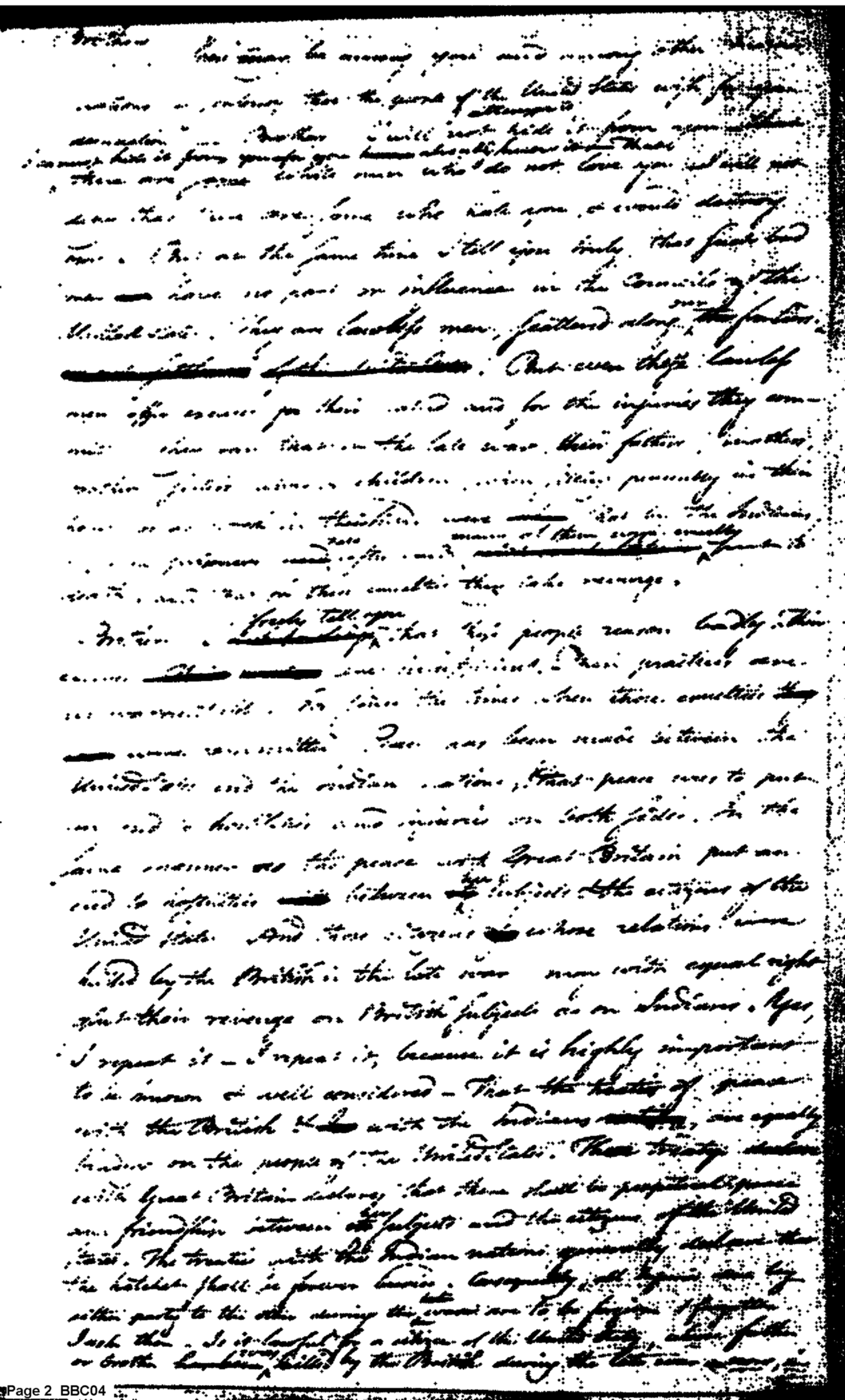
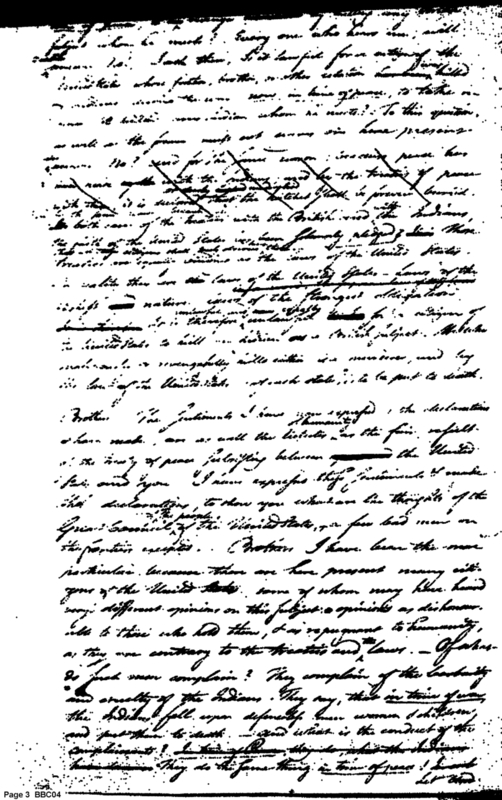
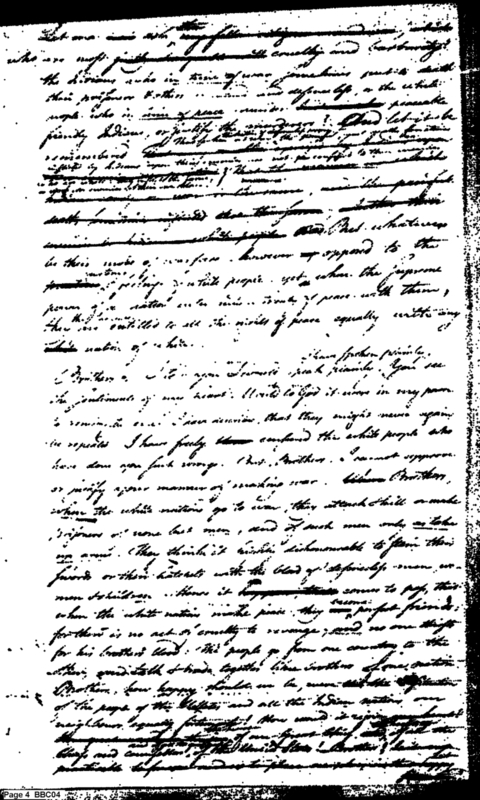
No human transcription currently available for this document.
This transcription was generated by machine using Anthropic's Claude Code (model sonnet 4.6). It may contain errors or inaccuracies. Please verify against the document image. Learn more about our generative AI methodology.
[undecipherable] [there?] [to?] [reason?] you and [many?] other [undecipherable]
[nations?] to [convince?] that the [people] of the United States with [foreign?]
[description?] — Brother I will [not?] hide it from you —
[I?] [cannot?] hide it from you for you have already [heard?] it [said?] that
There are [great?] white men who do not love you and will not
[do?] [then?] [those?] who hate you & would [destroy?]
[you?] — [But?] at the same time I tell you truly, that [such?] [bad?]
men [have?] no part or influence in the Councils of the
United States — [they] are lawless men, [scattered along] [the frontier] —
[undecipherable] [undecipherable] — But even these lawless
men offer excuses for their [acts?] and for the injuries they com-
mit — [they?] say that in the late war their fathers — [brothers?]
[mothers?] [their?] [fathers?] [wives?] [children] [were?] — [their?] [property?] in this
[home?] or on [something?] themselves were [?] [not?] to the [undecipherable]
[?] [many of them were cruelly?] [?]
[?] [death?], and [that?] in [their?] cruelty they take revenge —
Brother — [truely tell you?] [undecipherable] has [this?] [people?] [reason?] badly — [this?]
cause [this?] [and?] [undecipherable] — [their?] [practices are?]
[unreasonable?] — [To join?] the [times?] [when?] those cruelties [they?]
[were committed?] — Peace has been made between the
United States and the Indian nations — [That?] peace was to put
an end to hostilities and [injuries] on both sides — In the
same manner as the peace with Great Britain put an
end to hostilities [and?] between [the?] subjects [& the?] citizens of the
United States — And those [persons?] [to?] whose relations [were?]
[killed] by the British in the late war — men with equal right
[give their?] revenge on British subjects as on Indians — Yes,
I repeat it — I repeat it, because it is highly important
to be known & well considered — That the [treaty?] of peace
with the British [and?] with the Indians [nations?], are equally
binding on the people of the United States — [The?] treaty [with?]
Great Britain [declares?] that there shall be perpetual peace
and friendship between [the?] subjects and the [citizens] of the United
[States?] — The treaties with the Indian nations [?] that
the [hatred?] shall in [forever?] [be?] [buried?], [Consequently?] [it?] [is?] [?] [?] [duty?]
[of?] [either?] party to the other [?] during the [war?] [are to be?] [forgiven?] [by?]
[each other?] — Such then — Is it lawful for a citizen of the United [States?] [who?] [?] his
[or?] [brothers?] [truly?] [killed?] by the British, during [the?] [?] [?] —
[?] [whom he meets?] — Every one who [hears] him will
[call?] him to [account?] — I [ask] then, Is it lawful for an injured [?]
[whose] father, brother, or other [relative?] [was?] [killed?]
by [Indians?] [during the?] same [war?], in time of peace, to [father?]
[on?] [and?] [to?] [kill?] [every?] Indian [whom he meets?] — To this question
as well as the [former?] must not every one have [presenting?]
in [?] — No! I [said?] [for?] [the?] same reason: [because?] peace has
[now been made?] with the Indians, and [the?] [treaties?] of peace
with [them?], it is [determined?] that the [hatred?] [is?] [to be?] [buried?] —
[?] to both [?] of the [treaty?] with the British and the Indians —
the [guilt?] of the United States [has?] [been?] [solemnly?] pledged [for?] [those?]
[treaties?] — [?] [?] — Treaties are equally [binding?] as the laws of the United States —
In [reality?] they are the laws of the United States — laws of the [strongest?] [obligation?] —
[and most?] [easily?] [binding?] for a citizen of
the United States to kill an Indian as a British subject — [Murders?] [are?]
a [responsibility?] [which?] falls within [its?] [minimum?], and by
the laws of the United States [and?] such [state?], to be put to death —
Brother — The [judgments?] I have given [expressed?]: the [declarations?]
I have made, are as well the [beliefs?] as the [firm?] [belief?]
of the [treaty?] of peace [justifying?] between [undecipherable] the United
States and you — I now express [these?] [judgments?] [I?] make
[these?] [declarations], to show you what are the thoughts of the
[General?] [?] of the United States [?] [few?] [bad men on?]
the [frontier?] [excepted?] — Brother I have been the more
particular because there are here present many citizens
of the United States some of whom may [have?] heard
very different opinions on this subject; opinions as dishonourable
to those who hold them, as repugnant to humanity,
as they are contrary to the Treaties and [Laws?] — Of what do
[they?] [find?] [men?] complain? They complain of the [barbarity]
and cruelty of the Indians — They say, that in time of [war?],
the Indians fell upon defenceless men, women & children,
and put [them?] to death — And what is the conduct of the
[complainants?] [In time of Peace?] they do [undecipherable] [the Indians]
[undecipherable] — They do the same thing in time of peace — [Let them] —
[Let me?] [ask?] [also?] [my?] [fellow-citizens?] [undecipherable] — [who?]
are most guilty [undecipherable] — [of?] [cruelty and barbarity?] —
the [Indians?] who in time of [war?] [sometimes?] [put?] to death
their prisoners [brothers?] [undecipherable] [or?] the white
people who in time of peace murder [them?] [undecipherable] [peaceable?]
friendly Indians, or [justify?] the [murderers?] [?] — [?] [?] [?] [that?] [they?] [the?]
[?] [?] [something?] is not [confined to?] their [own?] [?]
[infested?] by Indians upon [their?] enemies — [undecipherable] — [?] [the?]
[same?] — [?] [our?] [enemies?] [?] — [something?] the principal
[death?] [bringing?] [divided?] [therefore?] — [?] [whatever may?]
[concern?] [him?] [with?] the people [?] — But, whatever may
be their mode of [warfare?] — however [I?] opposed to the
[sense of?] [humanity?], [?] the [present?] [feelings?] of the
whole people — yet, when the [Supreme?] power of a nation
enters into [a?] [treaty?] of peace with them, [they are something?] —
[?] they are [entitled?] to all the [rights?] of peace equally with any
[white?] nation of [whites?] —
[I have spoken plainly.]
[My?] Brothers — I [?] you [honestly?] [speak?] friendly — You see
the [judgments?] of my heart — [Would?] to God it were in my power
to [remove?] [them?] [ever?] — I now [mention?] that they might never again
be repeated — I have freely [blamed?] [condemned?] the white people who
have done you such wrong — But, Brothers — I cannot approve
or justify [your?] manner of making war — [Listen?] Brothers,
when the white nations go to war, they [attack?] [still?] or make
prisoners of none but men, and [?] such men only as take
up arms — [They?] [think?] it [truly?] dishonourable to [stain?] their
[swords?] or their [hatches?] with the blood of [defenceless?] men,
women or children — [Now?] it [?] [comes to?] pass, that
when the white nations make peace [they?] are perfect friends —
for there is no act of cruelty to revenge — [and?] no one [suffers?]
for his [brothers?] blood — the people go from one country to the
other, [trade?] [?], trade together like brothers of one [nation?] —
Brother, how happy should we be, were all the [?]
of the people of the [?] and all the Indian nations [our?]
neighbours [equally?] [?] [?] [?] [?] [?] — [?] [undecipherable] — [something?] [the?]
[?] [?] [?] [?] [?] [?] of the United States — Brothers [undecipherable] — [that?]
practically [?] [?] — [?] [?] [?] [?] — [they?] —
Type
Draft Document
Description
These are the proceedings of the Council with the Six Nations. The following matters are discussed: the Revolutionary War; Indians and Indian warfare; white aggression; Indian aggression; war with Western Indians; civilizing the Indians; benefits of writing; white encroachment; and the proof of the general government's good will.
Date
1791
Author
Recipient
Repository
Collection
Document number
1791999990105
Page start
1
Note
Partially illegible.
No author is shown but, based on content, it is presumed to be Pickering.
Notable persons
Timothy Pickering
Cornplanter
men of understanding
forefathers and grandfathers
English, French and other white nations
[black]smiths
Senecas
brothers, sachems, chiefs, warriors
lawless men
citizens of the United States
Notable locations
New York
Fort Stanwix
Tioga
Notable items
commission in behalf of the United States
good things of this life
clothes I have on
things which I have proposed to you
increase in your numbers
abundance of necessaries and good things like the white people
time to begin those improvements
stronger proofs of their love
their numbers are greater than you can reckon upon
till the ground
grow corn
other grain to make hay
abundance of cattle, sheep and hogs
things they needed for their own consumption
surplus sent to other countries for exchange
food
great hardships
present of goods to the Indians
hunting
cattle, sheep and hogs
black hair and black eyes
become as knowing as white people
iron tools
abundance of cattle
white people plough and raise so much corn
knowledge of writing & books
husbandry and other arts
necessaries of life in plenty
cultivate the ground
rights to sell and the rights of refusing to sell your lands
path of peace
we have committed faults
your wishes on the subject of tilling the ground
teach us to plough and to grind
building saw mills
broad axes, saws
tools
teach our children to read and to write and our women to spin and to weave
manner of your doing these things for us we leave to you who understand them
your lands
Indian lands
Great mouth
security for the remainder of your lands
protect you in all your just rights
Treaty of Fort Stanwix
plain words
your hearts
strong & lasting establishment of peace
chain of friendship
grounds of jealousy
time of peace
sentiments of my heart
your manner of making war
close of my speech
happy condition of the nations of white men as soon as peace made between them
friendship between us and the Six Natons was fast advancing
good disposition of the United States towards it had been sincerely declared
proofs I will now exhibit
Speech of our Great Chief
message inviting you to this council fire treaty
objects of our meeting
all causes of jealousies and discontents
special matter which suggested the expediency of kindling the council fire
war with the Western Indians
strongest obligation
British subject
sentiments I know you expressed
declarations of harm made
thoughts of the great conduct of the people of the United States
opinions as dishonourable to those who had them
cruelty of the Indians
equal right
treaties of peace with the British and with the Indians
influence in the councils of the United States
hostilities and injuries on both sides
same measure as the peace with Great Britain