Campaign Against the Indians
Document 1791Knox discusses Indian hostilities and the campaign against the Indians. He alludes to the possibility of a treaty that would eliminate the need for warfare.
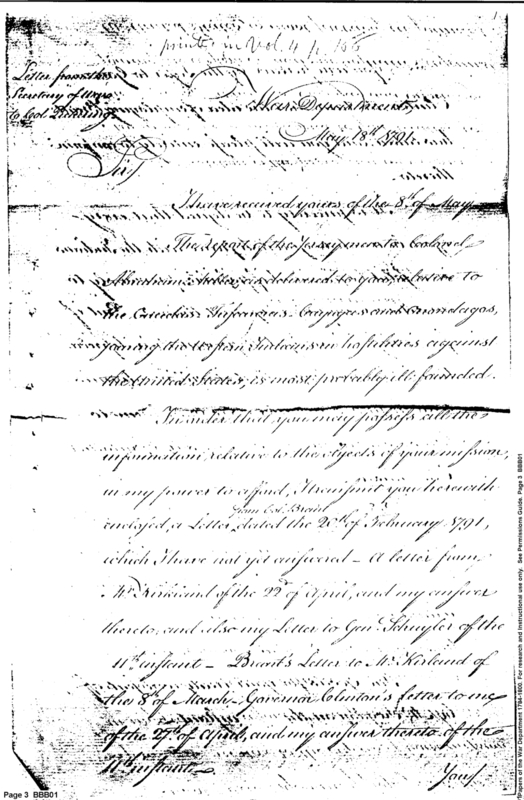
No human transcription currently available for this document.
This transcription was generated by machine using Anthropic's Claude Code (a mix of sonnet and opus models). It may contain errors or inaccuracies. Please verify against the document image. Learn more about our generative AI methodology.
the subject.
Counting on your Council for removing them in one, I hope will answer the good purposes to which they seem to aim, and establish that friendship which we have long wished to effect upon principles of mutual justice. The number of Council fires which have since the year 1784 been kindled in our Country, has kept our hearts in a state of inflammation, at many of which have we had a full representation - and although your present mode of treating with us, may prevent such abuses as have been practised, from being exercised in future by your Citizens, yet if partial representations are still received from our People, I can afford it will well fall short of effecting that happy end which our mutual interest requires. It is difficult for us to prevent individuals from interspersing you with ill-assumed powers, which they have no right to, if such meet encouragement, harmony cannot be established with permanency.
Obell (as the Complainter) a Seneca Chief, I understand has lately imposed himself on the President of the United States, as a representative of the Five Nations, he not being empowered by them, or any one of them, I am ignorant of his business, but it has been suggested to me, that amongst other things, he has complained of a deception upon the Indians in the purchase of the Genesee Country, in which I feel myself particularly called upon to contradict, in vindication of my own character, as well as in justification of the purchasers.
Influenced by [undecipherable] and other selfish views in the fall of 1787, he prevailed on the Chiefs (who were sent to Canandaigua to cover up the Council fire kindled there by M. Pierre Livingston) to lease the whole of the Five Nation Country, for a consideration of Twenty thousand Dollars, subject to an annual rent of Five thousand Dollars, and it was with the utmost difficulty, that the united efforts of the Five Nations were able to remove that Lease from off one half this Country in Spring 179[undecipherable], at which time Mr. Phelps came with authority from the State of Massachusetts and agreed with the Chiefs in a very full Council, for a Tract of Land on the Genesee river; the price of which the Chiefs requested the Rev. Mr. Kirkland, Col. Butler & myself would determine, which was done on these principles [undecipherable] that the whole Country in place of Twenty was worth Thirty thousand Dollars, consequently Colonel Livingston should pay Fifteen thousand Dollars, and One thousand annually. Mr. Phelps having about one third of the remainder, it followed of course that he should pay Five thousand, and we fixed the annual rent at Five hundred Dollars. The writings were then drawn and explained by Mr. Kirkland in full Council, and agreed to without a dissenting voice, they were afterwards lodged with Colonel Butler at Niagara, where they remained till the time of payment, the year following, and no dissatisfaction appeared amongst our People until they assembled at Canandaigua, to receive the money, when Obell demanded Ten thousand Dollars. he was honourably opposed by all the Chiefs, except the Senekas to whom he belonged, and finally gave up the point, and received the money.
I presume it must, from those circumstances, appear as extraordinary to every man of sense, as it does absurd to me, that the man who was the sole instigator of the Country being first sold, at Leased for 20,000 Dollars, in a clandestine manner, should afterwards object to the same purchase, which agreed upon openly and fairly in full Council for two thirds of it, it clearly evinces that self-interest was too predominant with him, and his not being bribed this, as he was formerly by the Leases, must be the cause of this extraordinary conduct in him. Should individuals, of Parties, without the concurrence of the whole, must cause [undecipherable: probable reading "resentment"], the Five Nations cannot be happy amongst themselves, nor can that harmony subsist between them and their neighbours, as might be produced by a general representation of the camps of usurpers, where there is any, which has long been the united wish of the Nations.
I have the honor &c.
The Rev. Sam. Kirkland }
to the Secretary of War } Oneida, 22 April 1791.
Hon. Sir,
When I was in Philadelphia the winter past, and honored with a personal interview with you, the character & present situation of the Indians were a subject of much conversation - among other things the propriety & practicability of an accommodation with the Indians in the vicinity of the Miamis, to prevent the havocss of an Indian war, were enquired into.
Their complaints & unwillingness which at length broke out into open hostilities, I ascribed to two causes - viz. the influence and artifice of unprincipled traders & others who had immediate access to them; - & secondly their ignorance of the fixed determinations & real dispositions of Congress [undecipherable] to the Indians. To remove those prejudices & correct their mistaken apprehensions, it was proposed, that a number of their Chiefs should be brought down to Congress, that both might have a fair hearing. This idea was suggested by Captain Obell (alias Complainter) who on the occasion remarked, "that the voice of Congress could never reach those Western tribes of Indians, before it passed thro' so vast a tract of Country it would either evaporate into the air, or be interrupted by the voice of Birds" - alluding to the artifice of evil-minded persons and unfriendly to the States.
Some time after my return from Philadelphia, as a friendly correspondence is kept up between Capt. Brant & myself, I wrote to him upon the state of the Indians at large; and the discouragement ments that attended every attempt (already made) to introduce the arts of civilized life among them; Subjects upon which we had frequently conversed with the utmost freedom. I also expressed my fears that their love of war with their spirit of jealousy, would terminate in their ruin. —
I must acknowledge, that my chief design in this, was to obtain his sentiments and feelings towards the hostile Indians, in the vicinity of the Miamis. A few days ago, I received his answer by two Runners. Your official character and known humanity, induce me, to transmit you a copy of his letter, for your own perusal, and not for publication - as my situation among them is delicate and am continually watched.
I shall at present make no comment upon his letter - am obliged to write in haste. The strong tinct of British influence & interests in many passages will not easily escape your discerning eye. Its [undecipherable] an Indian War, from every principle, both of humanity and policy; - if it can possibly be avoided without a direct violation of the laws of the General government; - permit me, Sir, to suggest the idea of sending Capt. Hendrick & one other Chief of the Stockbridge tribe to the Westward. This tribe had formerly more influence with the Miamies, Shewanese, Delawares and Chippewas, than all the Five Nations. Captain Hendrick is well acquainted with their customs & manners, and has since the war received several invitations from those Western tribes to make them a visit. He once went as far as Buffaloe Creek where he met with some of his own Nation, who reside in that quarter. In a private Council of the Oneida Chiefs, they have refused to themselves. Capt. Hendrick felt less himself; he could convince them of the justice & goodness of Congress in the treatment they are disposed to give to all Indians; & persuade them to lay down the hatchet, till they could give Congress a fair hearing. As you are in a good measure a stranger to Capt. Hendrick's character, allow me from long personal acquaintance, to say in a word, that he is very little inferior to Complainter - who also himself has a high opinion of Captain Hendrick, and mentioned him to me, while at Philadelphia, as a proper person for our Embassy to the Westward. Capt. Hendricks and one other will either gain the same on [undecipherable] by their own motion; or, at your direction - as may be thought best, if he can only be furnished for the journey, with the necessary articles of Clothing - Belts & strings of Wampum, with a little money - the whole amount of which would be no more than Fifty or Sixty Dollars. The support of his family might require as much as twenty bushels of grain between this and next fall. Should the proposal meet with your approbation as bearing the signatures of humanity & policy - you will please to honor me with the earliest notice, as no time should be lost for the enterprise; to forward which every aid in my power shall be most cheerfully afforded.
With Sentiments &c. &c.
Joseph Brant's Letter } Grand River
to the } 8th March 1791.
Rev. Samd Kirkland }
My dear Friend
I am happy in having the pleasure to acknowledge your favor by Mr. C. Phelps, dated the 12th ultimo, in which I observe with no small regret that you are discouraged of ever making that progress in civilization amongst the Indians in which you once appeared much more sanguine.
I must acknowledge that the present face of affairs seems to throw a damp upon the undertaking and makes the prospect more gloomy as it again spreads that dark veil which had begun to remove from off the minds of some, which will not only make the undertaking more difficult, but protract the work, whilst those already on enlightened are moving gradually off the stage, to leave the completion to less experienced hands.
Although the minds of the Indians seem to be encompassed in a cloud, which their own strength of judgement cannot remove, and their prejudices so great that it becomes difficult, fully, I cannot condemn them when I consider the many reasons which operate upon them. To impute it to defect in nature would be ascribing the blame where we have no right to found. They believe the Supreme Power created both them and the white People, but perhaps for different purposes; hence in justice the first prejudices - a chain of corroborating circumstances and events, seems to convince to them that the White People, under whatever pretense, aim at their destruction - possessed with such ideas, their prejudices naturally increase, and finding the fraud in more hand supported by injustice and corruption, [is] it any wonder they suspect the sincerity of any proposals made to them on the other hand, for so great a change as civilization would make; in what whatever color it is represented. 2dly They must first be convinced that a change will not place them in a worse situation than they are now in, and that it must be begun by a strict adherence to the dictates of justice, a rigid observance of all compacts and engagements on the part of the White People.
Boundaries may be fixed and territories described, unity and concord amongst themselves must be encouraged, and their own customs rather nourished than discouraged, whilst you introduce agriculture; by thus showing and proving that you have the happiness of them and their posterity at heart, you may gain their confidence by degrees, and civilization will then make progress.
But whilst the White People, who have already engrossed the best part of their former territory, continue to crowd, disunite and raise dissensions amongst the Indians, and individuals who are conversant with them & pretend the greatest friendship, and recommend civilization and adherence to the manners and customs of the White People, as an especial means of securing happiness, will not only connive at, but be the first instruments of fitting the designs of those wicked encroachments, harmony cannot long prevail, nor civilization flourish.
And [they] must know, the Indians require the [undecipherable] they will be [undecipherable] which have been practised upon them, by the White People and consequently they will be the more averse to adopting the manners of such People in the place of the customs of their own fathers who lived happy and free from strife before they became acquainted with them.
You express a desire to see my Indian History complete - I sincerely wish I could gratify my friends and the world with it; but the unhappy barrier which at present presents itself will either put a final stop to it or furnish materials for its enlargement, at any rate it will protract the work.
It has been my constant study since the peace between Great Britain and the United States, to unite the Indians together & make such a peace between them and the States, as would remove all prejudices and enable us to be quietly amongst our own [undecipherable] apprehensions and jealousy, and if not become more respectable, at least not more contemptible.
Could I have been instrumental in accomplishing that I should have been felicitated, and have had [undecipherable] to have visited the distant Indians and [undecipherable] at Miamis to proceed upon such my History, and to make it more serviceable to the public it is necessary to inform myself with the Ideas entertained by the different Nations of this [undecipherable] nation and of a future state - the Reforms preferred by the Indians amongst themselves, and also a knowledge of the medical Plants natural to this soil & climate.
You also wish me to suggest my Ideas on the practicability of accommodation between the Western Indians and the United States, to which I reply candidly that I think it still practicable if proper [undecipherable] after their Parties [undecipherable] by [undecipherable] the [undecipherable] they should direct the Union and make such proposals as will place the Indians in a more respectable footing than they have hitherto attempted, give up the idea of being possessors of the Country, as conquerors & treat, abandon that ancient mode of gaining them and separate themselves as parties to treat with them, which now forces to irritate and enflame their minds & retards the prevailing purpose.
If Governor [undecipherable] & now is the moment the Indians will still receive them a sufficiency of Land & be ready to establish an accommodating line upon reasonable terms, and if the States treat with them as a free people and abandon the idea of conquest, they may always obtain it at proper terms, as their possessors in [undecipherable], the Country will not be disputed. Let the Americans look back and take a view of their own affairs at the beginning of the late [war]; they say themselves it was not the amount of law, but the manner [undecipherable] & union which is so [undecipherable], because it is exposing men to danger for extending it over the whole of the Indians [undecipherable] limits within the Union. And which would be very bad and the highest degree of [undecipherable] for men from taking an active part in the late war, they hardly heard of such a time. But as the Idea of Conquest extended amongst them the outrage became more alarming and every man feels the urgency [undecipherable] has been Capt. [undecipherable] [undecipherable] in which manner the [undecipherable] is providing where no prejudice has before taken place.
Therefore continuing the [undecipherable] will [undecipherable] more opposition generally, and [undecipherable] against the White People will take such [undecipherable] that they will not be easily moved. [undecipherable] is general peace and [undecipherable], and which is most effectual in accomplishing that hope of [undecipherable] and [undecipherable] to the advantage [undecipherable] the [undecipherable] Miamis; the Indians fell in with a party of light Horse, beat them off, the commanding Officer next day, sent out a foraging Party and a [undecipherable] ment ensued, the Indians after some time made a faint retreat to give time for a reinforcement to come up, when they renewed the action and repelled the Enemy with the loss of about Seventy five men in all, the loss of the White People is supposed by the Indians to be between two & three hundred, but your situation will enable you to get a more accurate account of their loss than I can give you.
I have fully complied with your request as to the length of my Letter, if I have not answered your expectations in other respects - and I hope you will return the compliment by return of the Bearers, and then I shall be convinced that you mean to be a good correspondent.
I am, Dear Friend &c.
[The Secretary at War to } War Department
Col. Pickering } Aug 11th 1791
[undecipherable] [undecipherable] you Letter of [undecipherable]]
22d of April, for which I sincerely thank you. I highly approve of Capt. Hendrick's being employed, and will make good any reasonable allowance to him for his services. Let him call on Colonel Pickering at Wyoming, who will furnish him with Clothing & Necessaries for the purpose. General Schuyler also mentioned, a Oneida Chief of great respectability, with a [undecipherable] would also accompany the others. But I imagine the Complainter has already anticipated the others and gone forward.
Colonel Brant is right as to the principle of the boundaries. The idea or fixture of conquest ought to be relinquished, and fair purchase and optional sale to take place.
I should be glad to hear that you have pushed forward Capt. Hendricks and the Chief, Peter.
I am &c &c.
The Secretary at War } War Department
to Gen. Schuyler } May 11th 1791.
Dear Sir
I was in hopes to have heard from you relative to your idea of employing the Chief old Peter, of the Oneidas. Mr. Kirkland has written relative to the same object for Capt. Hendricks, of whom he speaks well.
The Complainter [undecipherable: continues farther?] probably has gone forward to the hostile Indians before this time.
If you think proper to employ Capt. Hendricks, and Peter, whom you mentioned, and furnish them with the necessary means for the purpose; I will instantly make the reimbursements to your order, pray let me hear from you as soon as possible.
I request the favor of you to forward the enclosed Letter as soon as possible.
I am, &c. &c.
Governor Clinton, to } New York, 27th April 1791
the Secretary at War }
Sir
I have received the Letter which you did me the honor to write on the 12th instant; and by the tenour of the communications therein contained I am led to conclude that the President has given you his discretionary powers in regard of the objects upon which you have been pleased to confer with me.
So far am with some regret that the measure of attempting a Convention of the whole Six Nations, hath been presented and acted upon. It cannot be intimated to you that those Nations are at present disjointed by private animosities. That there exists not among them mutual intercourse and confidence sufficient to lead to a general combination so as to effect (without the interposition of the agents of the United States) a general Congress of those Nations even for the purpose of deliberation. That this division produces impatency and causes inaction, and that if we should revive their importance by renewing their union we may give power and vigor which we cannot with certainty direct and over which we shall with much trouble and expense have an uncertain control. But having heretofore communicated to the President my sentiments upon the policy of that measure I shall not enter further into, and I entreat you to be assured that how much however I may differ as to the means I shall with the utmost cheerfulness most assiduously concur with you in endeavors to attain the ends which you justly consider as momentous and interesting to the Union.
I have communicated to Col. Willett your confidence in his talents and desire for the interposition of his influence with Brant, but have it not in my power to inform you if he received [any] inquiry - I could wish it, [that] an application might be made to him, having [undecipherable] if you see some continuance in the opinion of the importance of being, is possible exertions on the case to be given.
I had in June last appointed an interview with Brant contemplating the danger - was happy to approach him from his address and his influence with several of the Indian Nations (which I am gratified is very considerable and from different Letters I have since received from him). However, propose to hope he will give me the opportunity of a personal conference with him at this time the beginning of the coming Summer of the proposed Convention to which [undecipherable] endeavoured to promote will I doubt not predominate over any transient disgust that the measures of the Union may have heretofore excited in his mind and enable me to propose an interview with him at any time and place not particularly inconvenient. To accomplish this, however with certainty it may require the personal application of some one expressly delegated and in whom he will confide. As your wishes appear to be confined to Col. Willett, I shall not without your further directives undertake to exercise a discretion on this Subject. Your knowledge of the views of Government enable you to determine the importance of this measure; I am only told that the most perfect reliance may be had on my exertions to carry those views into effect when the positive commands of co-operation shall be defined and connected with competent authority.
With Sentiments &c.
The Secretary at War } War Department
to Governor Clinton } 11 May 1791.
Sir
I had the honor on the 5th instant, to receive your Excellency's favors dated the 27th ultimo, being an answer to my Letter, of the 12th of the same month.
I am sorry that you do not approve the Convention of the Six Nations at this particular, [undecipherable] - not only the measure appeared highly a expedient in order to prevent their joining the Western Indians; but if possible to induce them as a security to the continuance of their friendship, to join some of their young Warriors to the troops of the United States.
Although the Senekas were the principal object of the meeting, that tribe constituting the main body of the Six Nations resident within the general limits of the United States, yet it was conceived that it would have been impolitic to omit inviting the other tribes eastward of the Senekas, to the meeting.
My having seen your Letter to the President of the United States, relative to Capt. Joseph Brant, and knowing also from repeated personal communications with your Excellency the confidence Brant reposed in your character, together with a persuasion of your candidly to pacify more fires with the Indians, was my inducement to address you on the 12th ultimo.
My authority on the occasion was founded on the common [undecipherable] that the business of Indian Affairs had been established by law as a branch of the Department of War, and that the President of the United States had instructed me upon the objects of the Department during his absence.
I am not enough acquainted with the character or views of Capt. Brant, to be able to conclude whether he would work cordially in the design of peace, upon such principles as may not hereafter create greater embarrassments. This was a point which I submitted to your Excellency's decision.
I am fully possessed with the information of his enmity to the Complainter, who I am of opinion is greatly attached to the United States, upon the joint conviction of the measure being the only one by which he and the other Indians shall be secured from utter destruction.
The Complainter has been lately engaged to present the Indians to find [undecipherable] a powerful deputation under his direction, to assist Col. Butler to the Miamis Indians in order to incline those to peace.
This information has been lately received, from appearances I am inclined to believe that Col. Butler [undecipherable] by the Indians, may treat those here either actually with, or very [undecipherable] the notion [undecipherable].
Your Excellency may remember Capt. Brant's assertions in the year 1785, to procure a general Confederation of all the Nations of [undecipherable], and the [undecipherable].
By a late letter which he has written to Mr. Kirkland, and which I received yesterday, it [undecipherable] that he still should take that measure, if he could find it practicable. But such measures cannot but be for the [undecipherable] interest of the United States [undecipherable] although justice, policy & humanity dictate a liberal treatment of the Indians, it cannot be for the public [undecipherable]
Type
Contemporary Copy of Letter
Description
Knox discusses Indian hostilities and the campaign against the Indians. He alludes to the possibility of a treaty that would eliminate the need for warfare.
Date
05/18/1791
Author
Recipient
Sent from
War Department
Repository
Collection
Document number
1791051800001
Page start
1
Note
Partially illegible.
Notable persons
Timothy Pickering
Henry Knox, Secretary of War
[Samuel] Hodgdon
[Samuel] Kirkland
General Schuyler
Governor Clinton
Colonel [Joseph] Brant
Colonel Abraham [?]
Tuscaroras
Oneidas
Cayugas
Onondagos
Western indians in hostilities against the United States
Notable locations
War Department
Notable items
terms
necessity of another campaign
every facility to aid the messengers of peace
goods for your treaty were sent off
letter to the governor
active campaign against them
your mission
all the information