

Relations with the Five Nations
Document 1791Captain Brant discusses the Indian treaty, fraudulent Indian representatives, corruption, and land sales.

No human transcription currently available for this document.
This transcription was generated by machine using Anthropic's Claude Code (model sonnet 4.6). It may contain errors or inaccuracies. Please verify against the document image. Learn more about our generative AI methodology.
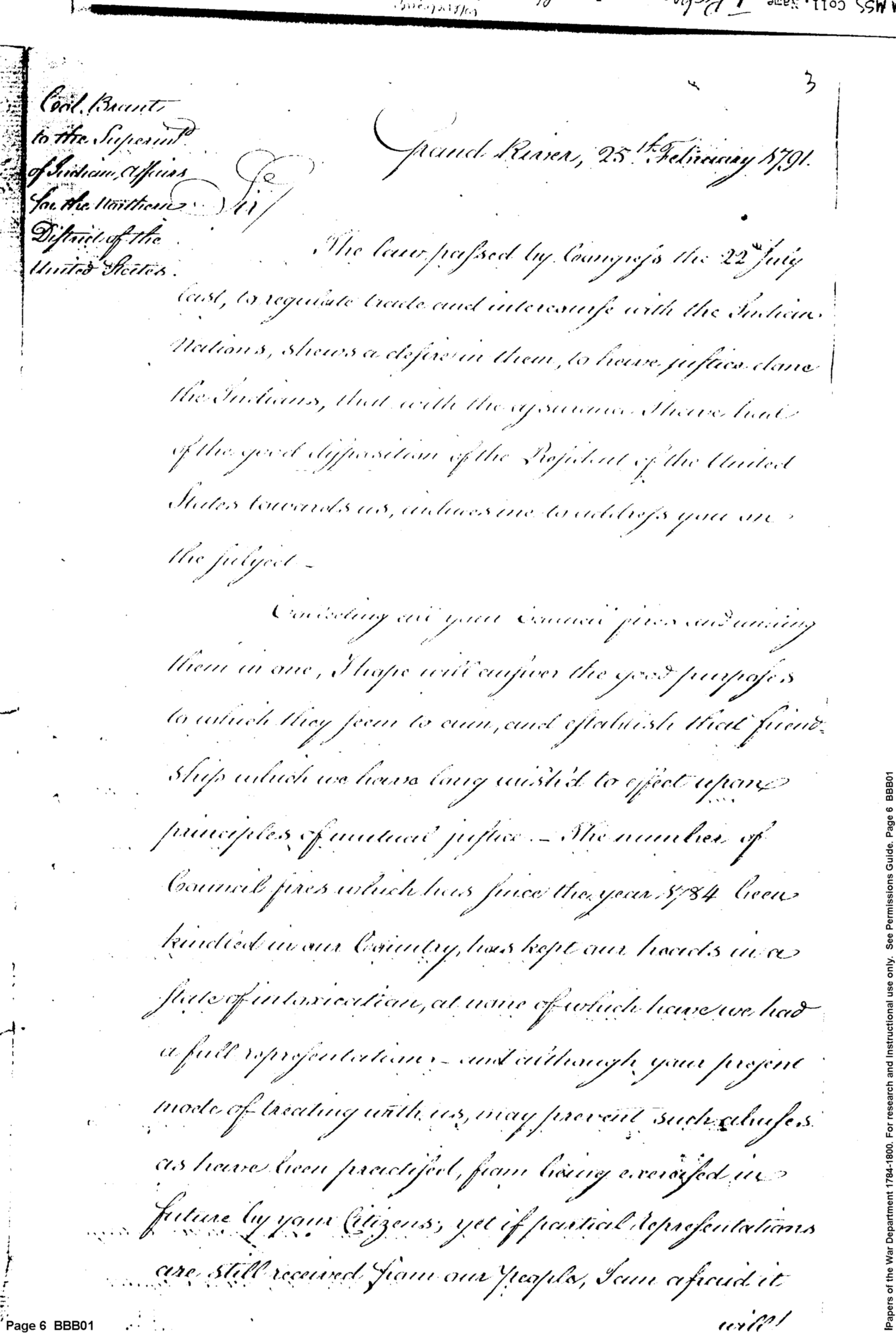
[Col. Brant
to the Supt
of Indian Affairs
in the Westren
Dt of the
States]
[N° 11]
Grand River, 25th February 1791
The laws passed by Congress the 22d July last, to regulate trade and intercourse with the Indian Nations, shews a desire in them, to have justice done the Indians, that with the assurances I have had of the good disposition of the President of the United States towards us, induces me to trouble you on the subject —
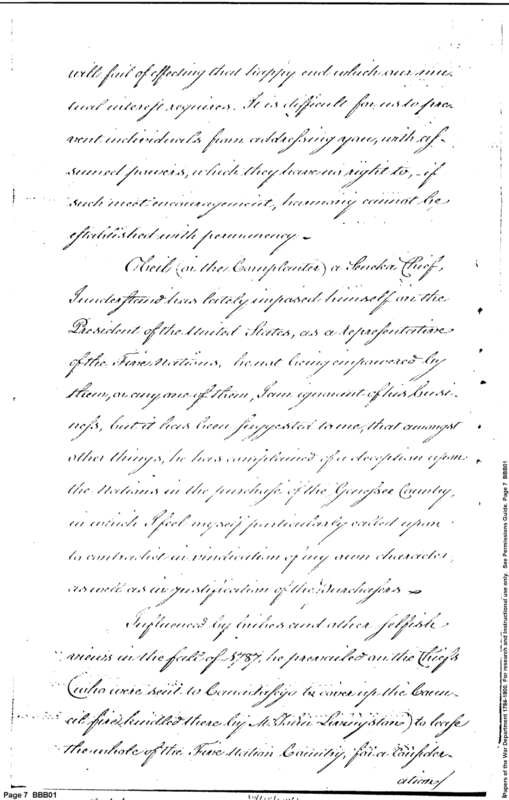
Counting on your Council fires as reducing them in one, I hope will answer the good purposes to extricate every thing from ruin, and establish that friend ship which we have long wished to effect upon principles of mutual justice — The number of Counsel fires which have since the year 83 been kindled in our Country has kept our hearts in a state of uncertainty, at none of which have we had a fair representation — and although your present mode of treating with us, may prevent such chiefs as have been practised from being received in future by your Citizens, yet if partial representations are still received from our People, I am afraid it will fail of effecting that happy end which our mutual interest requires. It is difficult for us to prevent individuals from addressing you, with assumed powers, which they have no right to — if such meet encouragement, harmony cannot be established with permanency —
Obeel (or the Cornplanter) a Seneka Chief, I understand has lately imposed himself on the President of the United States, as a Representative of the Five Nations, he not being impowered by them, or any one of them, I am ignorant of his business, but it has been suggested to me, that amongst other things, he has complained of a deception upon the Indians in the purchase of the Genesee Country, in which I feel myself particularly called upon to contradict in vindication of my own character as well as in justification of the Purchasers —
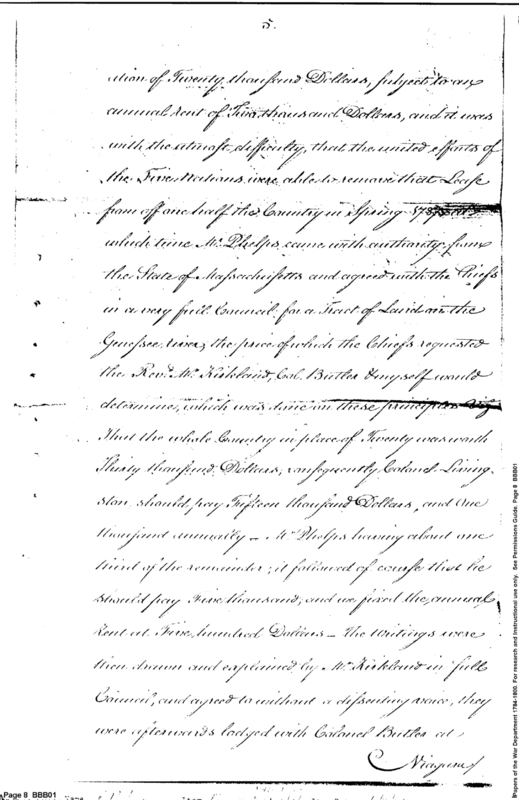
Influenced by Whites and other selfish views in the fall of 1787 he prevailed on the Chiefs who were sent to Connauhsago to come up the Country at first hunted there by Mr Peter Livingston, to lease the whole of the Five Nation Country, for a Consideration of Twenty thousand Dollars, subject to an annual rent of Two thousand Dollars, and it was with the utmost difficulty, that the united efforts of the Five Nations were able to remove their Lease from off one half the Country in Spring 1788 — which time Mr. Phelps came with authority from the State of Massachusetts and agreed with the Chiefs in a very full Council for a Tract of Land on the Genesee river, the price of which the Chiefs requested the Revd Mr. Kirkland Col. Butler & myself would determine, which was done on these principles —
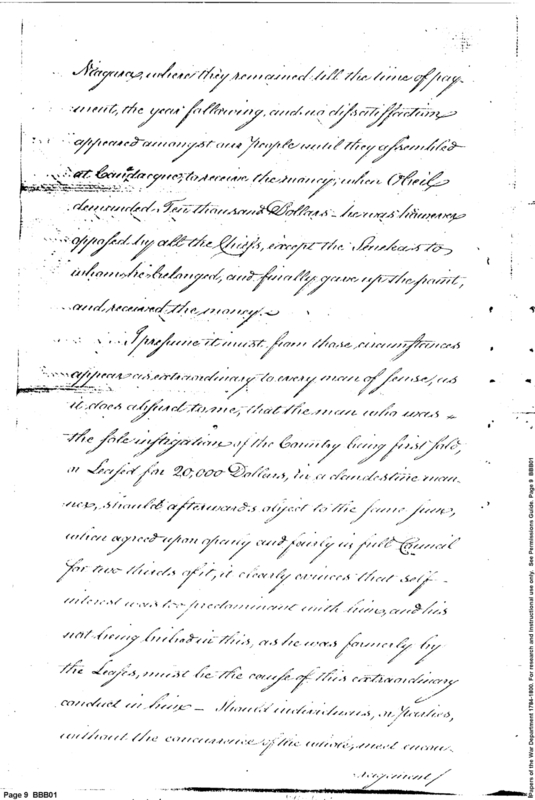
That the whole Country in place of Twenty was worth Thirty thousand Dollars, consequently Colonel Livingston should pay fifteen thousand Dollars, and two thousand annually — Mr Phelps having about one third of the remainder, it followed of course that he should pay Five thousand, and in lieu the annual Rent at Five hundred Dollars — The writings were then drawn and approved by Mr. Kirkland in full Council, and agreed to without a dissenting voice, they were afterwards lodged with Colonel Butler at Niagara where they remained till the time of payment, the year following, and no dissatisfaction appeared amongst our People until they assembled at Connatague to receive the money, when Obeel demanded Five thousand Dollars — he was unanimously opposed by all the Chiefs, except the Senecas to whom he belonged, and finally gave up the point, and received the money —
I presume it must from these circumstances appear extraordinary to every man of sense, as it does absurd to me, that the man who was — The sole instigator of the County being first sold, or leased for 20,000 Dollars, in a clandestine manner, should afterwards object to the fair transaction agreed upon openly and fairly in full Council for two thirds of it, it clearly evinces that self interest was his predominant motive, and his not being indulged in this, as he was formerly by the Lessee, must be the cause of this extraordinary conduct in him — Should individuals, or Factions, without the concurrence of the union, meet encouragement, the Five Nations cannot be happy amongst themselves, nor can that harmony subsist between them and their neighbours, as might be produced by a general representation of the causes of uneasiness, unless there is one, which has long been the united wish of the Nations —
I have the Honor &c
Type
Contemporary Copy of Letter
Description
Captain Brant discusses the Indian treaty, fraudulent Indian representatives, corruption, and land sales.
Date
02/25/1791
Author
Recipient
Sent from
Grand River
Repository
Collection
Document number
1791022590001
Page start
6
Note
Enclosed in Knox to Pickering, 05/18/1791.
Partially illegible.
Notable persons
Superintendent of Indian Affairs
Joseph Brant
Colonel Butler
Kirkland
Phelps
John Livingston
Obeil, or the Cornplanter
neighbors
Seneca Chief
representative of the Five Nations
Notable locations
Grand River
Canadaigua
Niagara
Genessee River
Massachusetts
Notable items
sole instigation of the country
object to the same sum when agreed upon openly and fairly in full council
self-interest was too predominant with him
leases
cause of this extraordinary conduct
united wish of the nations
time of payment
writings were then drawn and experienced
full council
agreed to without a dissenting voice
authority
lease the whole of the Five Nations country for a consideration of twenty thousand dollars subject to an annual rent
justifications of the purchasers
bribes and other selfish views
purchase of the Genessee country
present mode of treating with us
such abuses as have been practiced by your citizens
partial representations are still received from our people
happy end which our mutual interest requires
assumed powers which they have no right to
harmony cannot be established with permanency
law passed by Congress
trade and intercourse with the Indian nations
desire in them to have justice done the Indians
great disposition of the President of the United States towards us
good purposes to which they seem to claim
that friendship which we have long wish'd to effect
number of council fires kindled in our country
our heads in a state of intoxication
full representation