

Report of Indian Expedition, Including Battles and Sedition
Document 1791Suggests drawing upon reports of Captain Ferguson and Doctor Carmichael while waiting for official accounts from Harmar. Describes Indian attacks and different campaigns, often conflicting under different leaders and with discouraged militia members. Discusses provisions and inadequate clothing. Lists plunder of Indian towns for the quartermaster. Refers to leaving wounded on the field while the army retreated from the enemy. Reports insubordination of troops.

No human transcription currently available for this document.
This transcription was generated by machine using Anthropic's Claude Code (model sonnet 4.6). It may contain errors or inaccuracies. Please verify against the document image. Learn more about our generative AI methodology.
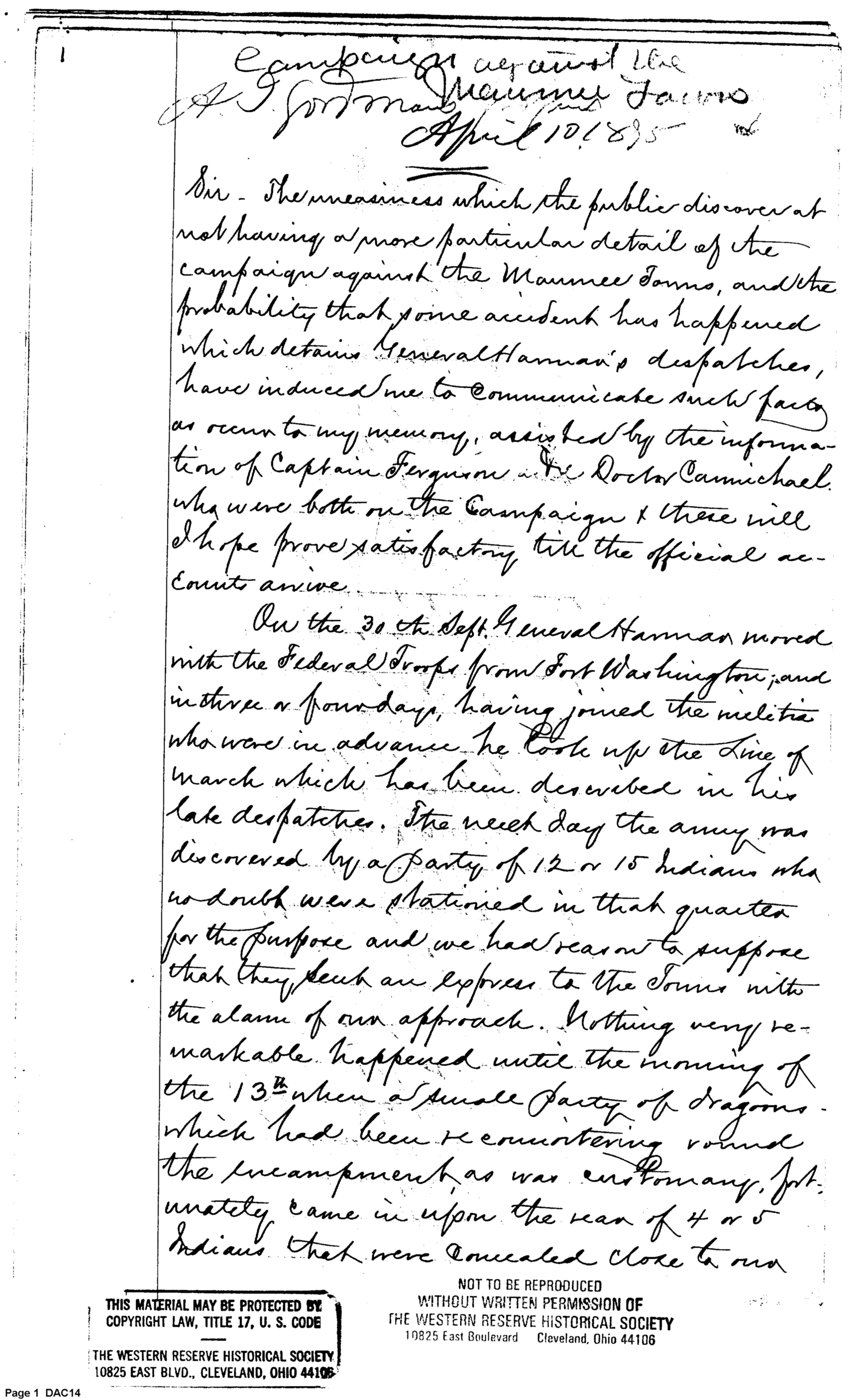
Campaign against the
A G Harmar Miami Towns
April 1791
Sir. The circumstances which the public discovers at not having a more particular detail of the campaign against the Miamee Towns, and the probability that some accident has happened which detains General Harman's despatches, have induced me to communicate such facts as occur to my memory, assisted by the information of Captain Fagnon — & Doctor Carmichael who was both on the Campaign & I trust will I hope prove satisfactory till the official account arrives.
On the 30 th Sept General Harmar moved with the federal Troops from Fort Washington, and in three or four days, having joined the militia who was in advance he took up the line of march which has been described in his late despatches. The next day the army was discovered by a party of 12 or 15 Indians who no doubt were Stationed in that quarter for the purpose and we had reason to suppose that they sent an Express to the Towns with the alarm of our approach. Nothing very remarkable happened until the morning of the 13th when a small party of Dragoons which had been reconnoisering around the encampment, as was customary, came in upon the rear of 4 or 5 Indians that were concealed close to our
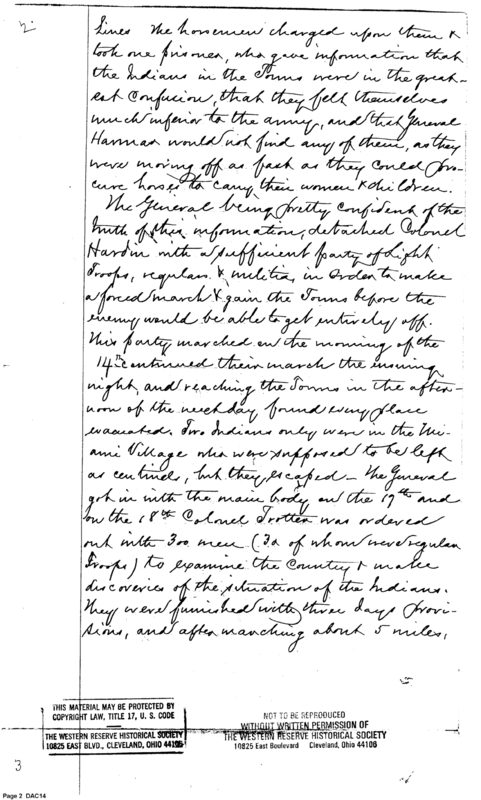
lines the horsemen charged upon them & took one prisoner, who gave information that the Indians in the Towns were in the greatest Confusion, that they held themselves much inferior to the army, and that General Harmar would not find any of them, as they were moving off as fast as they could from being forced to carry their women & children.
The General being pretty confident of the truth of this information, detached Colonel Hardin with a sufficient party of light Troops, regular & militia, in order to make a forced march & gain the Towns before the enemy would be able to get entirely off. This party marched in the morning of the 14th continued their march the morning night, and reaching the Towns in the afternoon of the next day, found every place evacuated. Five Indians only were in the Miami Village who were supposed to be left as sentinels, but they escaped. The General got in with the main body on the 17th and on the 18th Colonel Dotter was ordered out with 300 men (30 of whom were regular Troops) to examine the Country & make discoveries of the situations of the Indians. They were furnished with three days Provisions, and after marching about 5 miles,
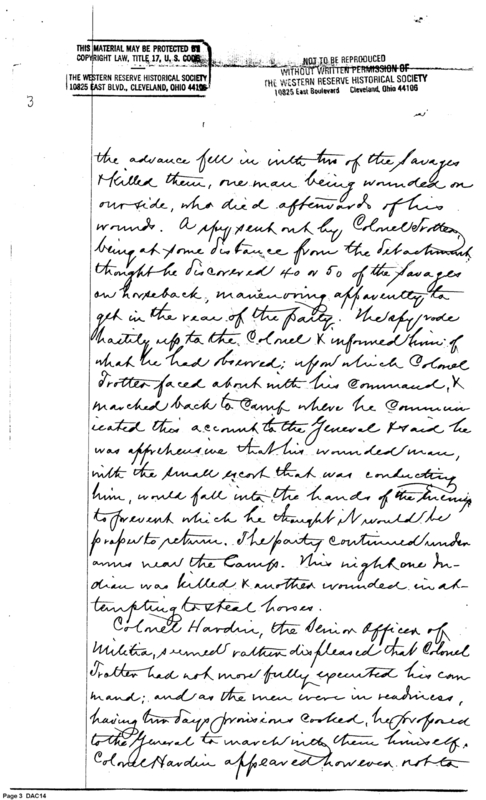
the advance fell in with two of the Savages & killed them, one man being wounded on our side, who died afterwards of his wound. A spy sent out by Colonel Dotter being at some distance from the detachment thought he discerned 40 or 50 of the Savages on horseback, manoeuvring apparently to get in the rear of the Party. The Spy rode hastily up to the Colonel & informed him of what he had observed, upon which Colonel Dotter faced about with his command, & marched back to Camp, where he communicated this account to the General, & said he was apprehensive that his wounded men, with the small scout that was conducting him, would fall into the hands of the Enemy to prevent which he thought it would be proper to return. The party continued under arms near the Camps. This night one Indian was killed & another wounded in attempting to steal horses.
Colonel Hardin, the Senior Officer of Militia, seemed rather displeased that Colonel Dotter had not more fully executed his command, and as the men were in readiness, having two days Provisions cooked, he proposed to the General to march with them himself. Colonel Hardin appeared however not to
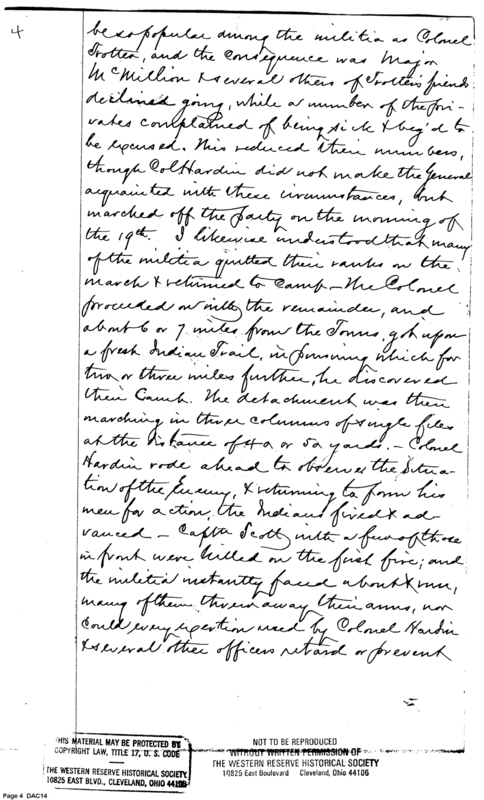
be so popular among the militia as Colonel Dotter, and the consequence was Major McMillan & several others of Dotter's friends declined going, while a number of the privates complained of being divided & being'd to be marched. This reduced their numbers, though Col Hardin did not make the General acquainted with these circumstances, but marched off the party on the morning of the 19th. I likewise understood that many of the militia quitted their ranks on the march & returned to camp. The Colonel proceeded on with the remainder, and about 6 or 7 miles from the Towns, got upon a fresh Indian Trail, in pursuing which for two or three miles further, he discovered their Camp. The detachment was then marching in three columns of single files at the distance of 40 or 50 yards. Colo Hardin rode ahead to observe the situation of the Enemy, & returning to form his men for action, the Indians fired & advanced — Capt Scott with a few of the three in front were killed on the first fire, and the militia instantly faced about & run, many of them throwing away their arms, nor could every exertion used by Colonel Hardin & several other officers retard or prevent
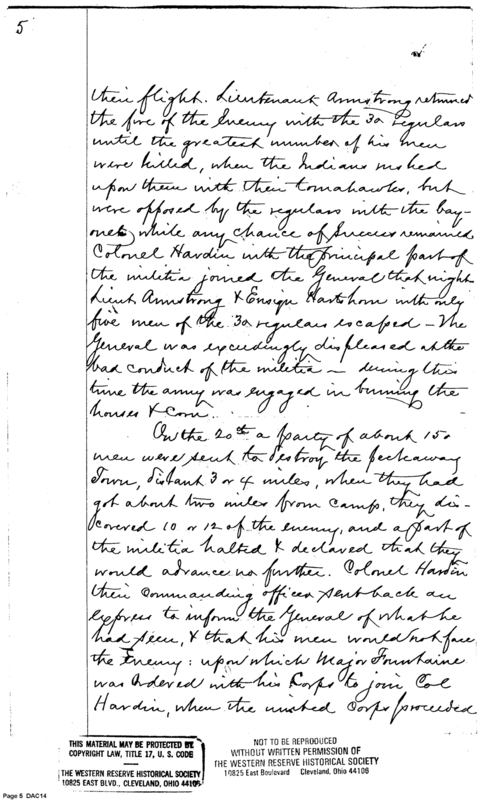
their flight. Lieutenant Armstrong retrained the fire of the Enemy with the 30 Regulars until the greatest number of his men were killed, when the Indians rushed upon them with their Tomahawks, but were opposed by the regulars with the bayonet, while any chance of success remained. Colonel Hardin with the principal part of the militia joined the General that night him & Ensign Hartshon with only five men of the 30 regulars escaped. The General was exceedingly displeased with the bad conduct of the militia — during this time the army was engaged in burning the houses & Corn.
On the 20th a party of about 150 men were sent to destroy the Pecaway Town, about 3 or 4 miles, when they had got about two miles from camp, they discovered 10 or 12 of the enemy, and a part of the detachment halted & declared that they would advance no further. Colonel Hardin their commanding officer sent back an Express to inform the General of what he had seen, & that his men would not face the Enemy; upon which Major Fontaine was ordered with his Troop to join Col Hardin, when the united Troop proceeded
effected the object of their instructions & killed two of the Indians.
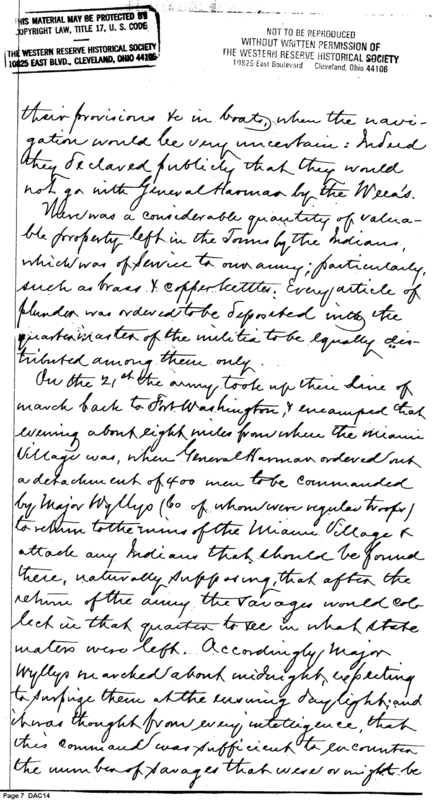
This Evening orders were issued, informing the army, that as they had completed the object of the Campaign, they were to take up the Line of march on the next day to return to Fort Washington. The General mentioned in his orders that he had a strong desire to take the Miami Towns in his route back, but the weak & reduced state of the Pack horses, together with some other circumstances, rendered it impractical He. One of the circumstances not particularly mentioned, which joined to make it impracticable for the army to return by the Miami Towns (if I might be permitted to judge) was the ill state of the clothing of the Penn: militia, who had taken the field very thinly clad, not expecting to be absent longer than two months, & the time was then nearly expired. She cold weather set in early, & to go by the route of Miami's would have been about 2 50 miles further than to return immediately to Fort Washington. The consequence would probably have been, that they would have had to march up the river in the winter, and to defend our taking
their provisions & in boats, when the navigation would be very uncertain. Indeed they declared publicly that they would not go with General Harmar by the Miami's.
There was a considerable quantity of valuable property left in the Towns by the Indians, which was of service to our army, particularly, such as brass & copper kettles. Every article of plunder was ordered to be distributed with the quartermaster of the militia to be equally distributed among them only.
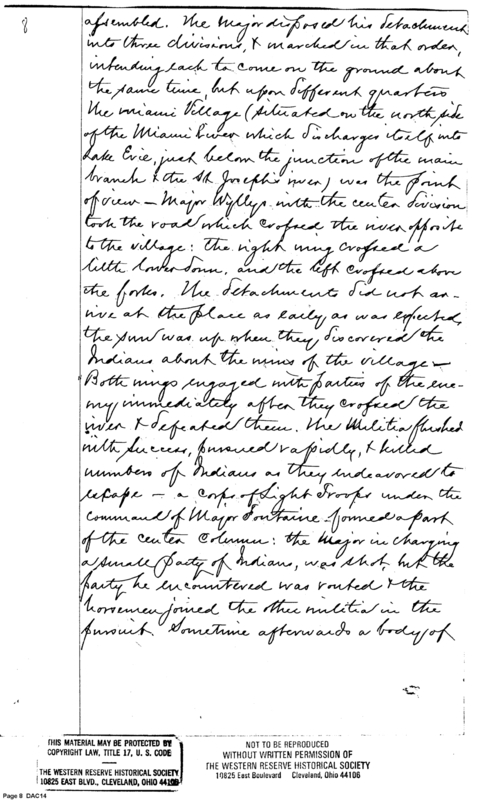
On the 2d the army took up their Line of march back to Fort Washington & encamped that evening about eight miles from where the Miami Village was, when General Harmar ordered out a detachment of 400 men to be commanded by Major Wyllys (60 of whom were regular Troops) to return to the ruins of the Miami Village & attack any Indians that should be found there, naturally supposing, that after the return of the army the Savages would collect in that quarter to see in what state matters were left. Accordingly Major Wyllys marched about midnight, expecting to surprise them at the morning day light, and it was thought from very intelligence, that this command was sufficient to encounter the number of Savages that were or might be
assembled. The Major disposed his detachment into three divisions, & marched in that order, unfolding each to come on the ground about the same time, but upon different quarters. The Miami Village (situated on the north side of the Miami River which I discharge itself into lake Erie, just below the junction of the main branch & the St Josephs river) was the point of view — Major Wyllys with the center division took the road which crossed the river opposite to the village. The right wing crossed a little farther down, and the left crossed above the forks. The detachments did not arrive at the place as early as was expected. The sun was up when they discovered the Indians about the ruins of the Village. Both wings engaged with parties of the enemy immediately after they crossed the river & defeated them. The Militia rushed with success, pursued rapidly, & killed large numbers of Indians as they endeavoured to escape — a corps of light Troops under the command of Major Fontaine formed a part of the center Column. The Major in charging a small party of Indians, was shot, but the party he encountered was routed & the horsemen joined the three militia in the pursuit. Sometime afterwards a body of
the Enemy, superior in numbers to Major Wyllys, came from a wood which was on his right & attacking him in the open field, both parties fought desperately. The Major raised a shot through his breast which surrounded him — Unfortunately the militia had pursued too far & was not within supporting distance, so that the regular Troops were finally overpowered & obliged to give way. — Capt Ashton & Ensign Morgan, with 12 men only got off — Major Wyllys, Lieut Frothingham & 48 men fell in the action. The Indians pursued the regular into the river St Joseph where they were repulsed by a party of good rifle men who were very judiciously posted on the opposite side. The Enemy endeavoured to force them way across, but a constant well directed fire which had great numbers in the water, obliged them to disperse — they were seen to carry off their wounded in the time of the action. The principal part of the command returned back upon the same ground, & assembling with their wounded in one of the fields, discharged & wiped out their rifles, loaded them again, buzzed & shouted, and after some time moved slowly to camp.
The first notice which the General had of
the engagement was given him unexpressably, by a fellow who left his command. The next was a messenger sent to inform him, that a smart & successful fight had taken place with the Indians, & that the Detachment were returning slowly to camp with the wounded. — Upon the first which a Battalion was sent to their assistance, but not the detachment returning — assistance however would have been unnecessary, provided proper attention had been paid to Major Wyllys's directions, and the Militia had not left him as they did.
The army remained in their encampment that day, burying & dressing the wounded. Our loss in this action was not equal to that of the Enemy. — their loss from the returns which were given in by the officers who paid them by on the ground, amounted to 150. Ours including three killed and burying on the 19th amounts to only 183; and as I passed through Kentucky on my way hither, I learned that several of the missing had got safe home long before the army had returned; so that the number of militia killed is very uncertain; but at any rate the loss of the Indians by the Campaign must be more than equal to ours.
Whether the General thought it unnecessary to return with the main body to the field of action, as the Savages would in all probability raise the dead and scalp them, if they had been buried; or whether he had not sufficient confidence in his force to risque the delay which it would have caused, I am not certain, but rather suppose the latter to be the Case. The militia in the first place, were not of that kind which is calculated for Indian Expeditions. They were Draft & substitutes, many of them had never fired a rifle in their lives, & it is very certain that numbers were so ignorant as scarcely to know the use of a musket. Besides they were in general very indifferently armed. These circumstances, together with their ungovernable disposition, being so much superior in numbers to the regulars, the unstable conduct of a great proportion of them, which was shown in two instances, & the effective strength being reduced by sickness & more particularly by the loss of so many of the best & bravest men were sufficient in my humble opinion, for the commanding officer to act as he did. He had every reason to believe that the Enemy were assembling from different quarters, &
a delay might have enabled them to make an attack with advantage upon the main body in which case, the few regular Troops, amounting to about 200 fit for duty, with all the sick & wounded of the army, three pieces of Cannon, the stores, provisions & so much ingenuity have fallen a sacrifice.
It has been reported that General Harmar suffered the wounded to be left in the field, that they fell into the hands of the Savages, & that the army was pursued & harassed all the way on their return, with many other insinuations much to his prejudice. These however are mischievous & unfounded rumours spread by a few disaffected men with a design to injure a reputation which rather deserves to be applauded for the services he has rendered.
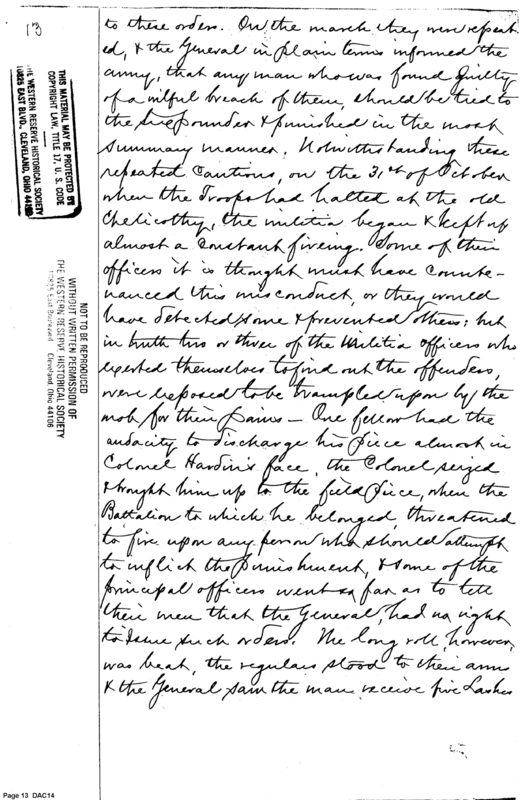
The Army continued their march on the 23d and met with no interruption, nor noticed anything very remarkable until they arrived at the old Chelicothay Town on the little Miami, when the militia gave a striking instance of their disobedience & mutinous disposition. At the Commencement of the Campaign General Harman had issued orders forbidding the discharge of fire arms in Camp; but the militia did not attend
to these orders. On the march they was repeatedly, & the General in plain terms informed the army, that any man who was found guilty of a wilful breach of them, should be tried to the trespass & punished in the most summary manner. Notwithstanding these repeated Cautions, on the 31st of October when the Troops had halted at the old Chelicothay, the militia began & kept up almost a constant firing. Some of their officers it is thought must have countenanced this misconduct, or they would have detached some & prevented them; but in truth two or three of the Militia officers who expected themselves to find out the offenders were exposed to be trampled upon by the mob for their pains — One fellow had the audacity to discharge his piece almost in Colonel Hardin's face. The Colonel pieced & brought him up to the field piece, when the Battalion to which he belonged threatened to fire upon any person who should attempt to inflict the punishment, & some of the principal officers went so far as to tell their men that the General had no right to issue such orders. The long roll however, was beat, the regulars stood to their arms & the General saw the man receive his lashes
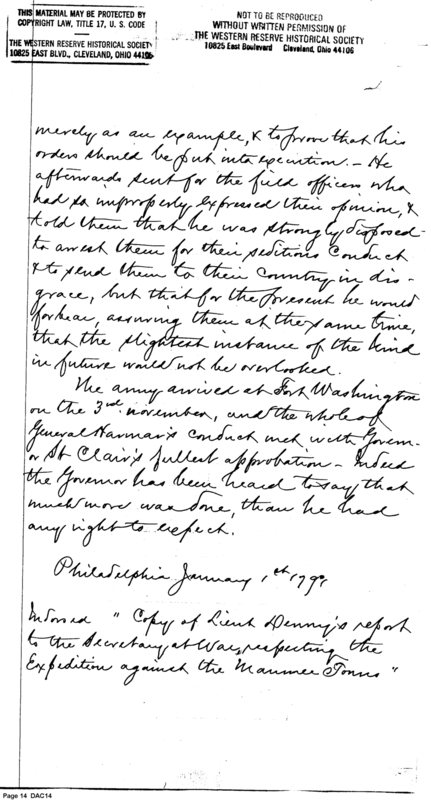
merely as an example, & to prove that his orders should be put into execution. — He afterwards sent for the field officers who had so improperly expressed their opinion, & told them that he was strongly disposed to arrest them for their seditious conduct & to send them to their country in disgrace, but that for the present he would forbear, assuring them at the same time, that the slightest instance of the kind in future would not be overlooked.
The army arrived at Fort Washington on the 3d November, and the whole of General Harmar's conduct met with Governor St Clair's fullest approbation. — Indeed the Governor has been heard to say, that much more was done, than he had any right to expect.
Philadelphia January 1st 179[?]
Inclosed " Copy of Lieut Denny's report to the Secretary at War, respecting the Expedition against the Miamee Towns "
Type
Autograph Letter
Description
Suggests drawing upon reports of Captain Ferguson and Doctor Carmichael while waiting for official accounts from Harmar. Describes Indian attacks and different campaigns, often conflicting under different leaders and with discouraged militia members. Discusses provisions and inadequate clothing. Lists plunder of Indian towns for the quartermaster. Refers to leaving wounded on the field while the army retreated from the enemy. Reports insubordination of troops.
Date
01/01/1791
Author
Recipient
Sent from
Philadelphia
Collection
Document number
1791010140001
Page start
1
Notable persons
Henry Knox
Lieutenant Denny
Josiah Harmar
Captain Ferguson
Doctor Carmichael
Federal Troops
Militia
Indians
Dragoons
Women
Children
Colonel Hardin
Miami Indians
Colonel Trotten
Spy
Major McMillion
Privates
Captain Scott
Lieutenant Armstrong
Ensign Hartshorn
Major Fountaine
Quartermaster
Major Wyllys
Captain Ashton
Ensign Morgan
Lieutenant Frothingham
Rifle Men
Notable locations
Philadelphia
Miami Villages
Fort Washington
Peckaway Town
Lake Erie
St. Joseph River
Chilicothe Town
Little Miami River
Notable items
Horses
Provisions
Tomahawks
Bayonets
Houses
Corn
Clothing
Boats
Brass
Copper Kettles
Rifles
Muskets
Cannon
Stores