Now I have all the images and can produce the complete transcription. The primary document runs pages 1–20; pages 21–44 are repository separator and duplicate copy pages (Western Reserve Historical Society), which fall outside the primary record per the transcription guidelines.
---
[Simcoe Papers. Packet Q. 14.]
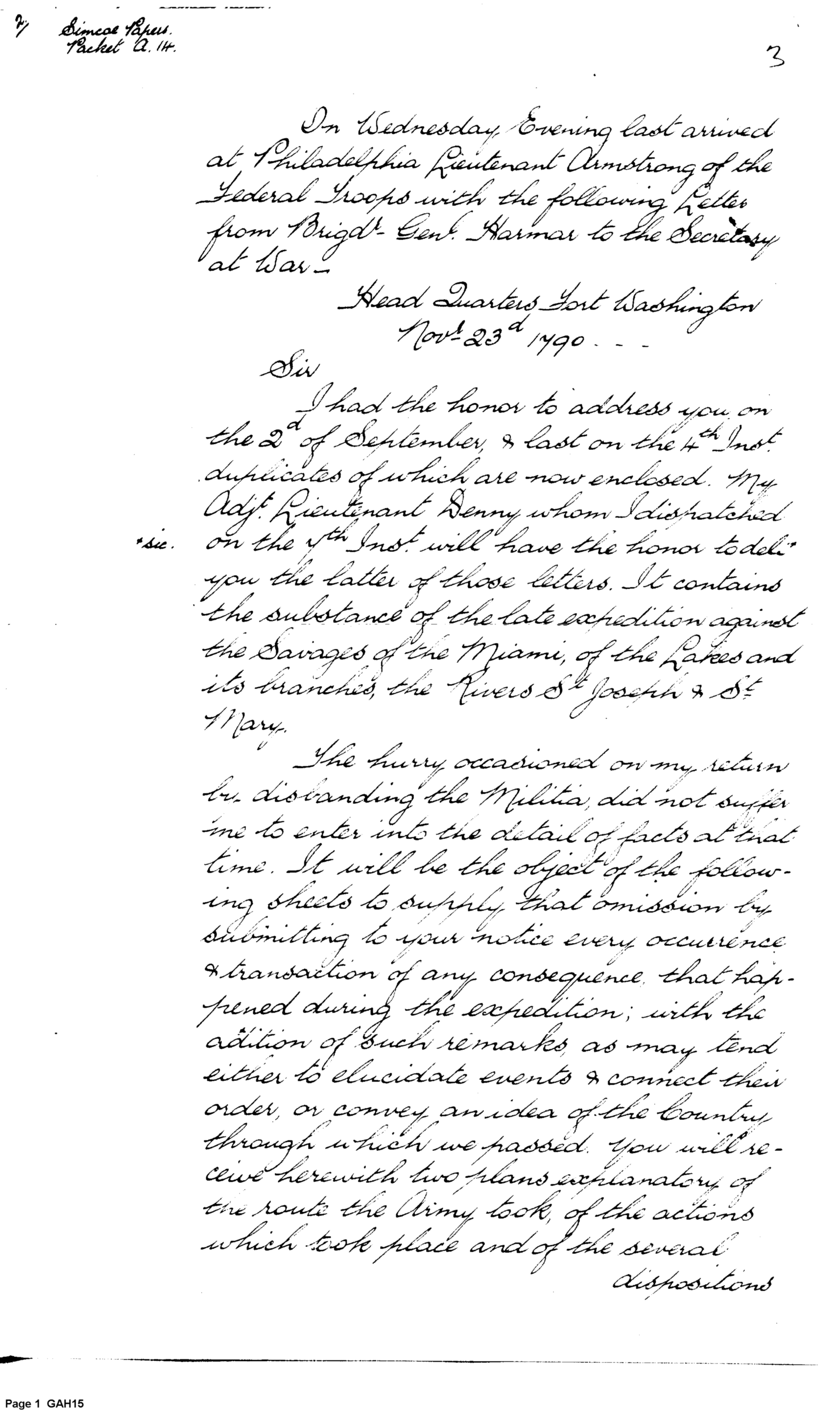
In Wednesday Evening last arrived at Philadelphia Lieutenant Armstrong of the Federal Troops with the following letter from Brigdr. Genl. Harmar to the Secretary at War.
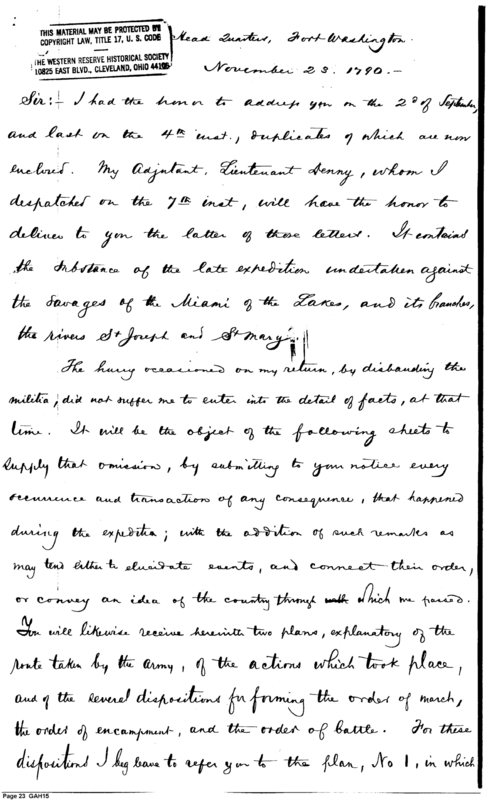
Head Quarters Fort Washington
Nov. 23d 1790.—
Sir
I had the honor to address you on the 2d of September, & last on the 4th Inst. duplicates of which are now enclosed. My Adjt. Lieutenant Denny whom I dispatched [*sic.] on the 5th Inst. will have the honor to deli* you the latter of those letters. It contains the substance of the late expedition against the Savages of the Miami, of the Lakes and its branches, the Rivers St Josehh & St Mary.
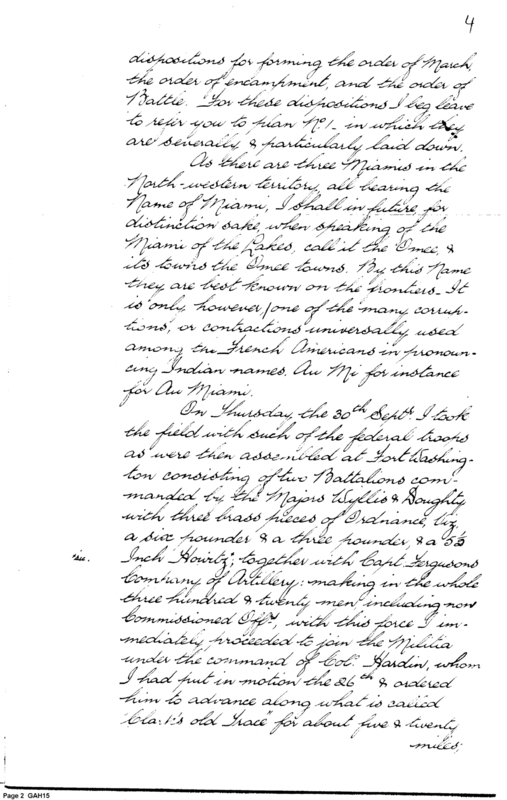
The hurry occasioned on my return by disbanding the Militia, did not suffer me to enter into the detail of facts at that time. It will be the object of the following sheets to supply that omission by submitting to your notice every occurrence & transaction of any consequence that happened during the expedition; with the adition of such remarks as may tend either to elucidate events & connect their order, or convey an idea of the Country through which we passed. You will receive herewith two plans explanatory of the route the Army took, of the actions which took place and of the several dispositions for forming the order of March, the order of encampment, and the order of Battle. For these dispositions I beg leave to refer you to Plan No1- in which they are severally & particularly laid down.
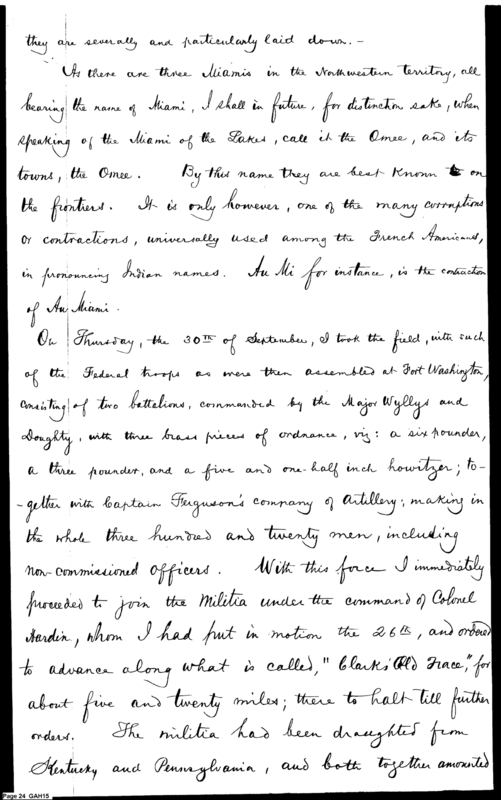
As there are three Miamis in the North-western territory, all bearing the Name of Miami, I shall in future, for distinction sake, when speaking of the Miami of the Lakes, call it the Omee, & its towns the Omee towns. By this Name they are best known on the frontiers. It is only however, one of the many corruptions, or contractions universally used among the French Americans in pronouncing Indian names. Au Mi for instance for Au Miami.
On Thursday, the 30th Sept. I took the field with such of the federal troops as were then assembled at Fort Washington consisting of two Battalions commanded by the Majors Wyllis & Doughty with three brass pieces of Ordnance, viz. a six pounder & a three pounder, & a 5½ Inch Hourtz; together with Capt. Fergusons [*sic.] Company of Artillery; making in the whole three hundred & twenty men, including non commissioned Offt. with this force I immediately proceeded to join the Militia under the command of Colo. Hardin, whom I had put in motion the 26th & ordered him to advance along what is called "Clar.t.'s old Trace" for about five & twenty miles; there to halt till further Orders. The Militia had been draughted from Kentucky & Pennsylvania, & both together amounted [*sic.] to [strikethrough: thirteen hundred] eleven hundred & thirty three Men. Many of the former were substitutes, & by no means equal in spirit or appearance to the generality of their Countrymen. My whole force then was fourteen hundred and fifty three (including two troops of Cavalry) but from this number we may safely deduct two hundred of the Militia as good for nothing. This day I marched northerly about seven miles, encamped at night on the Waters of Mill Creek which empties into the Ohio two Miles below this Fort, the Country through which we passed was rich & hilly but not very difficult. A pretty good road might easily be made through it. The next day being the first of October we advanced nine Miles: the general course N. The country now assumed a level face, covered thickly with under-wood; In the evening I was joined by Colo. Iruby of the Pennsylvania Militia, with such of the Cattle as had been left behind at Fort Washington. Our whole stock of Beeves consisted of one hundred & seventy five heads. The Pack Horses amounted to 578.
On the second we marched N. E. about 13 Miles to a branch of the little Miami River.
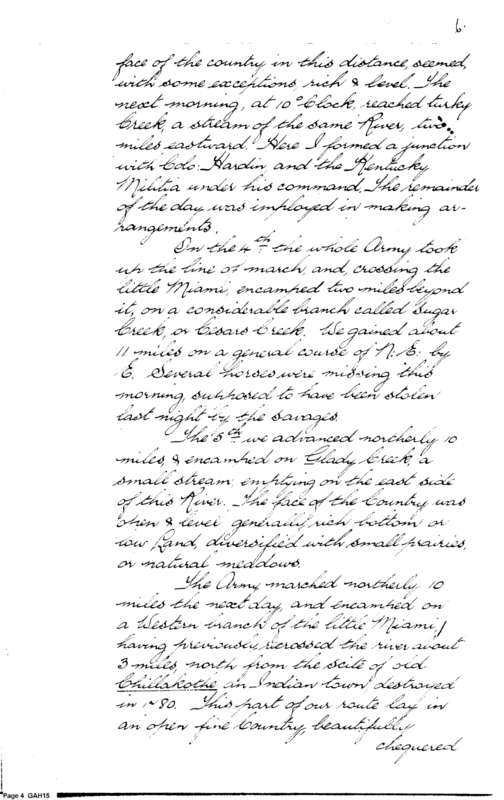
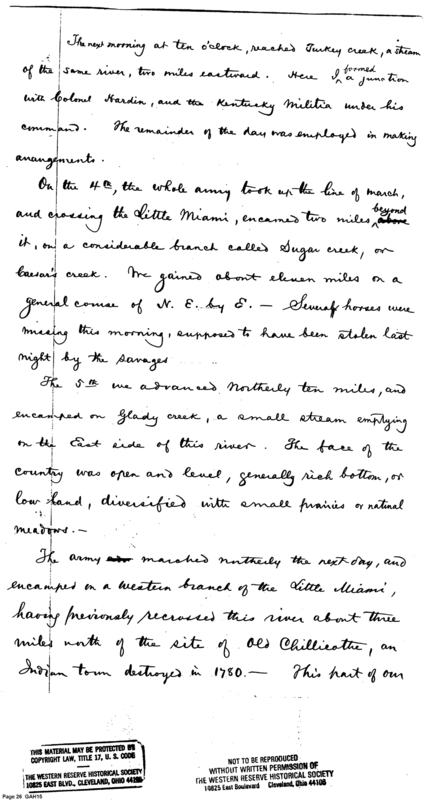
The underwood disappeared, & the face of the country in this distance, seemed, with some exceptions, rich & level. The next morning, at 10 o'clock, reached Turkey Creek, a stream of the same River, two miles eastward. Here I formed a junction with Colo: Hardin and the Kentucky Militia under his command. The remainder of the day was imployed in making arrangements.
On the 4th the whole Army took up the line of march, and, crossing the Little Miami, encamped two miles beyond it, on a considerable branch called Sugar Creek, or Ciesaro Creek. We gained about 11 miles on a general course of N.E. by E. Several horses were missing this morning, supposed to have been stolen last night by the savages.
The 5th we advanced northerly 10 miles, & encamped on Glady Creek, a small stream, emptying on the east side of this River. The face of the country was open & level, generally rich bottom or low Land, diversified with small prairies, or natural meddows.
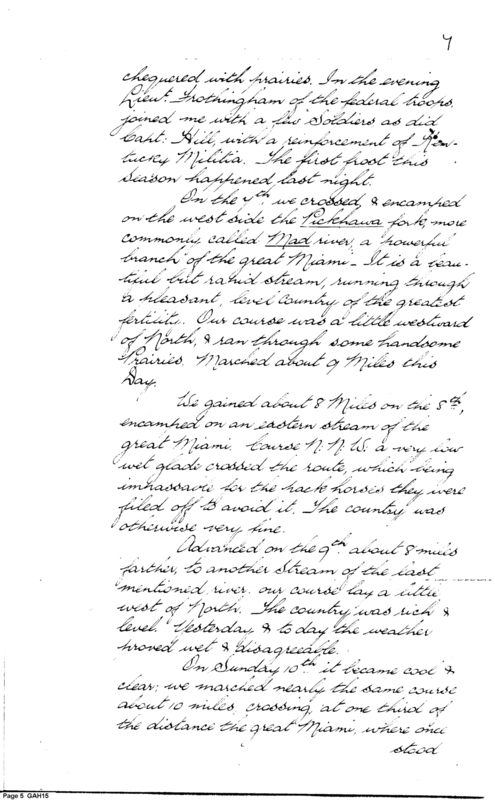
The Army marched northerly 10 miles the next day, and encamped on a Western branch of the little Miami, having previously recrossed the river about 3 miles, north from the scite of old [underline: Chillakothe] an Indian town, destroyed in 1780. This part of our route lay in an open fine Country, beautifully chequered with prairies. In the evening Lieut. Frothingham of the federal troops, joined me with a few Soldiers as did Capt. Hill with a reinforcement of Kentucky Militia. The first frost this Season happened last night.
On the 4th we crossed, & encamped on the west side the [underline: Pickhawa] fork, more commonly called [underline: Mad] river, a powerful branch of the great Miami. It is a beautiful but rapid stream, running through a pleasant, level country of the greatest fertility. Our course was a little westward of North, & ran through some handsome Prairies. Marched about 9 Miles this day.
We gained about 8 Miles on the 8th, encamped on an eastern stream of the great Miami. Course N. N. W. a very low wet glade crossed the route, which being impassable for the hack horses they were filed off to avoid it. The country was otherwise very fine.
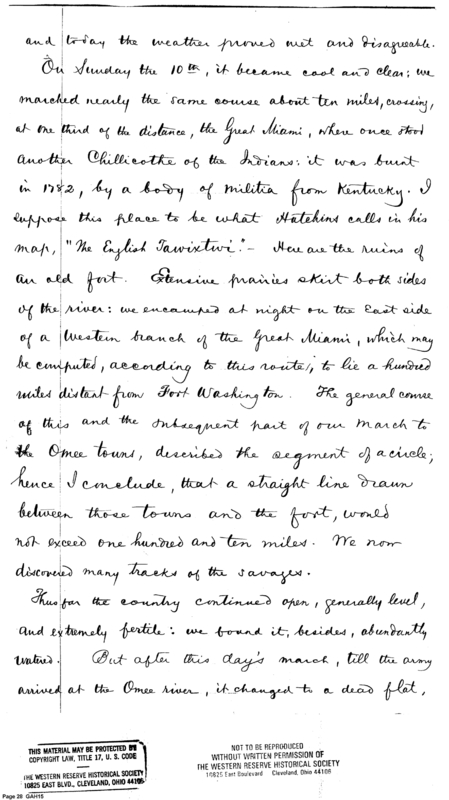
Advanced on the 9th about 8 miles farther, to another Stream of the last mentioned river. our course lay a little west of North. The country was rich & level. Yesterday & to day the weather proved wet & disagreeable.
On Sunday 10th it became cool & clear; we marched nearly the same course about 10 miles, crossing, at one third of the distance the great Miami, where once stood another [underline: Chillakothe] of the Indians; it was burnt in 1782. by a body of Militia from Kentucky. I suppose this [*sic.] place to be what Hutchins in his Map "[underline: The English Tawixtoi]" Here are the ruins of an old fort. Extensive Prairies skirt both sides of the River, we encamped at night on the east side of a Western branch of the great Miami. which may be computed according to this route, to lie an 100 Miles distant from Fort Washington. The general course of this & the subsequent part of our march to the [underline: Omee] towns, described the [strikethrough: side] sigment of a Circle. hence I conclude that a strait line drawn between those towns & the fort, would not exceed 110 miles. We now discovered many tracks of the Savages.
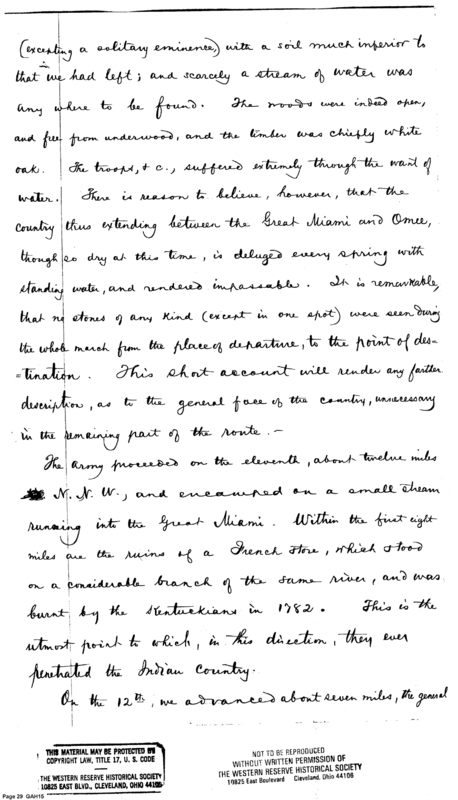
Thus far the country continued open, generally level & extremly fertile: we found it besides, abundantly watered. But after this days march, till the Army arrived at the Omee river, it changed to a dead flat (excepting a Solitary eminence) with a Soil much inferior to that we had left; & scarcely a stream of water was any where to be found. The woods were indeed open & free from under wood, & the timber chiefly White Oak. The troops &c suffered extremely through the want of Water. There is reason to believe, however, that the country thus extending between the great Miami & Omee, though so dry at this time, is deluged every spring with standing Water, rendered impassable. It is remarkable that no stones of any kind (except in one spot) were seen during the whole march, from the place of departure to the point of destination. This short Acct. will render any farther discription as to the general face of the Country unnecessary, in the remaining part of the route.
The Army proceeded on the 11th, About 12 miles N. N.W. & encamped on a small stream running into the great Miami. Within the first 8 miles are the ruins of a french Store, which stood on a considerable branch of the same river & was burnt by the Kentuckians in 1782. This is the utmost point to which, in this direction they ever penetrated the Indian Country.
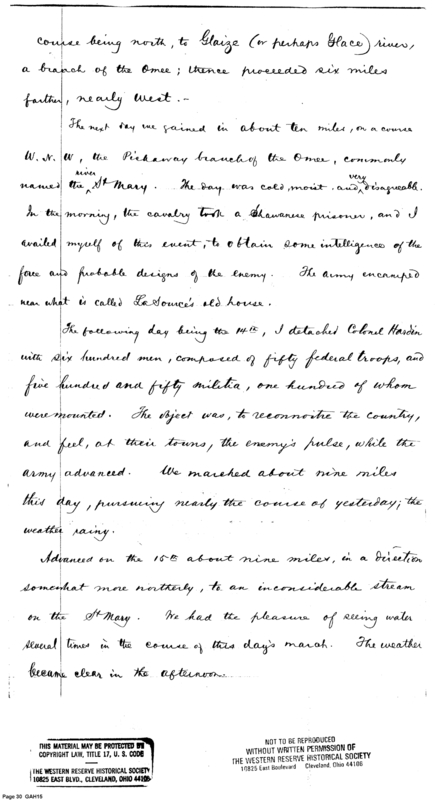
On the 12th we advanced about 4 miles, the General course being north to [underline: Glaize] (or perhaps [underline: Glace]) river, a branch of the [underline: Omee]; thence proceeded 6 miles farther nearly west.
The next day we gained in about 10 miles, on a course W. N. W. the [underline: Pickhawa] [*sic.] branch of the Omee, commonly named the river [underline: St Mary]. The day was cold, moist, & very disagreeable. In the morning the Cavalry took a Shawano Prisoner & I availed myself of this event to obtain some intelligence of the force & probable designs of the Enemy. The Army encamped near what is called La Sources old House. the following day being the 14th I detached Colo. Hardin with 600 men, composed of 50 federal troops, and 550 Militia, 100 of whom were mounted, the object was to reconnoitre the country, & feel at their towns the Enemies pulse, while the Army advanced. We marched about 9 miles this day, pursuing nearly the course of yesterday; the weather rainy.
Advanced on the 15th about 9 miles, in a direction somewhat more northerly, to an inconsiderable stream of the St. Mary. We had the pleasure of seeing water several times in the course of this days march. The weather became clear in the afternoon.
A dispatch arrived on the 16th from Colonel Hardin, informing me that the Savages and the Traders (who are perhaps, the worst Savages of the two) had evacuated their Towns, with appearances of precipitation, and burnt the principal Village called the Omee town together with all the traders houses.
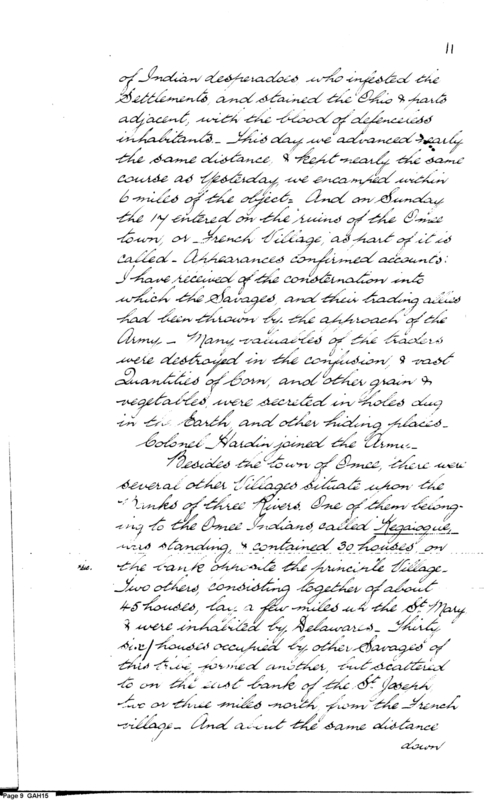
This Village lay on a pleasant point, formed by the junction of the Rivers Omee & St Josehh. It was situate on the east bank of the latter, opposite the mouth of St Mary, and had for a long time past been the Rendezvous of a set of Indian desperadois who infested the Settlements, and stained the Ohio & parts adjacent, with the blood of defenceless inhabitants. This day we advanced nearly the same distance, & kept nearly the same course as yesterday; we encamped within 6 miles of the object. And on Sunday the 17 entered on the ruins of the Omee town, or French Village, as part of it is called. Appearances confirmed accounts I have received of the consternation into which the Savages, and their trading allies had been thrown by the approach of the Army. Many valuables of the traders were destroyed in the confusion, & vast Quantities of Corn, and other grain & vegetables were secreted in holes dug in the Earth, and other hiding places.
Colonel Hardin joined the Army.
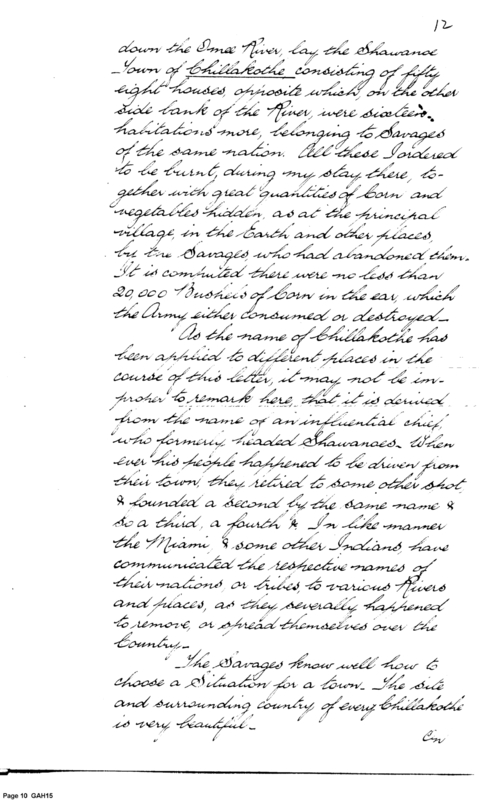
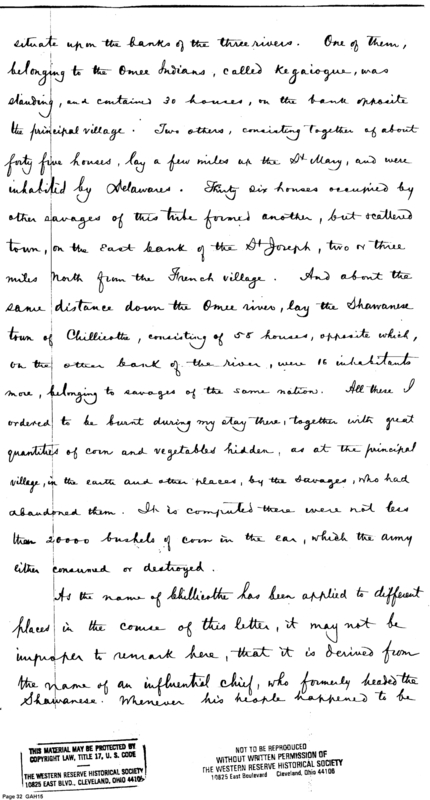
Besides the town of Omee, there were several other Villages situate upon the Banks of three Rivers. One of them belonging to the Omee Indians, called [underline: Kegioque], was standing, & contained 30 houses, on [*sic.] the bank opposite the principle Village. Two others, consisting together of about 45 houses, lay a few miles up the St Mary, & were inhabited by Delawares. Thirty six houses occupied by other Savages of this tribe, formed another, but scattered to on the east bank of the St Joseph two or three miles north from the French village. And about the same distance down the Oma River, lay the Shawanoe Town of [underline: Chillakothe] consisting of fifty eight houses, opposite which, on the other side bank of the River, were sixteen habitations more, belonging to Savages of the same nation. All these I ordered to be burnt, during my stay there, together with great quantities of Corn and vegetables hidden, as at the principal village, in the Earth and other places, by the Savages who had abandoned them. It is computed there were no less than 20,000 Bushels of Corn in the ear, which the Army either consumed or destroyed.
As the name of Chillakothe has been applied to different places in the course of this letter, it may not be improper to remark here, that it is derived from the name of an influential chief, who formerly headed Shawanoes. Whenever his people happened to be driven from their town, they retired to some other shot & founded a second by the same name & so a third, a fourth &. In like manner the Miami & some other Indians have communicated the respective names of their nations or tribes, to various Rivers and places, as they severally happened to remove, or spread themselves over the Country.
The Savages know well how to choose a Situation for a town. The site and surrounding country of every Chillakothe is very beautiful.
On the 18th two Indians were killed & scalped by the Cavalry; & another was killed at night. We lost a great number of horses at this time, occasioned by the negligence of the Militia guards & their [*sic.] disobediance of orders.
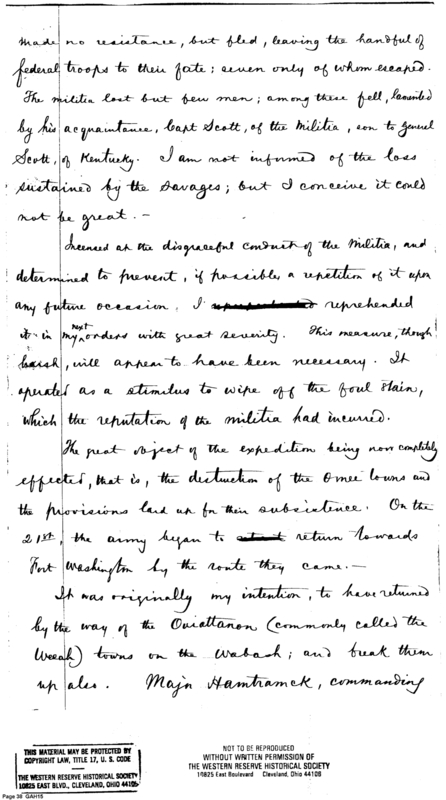
On the 19th Colonel Hardin was detached with 180 men, taken from the Pennsylvania & Kentucky militia, & 30 federal troops commanded by lieutenant Armstrong. Part of the detachment proceeded about 10 miles westerly of the main body of the Army, now posted at Chillakothe (the Pennsylvanians who formed the left column, having fallen some miles in the rear) when a body of Indians appeared & advanced to the attack; & though the Enemy did not, as it is believed, exceed a hundred and thirty, yet the militia made no resistance, but fled, leaving the federal troops to their fate; seven only of whom escaped. The Militia lost but few men; among these fell, lamented by his acquaintance, Capt. Scott of the Militia, Son to General Scott of Kentucky. I am not informed of the loss sustained by the Savages but I conceive it could not be great.
Incensed at the disgraceful conduct of the Militia, and determined to prevent, if possible, a repetition of it when any future occasion, I reprehended it in my next Orders with great Severity.
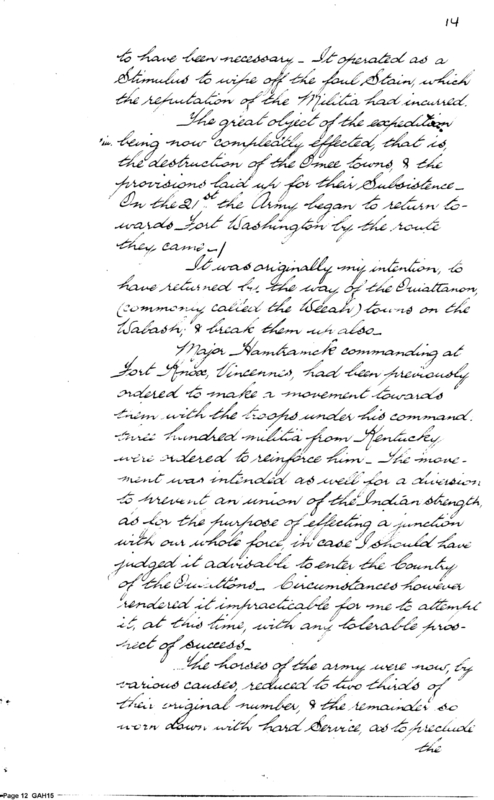
This measure, though harsh, will appear to have been necessary. It operated as a Stimulus to wipe off the foul Stain, which the reputation of the Militia had incurred.
The great object of the expedition being now [*sic.] compleatly effected, that is, the destruction of the Omee towns, & the provisions laid up for their Subsistence. On the 21st the Army began to return towards Fort Washington by the route they came.
It was originally my intention, to have returned by the way of the Ouiattanon, (commonly called the Weeah) towns on the Wabash, & break them up also.
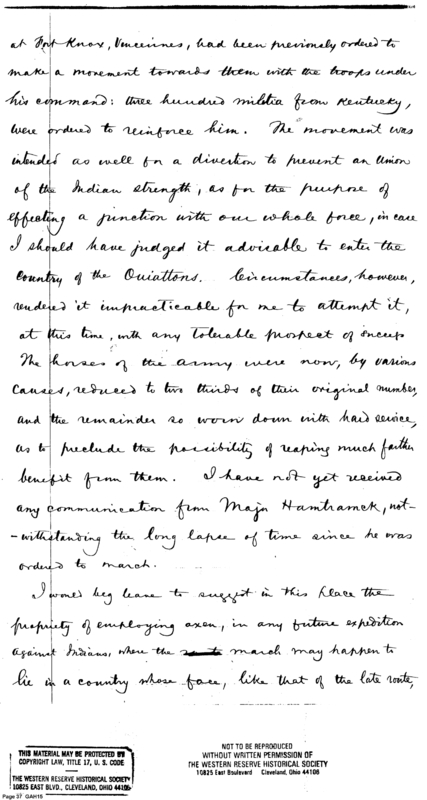
Major Hamtrameck commanding at Fort Knox, Vincennes, had been previously ordered to make a movement towards them with the troops under his command. Three hundred militia from Kentucky were ordered to reinforce him. The movement was intinded as well for a diversion to prevent an union of the Indian Strength, as for the purpose of effecting a junction with our whole force, in case I should have judged it advisable to enter the Country of the Ouiattens. Circumstances however rendered it impracticable for me to attempt it, at this time, with any tolerable prospect of success.
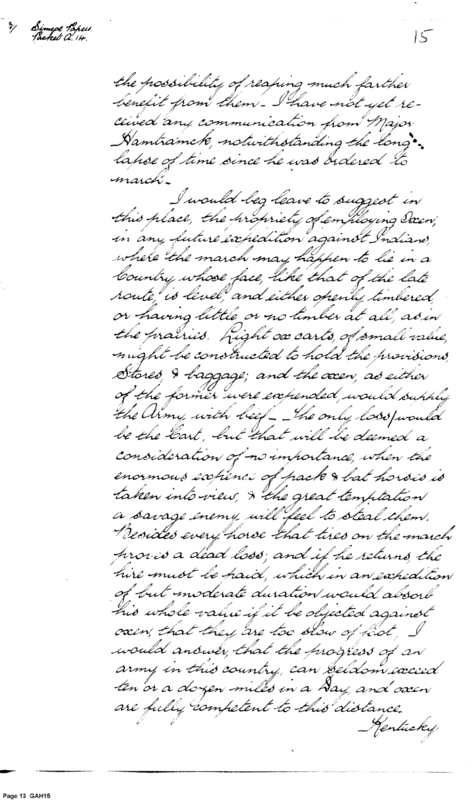
The horses of the army were now, by various causes, reduced to two thirds of their original number, & the remainder so worn down with hard Service, as to preclude the possibility of reaping much farther benefit from them. I have not yet received any communication from Major Hamtrameck, notwithstanding the long lapse of time since he was ordered to march.
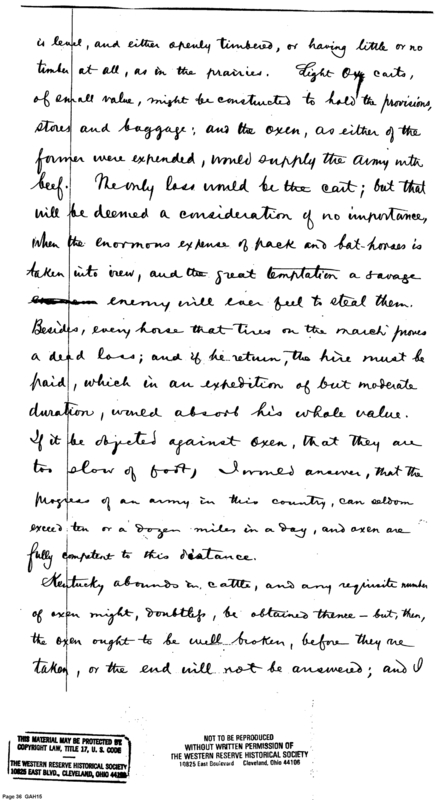
I would beg leave to suggest in this place, the propriety of employing Oxen, in any future expedition against Indians, where the march may happen to lie in a Country whose face, like that of the late route, is level, and either openly timbered, or having little or no timber at all, as in the prairies. Right ox carts of small value, might be constructed to hold the provisions Stores, & baggage; and the oxen, as either of the former were extended, would supply the Army with beef. The only loss would be the Cart, but that will be deemed a consideration of no importance, when the enormous exhence of pack & bat horses is taken into view, & the great temptation a savage enemy will feel to steal them. Besides every horse that tires on the march proves a dead loss; and if he returns, the hire must be paid, which in an expedition of but moderate duration would absorb his whole value if it be objected against oxen, that they are too slow of foot, I would answer, that the progress of an army in this country, can seldom exceed ten or a dozen miles in a Day, and oxen are fully competent to this distance.
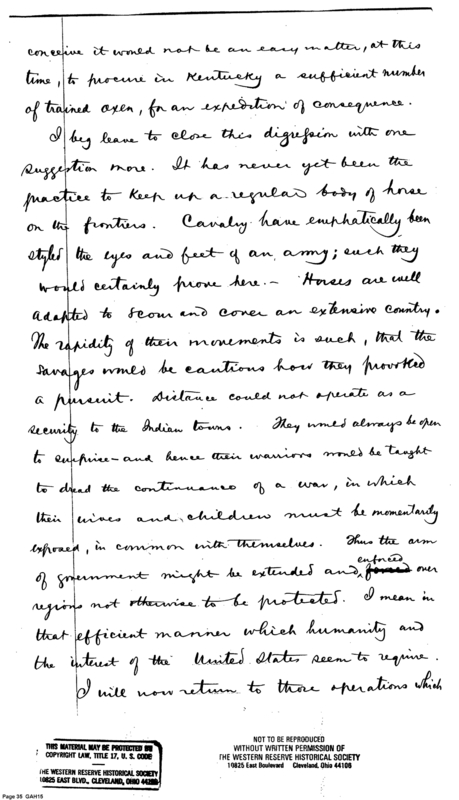
Kentucky abounds in cattle, and any requisite number of oxen might, doubtless, be obtained thence. but then, the oxen ought to be well broken before they are taken, or the end will not be answered; & I conceive it would not be an easy matter, at this time, to procure in Kentucky a sufficient number of trained oxen, for any expedition of consequence.
I beg leave to close this digression with one Suggestion more. It has never yet been the practice to keep up a regular body of horse on the frontiers. Cavalry have emphatically been styled the Eyes & feet of an army. such they would certainly prove here. Horses are well adapted to scour & cover an extensive country. The rapidity of their movements is such, that the Savages would be cautious how they provoked a pursuit. Distance could not operate as a security to the Indian towns. They would always be open to surprise. and hence their warriors would be taught to dread the continuance of a War, in which their wives and children must be momentally exposed, in common with themselves.
Thus the arm of government might be extended & enforced over regions not otherwise to be protected. I mean, in that efficient manner which humanity & the interest of the United States seem to require.
I will now return to those operations which followed, the destruction of the Omee towns.
On the 21st of October the Army decamped from Chillakothe, returning on the route we had come about 8 miles, here we remained till the morning of the 23d. Finding, in the mean time, that the enemy studiously avoided coming to a general action, & conceiving it improper to leave them in the quiet enjoyment of their late success; I resolved to make an effort to bring on another partial engagement.
For this purpose I detached on the 21st. late at night Colonel Hardin, & Major Wyllis, with 360 men, 60 of whom were federal Infantry. the rest being Militia from Pennsylvania & Kentucky. I had some time before, mounted a Company of Militia, & annexed it to the two troops of Kentucky cavalry, giving command of the whole to Major Fontaine, a brave & deserving officer, at that time serving as my Aid-de-camp. This corps made a part of the present command.
I gave orders to find out & fight the enemy at all events, & to be sharing of no means that might tend to lessen the number of the savages, knowing of what importance the life of every warrior is held among them.
The detachment reached the confluence of the Omee & St. Mary, early next morning, and filed off in three Columns.
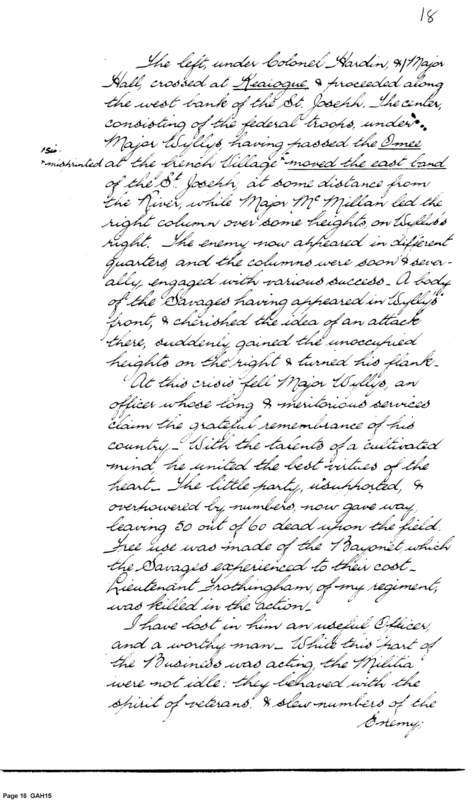
The left, under Colonel Hardin, & Major Hall, crossed at [underline: Keaiogue], & proceeded along the west bank of the St. Josehh. The center, consisting of the federal troops, under [*sic.] [misprinted at the french Village] Major Wyllys, having passed the Omee at the french Village, moved the east land of the St. Joseph, at some distance from the River, while Major McMillan led the right column over some heights, on Wyllys's right. The enemy now appeared in different quarters, and the columns were soon & severally engaged with various success. A body of the Savages having appeared in Wylly's front, & cherished the idea of an attack there, suddenly gained the unoccupied heights on the right & turned his flank.
At this crisis fell Major Wyllys, an officer whose long & meritorious services claim the grateful remembrance of his country. With the talents of a cultivated mind, he united the best virtues of the heart. The little party, unsupported, & overpowered by numbers, now gave way, leaving 50 out of 60 dead upon the field. Free use was made of the Bayonet, which the Savages experienced to their cost. Lieutenant Frothingham, of my regiment, was killed in the action.
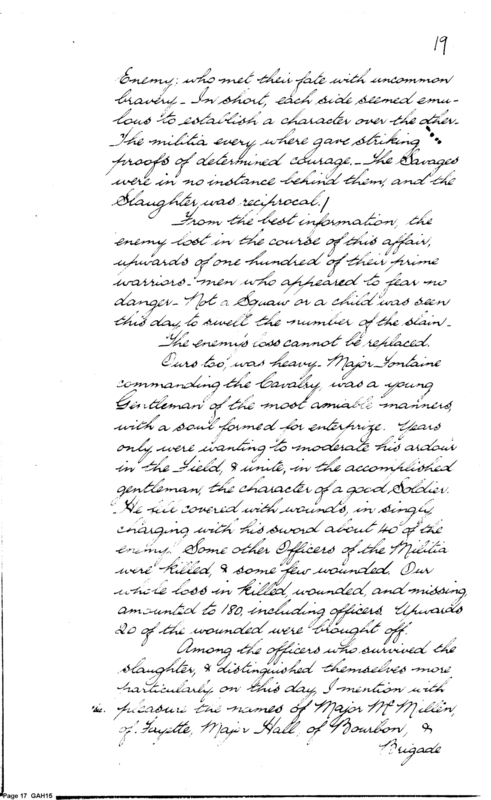
I have lost in him an useful Officer, and a worthy man. While this part of the Business was acting, the Militia were not idle: they behaved with the spirit of veterans, & slew numbers of the Enemy; who met their fate with uncommon bravery. In short, each side seemed emulous to establish a character over the other. The militia every where gave striking proofs of determined courage. The Savages were in no instance behind them, and the Slaughter was reciprocal.
From the best information, the enemy lost in the course of this affair, upwards of one hundred of their prime warriors. men who appeared to fear no danger. Not a Squaw or a child was seen this day, to swell the number of the slain.
The enemy's loss cannot be replaced.
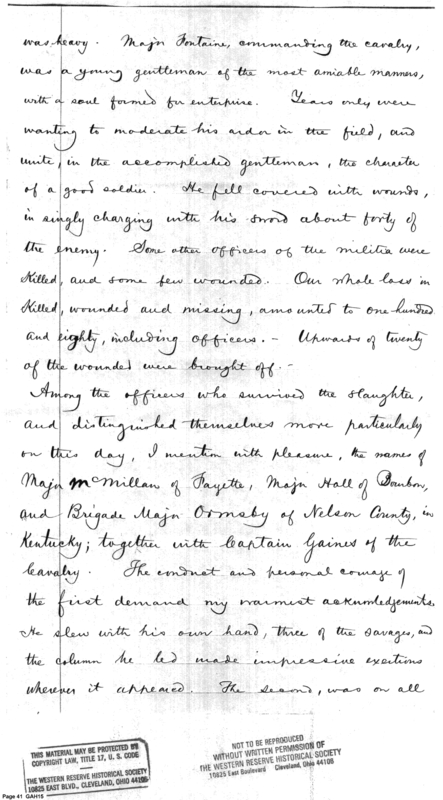
Ours too, was heavy. Major Fontaine commanding the Cavalry, was a young Gentleman of the most amiable manners, with a soul formed for enterprise. Years only were wanting to moderate his ardour in the Field, & unite, in the accomplished gentleman, the character of a good Soldier. He fell covered with wounds, in singly charging with his sword about 40 of the enemy. Some other Officers of the Militia were killed, & some few wounded. Our whole loss in killed, wounded, and missing amounted to 180, including officers. Upwards 20 of the wounded were brought off.
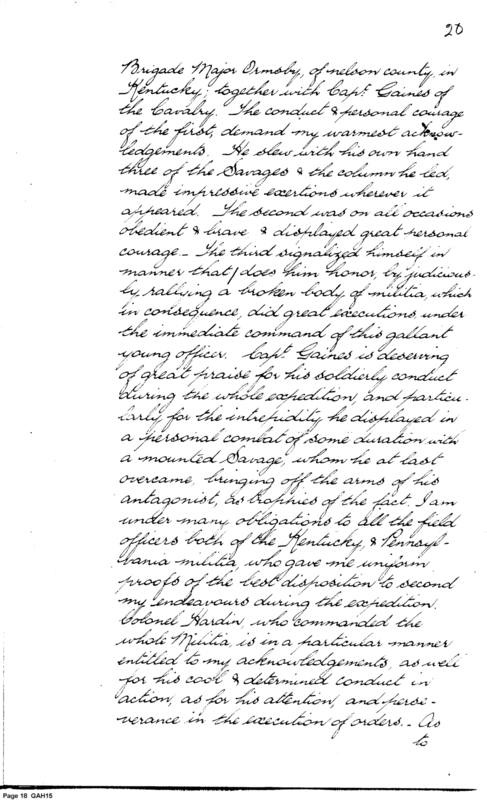
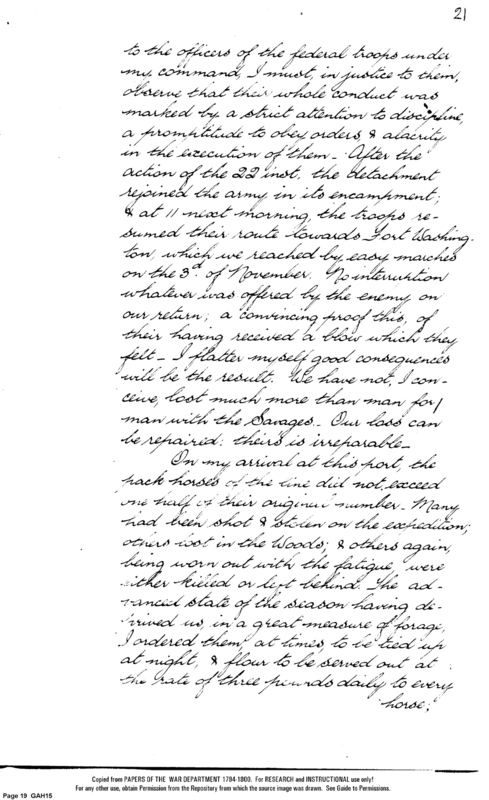
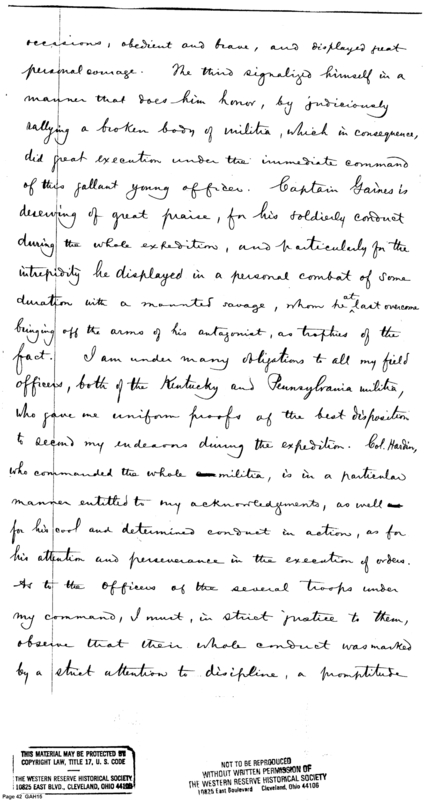
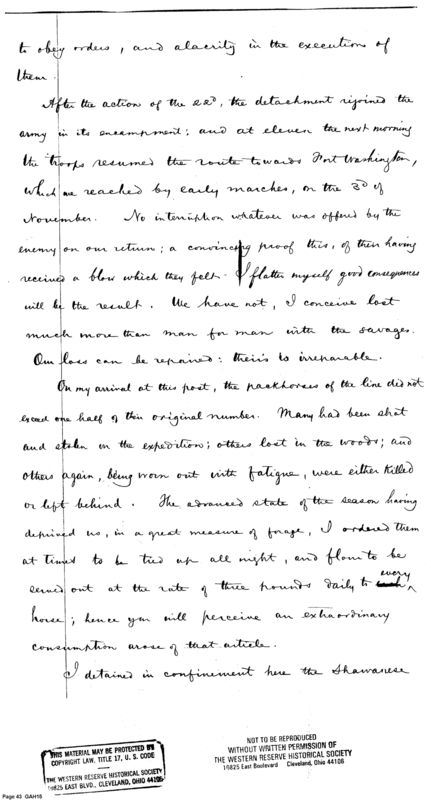
Among the officers who survived the slaughter, & distinguished themselves more particularly on this day, I mention with [*sic.] pleasure the names of Major McMillan, of Fayette, Major Hall, of Bourbon, & Brigade Major Ormoby, of nelson county, in Kentucky; together with Capt. Gaines of the Cavalry. The conduct & personal courage of the first, demand my warmest acknowledgements. He slew with his own hand three of the Savages & the column he led, made impressive exertions wherever it appeared. The second was on all occasions obedient & brave & displayed great personal courage. The third signalized himself in manner that does him honor, by judiciously rallying a broken body of militia, which in consequence, did great executions under the immediate command of this gallant young officer. Capt. Gaines is deserving of great praise for his soldierly conduct during the whole expedition, and particularly for the intrepidity he displayed in a personal combat of some duration with a mounted Savage, whom he at last overcame, bringing off the arms of his antagonist, as trophies of the fact. I am under many obligations to all the field officers both of the Kentucky & Pennsylvania militia, who gave me uniform proofs of the best disposition to second my endeavours during the expedition. Colonel Hardin, who commanded the whole Militia, is in a particular manner entitled to my acknowledgements, as well for his cool & determined conduct in action, as for his attention, and perseverance in the execution of orders. As to the officers of the federal troops under my command, I must, in justice to them, observe that their whole conduct was marked by a strict attention to discipline, a promptitude to obey orders & alacrity in the execution of them. After the action of the 22 inst. the Detachment rejoined the army in its encampment; & at 11 next morning, the troops resumed their route towards Fort Washington, which we reached by easy marches on the 3d of November. No interruption whatever was offered by the enemy on our return; a convincing proof this, of their having received a blow which they felt. I flatter myself good consequences will be the result. We have not, I conceive, lost much more than man for man with the Savages. Our loss can be repaired: theirs is irreparable.
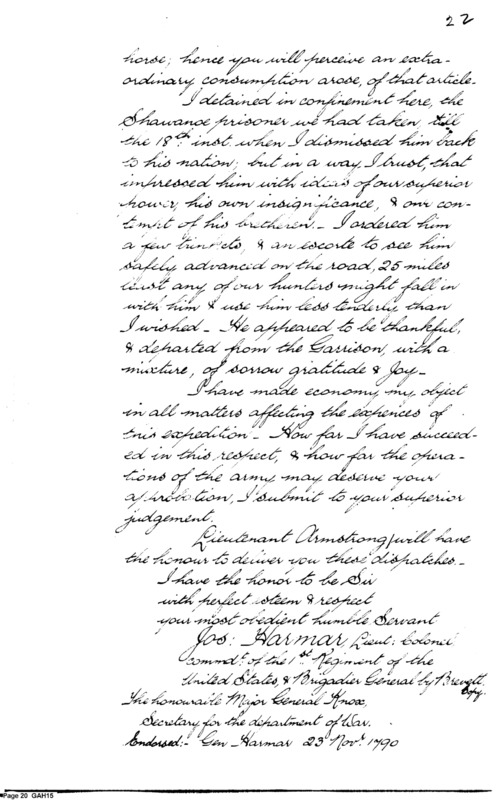
On my arrival at this port, the hack horses of the line did not exceed one half of their original number. Many had been shot & stolen on the expedition; others lost in the Woods; & others again, being worn out with the fatigue, were either killed or left behind. The advanced state of the season having deprived us, in a great measure of forage, I ordered them, at times, to be tied up at night, & flour to be served out at the rate of three pounds daily to every horse; hence you will perceive an extraordinary consumption arose, of that article.
I detained in confinement here, the Shawance prisoner we had taken, till the 18th inst. when I dismissed him back to his nation; but in a way, I trust, that impressed him with ideas of our superior power, his own insignificance, & our contempt of his brethren. I ordered him a few trinkets, & an escorte to see him safely advanced on the road, 25 miles least any of our hunters might fall in with him & use him less tenderly than I wished. He appeared to be thankful, & departed from the Garrison, with a mixture, of sorrow gratitude & Joy.
I have made economy my object in all matters affecting the expenses of this expedition. How far I have succeeded in this respect, & how far the operations of the army may deserve your approbation, I submit to your superior judgement.
Lieutenant Armstrong will have the honour to deliver you these dispatches.
I have the honor to be Sir
with perfect esteem & respect
your most obedient humble Servant
Jos: Harmar Lieut. Colonel
Commdt. of the 1st Regiment of the United States, & Brigadier General by Brevett.
The honourable Major General Knox,
Secretary for the department of War.
[Endorsed:- Gen Harmar 23 Novt. 1790]