[(2)
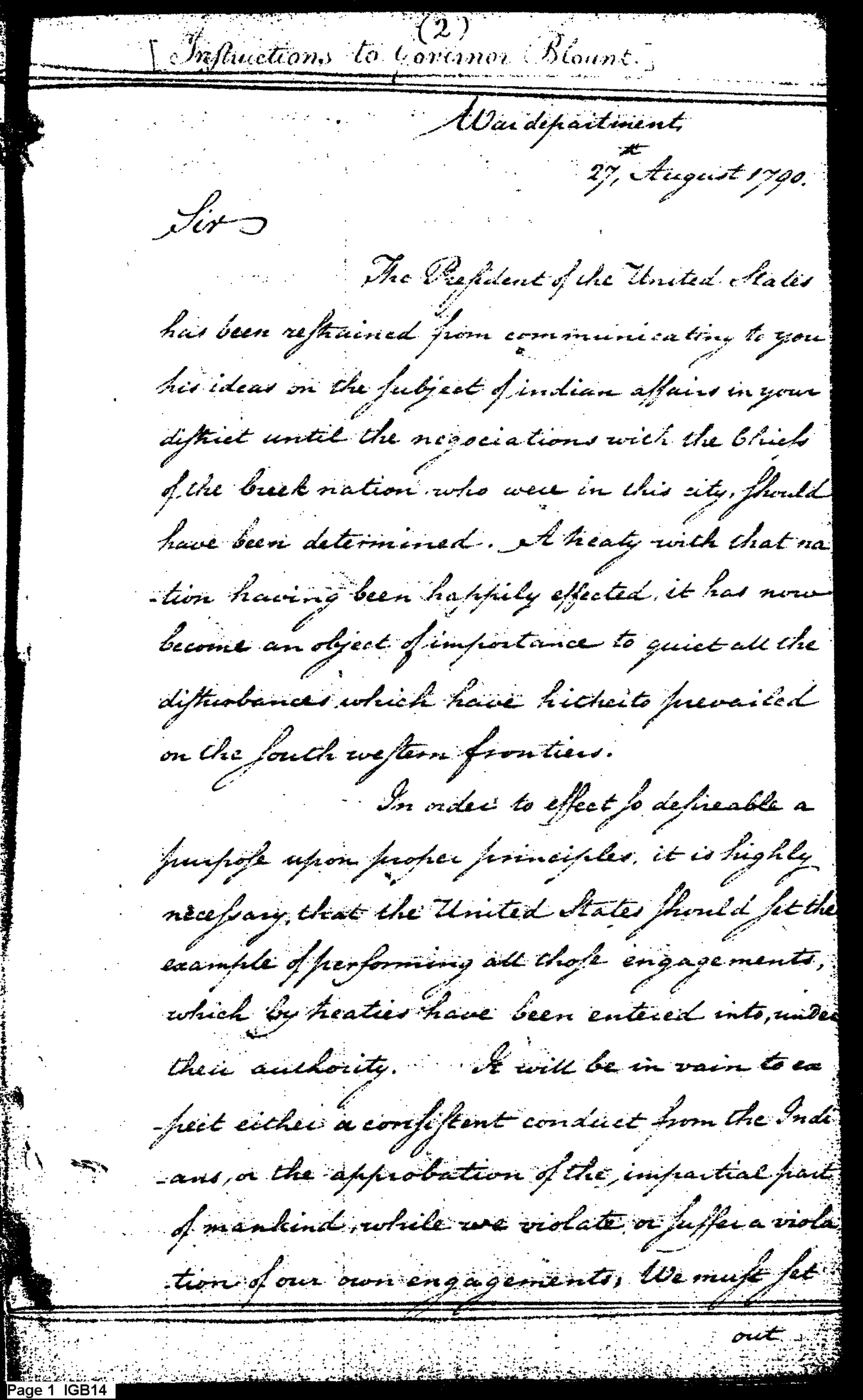
Instructions to Governor Blount.]
War department
27 August 1790.
Sir
The President of the United States has been restrained from communicating to you his ideas on the subject of Indian affairs in your district until the negotiations with the Chiefs of the Creek nation who were in this city, should have been determined. A treaty with that nation having been happily effected, it has now become an object of importance to quiet all the disturbances which have hitherto prevailed on the South western frontiers.
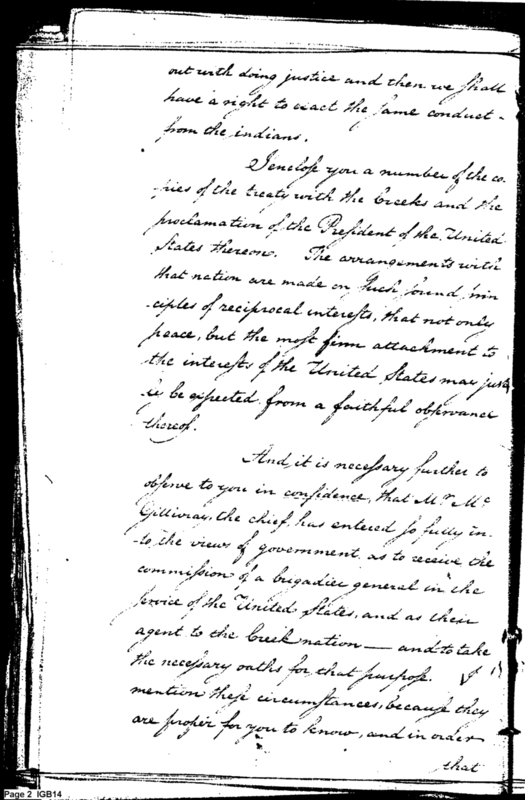
In order to effect so desireable a purpose upon proper principles, it is highly necessary, that the United States should set the example of performing all those engagements, which by treaties have been entered into, under their authority. It will be in vain to expect either a consistent conduct from the Indians, or the approbation of the impartial part of mankind, while we violate or suffer a violation of our own engagements. We must set out with doing justice and then we shall have a right to exact the same conduct from the Indians.
I enclose you a number of the copies of the treaty with the Creeks and the proclamation of the President of the United States thereon. The arrangements with that nation are made on such sound principles of reciprocal interests, that not only peace, but the most firm attachment to the interests of the United States may justly be expected from a faithful observance thereof.
And it is necessary further to observe to you in confidence, that Mr McGillivray, the chief, has entered so fully into the views of government, as to receive the commission of a Brigadier general in the service of the United States, and as their agent to the Creek nation — and to take the necessary oaths for that purpose. I mention these circumstances, because they are proper for you to know, and in order that you may communicate freely with him, and make use of his influence over the Creeks to quiet any disturbances which exist in their nations.
I also transmit you a number of copies of the proclamations of the President of the United States respecting the treaties with the Cherokees, Choctaws and Chickasaws, made at Hopewell in November 1785, and in January 1786; and also an act of Congress passed on the 22d day of last month, "to regulate trade and intercourse with the indian tribes."
As the constitution and laws of the United States place the administration of Indian affairs in the general government, and entirely precludes all interference, either of individuals, or of States, therein, it is necessary that such information should be generally known, in order to prevent individuals from unwarily involving themselves in an improper conduct.
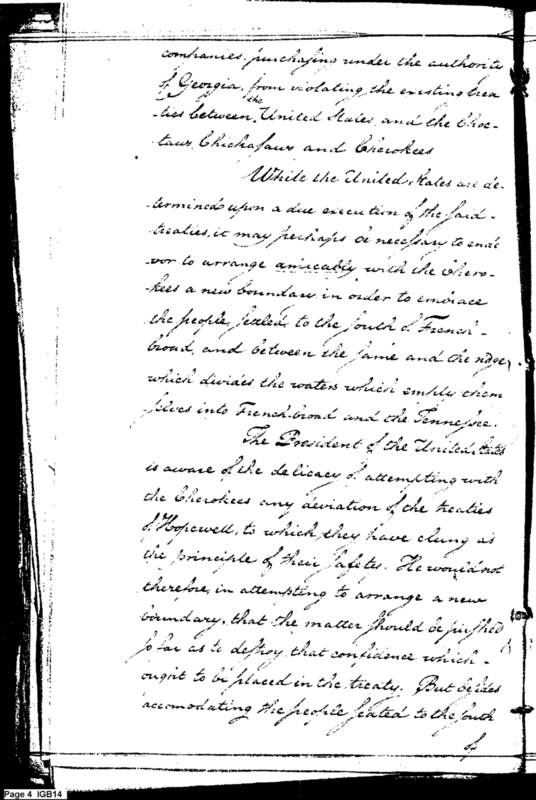
It is to be hoped that this information will effectually prevent any persons, or companies purchasing under the authority of Georgia, from violating the existing treaties between the United States and the Choctaws, Chickasaws and Cherokees.
While the United States are determined upon a due execution of the said treaties, it may perhaps be necessary to endeavor to arrange amicably with the Cherokees a new boundary in order to embrace the people settled to the south of French Broad, and between the same and the ridge, which divides the waters which empty themselves into French Broad and the Tennessee.
The President of the United States is aware of the delicacy of attempting with the Cherokees any deviation from the treaties of Hopewell, to which they have clung as the principle of their Safety. He would not therefore, in attempting to arrange a new boundary, that the matter should be pushed so far as to destroy that confidence which ought to be placed in the treaty. But cities accommodating the people settled to the south of French Broad, it has been represented as a circumstance of great importance that the new road from the mouth of French Broad, and by Clinch river and Emery's creek, and through Cumberland mountain to the settlements on Cumberland river, should be secured to the white people. It is extremely difficult to determine how this object could be effected consistently with the treaty of Hopewell, and the free consent of the Cherokees.
But were it possible and right to establish the following boundary, it would perhaps entirely satisfy the white people, to wit; Beginning at Duck river and thence running up the same to its source, from which a line drawn to the mouth of Clinch river, and thence up Holstein to the mouth of Little river, or the ridge before mentioned, which divides the waters running into the Tennessee from those running into the French Broad.
Perhaps the Cherokees would freely agree to the said boundary on the following conditions:
1st A solemn guarantee of the United States to the remainder of their territory, and protection by a military force if necessary.
2d A payment of a sum of money annually, not exceeding one thousand dollars, or goods to the value thereof, without any other than the real charges arising thereon; the money, or the goods to be delivered at the time and place stipulated.
And in all other respects, the treaty of Hopewell to be carried into full effect.
But if upon a fair experiment it shall be found impracticable to modify the boundary stipulated in the treaty of Hopewell, with respect to making Duck river the boundary in the manner before described, yet you will make up every just argument to obtain a stipulation for the use of the new road, to the settlements on Cumberland river, and arranging the ridge before mentioned to the south of French Broad as a boundary. The use of the new road would be the least liable to interruption by disputes between the whites and Indians, were the boundary established by the treaty of Hopewell continued along the ridge between the Cumberland and Tennessee rivers to the Twin mountain instead of running north east so as to strike the Cumberland river, forty five miles above Nashville, and from the said Twin mountain in such a manner as to keep south of the new road until it should strike Clinch river, and from thence to Little river on the ridge before mentioned, which divides the waters running into the French Broad from those running into the Tennessee rivers.
But if this matter could not be obtained, then you must attempt to obtain a stipulation for the free use of the new road, and for such houses to be established thereon for the convenience of travellers as shall be agreed upon.
In order that the objects to be obtained should not be misunderstood, they are recited, as follows;
First. The boundary to be extended from French Broad to the ridge which divides the waters running into the said French Broad, from those running into the Tennessee.
Secondly. "The Southern boundary to begin at the mouth of Duck river, thence running up the middle of the same to its main source, thence a line drawn to the mouth of Clinch river, and up Holstein to the mouth of Little river, on the ridge before mentioned, which divides the waters running into the French Broad from those running into the Tennessee."
Thirdly. The free and unmolested use of the new road from the mouth of French Broad, and by Clinch river, and Emery's creek and through the Cumberland mountain to the settlements on Cumberland river.
That for the two first articles, which comprehend the third, the United States will,
1. Solemnly guarantee the remainder of the Cherokee territory.
2d The United States will also cause the sum of One thousand dollars in money or goods, as shall be agreed upon, to be paid annually for the comfort and support of the said Cherokees.
That if the second object cannot be obtained, the United States will give the whole, or such proportion of the said thousand dollars annually, for the first and third articles as shall be agreed upon.
But it is explicitly stated as the direction of the President of the United States from which you must not depart — That however desirable it may be to obtain the boundary mentioned in the first and second articles aforesaid, yet if obtained it must be by the free and uninfluenced consent of a full and fair representation of the Cherokees, who are the proper proprietors of the land to be relinquished — with their full understanding of the extent of the cession they are performing, and the consequences for the whole not be any difficulties arising from any after misconceptions on either side. And if upon stating the second article and the reasons upon which it is founded of affording a more secure boundary, as being more satisfactory and convenient to the white people, the Cherokees should be greatly opposed, it must not be urged so far as to injure their confidence in the justice of the government — But the first and third articles may be more strenuously insisted on, and the difficulties stated which would arise in removing the settlers and cutting off the communication between the upper and lower settlements.
It is to be observed, that in arranging the boundary anew, and forming articles for that purpose, that an article may be inserted, that the said treaty shall be obligatory upon the United States, as soon as the same shall have been ratified by the President of the United States by and with the advice and consent of the Senate.
But if all arguments should fail to effect the desired object, you will assure the Cherokees that it is the fixed intention of the President of the United States to be at peace with their nation and to cultivate their friendship by all proper means.
And also that while it is the plan of the general government to treat the indian nations with justice and humanity, so it is the determination to punish severely all depredations on the frontiers.
That if the Indians think themselves aggrieved they must apply peaceably for redress, which they may be assured of obtaining.
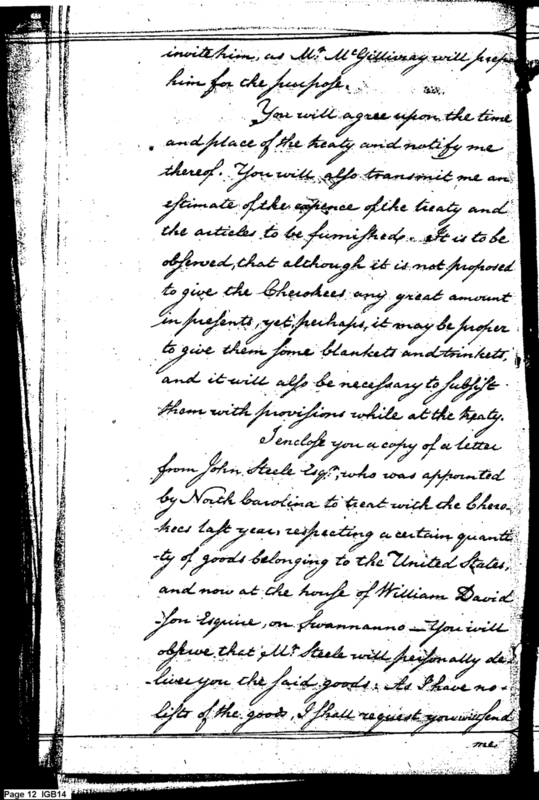
In treating with the Cherokees you must be careful to invite all the principal chiefs to be present, for unless the representation of the nation be complete, and you should be able to effect the objects herein specified, there would be no security given for the performance — The Little Turkey, with his [undecipherable] have taken [undecipherable] the Cherokees it will be particularly necessary to invite him, as Mr McGillivray will prepare him for the purpose.
You will agree upon the time and place of the treaty and notify me thereof. You will also transmit me an estimate of the expense of the treaty and the articles to be furnished. It is to be observed, that although it is not proposed to give the Cherokees any great amount in presents, yet, perhaps, it may be proper to give them some blankets and trinkets, and it will also be necessary to subsist them with provisions while at the treaty.
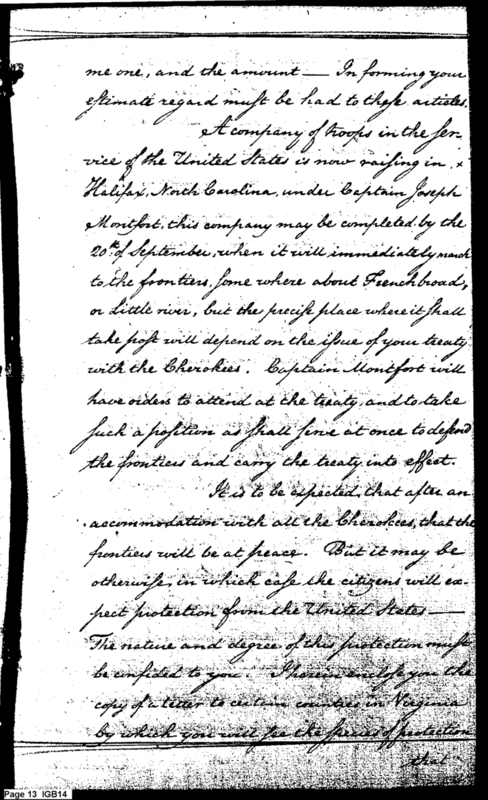
I enclose you a copy of a letter from John Steele Esqr, who was appointed by North Carolina to treat with the Cherokees last year, respecting a certain quantity of goods belonging to the United States, and now at the house of William Davidson Esquire, on Swannanoa — You will observe that Mr Steele will personally deliver you the said goods. As I have no list of the goods, I shall request you will send me one, and the amount — In forming your estimate regard must be had to those articles.
A company of troops in the service of the United States is now raising in Halifax, North Carolina, under Captain Joseph Montfort. This company may be completed by the 20th of September, when it will immediately march to the frontiers, some where about French Broad, or Little river, but the precise place where it shall take post will depend on the issue of your treaty with the Cherokees. Captain Montfort will have orders to attend at the treaty, and to take such a position as shall serve at once to defend the frontiers and carry the treaty into effect.
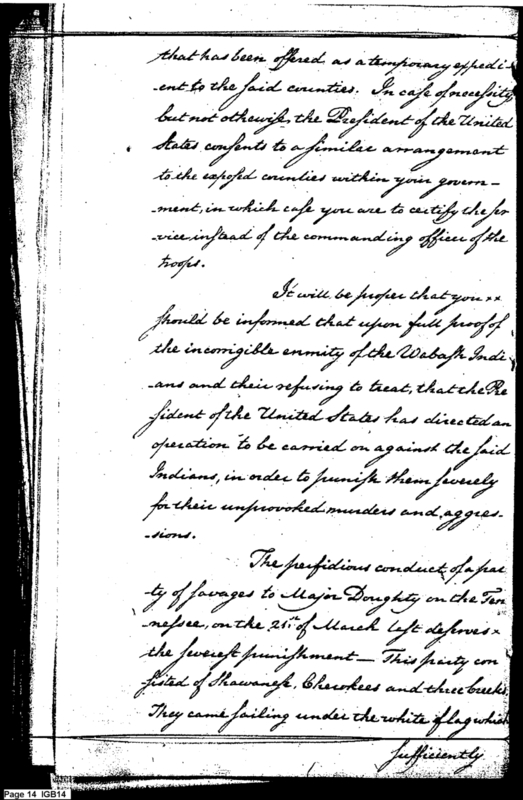
It is to be expected, that after an accommodation with all the Cherokees, that the frontiers will be at peace. But it may be otherwise, in which case the citizens will expect protection from the United States — The nature and degree of this protection must be confided to you. I herein enclose you the copy of a letter to certain counties in Virginia by which you will see the form of protection that has been offered as a temporary expedient to the said counties. In case of necessity, but not otherwise, the President of the United States consents to a similar arrangement to the exposed counties within your government, in which case you are to certify the service instead of the commanding officer of the troops.
It will be proper that you also should be informed that upon full proof of the incorrigible enmity of the Wabash Indians, and their refusing to treat, that the President of the United States has directed an operation to be carried on against the said Indians, in order to punish them severely for their unprovoked murders and aggressions.
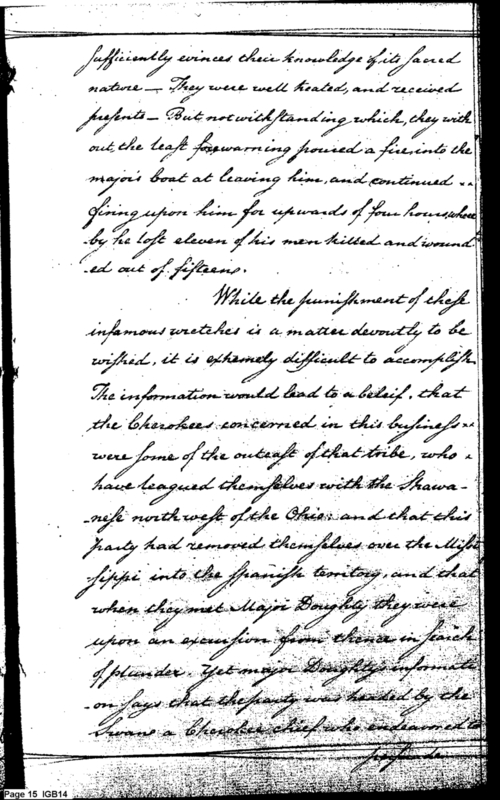
The perfidious conduct of a party of Savages to Major Doughty on the Tennessee, on the 21st of March last, deserves the severest punishment — This party consisted of Shawnagh, Cherokees and three Creeks. They came sailing under the white flag, which sufficiently evinces their knowledge of its sacred nature — They were well treated, and received presents — But notwithstanding which, they without the least forewarning, poured a fire into the Major's boat at leaving him, and continued firing upon him for upwards of four hours, by he lost eleven of his men killed and wounded out of fifteen.
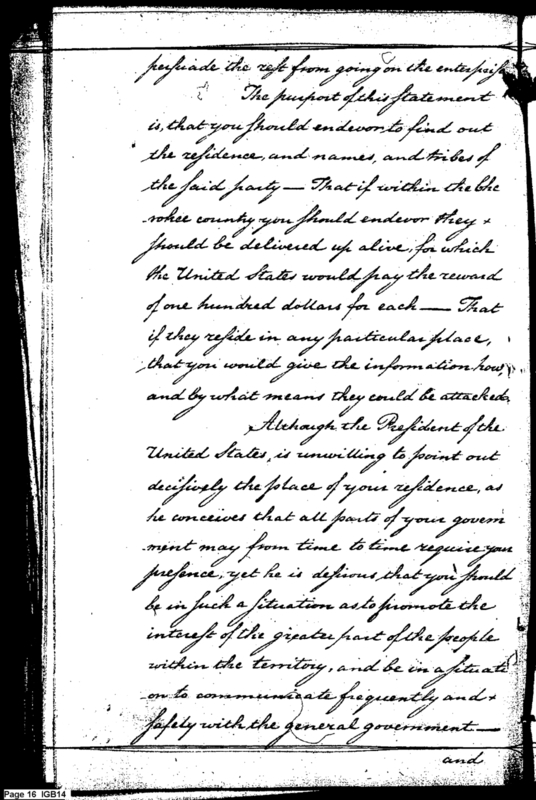
While the punishment of these infamous wretches is a matter devoutly to be wished, it is extremely difficult to accomplish. The information would lead to a belief, that the Cherokees concerned in this business were some of the outcasts of that tribe, who have leagued themselves with the Shawnees north west of the Ohio; and that this party had removed themselves over the Mississippi into the Spanish territory, and that when they met Major Doughty they were upon an excursion from thence in search of plunder. Yet Major Doughty's informant says that the party was headed by the Swan, a Cherokee chief, who endeavoured to persuade the rest from going on the enterprise.
The purport of this statement is, that you should endeavor to find out the residence, and names, and tribes of the said party — That if within the Cherokee country you should endeavor they should be delivered up alive, for which the United States would pay the reward of one hundred dollars for each — That if they reside in any particular place, that you would give the information how, and by what means they could be attacked.
Although the President of the United States, is unwilling to point out decisively the place of your residence, as he conceives that all parts of your government may from time to time require your presence, yet he is desirous that you should be in such a situation as to promote the interest of the greater part of the people within the territory, and be in a situation to communicate frequently and safely with the general government — and he is of opinion from the information he possesses on this subject, that some place on Holstein, or between that and French Broad, would for the present be proper for the seat of government — at the same time he desires that you would communicate your ideas to him upon the subject.
I have the honor to be,
&c.
Additions to Governor Blount's letter
The President of the United States has directed me to transmit to you as Superintendent of Indian affairs for the Southern district the enclosed act, intituled, "an act to regulate trade and intercourse with the Indian tribes"; and to enjoin your observance thereof, and of the enclosed regulations which he has thought fit to prescribe in pursuance of said act, for the government of trade and intercourse with the Indian tribes within the United States.
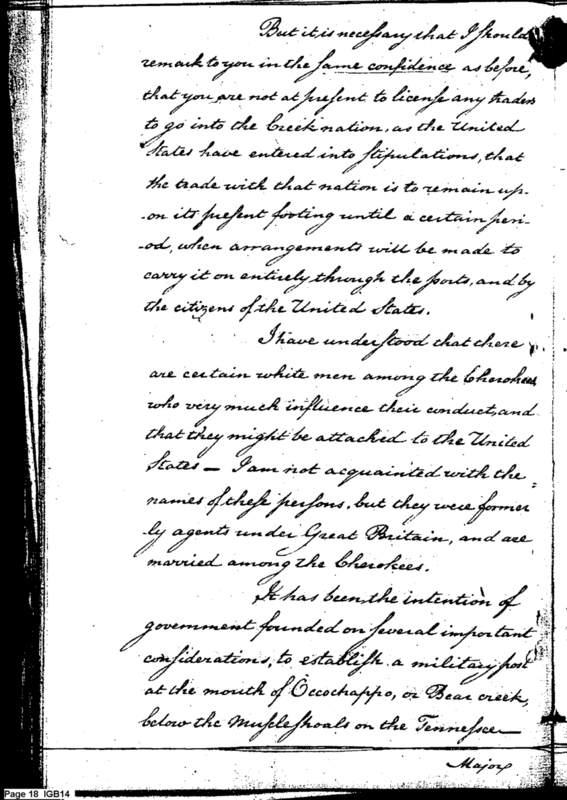
But it is necessary that I should remark to you in the same [underline: confidence] as before, that you are not at present to license any traders to go into the Creek nation, as the United States have entered into stipulations, that the trade with that nation is to remain upon its present footing until a certain period, when arrangements will be made to carry it on entirely through the ports, and by the citizens of the United States.
I have understood that there are certain white men among the Cherokees who very much influence their conduct, and that they might be attached to the United States — I am not acquainted with the names of these persons, but they were formerly agents under Great Britain, and are married among the Cherokees.
It has been the intention of government founded on several important considerations, to establish a military post at the mouth of Ocochappo, or Bear creek, below the Muscle Shoals on the Tennessee — Major Doughty was employed on this business, which was frustrated as before recited — It is important that the Cherokees should be persuaded to a cordial concurrence and support of this measure — arguments may be adduced to prove to them the advantage of it to the protection of their nation — We know that it is in the Chickasaw country, who will support the measure, and we have reason to believe that it will also be supported by the Creeks.
Information has been received that the trade of Cumberland river is monopolized by a Mr Berey, a Spanish merchant. Will you please to examine into this subject accurately and obtain the amount of the Cumberland trade annually.
It will be perceived by the act to regulate trade and intercourse with the Indian tribes, that no fees of any sort relative to the Indian trade are authorized.
I am &c.
H. Knox
P.S. I request you will be so obliging as to point out the most direct and safe mode of communication between your place of residence, and Philadelphia, the future seat of the general Government.
William Blount Esquire
Governor of the territory
of the United States,
South west of the Ohio