

Jefferson offers his opinion to Knox regarding the Treaty of Hopewell
Document 1790Letter, describes Treaty of Hopewell; describes rights of preemption and occupation.



No human transcription currently available for this document.
This transcription was generated by machine using Anthropic's Claude Code (model sonnet 4.6). It may contain errors or inaccuracies. Please verify against the document image. Learn more about our generative AI methodology.
[Augt 26. 1790]
[Mr Jefferson]
[The treaty of Hopewell]
Dear Sir
New York Aug. 26. 1790
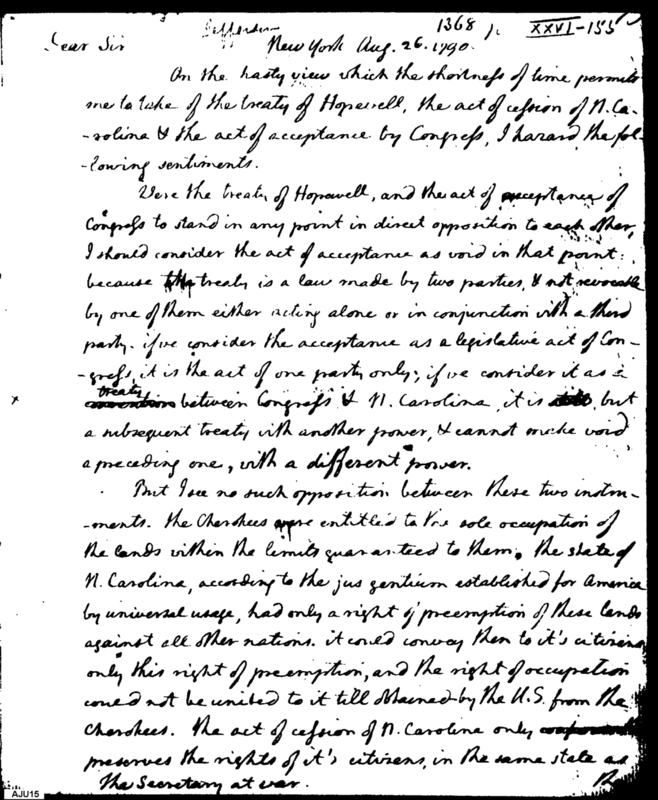
On the hasty view which the shortness of time permits me to take of the treaty of Hopewell, the act of cession of N. Carolina & the act of acceptance by Congress, I hazard the following sentiments.
Were the treaty of Hopewell, and the act of acceptance of Congress to stand in any point in direct opposition to each other, I should consider the act of acceptance as void in that point: because [strikethrough: the] the treaty is a law made by two parties, & not revocable by one of them either acting alone or in conjunction with a third party. if we consider the acceptance as a legislative act of Congress, it is the act of one party only; if we consider it as a [strikethrough: treaty] [strikethrough: convention] between Congress & N. Carolina, it is [strikethrough: also] but a subsequent treaty with another power, & cannot make void a preceding one, with a different power.
But I see no such opposition between these two instruments. the Cherokees [strikethrough: are] are entitled to the sole occupation of the lands within the limits guaranteed to them. the state of N. Carolina, according to the jus gentium established for America by universal usage, had only a right of preemption of these lands against all other nations. it could convey then to it's citizens only this right of preemption, and the right of occupation could not be united to it till obtained by the U.S. from the Cherokees. the act of cession of N. Carolina only, [strikethrough: confirms] preserves the rights of it's citizens, in the same state as
The Secretary at war.
they would have been, had that act never been passed. it does not make imperfect titles, perfect; but only prevents their being made worse. Congress, by their act, accept on these conditions. the claimants of N.C. then, and also the cherokees are exactly where they would have been, had neither the act of cession, nor that of acceptance been ever made; that is, [strikethrough: the] the Latter possess the right of occupation, & the former the right of preemption.
The three deductions seem clear enough, yet the question would be a disputable one between the general government, a particular government, & individuals, and it would seem very desireable to draw all the [strikethrough: holders] of preemption within a certain limit, by commuting for those out of it, and then to purchase of the Cherokees the right of occupation.
I have the honor to be, my dear Sir
yours respectfully & affectionately
Th: Jefferson
Type
Letter Signed
Description
Letter, describes Treaty of Hopewell; describes rights of preemption and occupation.
Date
08/26/1790
Author
Recipient
Sent from
New York
Repository
Collection
Document number
1790082640101
Page start
1
Notable persons
Henry Knox
Thomas Jefferson
Cherokees
Notable locations
New York
U.S. [United States]
Hopewell
N. [North] Carolina
Notable items
preserves the rights of it's citizens
secretary at war
had that act never been passed
it does not make imperfect titles perfect
only prevents their being made worse
claimants
latter possess the right of occupation
the former the right of preemption
these deductions seem clear enough
question could be a disagreeable one between the general government, a particular government & individuals
act of cession
act of acceptance by Congress
hazard the following sentiments
stand in any point in direct opposition to each other, I should consider the act of acceptance as void in that point
treaty is a law made by two parties
not revocable by one of them either acting alone or in conjunction with a third party
consider the acceptance as a legislature act of Congress
act of one party only
consider is as a treaty
subsequent treaty with another power
cannot make void a preceding one with a different power
see no such opposition between these two instruments
Cherokees were entitled to the sole occupation of the lands within the limits guaranteed to them
according to the jus genticon established for America by universal usage
right of preemption of these lands against all other nations
right of occupation could not be united to it till abandoned by the U.S. from the Cherokees
on the hasty view which the shortness of time permits me to take of the treaty of Hopewell