

Treaty with Creek Nation: 1790
Document 1790Treaty of Peace with Creek Nation, 1790. Treaty conducted under the authority vested in the Secretary at War, Henry Knox.


No human transcription currently available for this document.
This transcription was generated by machine using Anthropic's Claude Code (model sonnet 4.6). It may contain errors or inaccuracies. Please verify against the document image. Learn more about our generative AI methodology.
[undecipherable]
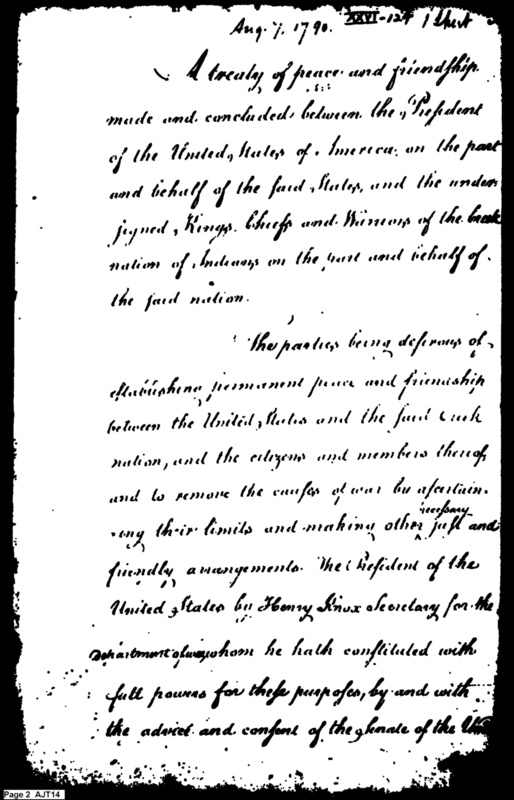
Aug. 7. 1790. XXVI-124 1 Sheet
A treaty of peace and friendship made and concluded between the President of the United States of America on the part and behalf of the said States, and the undersigned Kings, Chiefs and Warriors of the Creek nation of Indians on the part and behalf of the said nation.
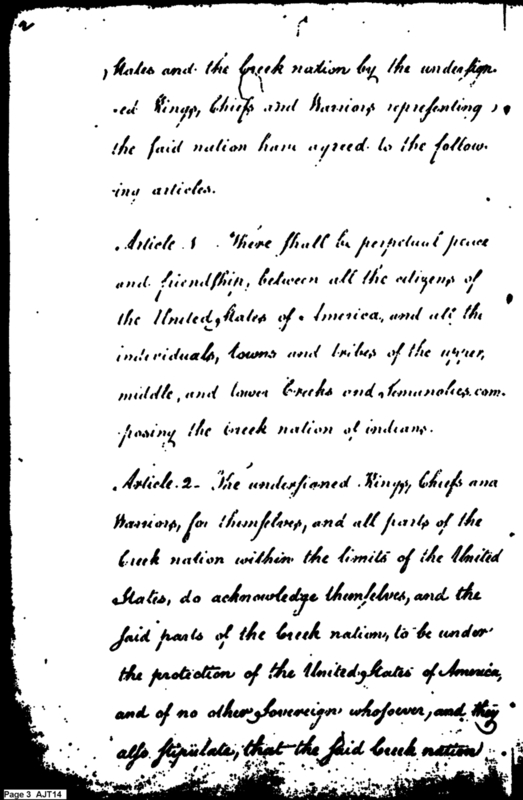
The parties being desirous of establishing permanent peace and friendship between the United States and the said Creek nation, and the citizens and members thereof, and to remove the causes of war by ascertaining their limits and making other just and necessary friendly arrangements. The President of the United States by Henry Knox Secretary for the Department of War whom he hath constituted with full powers for these purposes, by and with the advice and consent of the Senate of the U[nited] States and the Creek nation by the undersigned Kings, chiefs and Warriors representing the said nation have agreed to the following articles.
Article 1. There shall be perpetual peace and friendship, between all the citizens of the United States of America, and all the individuals, towns and tribes of the upper, middle, and lower Creeks and Seminolies composing the Creek nation of Indians.
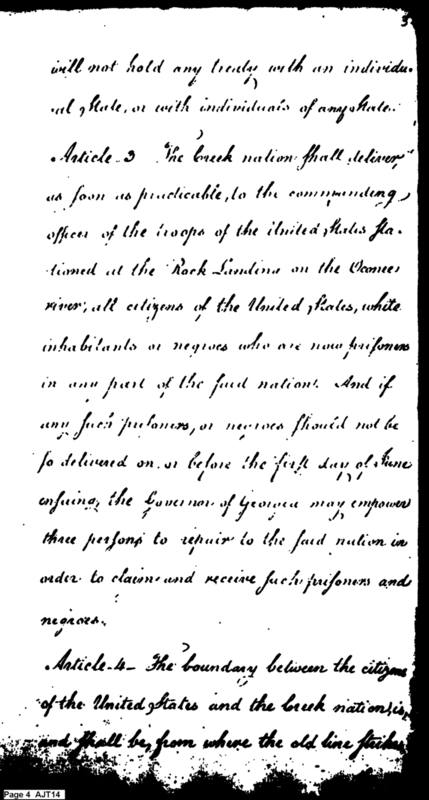
Article 2. The undersigned Kings, Chiefs and Warriors, for themselves, and all parts of the Creek nation within the limits of the United States, do acknowledge themselves, and the said parts of the Creek nation, to be under the protection of the United States of America, and of no other sovereign whosoever; and they also stipulate, that the said Creek nation will not hold any treaty with an individual State, or with individuals of any State.
Article 3. The Creek nation shall deliver, as soon as practicable, to the commanding officer of the troops of the United States stationed at the Rock Landing on the Oconee river, all citizens of the United States, white inhabitants or negroes who are now prisoners in any part of the said nation. And if any such prisoners, or negroes should not be so delivered on or before the first day of June ensuing, the Governor of Georgia may empower three persons to repair to the said nation in order to claim and receive such prisoners and negroes.
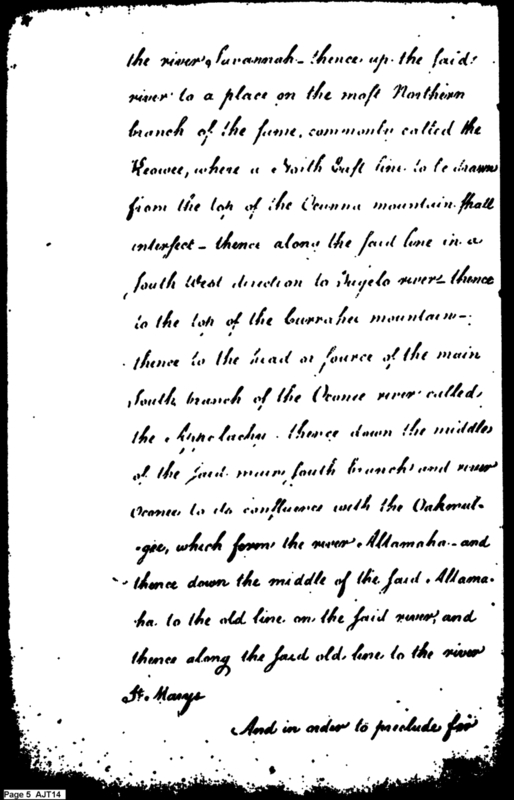
Article 4. The boundary between the citizens of the United States and the Creek nation is, and shall be, from where the old line strikes the river Savannah — thence up the said river to a place on the most Northern branch of the same, commonly called the Keowee, where a South East line is to be drawn from the top of the Ocunna mountain shall intersect — thence along the said line in a South West direction to Tugelo river — thence to the top of the Currahu mountain — thence to the head or source of the main South branch of the Oconee river called the Apalachee — thence down the middle of the said main South branch and river Oconee to its confluence with the Oakmulgee, which forms the river Altamaha — and thence down the middle of the said Altamaha to the old line on the said river; and thence along the said old line to the river St. Marys.
And in order to preclude [all]
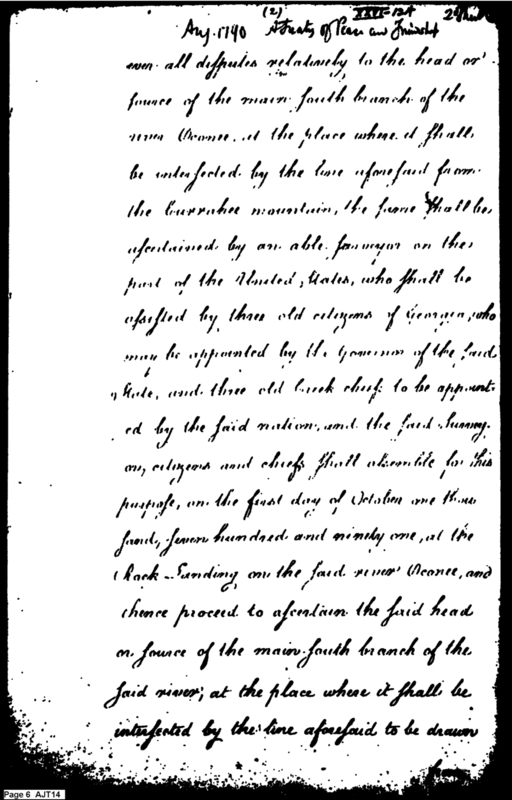
Aug. 1790 (2) XXVI-124 2d Sheet
A Treaty of Peace and Friendship
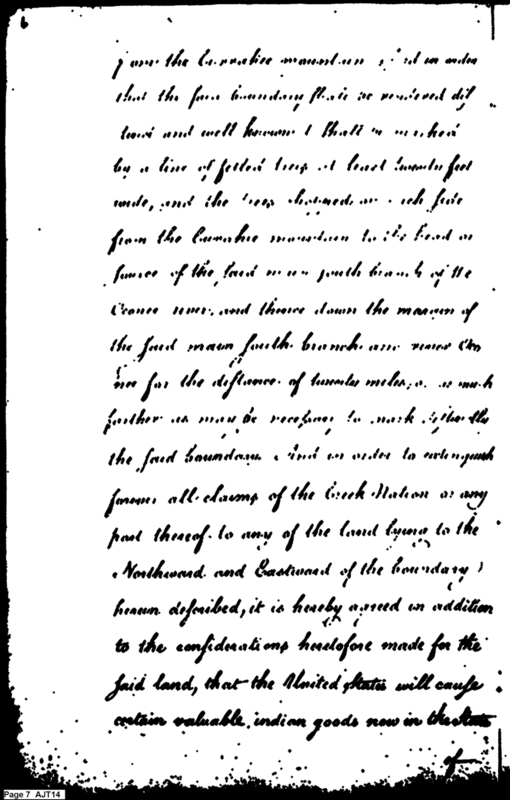
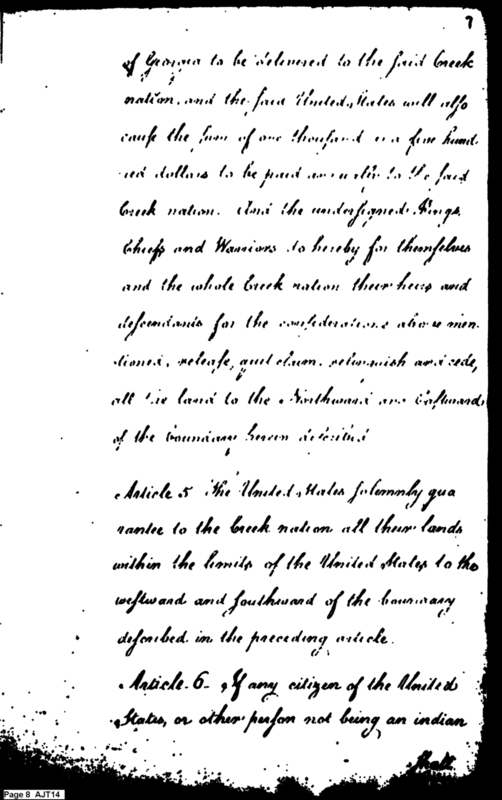
over all disputes relatively to the head or source of the main South branch of the river Oconee, at the place where it shall be intersected by the line aforesaid from the Currahu mountain, the same shall be ascertained by an able Surveyor on the part of the United States, who shall be assisted by three old citizens of Georgia, who may be appointed by the Governor of the said State, and three old Creek chiefs to be appointed by the said nation, and the said Surveyor, citizens and chiefs shall assemble for this purpose, on the first day of October one thousand seven hundred and ninety one, at the Rock Landing on the said river Oconee, and thence proceed to ascertain the said head or source of the main South branch of the said river, at the place where it shall be intersected by the line aforesaid to be drawn from the Currahu mountain. And in order that the said boundary shall be so rendered distinct and well known, it shall be marked by a line of felled trees at least twenty feet wide, and the trees cleared on each side from the Currahu mountain to the head or source of the said main South branch of the Oconee river, and thence down the margin of the said main South branch and river Oconee for the distance of twenty miles; or as much further as may be necessary to mark effectually the said boundary. And in order to extinguish forever all claims of the Creek Nation or any part thereof, to any of the land lying to the Northward and Eastward of the boundary herein described, it is hereby agreed in addition to the considerations heretofore made for the said land, that the United States will cause certain valuable Indian goods now in the State of Georgia to be delivered to the said Creek nation, and the said United States will also cause the sum of one thousand five hundred dollars to be paid annually to the said Creek nation. And the undersigned Kings, Chiefs and Warriors do hereby for themselves and the whole Creek nation their heirs and descendants for the considerations above mentioned, release, quit claim, relinquish and cede, all the land to the Northward and Eastward of the boundary herein described.
Article 5. The United States solemnly guarantee to the Creek nation all their lands within the limits of the United States to the westward and southward of the boundary described in the preceding article.
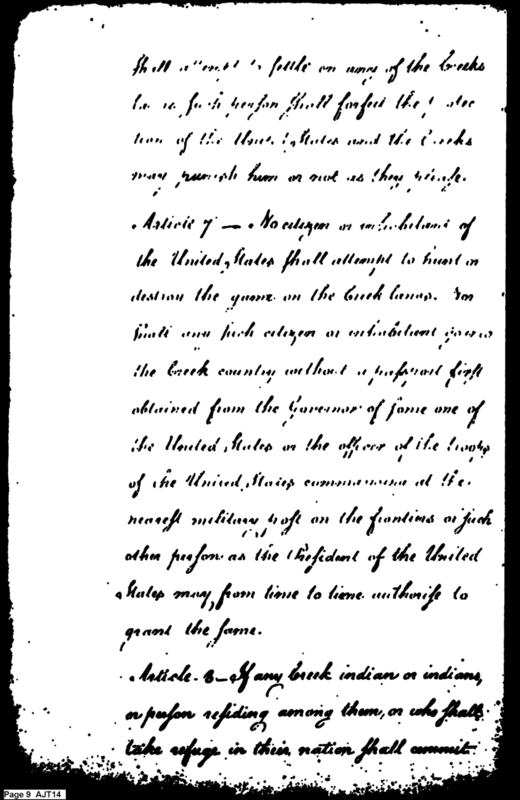
Article 6. If any citizen of the United States, or other person not being an Indian shall attempt to settle on any of the Creeks lands, he so forfeits the protection of the United States and the Creeks may punish him or not as they please.
Article 7. — No citizen or inhabitant of the United States shall attempt to hunt or destroy the game on the Creek lands. No [citizen] or inhabitant going into the Creek country without a passport first obtained from the Governor of some one of the United States or the officers of the troops of the United States commencing at the nearest military post on the frontiers or such other person as the President of the United States may, from time to time, authorize to grant the same.
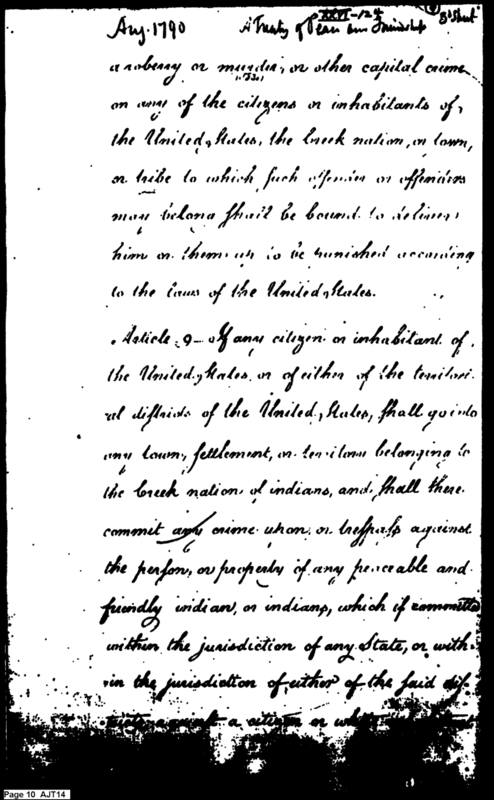
Article 8. If any Creek Indian or Indians, or person residing among them, or who shall take refuge in their nation shall commit
Aug. 1790 A Treaty of Peace and Friendship XXVI-124 8th Sheet
a robbery or murder, or other capital crime on any of the citizens or inhabitants of the United States, the Creek nation, or town, or tribe to which such offender or offenders may belong shall be bound to deliver him or them up to be punished according to the laws of the United States.
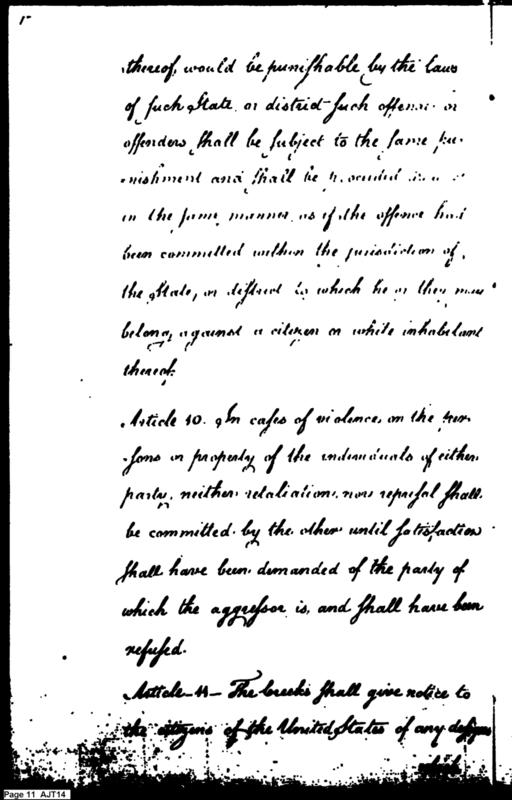
Article 9. If any citizen or inhabitant of the United States, or of either of the territorial districts of the United States, shall go into any town, settlement, or territory belonging to the Creek nation of Indians, and shall there commit any crime upon, or trespass against the person or property of any peaceable and friendly Indians, or Indians, which if committed within the jurisdiction of any State, or within the jurisdiction of either of the said districts thereof, would be punishable by the laws of such State or district — such offense or offenders shall be subject to the same punishment and shall be proceeded against in the same manner as if the offense had been committed within the jurisdiction of the State or district to which he or they may belong, against a citizen or white inhabitant thereof.
Article 10. In cases of violence on the persons or property of the individuals of either party, neither retaliation nor reprisal shall be committed by the other until satisfaction shall have been demanded of the party of which the aggressor is, and shall have been refused.
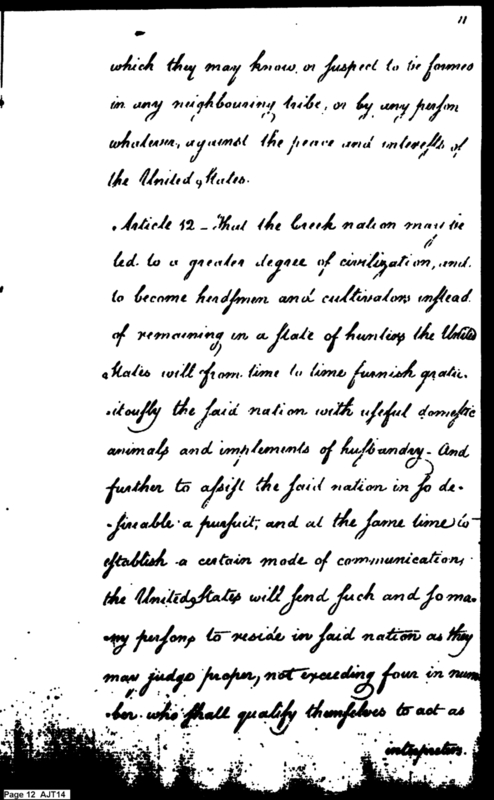
Article 11. The Creeks shall give notice to the citizens of the United States of any designs which they may know or suspect to be formed in any neighbouring tribe, or by any person whatsoever, against the peace and interests of the United States.
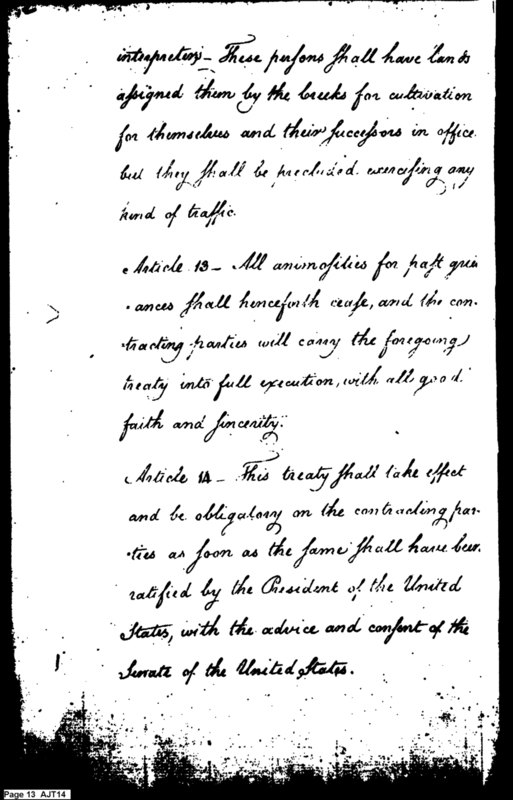
Article 12. That the Creek nation may be led to a greater degree of civilization, and to become herdsmen and cultivators instead of remaining in a state of hunters the United States will from time to time furnish gratuitously the said nation with useful domestic animals and implements of husbandry. And further to assist the said nation in so desirable a pursuit; and at the same time to establish a certain mode of communication, the United States will send such and so many persons to reside in said nation as they may judge proper, not exceeding four in number, who shall qualify themselves to act as interpreters. These persons shall have lands assigned them by the Creeks for cultivation for themselves and their successors in office; but they shall be precluded exercising any kind of traffic.
Article 13. All animosities for past grievances shall henceforth cease, and the contracting parties will carry the foregoing treaty into full execution, with all good faith and sincerity.
Article 14. This treaty shall take effect and be obligatory on the contracting parties as soon as the same shall have been ratified by the President of the United States, with the advice and consent of the Senate of the United States.
Type
Letterbook Copy
Description
Treaty of Peace with Creek Nation, 1790. Treaty conducted under the authority vested in the Secretary at War, Henry Knox.
Date
08/07/1790
Author
Repository
Collection
Document number
1790080790101
Page start
1
Notable persons
Henry Knox
Tallisee King
Alexander Mcgilivray
Creek Indians
Richard Morris
Richard Varick
Marinus Willet
John Rutledge
Joseph Allen Smith
Warriors
Notable locations
Oakmulgee
river Allamaha
river St. Mary's
Ceunna Mountain
Currahea Mountain
Shiyelo River
South branch of the Oconee River
Appalachy River
river Savannah
Keowee River
Georgia
Rock Landing on the Oconee River
United States of America
Notable items
in order to preclude ever all disputes relatively to the head or source of the main branc of the river Oconee at the place where it shall be
ascertained by an able surveyor
shall be assisted by three old citizens of Georgia who may be appointed by the Governor
three old Creek Chiefs to be appointed by the said nation
assemble for this purpose on the first day of October
cause certain valuable indian goods now in the state of Georgia to be delivered
dollars to be paid
Article 5
solemnly guarantee to the Creek nation all their lands
person not being an indian shall not settle
such persons forfeit protection
Article 6
Article 7
hunt or destroy the game on the Creek lands
passport first obtained from the Governor
officer of the troops
nearest military post on the frontiers or such other persons as the President of the United States may from time to time authorize to grant the same
Article 8
person residing among them or who shall take refuge in their nation shall commit a robbery or murder or other capital crime on any of the citizens or
won or tribe to which such offender or offenders may belong shall be bound to deliver him or them up to be punished according to the laws
Article 9
territorial districts
shall go into any town, settlement, or territory belonging to the Creek nation of indians and shall there commit any crime upon or trespass against
committed within the jurisdiction of any state
punishable by the laws of suh state or district
white inhabitant
Article 10
in cases of violence on the persons or property of the individuals of either party, neiher retaliation nor reprisal shall be committed the the other
Article 11
notice to the citizens
neighbouring tribe
peace and interests
Article 12
led to a greater degree of civilization and to become herdsmen and cultivators instead of remaining in a state of hunters
from time to time furnish gratiously the said nation with useful domestic animals and implements of husbandry
so desirable a pursuit
establish a certain mode of communications
qualify themselves to act as interpreters
persons shall have lands asssigned to them
cultivation for themselves and their successors on office
precluded exercising any kind of traffic
Article 13
animosities for past grievances shall henceforth cease
contracting parties will carry the foregoing treaty into full execution with all good faith and sinerity
take effect and be obligatory on the contracting parties as soon as the same shall have been ratified
with the advice and consent of the Senate
thence to the head or fource of the main south branch of the Oconee
confluence
drawn from the top of the Ceunna mountain
Article 4
boundary
where the old line stretches across theriver Savannah
place on the most northern branch of the same commonly called the Keowee
white inhabitants or negroes sho are now prisoners in any part of the said nations
if any such prisoners or negroes should not be so delivered on or before the first day of June ensuing
Governor of Georgia may empower three persons to repair to the said nation in order to claim and receive such prisoners and negroes
Secretary for the Department of War whom he hath constituted with full powers for these purposes by and with the advice and consent of the Senate
representing the said nation
agreed to the following articles
Article 1
perpetual peace and friendship between all citizens
individuals, towns and tribes of the upper, middle and lower Creeks and Seminoles composing the Creek nation of Indians
Article 2
all parts of the Creek nation within the limits of the United States do acknowledge themselves and the said parts of the Creek nation to under the
no other Sovereign whosoever
will not hold anytreaty with an individual state or with individuals of any state
Article 3
deliver us as soon as practicable to the commanding officer of th etroops of the United States stationed at Rock Landing on the Oconee River
citizens and members thereof
remove the causes of war by ascertaining their limits and making other necessary and just and friendly arrangements
treaty of peace and friendship made and concluded between the President of the United States of America on the part and behalf of the said States and
parties being desirous of establishing a permanent peace and friendship