No human transcription currently available for this document.
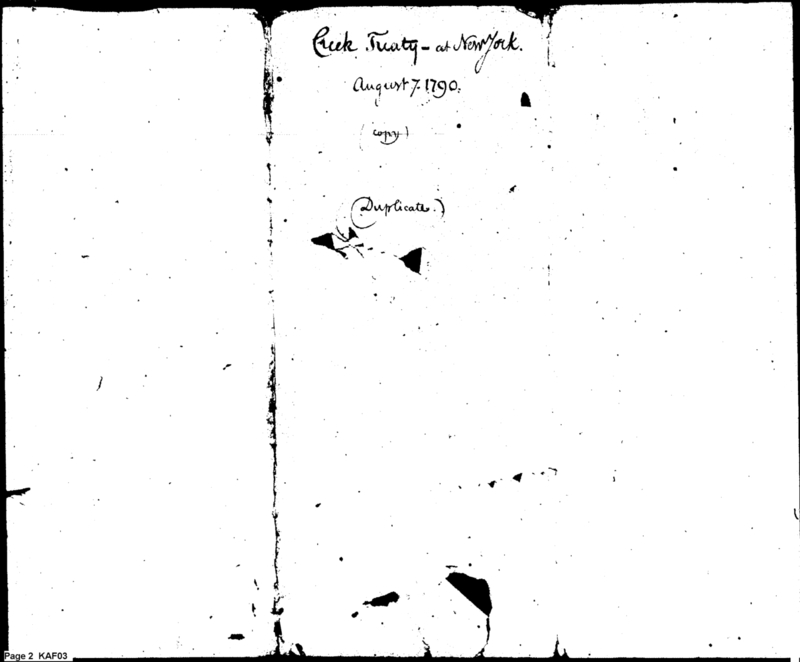
[Copy]
[Duplicate]
Creek Treaty - at New York.
August 7. 1790.
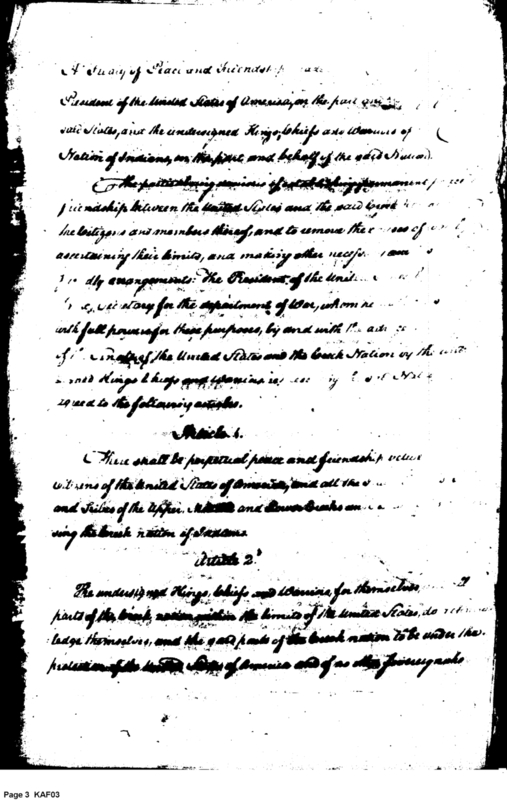
A Treaty of Peace and Friendship [undecipherable]
President of the United States of America, on the part [undecipherable]
said States, and the undersigned Kings, Chiefs and Warriors of
[the Creek] Nation of Indians, on the part, and behalf of the [undecipherable] Nation.
The parties being [desirous] of establishing permanent [undecipherable] [and]
friendship between the United States and the said Creek [undecipherable]
the citizens and members thereof, and to remove the [undecipherable] of [undecipherable]
ascertaining their limits, and making other necessa[ry undecipherable]
[friend]ly arrangements: The President of the Unite[d States,] [has]
[appointed the] Secretary for the departments of War, whom he [undecipherable]
with full power for these purposes, by and with the adv[ice undecipherable]
of [the] [S]enate of the United States and the Creek Nation by the [undecipherable]
[undecipherable] Kings[,] kings and Warriors [undecipherable]
[agreed] to the following articles.
Article 1.
There shall be perpetual peace and friendship [undecipherable]
citizens of the United States of America, and all the [undecipherable]
and Tribes of the [U]pper[,] [undecipherable] and Lower Creeks an[d undecipherable]
[undecipherable] the Creek nation of Indians.
Article 2.
The undersigned Kings, chiefs and Warriors for themselves [undecipherable]
parts of the Creek nation within the limits of the United States, do [undecipherable]
ledge themselves, and the [undecipherable] parts of the Creek nation to be under the
protection of the United States of America and of [no other foreign nation]
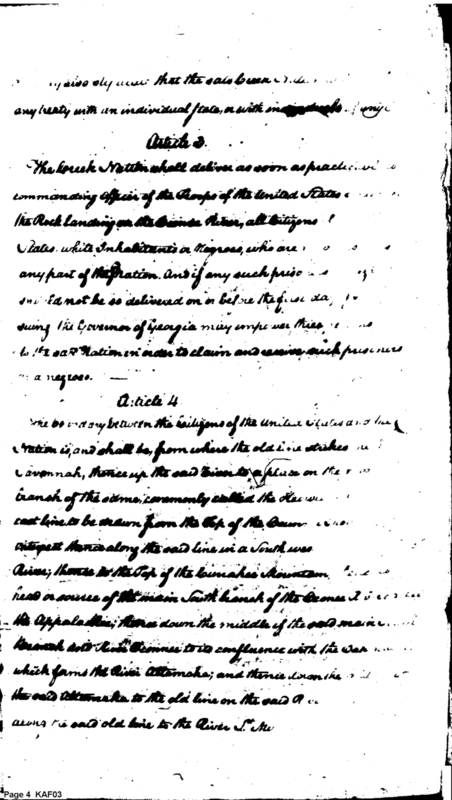
[; and] also d[o agree] that the said [Creek Nation shall not make]
any [undecipherable] treaty with an individual state, or with in[dividuals of any State.]
Article 3.
The Creek Nation shall deliver as soon as practicabl[e] to the
commanding Officer of the Troops of the United States [at]
[the] Rock Landing on the Oconee River, all citizens [of the United]
States, white Inhabitants or Negroes, who are [prisoners in]
any part of the[ir] Nation. And if any such pris[oners]
should not be so delivered on or before the [first] da[y, the next en-]
suing the Governor of Georgia may empower three [undecipherable]
to [the] said Nation in order to claim and receive such pris[oners]
[a]nd negroes. —
Article 4
The boundary between the citizens of the United States and the [Creek]
Nation is, and shall be, from where the old line strikes [the River]
[S]avannah, thence up the said [River to a] place on the [northern]
branch of the same, commonly called the [Keow-]
ee[;] east line to be drawn from the top of the [Oconee] [moun-]
tain[;] thence along the said line in a South we[st direction to the]
River; thence [to] the top of the [Currahee] [M]ountai[n;] [thence to the]
head or source of the main South branch of the Oconee [River within]
the Appalachin[a;] thence down the middle of the said main [South]
[b]ranch [and] [Little] Oconee to its confluence with the [other branch]
which forms the River Altamaha; and thence down the [said river]
the said Altamaha to the old line on the said [River;]
along the said old line to the River S[t. Ma-]
[rys]
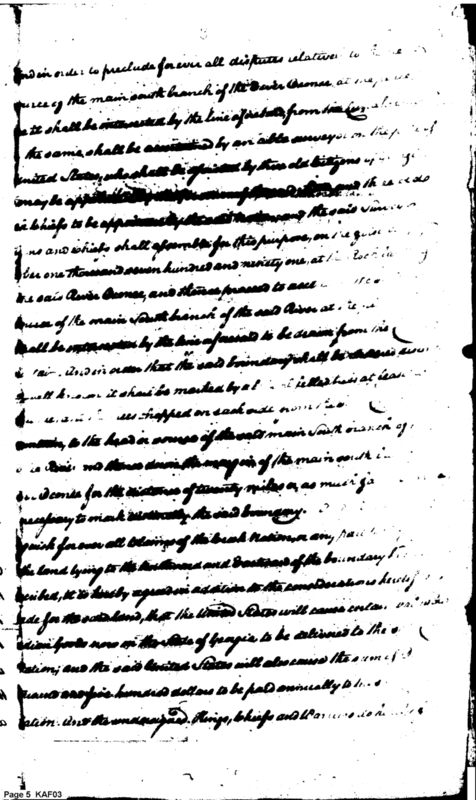
[A]nd in order to preclude forever all disputes relative to [undecipherable]
[sou]rce of the main south branch of the [Oconee] [River,] at [undecipherable]
[wh]ere it shall be intersected by the line of [latitude] from [undecipherable]
the same shall be [ascertained] by an able [surveyor] on the part [of the]
United States, who shall be appointed by three old citizens [undecipherable]
[may] be appointed [undecipherable] the said [bounds]
[a]s [undecipherable] chiefs to be appointed [by] the said Nation and the said [surveyor]
[undecipherable] and which shall assemble for this purpose, on [undecipherable]
the one thousand seven hundred and ninety one, at [the] Rock La[nd-]
[i]ng the said River Oconee, and thence proceed to ascer[tain the]
[sou]rce of the main South branch of the said River at [undecipherable]
[sh]all be intersected by the line of [latitude] to be drawn from [undecipherable]
[the] rain. And in order that the said [bound]ary shall be [well] [known and]
[well] known it shall be marked by a [number of] [tall] [undecipherable] trees at leas[t]
[t]wo [undecipherable] trees chopped on each side [numbered from] [undecipherable]
[t]wenty, to the head or source of the said main South [b]ranch of [the]
[Oconee River] and thence down the margin of the main south [undecipherable]
[undecipherable] for the distance of twenty miles or as much [as may be]
necessary to mark [distinctly] the said boundary.
[In con]sideration for all [undecipherable] of the Creek Nation on any part [of]
the land lying to the Eastward and Northward of the boundary [herein de-]
[sc]ribed, it is hereby agreed in addition to the considerations hereto[fore]
[ma]de for the said land, that the United States will cause [certain] [undecipherable]
[undecipherable] now on the [undecipherable] side of Georgia to be delivered to the [Creek]
[N]ation; and the said United States will also cause the [sum of]
[undecipherable] hundred dollars to be paid annually to [the]
[N]ation. And the undersigned Kings, chiefs and Warriors do her[eby]
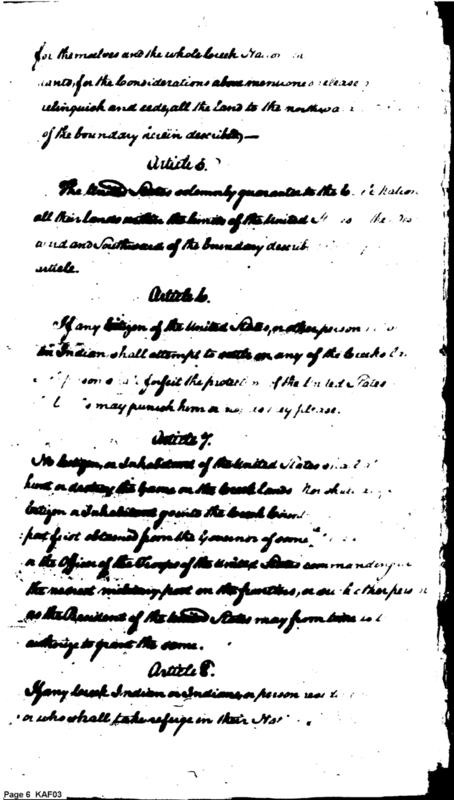
for themselves and the whole Creek Na[tion undecipherable]
[for the] considerations above mentioned [do] release [and]
relinquish and cede, all the land to the northwa[rd and eastward]
of the boundary herein describ[ed.] —
Article 5.
The United [States] solemnly guarantee to the [Creek] Nation
all their lands within the limits of the United States to the [East-]
ward and Southward of the boundary describ[ed in the preceding]
article.
Article 6.
If any citizen of the United States, or other person [not being]
[an] Indian, shall attempt to settle on any of the Creek la[nds,]
[he] [sho]uld [shall] forfeit the protect[ion] of the United States[,]
[and the Indians] may punish him a[s] [they see] fit [and] please.
Article 7.
No [citizen or] Inhabitant of the United States shal[l be per-]
[mitted to] hunt or destroy the game on the Creek lands. Nor shal[l any]
citizen [or] Inhabitant [go] into the Creek [t]errito[ry]
[with]out first [having] obtained from the Governor of [some State,]
[or th]e Officer of the Troops of the United States commandin[g at]
the nearest military post on the [frontier,] or [such] [o]ther person [n]
as the President of the United States may from time to [time]
authority to grant the same.
Article 8.
If any Creek Indian or Indians or person resi[ding among them]
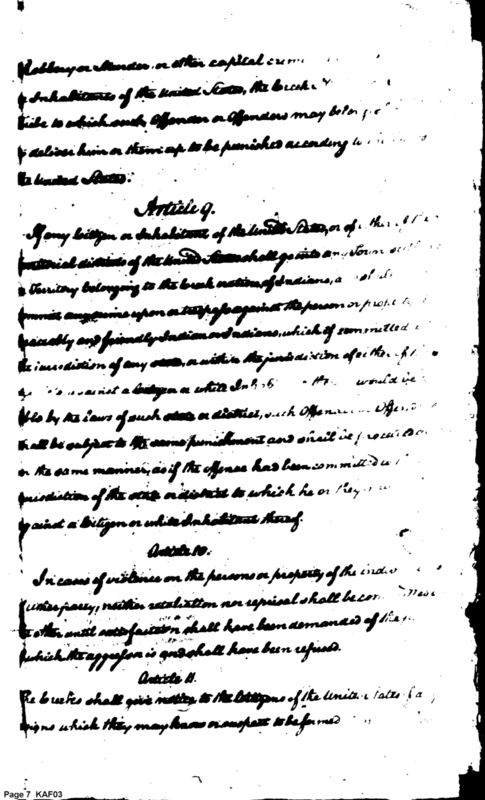
or who shall take refuge in their Na[tion shall rob,] [murder] or other capital crime[s]
[against any] Inhabitants of the United States, the Creek [N]ation[,]
[t]ribe to which such Offender or Offenders may belo[ng,]
[shall] deliver him or them up to be punished according to [the laws of]
the United States.
Article 9.
If any citizen or Inhabitant of the United States, or of [the] [terri-]
[t]orial districts of the United States shall go into any [town or settle-]
[ment or] Territory belonging to the Creek nation of Indians, a[nd shall]
[co]mmit any crime upon or trespass against the person or prop[erty of any]
peaceably and friendly Indian and [actions,] which if comm[itted under]
the jurisdiction of any [state,] or within the jurisdiction of [the district,]
[undecipherable] against a citizen or white Inhabit[ant,] [the undecipherable would be puni-]
[sha]ble by the laws of such state or district, such Offens[e or Offender]
shall be subject to the same punishment and shall be [prosecuted]
in the same manner, as if the offense had been committed [within the]
jurisdiction of the [state or] district to which he or they [offended]
against a citizen or white Inhabitant thereof.
Article 10.
In cases of violence on the persons or property of the indi[viduals of either]
party, neither retaliation nor reprisal shall be com[menced]
[n]either until satisfaction shall have been demanded of the [party to]
[w]hich the aggressor is and shall have been refused.
Article 11.
The [Creek Nation] shall give notice to the citizens of the Unite[d] States [of]
[any] designs which they may know or suspect to be form[ed]
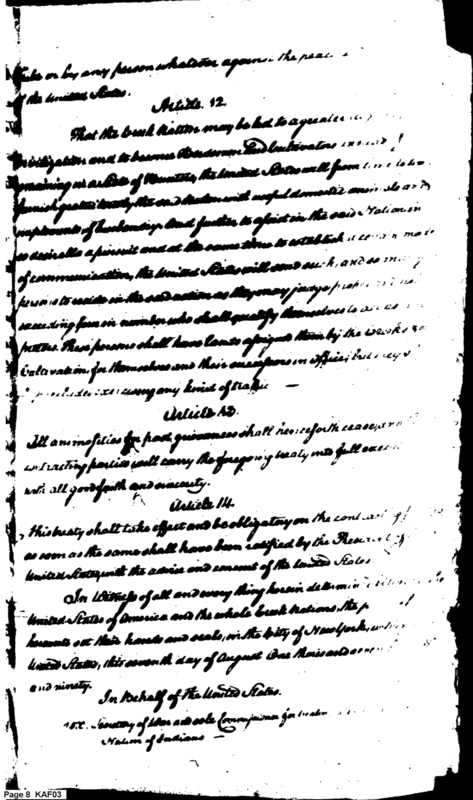
[in any neighboring tribe] or by any person whatsoever against the peace [and interest]
of the United States.
Article 12.
That the Creek Nation may be led to a [greater degree of]
[c]ivilization and to become [Husbandmen] and [c]ultivators [of the earth,]
[r]emaining at a State of [Hunters,] the United States will from time to [time]
[furnish] gratui[tously] the said Nation with [useful domestic] animals [and]
[im]plements of [H]usbandry[,] and [further,] to assist in the said Nation in
[every way] as desirable a pursuit and at the same time to establish [a certain mode]
of communication, the United States will send [such,] and [as many]
persons to assist in the said nation as [they may judge] [proper and not]
exceeding [four] in number, who shall qualify themselves to [act as]
[in]terpreters. These persons shall have lands assigned them by the [Creek]
[N]ation for cultivation for themselves and their successors in office[,] [but] [they]
[shall] [not] [be res]trained from any kind of trad[e.] —
Article 13.
All animosities for past grievances shall henceforth cease, and [the]
contracting parties will carry the foregoing treaty into full exe[cution,]
with all good faith and sincerity.
Article 14.
This treaty shall take effect and be obligatory on the cont[racting parties]
as soon as the same shall have been ratified by the Presi[dent of] the
United States with the advise and consent of the United States [Senate.]
In Witness of all and every thing herein determined [and done,] the
United States of America and the whole Creek Nations, the [parties have]
hereunto set their hands and seals, in the City of New York, with[in the]
United States, this seventh day of August One thousand [seven hundred]
and ninety.
In behalf of the United States.
[H. W. Knox,] Secretary of [War] and sole Commissioner for [Indian]
Nation of Indians —
In behalf of themselves and the whole Creek Nation of [Indians.]
Alexander McGillivray - - - -
[undecipherable] { Tuskolohe Mico, or Bird Tail King, - - - - -
his { Neathlock, or Second Man: - - - -
{ Hollelomicthle, or Blue Giver, - - - - -
Siltle { Opay Mico, or the Singer, - - - - -
Tallis[e] { [Fu]ckachajou, or [undecipherable], - - - -
Big Tallise { Hoopothle Mico or Tallise King, [undecipherable]
{ Okatolacta, or Long Site - - -
[undecipherable] { Tokolofou, or Young Second Man, - - - -
[undecipherable] { Ochechajou, or Aleck [Counsel]. - - -
Chuiabie or the great Natchez Warrior -
[his] { Watenwachehee or the great Natchez Warriors Brother
marks { Thakoloches or the Mole - - - - -
{ Oquakabie
Tustennah or [Big] Lieutenant
[his marks] [undecipherable]
Whirnabie or Natheus
Juleclaulematha or Dry Arm
[Lower Indian] { Chiawoithly Mico - -
[towns] { [undecipherable] Hopoy or the Measurer
[his mark] { Muhlee thoklipen
{ Stimafatchee or Good Humour
[undecipherable] Ailnaloje, or Disputor -
[undecipherable] Mumagechee David Francis.
Done in presence of
[undecipherable] [Chief] Justice of the State of New York[,] Richard [undecipherable]
Mayor of the City of New York, Marinus Willet Thomas Lee Shipp[en of]
Pennsylvania John Rutledge Jun[ior] Joseph Allen Smith. Henry [undecipherable]
[his]
Joseph [undecipherable] [Curnell] Interpreter. —
marks