

Commisioners' Report on Negotiations with the Creek Nation
Document 1789The Commissioners--Lincoln, Griffin, and Humphreys--report on their mission to negotiate a treaty with the Creek Nation. Since their mission was unsuccessful, they make recommendations regarding the measures needed to protect frontier settlers. They also suggest that further efforts should be made to improve relations with the Creeks. They have much to say about the Creeks and other southern tribes with respect to their culture, traditions, governments, etc.




No human transcription currently available for this document.
This transcription was generated by machine using Anthropic's Claude Code (model sonnet 4.6). It may contain errors or inaccuracies. Please verify against the document image. Learn more about our generative AI methodology.
[Illegible Text — some pages of this file are wholly or in part illegible. A better copy could not be located.]
[undecipherable] [undecipherable] the [Commissioner?] [undecipherable]
[undecipherable]
[undecipherable] New York, [undecipherable]
[undecipherable] [Honorable?] [Secretary at War?] [undecipherable]
[Missing Page/s — some pages of this file are wholly or in part missing]
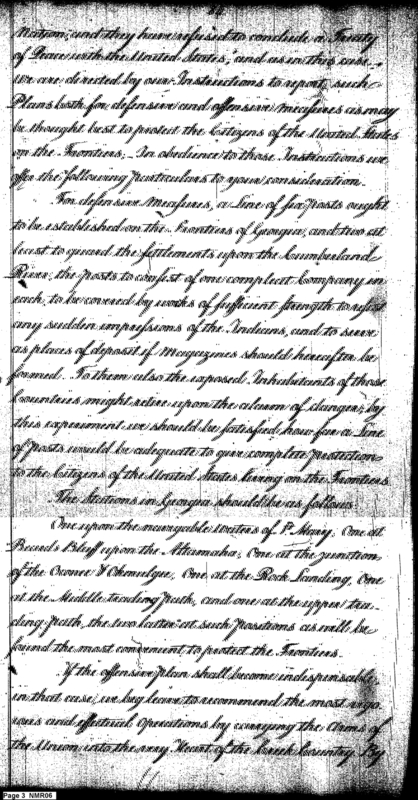
Nations, and they have refused to conclude a Treaty of Peace with the United States, and as in this case, we are directed by our Instructions to report such Plans both for defensive and offensive measures as may be thought best to protect the Citizens of the United States on the Frontiers. In obedience to these Instructions we offer the following Observations to your consideration.
For defensive Measures, a line of fix Posts ought to be established on the Frontiers of Georgia, and there at least to guard the Settlements upon the Cumberland River, the posts to consist of one compleat Company in each, to be covered by works of sufficient strength to resist any sudden impressions of the Indians, and to serve as places of deposit if Magazines should hereafter be formed. To them also the exposed Inhabitants of those Countries might retire upon the alarm of danger; by this arrangement we should be satisfied that a line of posts would be adequate to give compleat protection to the Citizens of the United States living on the Frontiers.
The Stations in Georgia should be as follows:
One upon the navigable waters of [St. Mary?], One at Beards Bluff upon the Altamaha, One at the junction of the Oconce & Okmulgee, One at the Rock Landing, One at the Middle landing Path, and one at the upper [Boarding?] Path, the two latter at such positions as will be found the most convenient to protect the Frontiers.
If the offensive plan shall become indispensable, in that case, we lay leave to recommend the most vigorous and effectual Operations by carrying the [undecipherable] of the [undecipherable] with the [Army?] [Head?] of the [South?] running [by?]
[Missing Page/s]
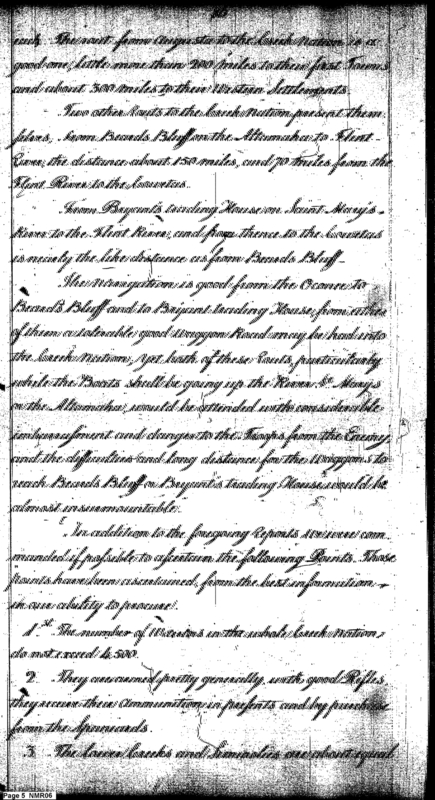
such, the most from Georgia to the Creek Nation, is a good one, little more than 200 miles to their first Towns, and about 500 miles to their Western Settlements.
Two other Routes to the Creek Nation present themselves, from Beards Bluff on the Altamaha to Flint River, the distance about 150 miles, and 70 miles from the Flint River to the Cowetas.
From Bryants trading House on Saint Mary's River to the Flint River, and from thence to the Cowetas is nearly the like distance as from Beards Bluff.
The Navigation is good from the Oconce to Beards Bluff and to Bryants trading House, either of them a tolerable good stream. Road may be had into the Creek Nation, yet both of these routes, particularly while the Boats should be going up the River St. Mary's or the Altamaha, would be attended with considerable embarrassment and danger to the Troops from the Enemy, and the difficulties and long distance for the Waggons to reach Beards Bluff or Bryants trading House would be almost insurmountable.
In addition to the foregoing Reports [Commissioners?] commanded if possible, to ascertain the following Points. Those points have been ascertained from the best information in our ability to procure.
1st The number of Warriors in the whole Creek Nation do not exceed 6,500.
2 They are in a great measure [Hunters?], however they cultivate some Indian Corn and Potatoes, raise Cattle and Hogs, to few Slaves, and lately in some instances have introduced the Plough.
[undecipherable] to the upper Creeks in number, the Lower Creeks rather more numerous than the Seminoles.
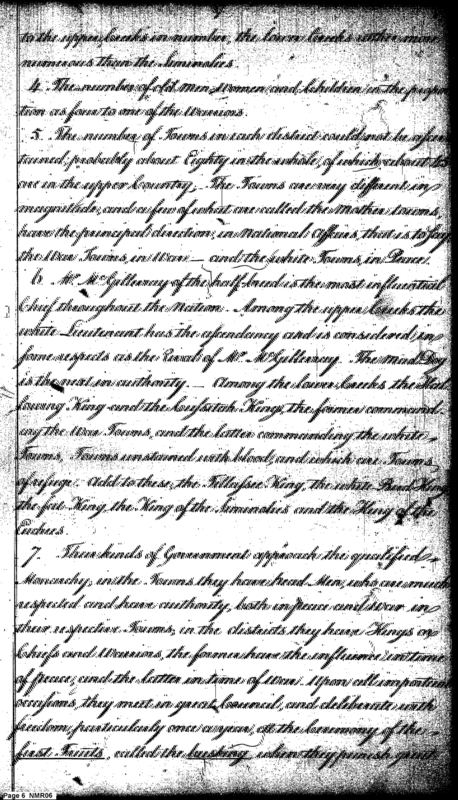
4. The number of old Men Women and Children in proportion as four to one of the Warriors.
5. The number of Towns in each district could not be ascertained, probably about Eighty in the whole, of which about Forty are in the upper Country. The Towns are very different in magnitude, and a few of what are called the Mother Towns, have the principal direction in National Affairs, that is to say the War Towns in War — and the white Towns in Peace.
6. Mr McGillivray of the half breed is the most influential Chief throughout the Nation. Among the upper Creeks the white Lieutenant has the ascendancy and is considered in some respects as the rival of Mr McGillivray. The Mad Boy is the next in authority. Among the Lower Creeks the Tallassee King and the Cussetah King; the former commanding the War Towns, and the latter commanding the white Towns. Towns sustained with blood, and which are Towns of refuge. Add to these, the Tallassee King, the white Road King, the fat King, the King of the Seminoles and the King of the Uchees.
7. Three kinds of Government approach the qualified Monarchy, in the Towns they have head Men, who are much respected and have authority, both in peace and war in their respective Towns; in the districts they have Kings or chiefs and Warriors; the former have the influence in times of peace, and the latter in times of War. Upon all important occasions they meet in great Council, and deliberate with freedom, particularly once [undecipherable], at the harmony of the first Towns called the [undecipherable: busking?], when they punish [undecipherable: Robbers?], and plunder extensively, going from Towns to Towns for hunting at this the crossing [Season?].
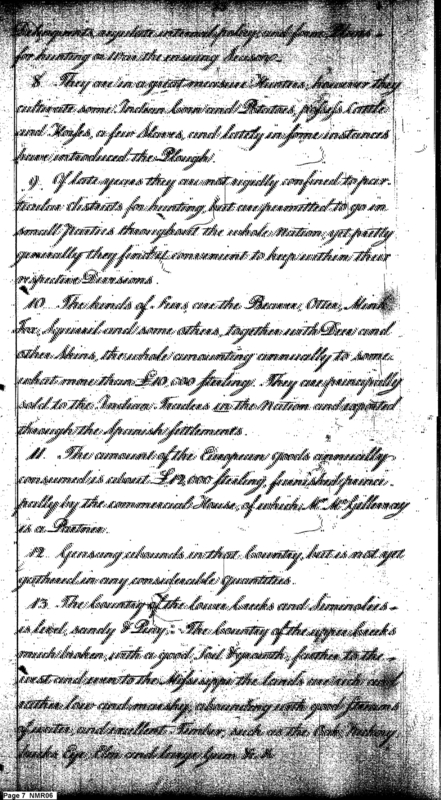
8. They are in a great measure Hunters, however they cultivate some Indian Corn and Potatoes, raise Cattle and Hogs, to few slaves, and lately in some instances have introduced the Plough.
9. Of late years they are not rigidly confined to particular districts for hunting, but are permitted to go in small parties throughout the whole Nation; yet pretty generally they find it convenient to keep within their respective Divisions.
10. The kinds of furs are the Beaver Otter, Mink, Fox, Squirrel and some others, together with Deer and other Skins, the whole amounting annually to somewhat more than £10,000 Sterling. They are principally sold to the Indian Traders in the Nation and exported through the Spanish Settlements.
11. The amount of the European goods annually consumed is about £12,000 Sterling, furnished principally by the commercial House of which Mr McGillivray is a Partner.
12. Genseing abounds in that Country, but is not yet gathered in any considerable Quantities.
13. The Country of the lower Creeks and Seminoles is level, sandy & Dry: - The Country of the upper Creeks much broken, with a good Soil & growth, further to the West and even to the Mississippi the lands are rich and [undecipherable] and marshy, abounding with [undecipherable] of water, and excellent Timber, such as the Oak, Hickory, Locust, Eye Elm and Beech [undecipherable].
14. The waters of the [undecipherable], the one Branch 170 miles from the Ocean to the licking Settlement, where Mr McGillivray resides, and the other Branch about 320 miles into the Choctaw and Chickasaw Country, and within fifty miles of the great Point of the [Tensee?]. The waters of the Upalachicola, particularly the Flint River and [Catitabuche?], and the waters of the Altamaha, particularly the Beavers Oconce and Okmulgee, are navigable for Boats some hundred miles from the northern navigable Streams of those Rivers to the furthern navigable waters of the [Tensee?], there are no established Portages, but the Country is level, good Canals might easily be made, and the greatest distances not more than one hundred miles.
15. We could not ascertain with precision the nature of the Connection which the Creeks have formed with the Spaniards, but from intelligence from [undecipherable] to be relied on we believe that Connection to consist principally in paying [undecipherable] of Indian Goods imported [at prices?] less than the Spaniards themselves pay, by a guarantee of all the Creek possessions, and by military Distinctions and Presents to Mr McGillivray, and other considerable chiefs. We could procure no copy of any Treaty subsisting between them. The predominating prejudices of the Creeks are seriously adverse to the Spaniards; particularly Mr McGillivray has often mentioned and declared that a Connection with the United States would be more material to the Creek Nation if they could obtain such Conditions of Interest and friendship, the [undecipherable] justify and induce them to break with the Spanish Government.
16. We had but little opportunity to ascertain similar information with the Indians from [undecipherable] considerable [undecipherable]
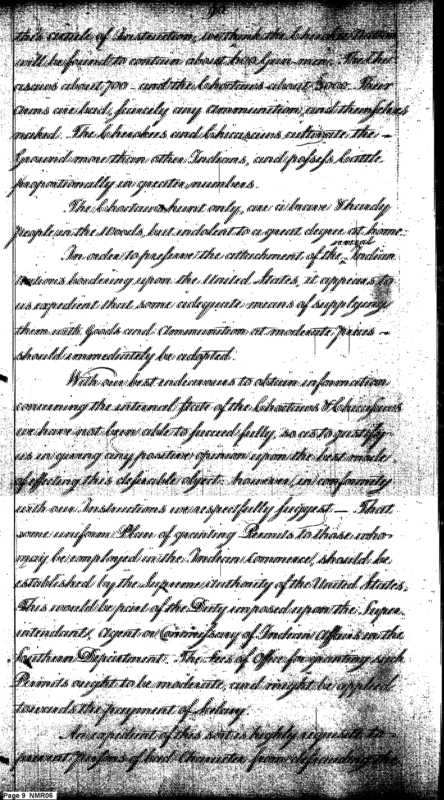
[undecipherable] this state of Instructions, we think the Cherokees will be found to contain about 2,000 [undecipherable]. The Chickesaws about 700 and the Choctaws about 6,000. Their Arms are bad, scarcely any ammunition [undecipherable]. The Cherokees and Choctaws cultivate the Ground more than other Indians, and possess Cattle proportionally in greater numbers.
The Choctaws however only, are known a hardy people in the woods, but indolent to a great degree at home.
In order to perform the attachment of the Indian nations bordering upon the United States, it appears to us expedient that some adequate means of supplying them with Goods and Ammunition at moderate prices should immediately be adopted.
With our best endeavours to obtain information concerning the internal state of the Choctaws & Chickasaws we have not been able to proceed fully, so as to qualify us in expressing any positive opinion upon the best mode of effecting this desirable object. However in conformity with our Instructions we respectfully suggest. That some uniform Plan of granting Permits to those who may be employed in the Indian Commerce, should be established by the Supreme authority of the United States. This would be part of the Duty imposed upon the Superintendant, Agent or Commissary of Indian Affairs in the Southern Department. The fees of Office for granting such Permits ought to be moderate, and might be applied towards the payment of Salary.
An expedient of this sort highly requisite to ascertain [undecipherable] of good Character from [undecipherable]
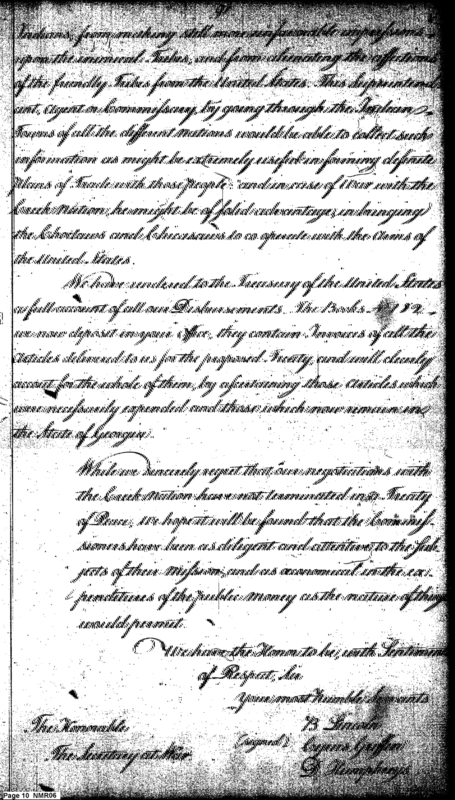
[undecipherable] Indians, from on any side, all men [undecipherable] upon the internal Tribes, and from alienating the affection of the Friendly Tribes from the United States. The Superintendent, agent as Commissioner, by going through the Indian Towns of all the different nations would be able to collect such information as might be extremely useful in framing [definite?] Plans of Trade with those people: and in case of War with the Creek Nation, he might be of solid advantage in bringing the Choctaws and Chickasaws to co operate with the [Claims?] of the United States.
We have rendered to the Treasury of the United States in full account of all our Disbursements. The Books N. [undecipherable] are now deposit in your Office. They contain Invoices of all the Articles delivered to us for the proposed Treaty, and will clearly account for the whole of them, by ascertaining those Articles which were necessarily expended and those which now remain [in] the State of Georgia.
Whilst we sincerely regret that our negotiations with the Creek Nation have not terminated in a Treaty of Peace, it is hoped it will be found that the Commission[ers] have been as diligent and attentive to the subjects of their mission, and as economical in the expenditures of the public money as the nature of things would permit.
We have the Honor to be, with Sentiments of Respect, Sir,
Your most Humble Servants
The Honorable B. Lincoln
The Secretary at War Cyrus Griffin
D. Humphreys
Type
Letter Signed
Description
The Commissioners--Lincoln, Griffin, and Humphreys--report on their mission to negotiate a treaty with the Creek Nation. Since their mission was unsuccessful, they make recommendations regarding the measures needed to protect frontier settlers. They also suggest that further efforts should be made to improve relations with the Creeks. They have much to say about the Creeks and other southern tribes with respect to their culture, traditions, governments, etc.
Date
11/20/1789
Author
Recipient
Sent from
New York
Collection
Document number
1789112040001
Page start
1
Note
Lincoln, Griffin, and Humphreys are the Commissioners appointed to treat with the Indians south of the Ohior River.
Notable persons
Henry Knox
Benjamin Lincoln
Cyrus Griffin
David Humphreys
Creek Nation
Spaniards
Lower Creeks
Alexander McGillivray
the White Lieutenant
the Mad Dog
Upper Creeks
Cusetah King
Tallassee King
King of the Seminoles
Head Men
hunters
slaves
Indian traders
Cherokees
Choctaws
Chickasaws
Commissary of Indian Affairs in the Southern Department
Notable locations
New York
settlements upon the Cumberland River
stations in Georgia
navigable waters of St. Mary
Breed's Bluff upon the Altamaha
Rock Landing
Augusta
Flint River
Bryant's trading house on St. Marys
Spanish settlements
Mississippi
Choctaw and Chickasaw Country
great bend of the Tennessee [River]
Appalachacola
Notable items
treaty of peace with the United States
sudden impassions of the Indians
magazines
alarm of dangers
middle trading post
offensive plan
arms of the Union
navigation
wagon road
boats
rifles
ammunition
presents [gifts]
time of war
Great Council
Indian corn
potatoes
cattle
plough
furs
beaver
otter
mink
fox
squirrel
deer
skins
European goods
good roads
intelligence
permits to those employed in Indian commerce
Treasury of the United States
disbursements