No human transcription currently available for this document.
Now I have all 18 pages. Here is the complete transcription:
[Copy]
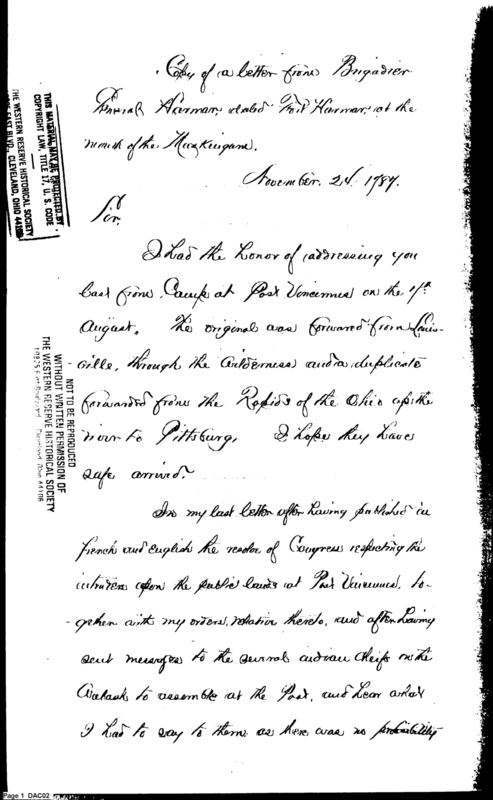
Copy of a letter from Brigadier General Harmar, dated Fort Harmar, at the mouth of the Muskingum.
November 2d 1789.
Sir
I had the Honor of addressing you last from Camp at Post Vincennes on the 1st August. The original was forwarded from Louisville, through the Wilderness and a duplicate forwarded from the Rapids of the Ohio up the river to Pittsburg. I hope they have safe arrived.
In my last letter after having published in French and English the resolve of Congress respecting the intrusion upon the public lands at Post Vincennes, together with my orders relative thereto, and after having sent messages to the several and mean Chiefs on the Wabash to assemble at the Post, and learn what I had to say to them, as there was no probability
of those chiefs coming in, in less than a month I informed you that it was my intention to employ that time in visiting Kaskaskias, in order that I might be enabled to render a statement of affairs in that part of the United States.
Accordingly I marched on the 19th of (August) from the Post with a Subaltern (Ensign McDowell) and thirty men through the Prairies and arrived at Kaskaskias on the 16th of the same month. Our March was very fatiguing, as the weather was excessive warm and water very bad and scarce on our route. The distance is about 160 miles, the French call it 86 leagues. I was accompanied by two Indians, (Pachan a Miami Chief and his Comrado) who hunted and supplied the party with meat, (Buffalo and Deer) both on the march and upon our return.
These Prairies are very extensive natural meadows, covered with long grass. One is particularly
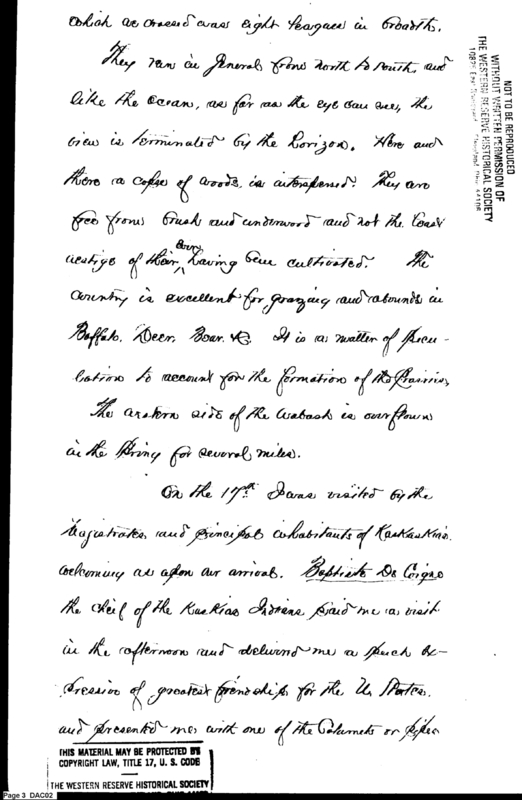
which as crossed was eight leagues in breadth.
They run in general from north to south, and like the ocean, as far as the eye can see, the view is terminated by the Horizon. Here and there a copse of woods is interspersed. They are free from brush and underwood and not the least vestige of their ever having been cultivated. The country is excellent for grazing and abounds in Buffalo, Deer, Bear &c. It is a matter of speculation to account for the formation of the Prairies.
The western side of the Wabash is overflown at the Spring for several miles.
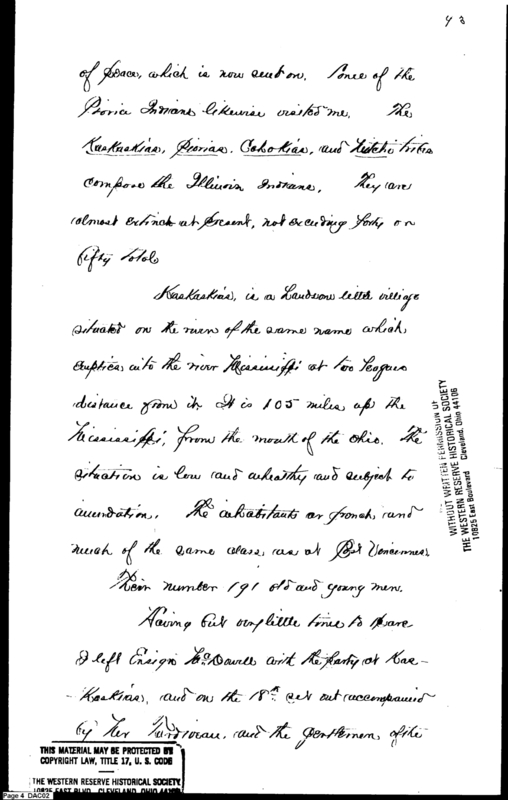
On the 17th I was visited by the Magistrates and principal inhabitants of Kaskaskias, welcoming us upon our arrival. Baptiste De Coigne the chief of the Kaskias Indians paid me a visit in the afternoon and delivered me a speech expression of greatest friendship for the U. States, and presented me with one of the Calumets or pipes
of peace, which is now sent on. Some of the Peoria Indians likewise visited me. The Kaskaskian, Peorian, Cahokian, and [underline: Lutchi] tribes compose the Illinois Indians. They are almost extinct at present, not exceeding forty or fifty totals.
Kaskaskias, is a handsome little village situated on the river of the same name which empties into the river Mississippi at two leagues distance from it. It is 105 miles up the Mississippi, from the mouth of the Ohio. The situation is low and unhealthy and subject to inundation. The inhabitants are French, and much of the same class, as at Post Vincennes. Their number 191 old and young men.
Having but very little time to spare I left Ensign McDowell with the party at Kaskaskias, and on the 18th set out accompanied by Mr Gardineau, and the Gentlemen, of the
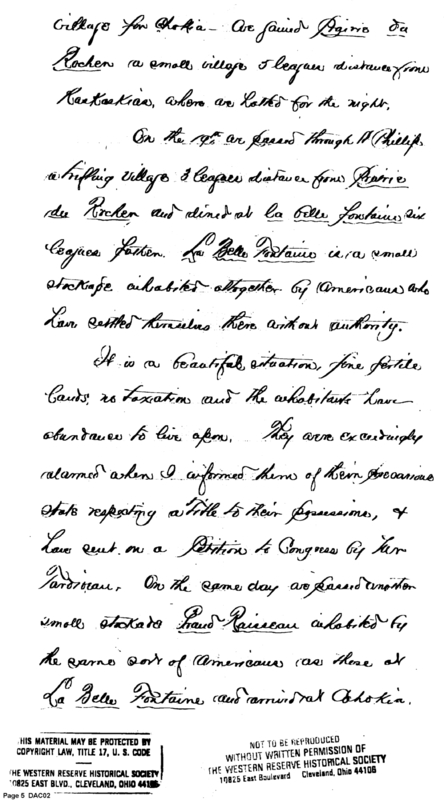
Village for Cahokia. We passed [underline: Prairie du Rocher] a small village 3 leagues distance from Kaskaskias, where we halted for the night.
On the 19th we passed through [underline: A Phillips], a trifling village 3 leagues distance from [underline: Prairie du Rocher] and dined at [underline: La Belle Fontaine] six leagues farther. [underline: La Belle Fontaine] is a small stockade inhabited altogether by Americans who have settled themselves there without authority.
It is a beautiful situation, fine fertile lands, no taxation and the inhabitants have abundance to live upon. They were exceedingly alarmed when I informed them of their precarious state respecting a title to their possessions, & have sent on a Petition to Congress by Mr Gardineau. On the same day we passed another small stockade [underline: Grand Ruisseau] inhabited by the same sort of Americans as those at [underline: La Belle Fontaine] and arrived at Cahokia.
that evening.
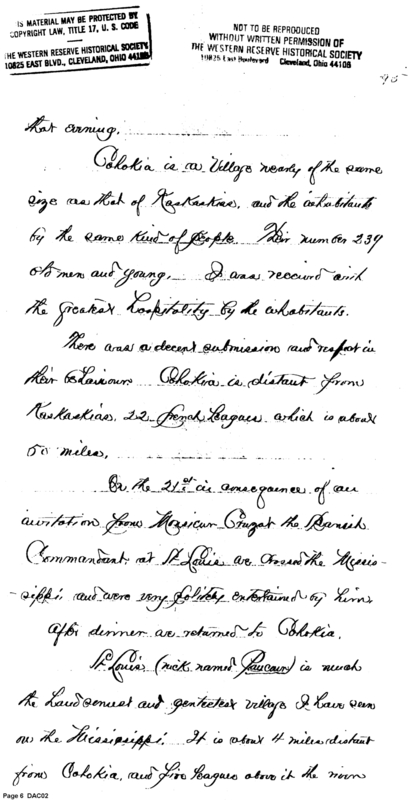
Cahokia is a Village nearly of the same size as that of Kaskaskias, and the inhabitants by the same kind of People. Their number 239 old men and young. I was received with the greatest hospitality by the inhabitants.
There was a decent submission and respect in their behaviour. Cahokia is distant from Kaskaskias, 22 French leagues, which is about 50 miles.
On the 21st in consequence of an invitation from Monsieur Cruzat the Spanish Commandant at St. Louis we crossed the Mississippi and were very politely entertained by him. After dinner we returned to Cahokia.
St. Louis (nick named [underline: Paincau]) is much the handsomest and genteelest village I have seen on the Mississippi. It is about 4 miles distant from Cahokia, and five leagues above it the river
Missouri unites with the Mississippi. The inhabitants are of the same sort as before described, excepting that they are more wealthy. About 20 regular Spanish troops are stationed here.
On the 22d I left Cahokia to return to Kaskaskias. Previous to my departure, at the request of the inhabitants I assembled them and gave them advice to place their Militia upon a more respectable footing, than it was, to abide by the decisions of their Courts &c. and if there were any turbulent or refractory persons to put them under guard, until Congress should be pleased to order a government for them.
Exclusive of the intruders already described, there are about thirty more Americans settled on the rich fertile bottoms on the Mississippi, who are likewise petitioned by this conveyance.
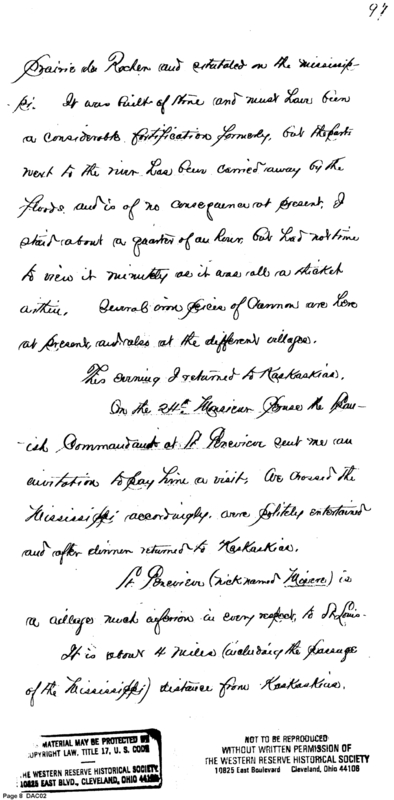
On the 23d I passed by the ruins of Fort Chartres, which is one league above the
Prairie du Rocher and situated on the Mississippi. It was built of Stone and must have been a considerable fortification formerly, but the part next to the river has been carried away by the floods and is of no consequence at present. I staid about a quarter of an hour, but had not time to view it minutely as it was all a thicket within. Several iron pieces of Cannon are here at present, and others at the different villages.
This evening I returned to Kaskaskias.
On the 24th Monsieur Tornea the Spanish Commandant at St. Genevieve sent me an invitation to pay him a visit. We crossed the Mississippi accordingly, were politely entertained and after dinner returned to Kaskaskias.
St. Genevieve (nick named [underline: Misere]) is a village much inferior in every respect, to St. Louis. It is about 4 miles (including the passage of the Mississippi) distance from Kaskaskias.
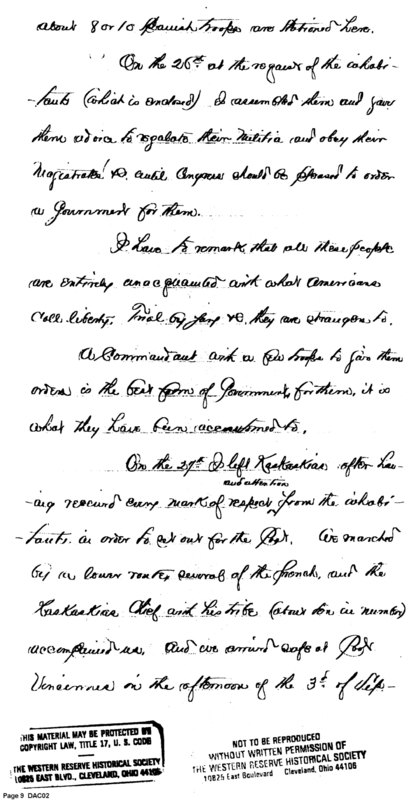
about 8 or 10 Spanish troops are stationed here.
On the 26th at the request of the inhabitants (which is enclosed) I assembled them and gave them advice to regulate their Militia and obey their Magistrates &c. until Congress should be pleased to order a government for them.
I have to remark that all these people are entirely unacquainted with what Americans call liberty. Trial by jury &c. they are strangers to.
A Commandant and a few troops to give them orders is the best form of Government for them, it is what they have been accustomed to.
On the 27th I left Kaskaskias after having [and attention] received every mark of respect from the inhabitants, in order to set out for the Post. We marched by a lower route, several of the French, and the Kaskaskian Chief and his tribe (about ten in number) accompanied us, and we arrived safe at Post Vincennes on the afternoon of the 3d of Sep-
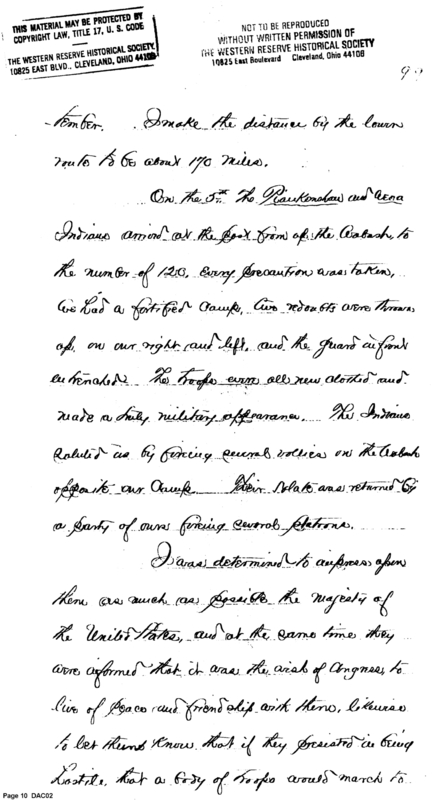
-tember. I make the distance by the lower route to be about 170 miles.
On the 5th the Piankashaws and Wea Indians arrived at the Post from of the Wabash to the number of 120. Every precaution was taken. We had a fortified camp. Two redoubts were thrown up, on our right and left, and the guard in front entrenched. The troops were all new clothed and made a truly military appearance. The Indians saluted us by firing several vollies on the Wabash opposite our camp. Their Salate was returned by a party of ours firing several platoons.
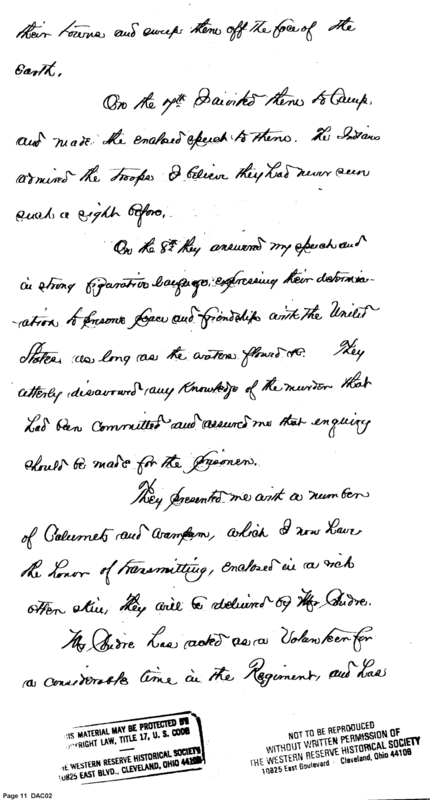
I was determined to impress upon them as much as possible the majesty of the United States, and at the same time they were informed that it was the wish of Congress to live of peace and friendship with them, likewise to let them know that if they persisted in being hostile, that a body of troops would march to
their towns and sweep them off the face of the Earth.
On the 7th I invited them to Camp, and made the enclosed speech to them. The Indians admired the troops I believe they had never seen such a sight before.
On the 8th they answered my speech and in strong figurative language, expressing their determination to preserve peace and friendship with the United States as long as the waters flowed &c. They utterly disavowed any knowledge of the murders that had been committed and assured me that enquiry should be made for the prisoners.
They presented me with a number of Calumets and Wampum, which I now have the honor of transmitting, enclosed in a rich otter skin. They will be delivered by Mr Duidre.
Mr Duidre has acted as a Volunteer for a considerable time in the Regiment, and has
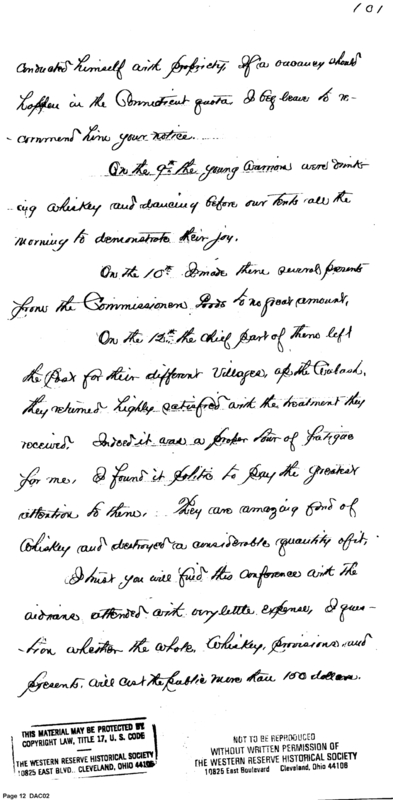
conducted himself with propriety. If a vacancy should happen in the Connecticut quota, I beg leave to recommend him your notice.
On the 9th the young warriors were drinking whiskey and dancing before our tents all the morning to demonstrate their joy.
On the 10th I made them several presents from the Commissioners goods to no great amount.
On the 12th the chief part of them left the Post for their different villages, up the Wabash. They returned highly satisfied with the treatment they received. Indeed it was a proper tour of fatigue for me. I found it politic to pay the greatest attention to them. They are amazing fond of Whiskey and destroyed a considerable quantity of it.
I trust you will find this Conference with the Indians attended with very little expense. I question whether the whole, Whiskey, Provisions and Presents, will cost the Public more than 150 dollars.
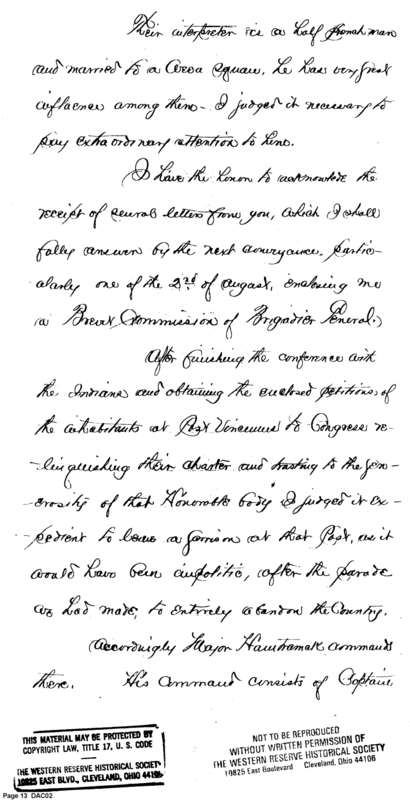
Their interpreter is a half French man and married to a Wea squaw. He has very great influence among them. I judged it necessary to pay extraordinary attention to him.
I have the honor to acknowledge the receipt of several letters from you, which I shall fully answer by the next conveyance. Particularly one of the 2d of August, enclosing me a Brevet Commission of Brigadier General.
After finishing the conference with the Indians and obtaining the enclosed petitions of the inhabitants at Post Vincennes to Congress relinquishing their charter and trusting to the generosity of that Honorable body I judged it expedient to leave a garrison at that Post, as it would have been impolitic, after the parade we had made, to entirely abandon the Country.
Accordingly Major Hamtramck commands there. His command consists of Captain
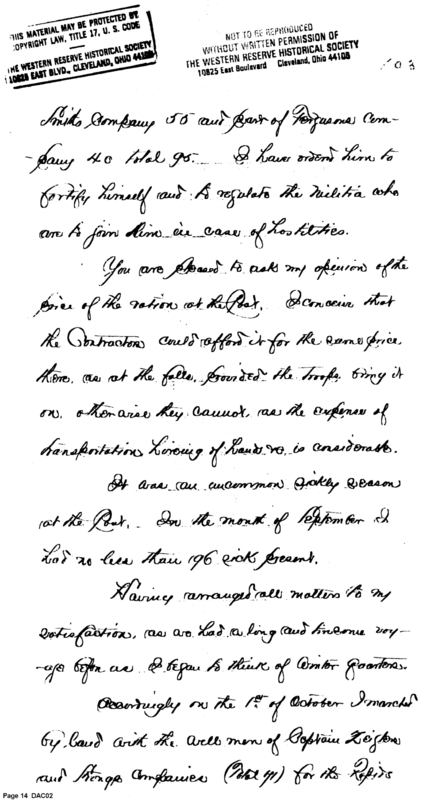
Smith's Company 55 and part of Ferguson's Company 40 total 95. I have ordered him to fortify himself and to regulate the militia who are to join him in case of hostilities.
You are pleased to ask my opinion of the price of the ration at the Post. I conceive that the Contractors could afford it for the same price there, as at the falls, provided the troops bring it on, otherwise they cannot, as the expense of transportation hiring of hands &c. is considerable.
It was an uncommon sickly season at the Post. In the month of September I had no less than 196 sick present.
Having arranged all matters to my satisfaction, as we had a long and tiresome voyage before us, I began to think of Winter Quarters.
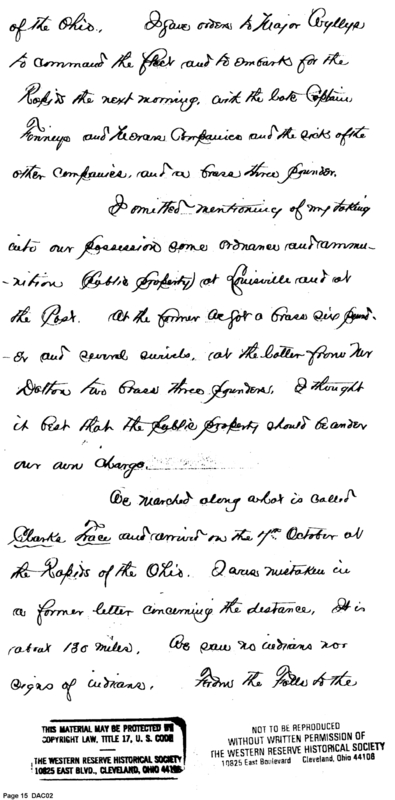
Accordingly on the 1st of October I marched by land with the able men of Captain Leighton and Strong's Companies (Total 91) for the Rapids
of the Ohio. I gave orders to Major Wyllys to command the fleet and to embark for the Rapids the next morning, and the late Captain Finney's and Merans Companies and the sick of the other Companies, and a brass three Pounder.
I omitted mentioning of my taking into our possession some Ordnance and ammunition (public property) at Louisville and at the Post. At the former we got a brass six Pounder and several swivels, at the latter from Mr Dolton two brass three Pounders. I thought it best that the Public Property should be under our own charge.
We marched along what is called [underline: Clarke's Trace] and arrived on the 11th October at the Rapids of the Ohio. I was mistaken in a former letter concerning the distance, it is about 180 miles. We saw no Indians nor signs of Indians. From the Falls to the
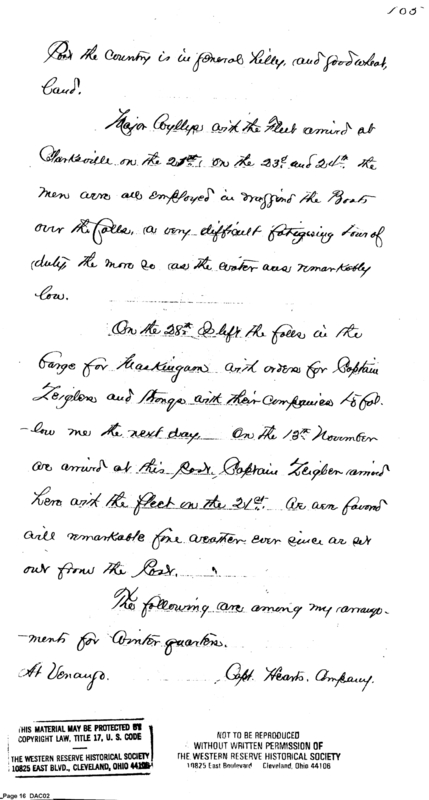
Post the country is in general hilly, and good wheat land.
Major Wyllys with the fleet arrived at Clarksville on the 20th. On the 23d and 24th the men were all employed in dragging the Boats over the falls, a very difficult fatiguing tour of duty, the more so as the water was remarkably low.
On the 28th I left the falls in the barge for Muskingum and orders for Captain Leighton and Stronga with their Companies to follow me the next day. On the 13th November we arrived at this Post. Captain Leighton arrived here with the fleet on the 21st. We are favored with all remarkable fine weather ever since we set out from the Post.
The following are among my arrangements for Winter quarters.
At Venango. Capt. Hearts. Company.
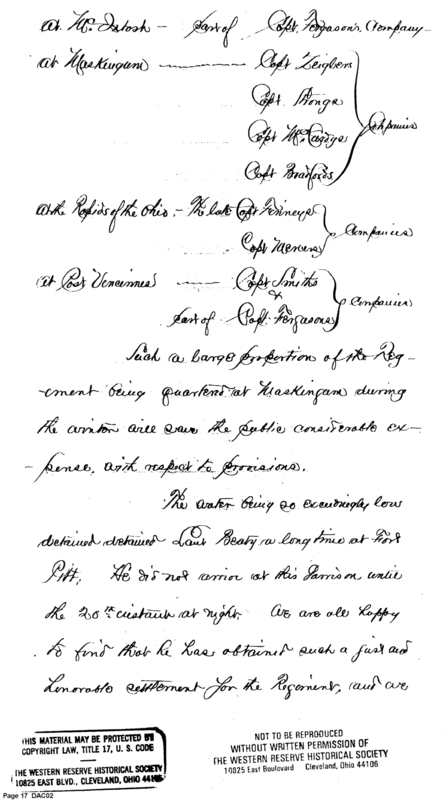
At McIntosh — Part of Capt. Ferguson's Company.
At Muskingum — — Capt. Leighton }
Capt. Stronga }
Capt. McCarty } Companies
Capt. Bradford }
At the Rapids of the Ohio — The late Capt. Finney's } Companies
Capt. Mercer's }
At Post Vincennes — Capt. Smith's } Companies
Part of Capt. Ferguson's }
Such a large proportion of the Regiment being quartered at Muskingum during the winter will save the public considerable expense, with respect to provisions.
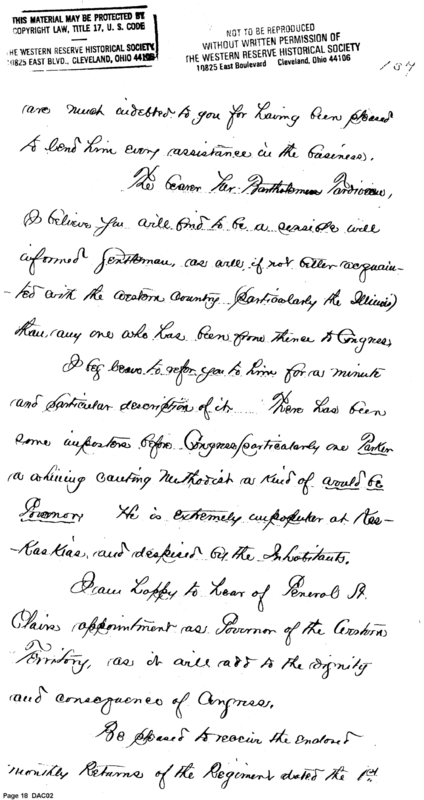
The water being so exceedingly low [strikethrough: detained] detained Lieut. Beaty a long time at Fort Pitt. He did not arrive at this garrison until the 20th [undecipherable] at night. We are all happy to find that he has obtained such a just and honorable settlement for the Regiment, and we
are much indebted to you for having been pleased to lend him every assistance in the business.
The Bearer Mr Bartholomew Gardineau, I believe you will find to be a sensible well informed Gentleman, as well, if not better acquainted with the western country (Particularly the Illinois) than any one who has been from thence to Congress.
I beg leave to refer you to him for a minute and particular description of it. There has been some impostors before Congress particularly one Parker a whining canting Methodist as kind of [underline: would be Governors]. He is extremely unpopular at Kaskaskias, and despised by the inhabitants.
I am happy to hear of General St. Clair's appointment as Governor of the Western Territory, as it will add to the dignity and consequence of Congress.
Be pleased to receive the enclosed monthly Returns of the Regiment dated the 1st