

Describes Territory, People, Indians Surrounding Kaskaskia
Document 1787Reports a fatiguing march with Ensign McDowell, 30 men, and 2 Indians: Pachan, a Miami chief, and his commande, who hunted and supplied the company with meat. Describes geography. Welcomed by magistrate and inhabitants of Kaskaskia and Baptiste DeCoigne, the Kaskaskian chief, who presented him with a peace pipe. Received visits also from Peoria, Cahokia, Mitchi, and Illinois Indians. Describes the Kaskaskia village and the surrounding settlements. Were entertained by Monsieur Cruzat, the Spanish Commandant at St. Louis. Recognizes General St. Clair's appointment as governor of the Western Territory.
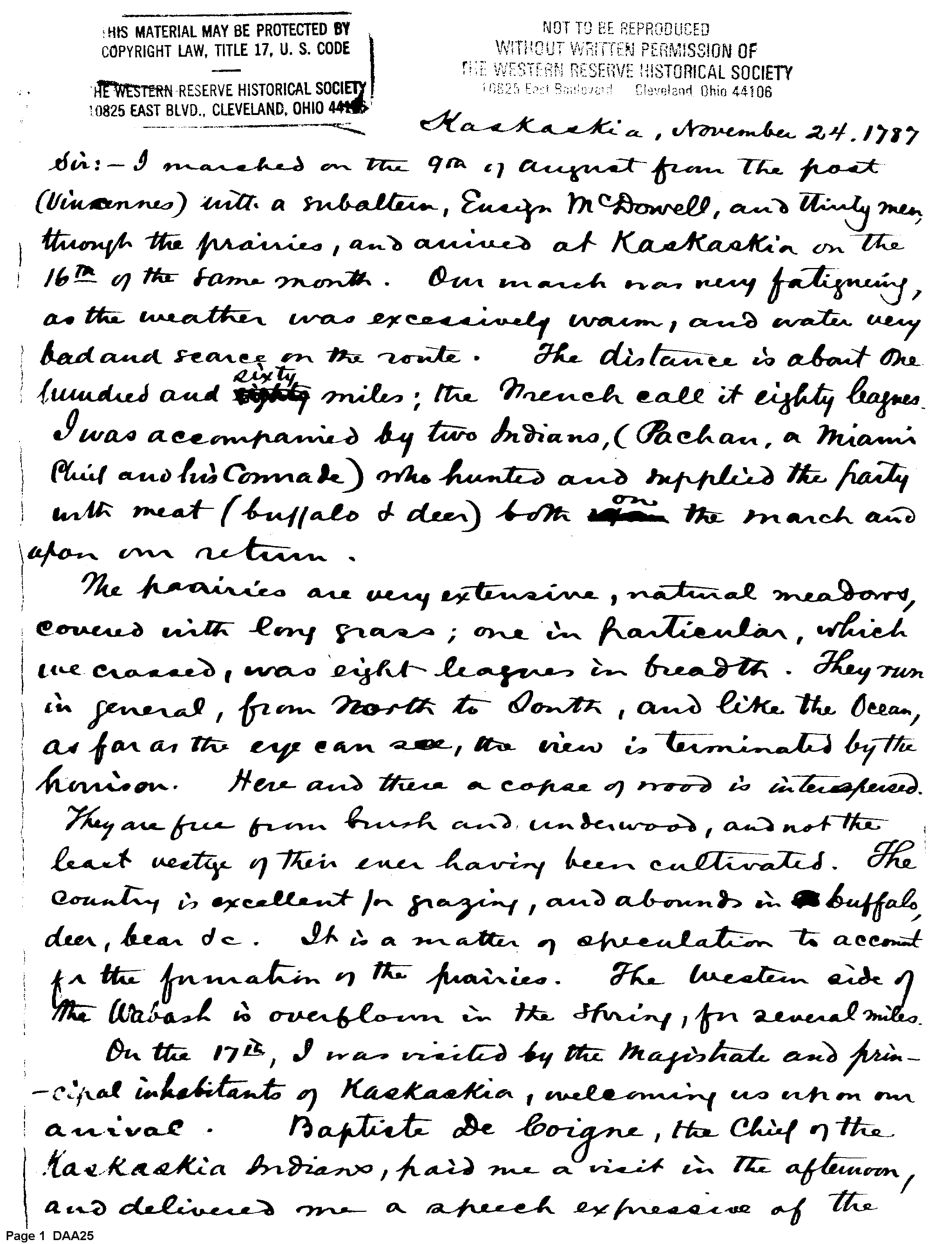
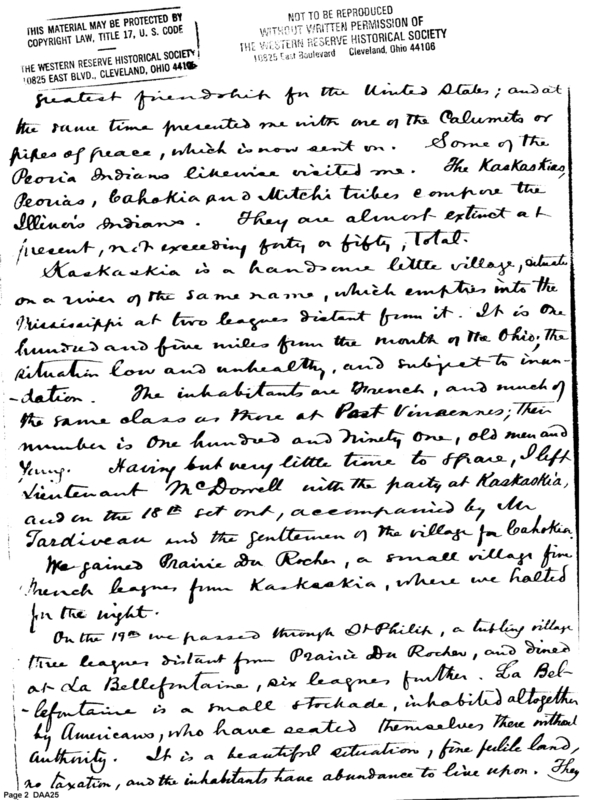
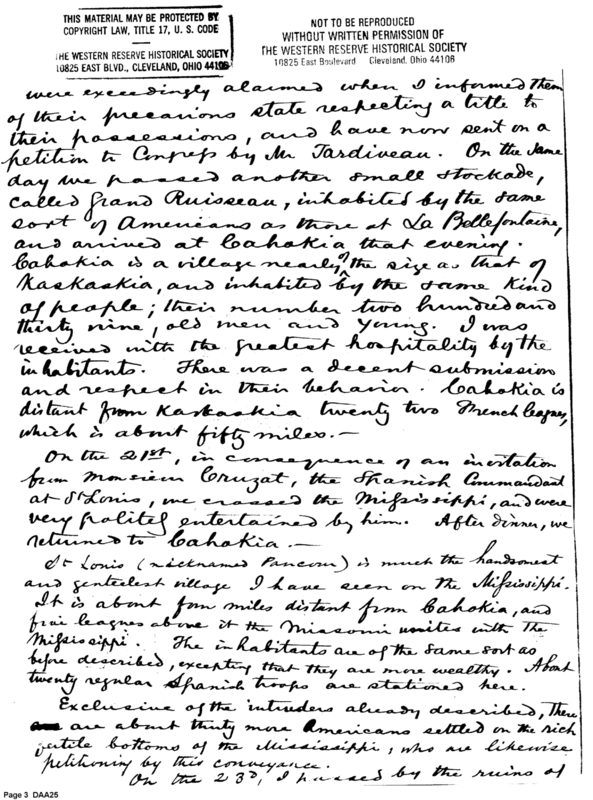
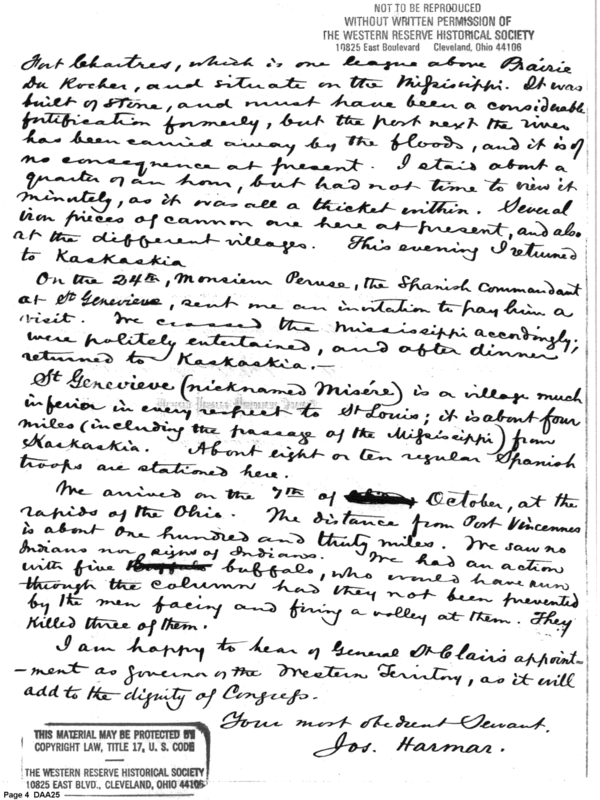
Kaskaskia, November 24, 1787 Sir: – I marched on the 9th of August from the post (Vincennes) with a subaltern, Ensign McDowell, and thirty men, through the prairies, and arrived at Kaskaskia on the 16th of the same month. Our march was very fatigueing, as the weather was excessively warm, and water very bad and scarce on the route. The distance is about one hundred and eighty sixty miles; the French call it eighty leagues. I was accompanied by two Indians, (Pachan, a Miami Chief and his Comrade) who hunted and supplied the party with meat (buffalo & deer) both [editor’s note: author crossed out undecipherable word] on the march and upon our return. The prairies are very extensive, natural meadows, covered with long grass; one in particular, which we crossed, was eight leagues in breadth. They run in general, from North to South, and like the Ocean, as far as the eye can see, the view is terminated by the horison. Here and there a copse of wood is interspersed. They are free from brush and underwood, and not the least vestige of their ever having been cultivated. The country is excellent for grazing, and abounds in [editor’s note: author crossed out undecipherable word] buffalo, deer, bear &c. It is a matter of speculation to account for the formation of the prairies. The western side of the Wabash if overflown in the Spring, for several miles. On the 17th, I was visited by the Magistrate and prin- -cipal in habitants of Kaskaskia, welcoming us upon our arrival. Baptiste De Coigne, the Chief of the Kaskaskia Indians, paid me a visit in the afternoon, and delivered me a speech expressive of the greatest friendship for the United States; and at the same time presented me with one of the Calumets or pipes of peace, which is now sent on. Some of the Peoria Indians likewise visited me. The Kaskasias, Peorias, Cahokia and Mitchi tribes compare the Illinois Indians. They are almost extinct at present, not exceeding forty or fifty, Total. Kaskaskia is a handsome little village, situated on a river of the same name, which empties into the Mississippi at two leagues distant from it. It is one hundred and five miles from the mouth of the Ohio; the situation low and unhealthy, and subject to inun- -dation. The inhabitants are French, and much of the same class as there at Post Vincennes; their number is one hundred and ninety one, old men and young. Having but very little time to spare, I left Lieutenant McDowell with the party at Kaskaskia, and on the 18th set out, accompanied by Mr Tardiveau and the gentleman of the village for Cahokia. We gained Prairie Du Rocher, a small village five french leagues from Kaskaskia, where we halted for the night. On the 19th we passed through St. Philip, a trifling village three leagues distant from Prairie Du Rocher, and dined at La Bellefontaine, six leagues further. La Bel- -lefontaine is a small stockade, inhabited altogether by Americans, who have seated themselves there without authority. It is a beautiful situation, fine fertile land, no taxation, and the inhabitants have abundance to live upon. They were exceedlingly alarmed when I informed them of their precarious state respecting a title to their possessions, and have now sent on a petition to Congress by Mr Tardiveau. On the same day we passed another small stockade, called Grand Ruisseau, inhabited by the same sort of Americans as those at La Bellefontaine, and arrived at Cahokia that evening. Cahokia is a village nearly ^of the size as that of Kaskaskia and inhabited by the same kind of people; their number two hundered and thirty nine, old men and young. I was received with the greatest hospitality by the inhabitants. There was a decent submission and respect in their behavior. Cahokia is distant from Kaskaskia twenty two French leagues, which is about fifty miles.- On the 21st, in consequence of an invitation from Monsieur Cruzat, the Spanish Commandant at St Louis, we crossed the Mississippi, and were very politely entertained by him. After dinner, we returned to Cahokia.- St. Louis (nicknamed Pancorn) is much the handsomest and genteelest village I have seen on the Mississippi. It is about four miles distant from Cahokia, and five leagues above it the Missouri unites with the Mississippi. The inhabitants are of the same sort as before described, excepting that they are more wealthy. About twenty regular Spanish troops are stationed here. Exclusive of the intruders already described, there are about thirty more Americans settled on the rich fertile bottoms of the Mississippi, who are likewise petitioning by this conveyance. On the 23d, I passed by the ruins of Fort Chartres, which is one league above Prairie Du Rocher, and situate on the Mississippi. It was built of stone, and must have been a considerable fortification formerly, but the post next the river has been carried away by the floods, and it is of no consequence at present. I staid about a quarter of an hour, but had not time to view it minutely, as it was all a thicket within. Severl iron pieces of cannon are here at present, and also at the different villages. This evening I returned to Kaskaskia. On the 24th, Monsieur Peruse, the Spanish commandant at St. Genevieve, sent me an invitation to pay him a visit. We crossed the Mississippi accordingly; were politely entertained, and after dinner returned to Kaskaskia.- St. Genevieve (nicknamed Misere) is a village much inferior in every respect to St. Louis; it is about four miles (including the passage of the Mississippi) from Kaskaskia. About eight or ten regular Spanish troops are stationed here. We arrived on the 7th of [editor’s note: author crossed out undecipherable word] October, at the rapids of the Ohio. The distance from Post Vincennes is about one hundred and thirty miles. We saw no Indians nor signs of Indians. We had an action with five [editor’s note: author crossed out undecipherable word] buffalo, who would have run through the column had they not been prevented by the men facing and firing a volley at them. They killed three of them. I am happy to hear of General St. Clair’s appoint- -ment as Governer of the Western Territory, as it will add to the dignity of Congress. Your most obedient Servant, [editor’s note: signed] Jos. Harmar.
This transcription was generated by machine using Anthropic's Claude Code (model sonnet 4.6). It may contain errors or inaccuracies. Please verify against the document image. Learn more about our generative AI methodology.