

Report of Congressional Committee
Document 1786Report of a committee of Congress on the report submitted by Secretary at War Knox on the Army's Articles of War and Courts Martial. Lays out regulations for the Army courts martial and the administration of justice

No human transcription currently available for this document.
This transcription was generated by machine using Anthropic's Claude Code (model sonnet 4.6). It may contain errors or inaccuracies. Please verify against the document image. Learn more about our generative AI methodology.
[71. 344-731 (1)]
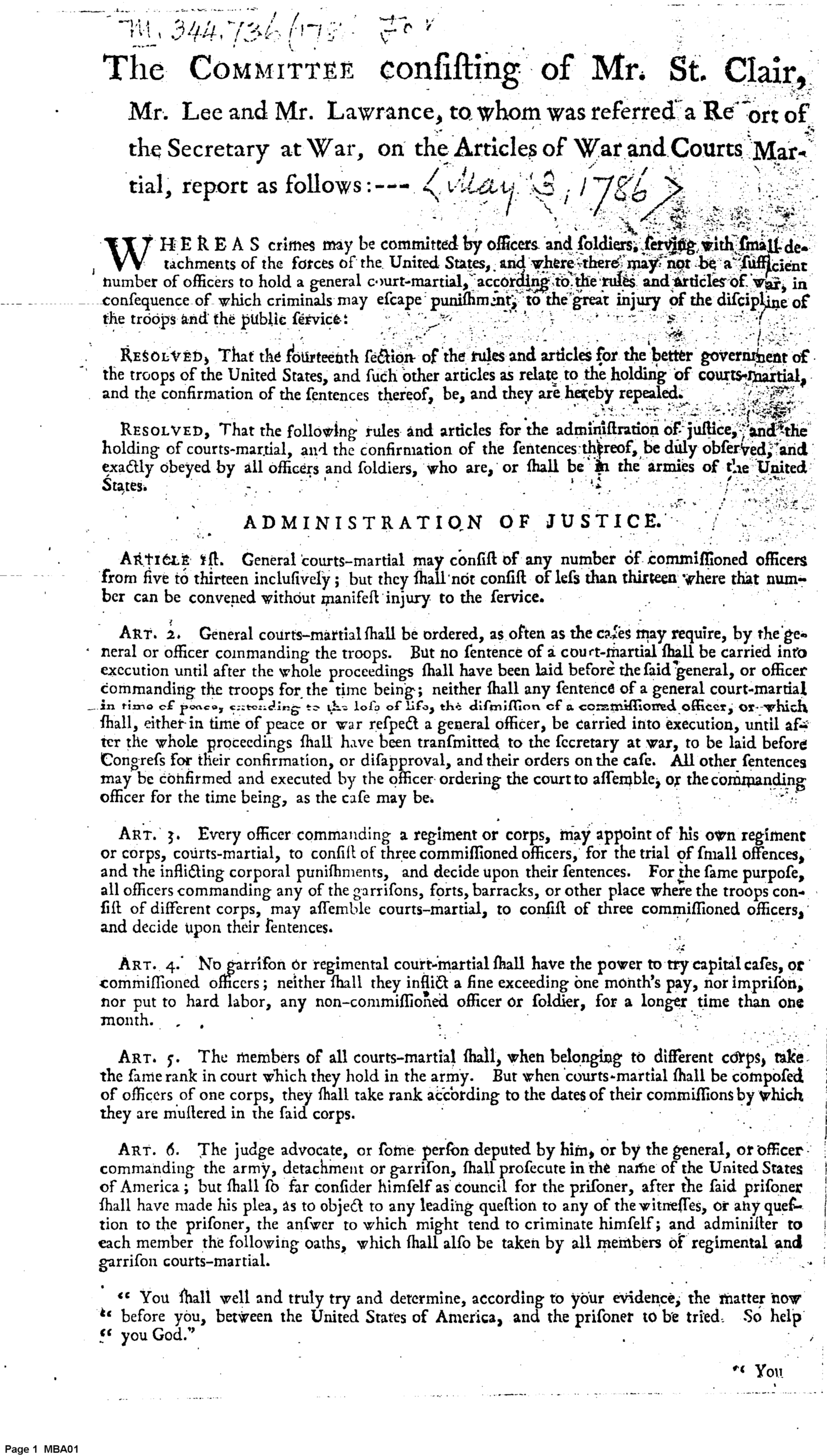
The COMMITTEE consisting of Mr. St. Clair, Mr. Lee and Mr. Lawrance, to whom was referred a Report of the Secretary at War, on the Articles of War and Courts Martial, report as follows: — May 3, 1786
WHEREAS crimes may be committed by officers and soldiers, serving with small detachments of the forces of the United States, and where there may not be a sufficient number of officers to hold a general court-martial, according to the rules and articles of war, in consequence of which criminals may escape punishment, to the great injury of the discipline of the troops and the public service.
RESOLVED, That the fourteenth edition of the rules and articles for the better government of the troops of the United States, and such other articles as relate to the holding of courts-martial, and the confirmation of sentences thereof, be, and they are hereby repealed.
RESOLVED, That the following rules and articles for the administration of justice, and the holding of courts-martial, and the confirmation of the sentences thereof, be duly observed, and exactly obeyed by all officers and soldiers, who are, or shall be in the armies of the United States.
ADMINISTRATION OF JUSTICE.
ARTICLE 18. General courts-martial may consist of any number of commissioned officers from five to thirteen inclusively; but they shall not consist of less than thirteen where that number can be collected without manifest injury to the service.
ART. 1. General courts-martial shall be ordered, as often as the exigencies may require, by the general or officer commanding the troops. But no sentence of a court-martial shall be carried into execution until after the whole proceedings shall have been transmitted to the general, or officer commanding the troops for the time being; neither shall any sentence of a general court-martial in time of peace, extending to the loss of life, the dismission of a commissioned officer, or which shall, either in time of peace or war respect a general officer, be carried into execution, until after the whole proceedings shall have been transmitted to the Secretary at war, to be laid before Congress for their confirmation, or disapproval, and their orders on the case. All other sentences may be confirmed and executed by the officer ordering the courts assembly, or the commanding officer for the time being, as the case may be.
ART. 2. Every officer commanding a regiment or corps, may appoint of his own regiment or corps, courts-martial, to consist of three commissioned officers, for the trial of small offences, for the inflicting corporal punishment, and also for examining into accounts. These courts shall sit between the hours of eight in the morning and three in the afternoon, except in cases which require more immediate example.
ART. 3. No garrison or regimental court-martial shall have the power to try capital cases, or commissioned officers; nor shall they inflict a fine exceeding two months pay, either by himself, or by any prisoner in his behalf, whether such sentence be approved or not.
ART. 4. No garrison or regimental court-martial shall have the power to try capital cases, or commissioned officers; nor put to hard labor, any non-commissioned officer or soldier, for a longer time than one month.
ART. 5. The members of all courts-martial shall, when belonging to different corps, take the same rank in court with each other as in corps; if they belong to the same corps, and consist of officers of one corps, they shall take rank according to the dates of their commissions by which they are mustered into service.
ART. 6. The judge advocate, or some person deputed by him, or by the general, or officer commanding the army, detachment or garrison, shall prosecute in the name of the United States of America, but shall it be lawful for the accused to object to him, after the said prosecutor shall have made his plea, as to object to any leading question to any of the witnesses, or any question to the prisoner, the answer to which might tend to criminate himself. He shall administer to each member the following oaths, which shall also be taken by all members of regimental and garrison courts-martial.
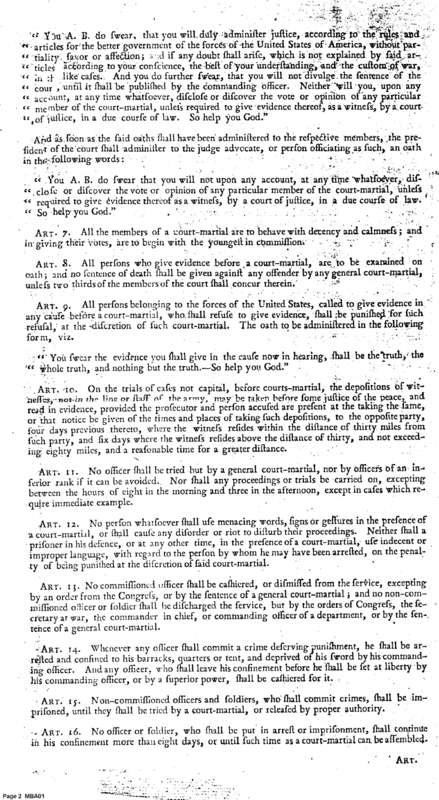
" You A. B. do swear, that you will duly administer justice, according to the rules and articles for the better government of the forces of the United States of America, without partiality, favor or affection: if any doubt shall arise, which is not explained by the said rules and articles, you shall determine, the best of your understanding, and the custom of war, in like cases. And you do further swear, that you will not divulge the sentence of the court, until it shall be duly confirmed by the proper authority. Neither will you, upon any account, at any time whatsoever, disclose or discover the vote or opinion of any particular member of the court-martial, unless required to give evidence thereof, as a witness, by a court of justice, in a due course of law. So help you God."
And as soon as the faid oaths shall have been administered to the respective members, the president of the court shall administer to the judge advocate, or person officiating as such, an oath in the following words:
" You A. B. do swear that you will not upon any account, at any time whatsoever, disclose or discover the vote or opinion of any particular member of the court-martial, unless required to give evidence thereof as a witness, by a court of justice, in a due course of law. So help you God."
ART. 7. All the members of a court-martial are to behave with decency and calmness; and in giving their votes, are to begin with the youngest in commission.
ART. 8. All persons who give evidence before a court-martial, are to be examined on oath; and no finding of death shall be given against any offender, by any general court-martial, unless two thirds of the members of the court shall concur thereto.
ART. 9. All persons belonging to the forces of the United States, called to give evidence in any case before a court-martial, shall be bound to give evidence, in any case from which the offender came, or usually resides; after which it shall be deemed scandalous for any officer to associate with him.
" You swear the evidence you shall give in the cause now in hearing, shall be the truth, the whole truth, and nothing but the truth. So help you God."
ART. 10. On the trials of cases not capital, before courts-martial, the depositions of witnesses, not in the line or staff of the army, may be taken before some justice of the peace, and used in the proceedings, upon due proof made, that the person accused are present at the taking, or that notice be given of the times and places of taking such depositions, to the opposite party, four days previous thereto — the person to be sworn must reside at the distance of thirty miles of the offender at the direction of a court-martial, and a reasonable time for a greater distance.
ART. 11. No officer shall be tried but by a general court-martial, nor by officers of an inferior rank, unless a sufficient number of superior rank cannot be collected. The court shall sit between the hours of eight in the morning and three in the afternoon, except in cases which require more immediate example.
ART. 12. No person whatsoever shall use menacing words, signs or gestures in the presence of or during the sitting of a court-martial, or cause any disorder or riot to disturb their proceedings. Neither shall a prisoner in his defence, or at any other time, in the presence of a court-martial, use indecent or contemptuous language, addressing to the court, or the members; and he may have been arrested, on the penalty of being punished at the discretion of said court-martial.
ART. 13. No commissioned officer shall be cashiered, or dismissed from the service, excepting by order from the President of the United States, or by sentence of a court-martial; nor shall any commissioned officer or soldier shall be discharged the service, but by the orders of Congress, the Secretary at war, the commander in chief, or commanding officer of a department, or by the sentence of a general court-martial.
ART. 14. Whenever any officer shall commit a crime deferring punishment, he shall be arrested and confined to his barracks, quarters or tent, and deprived of his sword by his commanding officer, and not released without the authority of a court-martial; and he shall be set at liberty by his commanding officer, or by a superior power, if he be cashiered for it.
ART. 15. Non-commissioned officers and soldiers, who shall commit crimes, shall be imprisoned, until they shall be tried by a court-martial, or released by proper authority.
ART. 16. No officer or soldier, who shall be put in arrest or imprisonment, shall continue in his confinement more than eight days, or until such time as a court-martial can be assembled.
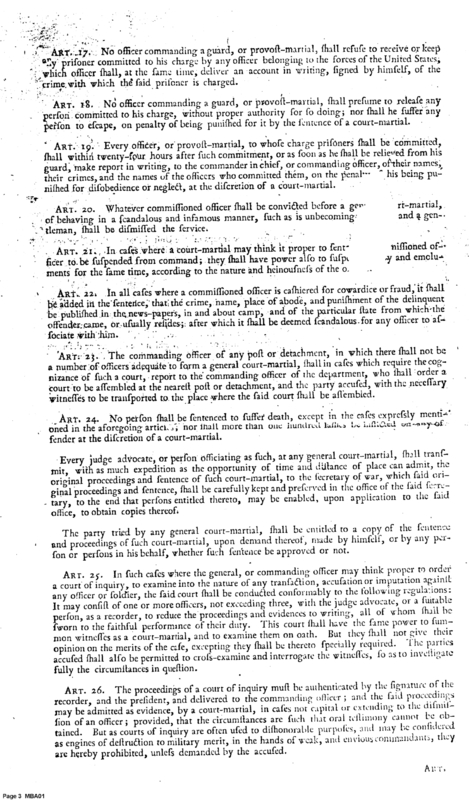
ART. 17. No officer commanding a guard, or provost-martial, shall refuse to receive or keep any prisoner committed to his charge by any officer belonging to the forces of the United States, which officer shall, at the same time, deliver an account in writing, signed by himself, of the crime with which the said prisoner is charged.
ART. 18. No officer commanding a guard, or provost-martial, shall presume to release any person committed to his charge, without proper authority for so doing; nor shall he suffer any person to escape, on penalty of being punished for it by the sentence of a court-martial.
ART. 19. Every officer, or provost-martial, to whose charge prisoners shall be committed, shall within twenty-four hours after such commitment, or as soon as he shall be relieved from his guard, make report in writing, to the commander in chief, or commanding officer, of their names, their crimes, and the names of the officers who committed them, on the penalty of his being punished for disobedience or neglect, at the discretion of a court-martial.
ART. 20. Whenever a commissioned officer shall be convicted before a general court-martial, of behaving in a scandalous and infamous manner, such as is unbecoming an officer and a gentleman, shall be dismissed the service.
ART. 21. In cases where a court-martial may think it proper for an officer to be dismissed for the service, they shall also have power to inflict corporal punishment also to fine and emoluments for the same time, according to the nature and heinousness of the offence.
ART. 22. In all cases where a commissioned officer is cashiered for cowardice or fraud, it shall be added in the sentence, that the crime, name, place of abode, and punishment of the delinquent be published in the newspapers, in and about the camp, and in the state or province from which the offender came, or usually resides; after which it shall be deemed scandalous for any officer to associate with him.
ART. 23. The commanding officer of any poll or detachment, in which there shall not be a number of officers adequate to form a general court-martial, shall in cases which require the cognizance of such a court, report to the commanding officer of the department, who shall order a court to be assembled at the nearest poll or detachment; and the party accused, with the necessary witnesses to be transported to the place where the said court shall be assembled.
ART. 24. No person shall be sentenced to suffer death, except in the cases expressly mentioned in the aforegoing articles, nor to pay more than one hundred lashes in inflicted on any offender at the direction of a court-martial.
Every judge advocate, or person officiating as such, at any general court-martial, shall transmit, with as much expedition as the opportunity will admit, the minutes of place an administrative proceedings on the minutes of a court-martial, to the Secretary of war, which said original proceedings and sentence, shall be carefully kept and preserved in the office of the said Secretary; to the end that parties entitled thereto, may be enabled, upon application to the said office, to obtain copies thereof.
The party tried by any general court-martial, shall be entitled to a copy of the sentence and proceedings of the court, upon demand thereof, either by himself, or by any prisoner or person in his behalf, whether such sentence be approved or not.
ART. 25. In all cases where the general, or commanding officer may think proper to order a court of inquiry, to examine into the nature of any transaction, accusation or imputation against any officer or soldier, he may order such an examination. The court for this purpose shall consist of one or more officers, not exceeding three, with the judge advocate, or a suitable person, as a secretary, to record the proceedings; and the members of the court shall be bound by oath to the faithful performance of their duty. This court shall have the same power to summon witnesses as a court-martial, and shall be compelled to the oath that they think will do their business on the merits of the case, excepting they shall be thereon specially required. The parties accused shall also be permitted to cross-examine and interrogate the witnesses, to ably investigate fairly the circumstances of the case.
ART. 26. The proceedings of a court of inquiry must be authenticated by the signature of the recorder, and the president, and delivered to the commanding officer; and the said proceedings may be admitted in evidence by a court-martial, in cases not capital, where the parties gave notice of an officer; provided, that the circumstances are such that oral testimony cannot be obtained. But as courts of inquiry are often used as engines of oppression, against the most meritorious officers, and as appeals to military tribunals, by the hands of weak and envious commanders, they are hereby prohibited, unless demanded by the accused.
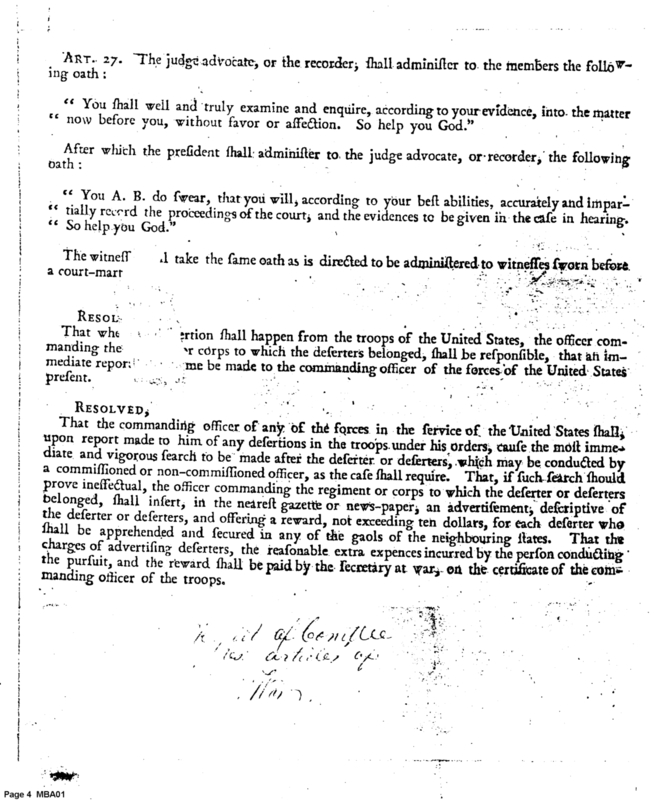
ART. 27. The judge advocate, or the recorder, shall administer to the members the following oath:
" You shall well and truly examine and enquire, according to your evidence, into the matter now before you, without favor or affection. So help you God."
After which the president shall administer to the judge advocate, or recorder, the following oath:
" You A. B. do swear, that you will, according to your best abilities, accurately and impartially record the proceedings of the court, and the evidences to be given in the case in hearing. So help you God."
The witness shall take the same oath as is directed to be administered to witnesses sworn before a court-mart
RESOL
That wh[en] desertion shall happen from the troops of the United States, the officer commanding the [regiment or] corps to which the deserters belonged, shall be responsible, that an immediate report [be made at the sa]me be made to the commanding officer of the forces of the United States present.
RESOLVED,
That the commanding officer of any of the forces in the service of the United States shall, upon report made to him of any desertions in the troops under his orders, cause the most immediate and vigorous search to be made after the deserter or deserters, which may be conducted by a commissioned or non-commissioned officer, as the case shall require. That, if such search should prove ineffectual, the officer commanding the regiment or corps to which the deserter or deserters belonged, shall insert, in the nearest gazette or news-paper, an advertisement, descriptive of the deserter or deserters, and offering a reward, not exceeding ten dollars, for each deserter who shall be apprehended and secured in any of the gaols of the neighbouring states. That the charges of advertising deserters, the reasonable extra expences incurred by the person conducting the pursuit, and the reward shall be paid by the Secretary at war, on the certificate of the commanding officer of the troops.
[In act of Comittee
the Articles of
War.]
Type
Document
Description
Report of a committee of Congress on the report submitted by Secretary at War Knox on the Army's Articles of War and Courts Martial. Lays out regulations for the Army courts martial and the administration of justice
Date
05/13/1786
Collection
Document number
1786051390001
Page start
1
Notable persons
Congress
Secretary at War
Mr. St. Clair
Mr. Lee
Mr. Lawrence
officers and soldiers
judge advocate
forces of the United States
provost martial
troops
Notable items
articles of war
courts martial
administration of justice
crime
deserter
regiment
corps
oath
public service