

Commutation of Pay
Document 1785Doesn't feel he is sufficiently empowered to grant Sullivan his "commutation" but believed that his pay that was due at the termination of service should be paid despite law or act of Congress that is currently inhibiting his pay.
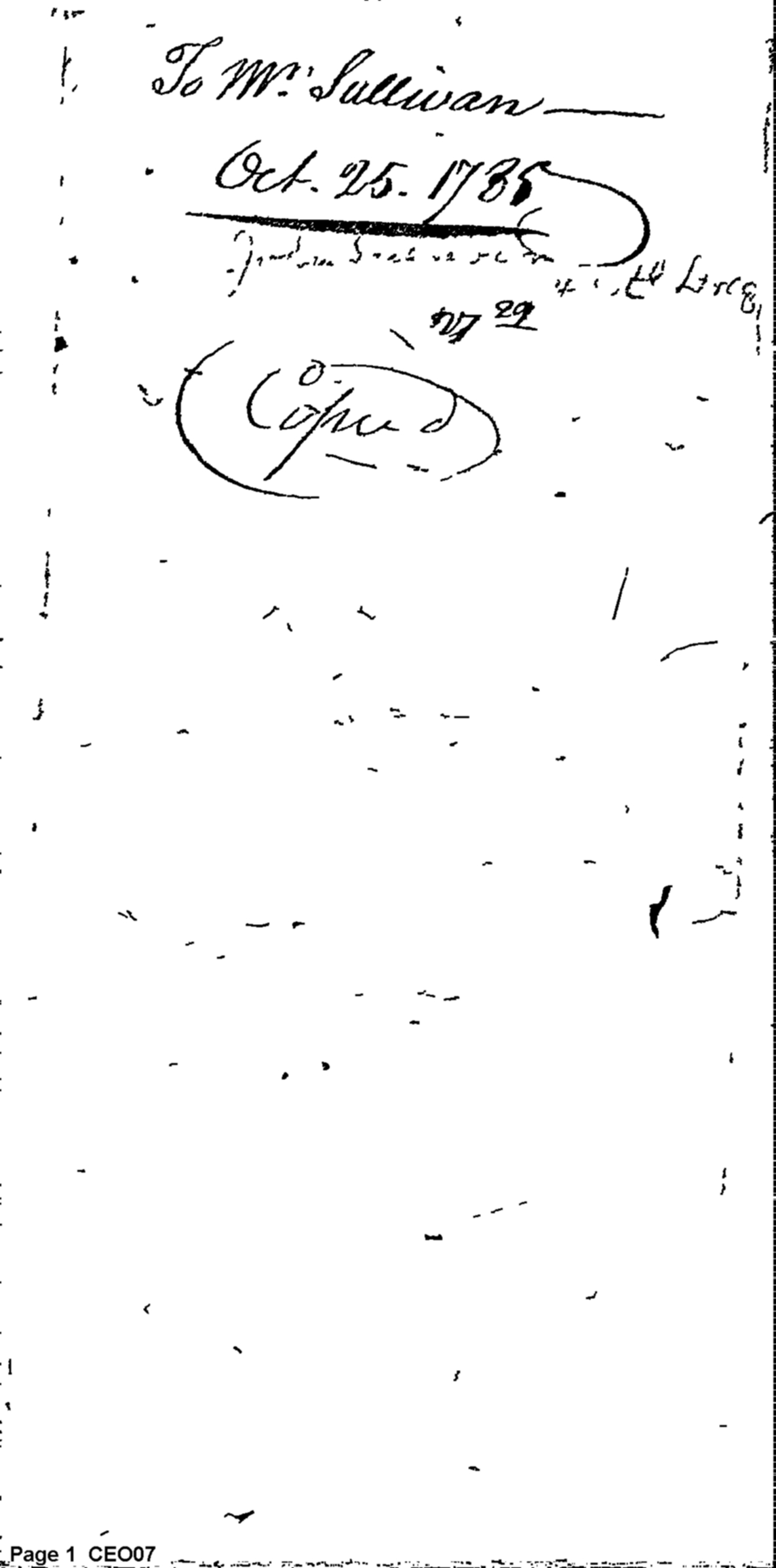
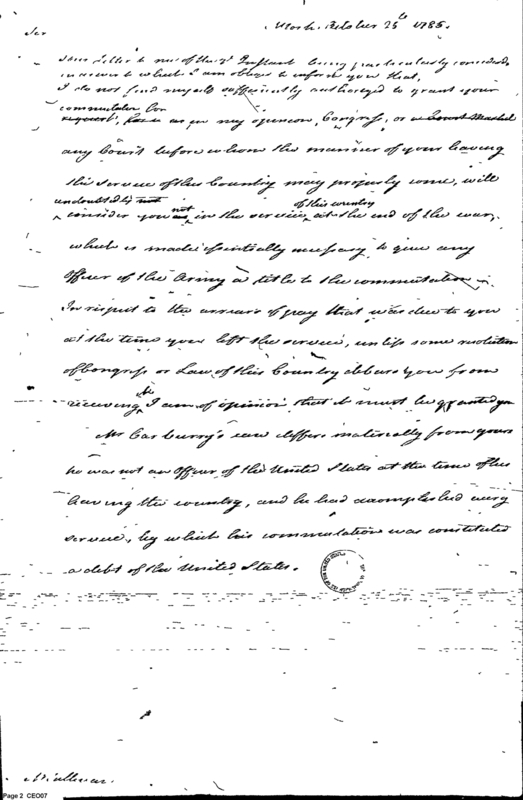
[editor’s note: everything centered] To Mr. Sullivan Oct. 25. 1785 [undecipherable] 2729 Copied [editor’s note: circled] N York October 25th. 1785. Sir Your Letter to me of the 2d Instant being particularly considered, in answer to which I am obliged to inform you I do not find myself sufficiently authorized to grant your request, for to as commutation for in my opinion, Congress, or a Court Marshal any Court before whom the manner of your having the service of this Country may properly come, will undoubtedly not consider you not in the service of this country at the end of the war, which is made essentially necessary, to give any officer of the army a title to the commutation — In respect to the arrears of pay that was due to you at the time you left the service, unless some resolution of Congress or Law of this Country debars you from receiving it I am of opinion that it must be granted you Mr Carburry’s case differs materially from yours he was not an officer of the United States at the time of his leaving the country, and he had accomplished every service, by which his commutation was constituted a debt of the United States. Mr Sullivan
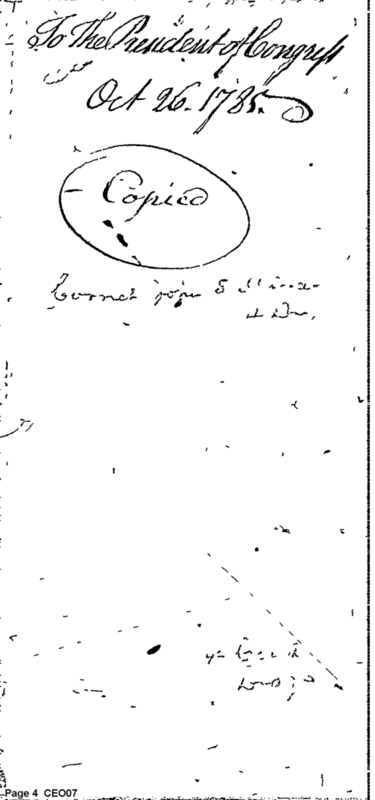
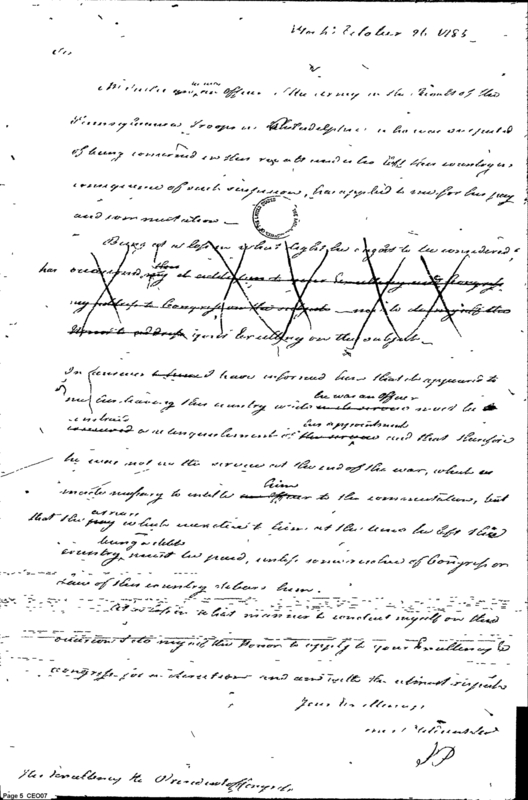
To the President of Congress Oct 26, 1785, (Copied) Cornet John Sullivan 4 [undecipherable] [undecipherable] N York; October 26 1785 Sir Mr Sullivan who was an Officer of the army in the Ranks of the Pennsylvania Troops in Philadelphia who was suspected of being concerned in the revolt and who left this country in consequence of such suspicion, has applied to me for his pay and commutation — [entire ¶ below x’d out,] [Being at a loss in what light he ought to be considered, has occasioned my the at address to your Excellency and Congress my address to Congress on the subject which to do myself the Honor to address your Excellency on the subject] In answer to have I have informed him that it appeared to me on leaving this country while in the service he was an officer would be to censured construed a relinquishment of the service his appointment and that therefore he was not in the service at the end of the war, which as made necessary to entitle an officer him to the commutation, but that the pay arrears which was due to him, at the time he left the country being a debt must be paid, unless a new resolve of Congress or Law of this country debars him. At a loss in what manner to conduct myself on this occasion I do myself the honor to apply myself to your Excellency & congress for consideration — and am with the utmost respect Your Excellencys most obedient Sert JP His Excellency the President of Congress
This transcription was generated by machine using Anthropic's Claude Code (model sonnet 4.6). It may contain errors or inaccuracies. Please verify against the document image. Learn more about our generative AI methodology.