

Treaty at Fort McIntosh
Document 1785Articles of treaty between U.S. and the Wyandot, Delaware, Chippewa, and Ottawa Nations. Outlines peace and boundary lines between nations.
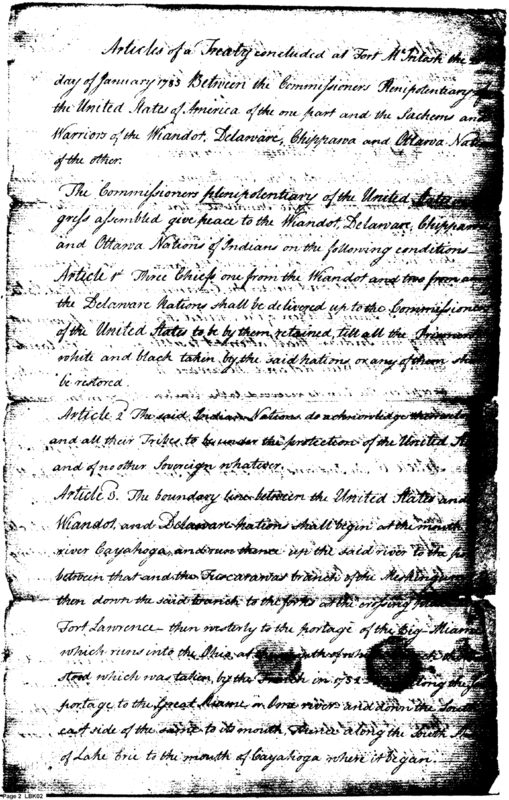
Articles of a Treaty concluded at Fort McIntosh the 21st day of January 1785 Between the Commissioners Plenipotentiary of the United States of America of the one part and the Sachems and Warriors of the Wiandot, Delaware, Chippawa and Ottawa Nations of the other.
The Commissioners plenipotentiary of the United States Congress assembled give peace to the Wiandot, Delaware, Chippewa and Ottawa Nations of Indians on the following conditions-
Article 1 Three Chiefs from the Wiandot and two from the Delaware Nations shall be delivered up to the Commissiioners of the United States to be by them retained, till all the Prisoners white and black taken by the said Nations or any of them shall be restored.
Article 2 The said Indian Nations do acknowledge themselves and all their Tribes to be under the protection of the United States and no other Sovereign whatever.
Article 3. The boundary line between the United States and Wiandot, and Delaware Nations shall begin at the mouth of river Cayahoga and run thence up the said river to the [pt.] between that and the Tuscararas branch of the Meskingum then down the said branch to the forks at the crossing [undecipherable] Fort Lawrence then westerly to the portage to the Big-Miami which runs into the Ohio at the mouth of [undecipherable] stood which was taken by the French in 1751 then along the portage to the Great Miami or Ome - and down the Southeast side of the same to its mouth. Thence along the South shore of Lake Erie to the mouth of Cayahoga where it began.
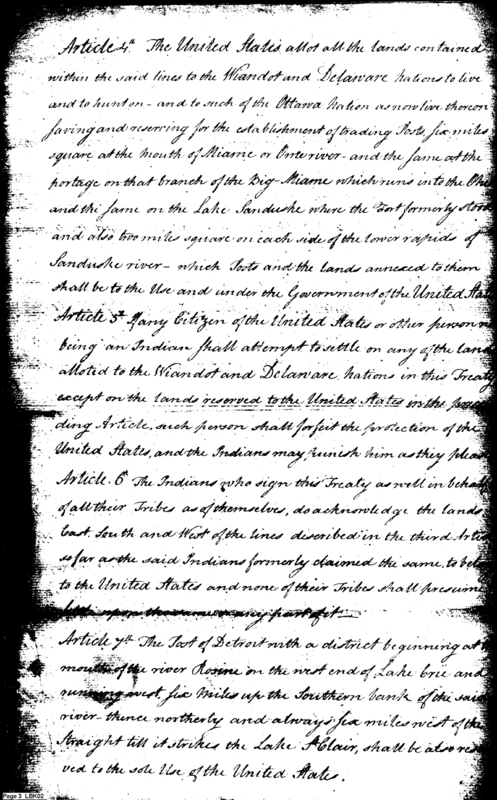
Article 4. The United States allot all the lands contained within said lines to the Wiandot and Delaware nations to live and to hunt on- and to such of the Ottawa Nation as now live thereon saving and reserving for the establishment of trading Posts six miles square at the mouth of the Miami or Omi [?] river- and the same at the portage on that branch of the Big-Miami which runs into the Ohio and the same on the Lake Sanduske where the Fort formerly stood and also two miles square on each side of the lower rapids of Sanduske river- which Posts and the lands annexed to them shall be to the Use and under the Government of the United States.
Article 5. If any Citizen of the United States or other person not being an Indian shall attempt to settle on any of the lands alloted to the Wiandot and Delaware Nations in this Treaty except on the lands reserved to the United States in the preceding Article, such person shall forfeit the protection of the United States, and the Indians may punish him as they please.
Article 6. The Indians who sign this treaty as well in behalf of all their Tribes as of themselves, do acknowledge the lands East, South and West of the lines described in the third Article as far as said Indians formerly claimed the same, to belong to the United States and none of their Tribes shall presume [undecipherable] any part of it__
Article 7. The Post of Detroit with a district beginning at the mouth of the river Rosine on the west end of Lake Erie and running west six miles up the Southern bank of said river- thence northerly and always six miles west of the Straight till it strikes the Lake St. Clair, shall be also reserved to the sole use of the United States.
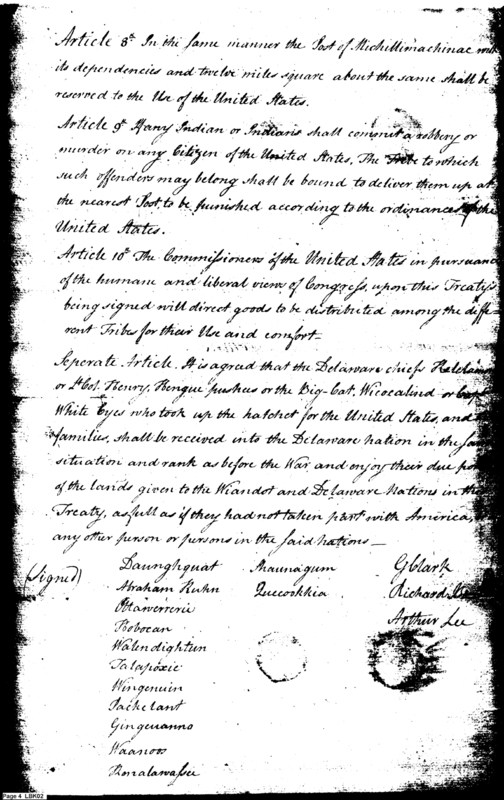
Article 8. In the same manner the Post of Michillimahinac with its dependencies and twelve miles square about the same shall be reserved to the use of the United States.
Article 9th. If any Indian or Indians shall commit a robbery or murder on any Citizen of the United States, The Tribe to which such offenders may belong shall be bound to deliver them up at the nearest Post to be punished according to the ordinances of the United States.
Article 10th. The Commissioners of the United States in pursuance of the humane and liberal views of Congress, upon this Treaty’s being signed will direct goods to be distributed among the different Tribes for their use and comfort-
Seperate Article. It is agreed that the Delaware chiefs [undecipherable] or Lt Col. Henry [undecipherable] or the Big-Cat, Wicocalind or [undecipherable] White Eyes [names are difficult to decipher] who took up the hatchet for the United States, and families, shall be received into the Delaware Nation in the same situation and rank as before the War and enjoy their due part of the lands given to the Wiandot and Delaware Nations in the Treaty, as full as if they had not taken part with America, as any other person or persons in the said Nations-
(Signed)
Daunghquat; Shaunagum; GClark
Abraham Kuhn; Quecookkis; Richard Butler
Ottawerrerie; Arthur Lee
Hobocan
Walendightum
Talapoxie
Wingenuim
Packelant
Gingeuanno
Waanoos
Ronalawassee
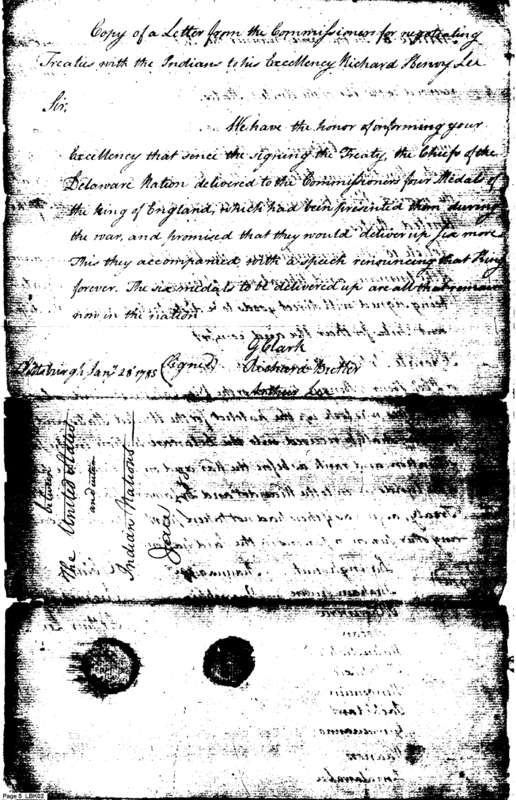
Copy of a Letter from the Commissioner for negotiating Treaties with the Indians to his Excellency Richard Henry Lee
Sir,
We have the honor of informing your Excellency that since the signing the Treaty, the Chiefs of the Delaware Nation delivered to the Commissioners four Medals of the King of England, which had been presented them during the war, and promised that they would deliver up six more. This they accompanied with a speech renouncing that King forever. The six medals to be delivered up are all that remain now in the nation
G Clark
Pittsburgh Jany 28 1785 (Signed) Richard Butler
Arthur Lee
[undecipherable] between The United States and certain Indian Nations Jan 1785
This transcription was generated by machine using Anthropic's Claude Code (model sonnet 4.6). It may contain errors or inaccuracies. Please verify against the document image. Learn more about our generative AI methodology.