

News: Document Guides
What is a Nighthead?
One of the many documents sent and received by Josiah Fox regarding the construction of frigates in 1796 discussed a rumor that the night heads had not been raised with the frames. From the context, a night head must be part of a ship, but what is it?
The term appears in a 1781 book Naval Architecture, or the Rudiments and Rules of Ship-Building spelled as “knighthead” not “nighthead”. It is used as a reference point when taking measurements, often referred to in conjunction with hawse-pieces. A hawse is the part of the bow, or forward part, of a ship in which holes (called hawse-holes) are cut for cables to pass through. Knightheads are therefore part of the bow. According to the Oxford English Dictionary, they are a large timber which rise from the keel to support the bowsprit, the large spar which extends forward from the bow. The knighthead is an important part of the strucutural integrity of the ship.
Read moreIn a Humor for Reading
Although the bulk of the War Department correspondence is taken up with matters of business, personal letters sometimes slip in and offer a glimpse of other parts of the lives of clerks and quartermasters.
In February 1799, Samuel Hodgdon sent his colleague and friend Isaac Craig two pieces of reading material: Three volumes of Judith Sargent Murrayâs The Gleaner and Matthew Gregory Lewisâ 1796 Gothic novel The Monk. He described Murrayâs essays as being âon many pleasing subjects,â while the novel is âdeep and dreadful.â
Read moreCaptain Hendrick Aupaumut
Captain Hendrick Aupaumut  (1757-1830) was a Mahican (also Mohican) sachem, Revolutionary War soldier, and diplomat for the United Statesâ efforts  to broker peace agreements with the Western Indians of the Ohio country.
The Mahicans were an  Algonquin tribe that settled in the Hudson River Valley.  They later moved to western Massachusetts in the town of Stockbridge, where many converted to Christianity and became known as the âStockbridge Indians.â
Read moreWar Department Accountant requests a Pay Raise
On January 30, 1796, the Accountant of the War Department – William Simmons – wrote a letter to a committee of the House of Representatives advocating for a raise in his salary. Simmons wrote that he did this upon hearing of a “motion lately made in Congress to augment the Salary of the Accountant.”
As Simmons explains in his letter to the committee, the Office of Accountant was established by an act of Congress on May 8, 1792. The original duties of the Accountant was “to settle all accounts relative to the Pay, Forage, and Subsistence of the Army.” For these duties, the Accountant was allowed a salary of $1,200 (just over $15,000 in today’s money, adjusted for inflation).
Read moreFumigating Public Stores
In late June 1800, Samuel Hodgdon wrote to Israel Wheelen ordering him to fumigate the public stores in Philadelphia. The objective was not only to kill insects but mainly to prevent contagion; summer was the usual time for outbreaks of yellow fever and fumigation was believed to help stop the spread of disease.
Hodgdon recommended that Wheelen use nitre or brimstone (sulfur) for the fumigation. In 1795 the British had carried out a successful experiment on the hospital ship Union using a combination of concentrated vitriolic acid and nitrate of potash (sulfuric acid and potassium nitrate), conducting twice daily fumigation to prevent the spread of a fever. Brimstone, or sulfur, had been used to clear diseased air from ships since the 1750s, and vinegar was also supposed to help clear the air of infection. The prevailing medical theory of the time held that diseases spread through the air in a cloud, or miasma; therefore clearing or treating the air would reduce the risk of disease transmission.
Read moreWho was William Blount?
Blount’s name appears in thousands of War Department Papers. Who was he? Blount came from Windsor North Carolina, born into a family of merchants and planters who owned large tracts of property along the Pamlico River. During the American Revolutionary War, he was a regimental paymaster for the 3rd North Carolina Regiment. He participated in the regiment’s march north in the late spring of 1777 to join Washington’s army in the defense of Philadelphia. His North Carolina unit later served under Saratoga hero General Horatio Gates, who engaged Cornwallis in a bloody loss at Camden, South Carolina.  Having earned his revolutionary credentials, Blount served as a delegate to the Continental Congress and the Federal Convention of 1787. Later, Blount received an appointment from President Washington as Governor of the Southwest Territory (Tennessee) and Superintendent of Indian Affairs for the Southern Department. He established Knoxville (named after the Secretary of War) as the territorial capital.
Read moreThe Difficulties of Wagon Transportation
We often take for granted the incredible advances in transportation that have taken place over the course of the last two centuries. In the nineteenth century, the advent of the steamboat and railroad – along with vast improvements in the road system – inaugurated what Daniel Walker Howe has called a “transportation revolution.” Unfortunately for the War Department in the 1790s however, none of these technologies were yet available. Transporting much-needed supplies – such as stationary, muskets, gunpowder, cartridges, knives, clothing, food, and other key military provisions – was a costly and risky endeavor that often frustrated the department. Provisions had to be waggoned over scarcely maintained and often impassable roads and trails, often for incredible lengths through thinly-inhabited areas.
Read moreSmallpox Inoculation 1792
In July 1792, General Anthony Wayne opened a letter to Secretary of War Henry Knox with concerns about small pox among the troops. The prevalence of small pox in Pittsburgh had led him to inoculate a small group of soldiers, but this was only a temporary fix as new detachments were arriving with the possibility of more soldiers who had neither been inoculated nor had the disease.
Wayne was reluctant to establish a routine of constant inoculation, risking the health of those soldiers affected. Inoculation, after all, involved infecting the person; while most people survived, there was always a risk of serious illness and death. Wayne proposed separating those who were still susceptible to small pox, sending them to the block house at Big Beaver, at least until Knox could offer an opinion on whether to proceed with inoculation.
Read moreWho was Andrew Pickens?
Andrew Pickens was born in Bucks County, Pennsylvania, on September 19, 1739. His Scots-Irish family Andrew moved south in search of new land, living in Augusta County in the Shenandoah Valley, later in the Waxhaw settlement along the North Carolina-South Carolina border, and eventually in the Long Cane settlement in Abbeville County, South Carolina, bordering Georgia.
At Long Canes, Pickens would marry and start a family. He farmed and became prosperous trading with his Indian neighbors. An ardent patriot as the American Revolution approached, Pickens became a military leader during the war. He led expeditions against the Loyalist-allied Cherokee and in 1779, when Sir Henry Clinton sent British troops into South Carolina to bolster support for the Loyalists, Pickens and his three-hundred man militia defeated a larger British force under Colonel Boyd at Kettle Creek in North Georgia. Pickens was later captured by the British and took an oath to sit out the remainder of the war. But when Tories destroyed much of his property and frightened his family, he gathered his militia and fought with them as a guerilla unit against the British. Under Daniel Morgan, Pickensâ militia played a key role in the defeat of the Lt. Colonel Banastre Tarleton at the Battle of Cowpens as they feigned retreat and then counterattacked the British Regulars.
Read moreChocolate for Invalids
In April 1792, Isaac Craig sent Captain Jonathan Cass some supplies for the sick men under his command: five pounds sugar, two pounds of tea, and four pounds of chocolate. These three items also show up in lists of hospital stores throughout the 1790s. Why? Were they being used as medicine?
Not exactly. Medical theory and practice of the time concerned itself not only with the ailment at hand but with the diet of the invalid. Tea was believed to act as a sedative and sugar had been used as a medical additive for centuries. Chocolate was not only used to improve the taste of some medicines, but was a part of the recommended diet for patients suffering from a variety of illnesses.
Read moreSt. Clair Defeat
Following the disastrous Harmar expedition against the Western Indians in the fall of 1790, which resulted in the loss of 180 men (including 73 federal troops), planning began for another expedition in 1791.  Governor Arthur St. Clair was appointed General in Chief, Richard Butler commanded the levies, Samuel Hodgdon became the Quarter Master General and General Charles Scott commanded the Kentucky militia. The public clamored for a swift and effective response against the Indians of the Ohio wilderness.  This in turn pressured Hodgdon to take up a frantic pace in administering the procurement of supplies. The problems of supply were many, but the major ones were related to coordination with contractors, transportation of supplies through the rugged wilderness, and the generally low quality of the arms and supplies themselves.   Delays throughout the spring and summer of 1791 taxed the patience of St. Clair, who became concerned about the onset of winter and the expiration of six month long militia enlistments.   So in August, he began to move his incomplete force toward Fort Washington (modern day Cincinnati).  Eventually General Butler and his levies joined up with St. Clair, but movement remained extremely sluggish as the army stopped to build forts and struggled under the weight of excessive baggage and a seemingly limitless trail of wives, washerwomen and camp followers. Morale too suffered because of supply problems. Desertion was so rampant that St. Clair resorted to public execution of deserters.
Read moreCaptain Molly
One of the many tasks of the War Department in the 1780s and 90s was the administration of wounded or invalid veterans of the Revolutionary War. In general, all that had to be done was keeping track of the residence of a veteran and paying pensions. William Price, Deputy Commissary of Military Stores and officer in charge at West Point from 1785 to 1786, had more to deal with when it came to one particular pensioner: Captain Molly.
Read moreTwo Captured Soldiers Seek “Redemption’
In the Summer of 1784 two American soldiers, William Moore of South Carolina and Thomas Ward of Maryland, describing themselves as “unfortunate subscribers,” submitted their third petition for their release as “redemptioners” and asked that their pay be applied as their “redemption money.” They wrote their  letter on board the vessel “Favourite,” dated the 11th of August 1784. It was addressed  to the Commissioners of the Board of War, a standing committee created by the Continental Congress to supervise the army. Moore and Ward stated that they had been captured by the British on the 10th day of August 1780, following the “Capitulation of Charles Town,” and held for several months on British “prison ships and gaols [jails]” and then “forcibly compelled into the West Indies Service.”
Read moreGeneral Washington’s New Uniform
In late January 1799, George Washington, Commander in Chief of the Armies, wrote to James McHenry, Secretary of War, to discuss an important topic: his new uniform.
New regulations on the Uniform for the Army of the United States had been released earlier that month, approved by McHenry and President Adams. The commander in chief was to wear the following uniform: âa blue coat, with yellow buttons, and gold epaulets, each having three silver stars, with lining, cape and cuffs, of buffâ¦. The coat to be without lappels [sic], and embroidered on the cape and cuffs and pockets.â
Read moreSteam-powered boats and the War Department
In 1787 John Fitch constructed the first steam-powered boat in America. Fitch was not the original inventor of the steamboat – that honor goes to the Scottish inventor James Watt – but Fitch successfully brought the technology to the United States.
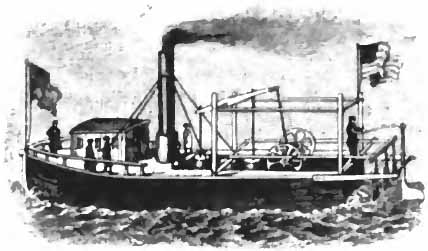
In a letter to Washington’s Cabinet on June 22, 1790, Fitch applied for a patent for “applying steam to the purposes of propelling Vessels thro’ the water.” Fitch predicted that the new technology would have “great immediate utility” and would have “important advantages… not only to America, but to the World at large.”
Read moreBefore Clara Barton’s Vision
The mission of the American Red Cross is to provide humanitarian relief to those in need of assistance and was formally adopted at the Treaty of Geneva in 1864. Prior to the formation of the Red Cross, Clara Barton provided relief to wounded soldiers as a field nurse and was among many women assisting the U.S. military, during and well before the Civil War.
A document written by Frederick Frye to William Simmons in 1797 shows that women were indeed on the payroll of the U.S. government, albeit an informal employment. Frye noted that he brought on a soldiers wife to serve as a nurse at Governor’s Island in the newly commissioned hospital and that she was allotted pay for her services. In 1795 Simmons approved the pay of Sarah Brooks for her service as a nurse in Carlisle, PA. As far back as 1784 War Department documents contain evidence of female nurses staffing hospitals.
Read moreGeneral Statement of Indian Policy
As President George Washington’s Secretary of War, Henry Knox was responsible for Indian affairs. During the first year of Washington’s presidency, Know wrote a letter to the president in which he described in some detail his views on Indian policy. Written in January 1790, this document is the closest thing we have to a comprensive statement of the early Indian policies of Knox and Washington.
Knox discusses the cost of war and peace with the Indian Nations along the Southwestern frontier. He speculates on the size of an army necessary to engage hostile Indians along this vast expanse of territory. He concludes that peace and diplomacy are much less costly than war: “A comparative view of the expenses of a hostile or conciliatory system towards the Indians, will evince the infinite economy of the latter over the former.” (In an earlier letter, Knox had made the same claim, only in more specific terms: “…the expence of managing the said Indians and attaching them to the United States for the ensuing period of fifty years may on average cost 15,000 dollars annually. A system of coercion and oppression for the same period…would probably amount to a much greater sum of money.”)
Read moreHarpers Ferry and “The Habitual Laziness of the Poor in this Country”
It is fairly well known that ever since the days of the French and Indian War, George Washington had been an aggressive land speculator up and down the Shenandoah Valley and around the Potomac River. Washington believed passionately in the economic potential of the Potomac River, and was president of a joint stock venture called the “Potowmack Company.” Behind all this entrepreneurial spirit was a belief that commerce and industry, taking place alongside rivers like the Potomac, would unify the new nation. Indeed, Washington envisioned a symbol of this unity a few miles down river in what would become the City of Washington.
Read moreThe Greaton Women and the War Department
Here and there between the lists of supplies and records of accounts paid, you find the story of a family or a woman whose life was tied to the Department. Two such women were members of the Greaton family of Massachusetts, both of whom wrote to the War Department in the 1790s.
The first lady to write was Sarah Greaton, wife of General John Greaton. She wrote to Secretary of War Henry Knoxin in July 1791 ( this letter does not survive) and again in March 1792, trying to secure money due her husband for his service in the Revolutionary War. From the March letter it seems that previous attempts to receive the funds had fallen afoul of one problem after another. According to the Daughters of the American Revolution and other genealogical records, General Greaton died in December 1783. Between his death and writing to Knox, Sarah Greaton worked to support herself and her children. It is not clear what finally moved her to write to Knox over seven years after being widowed, but she did.
Read moreThe Jeffersonian Revolution, and its Implications for the War Department and Federalist Party
The ascension of the Democratic-Republicans to Congress in 1801, along with the election of Thomas Jefferson in the same year, represented a clear break from Federalist policy in the latter half of the 1790s. Led by Alexander Hamilton, the Federalist Party possessed control of both houses of Congress from 1797 to 1800 (the fifth and sixth Congresses), and enjoyed control of the executive branch. The Federalists generally supported a stronger, more centralized national government, with protective tariffs, a National Bank, and – most pertinent to the War Department Papers collection – a strong national military.
Read moreUncle Henry Wants You
In a directive of early December 1789, Secretary of War Henry Knox informs Captains Burbeck and Savage that each of them is directed to recruit the requisite number of men to complete their two companies. He lists the qualities he requires of new recruits and sets the deadline for the completion of the recruitment effort. He wants “men of the best qualifications for soldiers” and specifies that their companies must be completed by February 1st; i.e., the two captains have only two winter months to recruit the men necessary to fill the quota of forty men for each company.
Read moreThe USS Crescent
Today most of us would react in horror to the idea of arming our adversaries with an American-built warship to bribe them from attacking our merchant vessels. But before the United States became a maritime power, many considered it cheaper to pay tribute to North African pirates than to build a navy from scratch. Thus, in 1796, while the original six frigates were under construction, word arrived of a diplomatic settlement with Algiers. Terms included payment of a lump sum of half a million dollars as ransom for American prisoners, an annual tribute of over $20,000, and construction of four ships, one of which would become the frigate “Crescent. ”
Read moreBeginning of the Quasi-War
France had been the key ally of the United States during the Revolutionary War and a Treaty of Alliance had been signed in 1778 but in 1794 the French monarchy was overthown during that country’s bloody revolution. The new American government had earlier declared neutrality in the seemingly endless war between Britain and France but the controversial Jay Treaty with Britain, combined with new British-American trade agreements, signaled a change of allegiance that enraged revolutionary France. The U.S. exacerbated the rift when it ceased paying its war debts to France, arguing that the American obligation was to the French monarchy and not to the new French republic.
Read moreWhat are these hospital supplies?
This is an inventory or return of hospital supplies for the hospital at Fort Mifflin, on the Delaware River at Philadelphia. Mezereon is a deciduous shrub that can be poisonous. It appears to have been used to treat tooth aches and skin disorders, and possibly as a compress. Tartar and castor oil could have been used as laxatives. Guaiacum resin could have been used to treat coughs, arthritis, and possibly syphilis. Other items include a pestle, an ointment spatula, and a funnel. The return is signed by a surgeon’s mate of the 2nd Regiment of Artillerists and Engineers. It is verified by Doctors Gillaspy and Strong.
Read moreWinter Quarters
A challenging annual undertaking  for eighteenth century armies was the establishment of winter quarters for hundreds of officers and troops. With a few notable exceptions, armies did not fight during the winter so they had to find a suitable place to live. As with the British during the War for Independence, the more fortunate armies could find quarters in cities despite the fact that this arrangement caused hardships for the citizens who lived in the cities. During the American Revolution, large portions of New York and Philadelphia were comandeered for the use of the British army so the local homeowners would either have to make room for officers and soldiers or move out and find living space elsewhere. Normally, however, winter quarters would be established in encampments.
Read more